

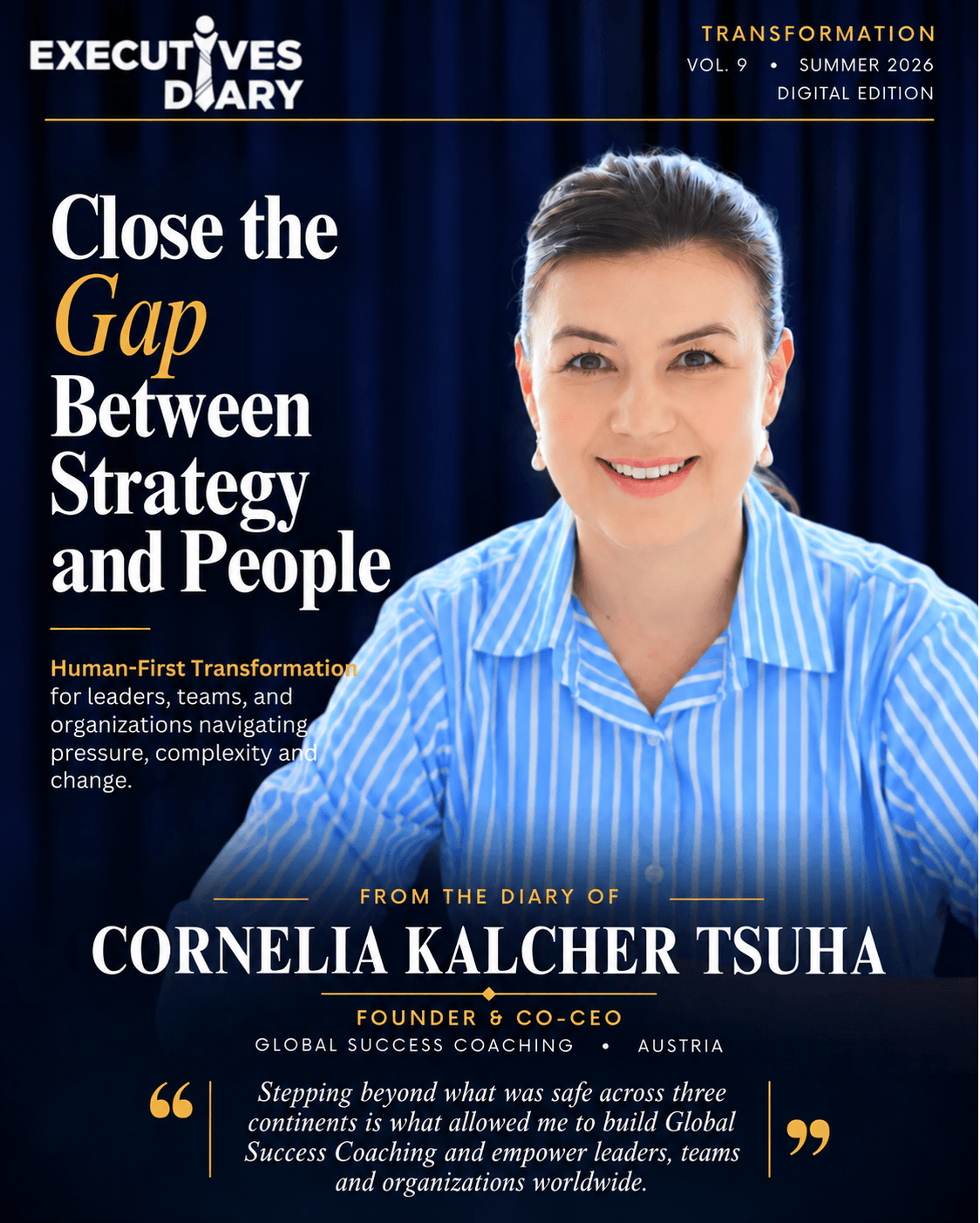
Cornelia Kalcher Tsuha
Founder & CO-CEO @ Global Success Coaching®Global Leadership Expert | Executive Coach & International Speaker
At twenty-five after graduation, with no contacts and no safety net, Cornelia Kalcher Tsuha left Austria for Washington, D.C. Eight years later she consciously gave up a secure, successful life and career in the United States to start over in Japan. Both leaps ran against every instinct that keeps a career safe, and both paid off. And it was those first-hand experiences that gave her deep insight into what change asks of people – and the courage it takes to step into it.
Nowadays technology moves at a terrifying speed. But human behavior does not.
That gap, between how fast a company can change its systems and how slowly it can change its people, is where global strategies quietly fail. Closing it takes more than a new management theory. It takes leaders who have made that kind of leap themselves.
Architecting The Human Operating System
Cornelia Kalcher Tsuha understands exactly how to close that gap. As Founder and Co-CEO of Global Success Coaching, she leads what she calls Human-First Transformation, helping leaders, teams and organizations build both the strategic and analytical capacity and the human and emotional capacity this new era demands.
She does not just train leaders and executives. She rewires how entire teams operate through pressure, complexity and change, not just to survive, but to thrive. Her work ensures that a company’s human capacity perfectly matches its strategic ambition.

Leaving What Was Safe, Twice
Born and raised in Austria, Cornelia Kalcher Tsuha was twenty-five when she graduated from her MBA studies, with no connections and no recommendations, when she made the leap professionally to Washington, D.C. She spent eight years working with major international organizations there, including the World Bank and the Inter-American Development Bank. The transition was not easy, so she sought out mentors, training in the late 1990s with figures like Tony Robbins, and the experience lit a fire to give back. In 1998, at a time when most people still pictured a sports coach, or assumed something had to be wrong with you to need one, she began her own training and certification in professional coaching and leadership development. Years into her career in Washington, she grew close to Japanese colleagues who reminded her of her own early struggles: speaking up, holding an opinion, working across cultures. A vacation to Japan turned into what she calls a calling. “I gave up a secure, successful life in the U.S. and moved to Japan,” she says. She spent more than five years there training Japanese managers and expatriate executives, before IKEA entered the Japanese market and hired her on the spot as the company’s first Country Learning and Development Leader, a three-year chapter that became her final corporate role before she founded Global Success Coaching.
She was handed a complete blank slate. She built the national training infrastructure from scratch, establishing a culture of empowerment across a complex cultural divide. Working alongside global leaders from Sweden, she facilitated leadership programs in Shanghai for top executives across the entire Asia-Pacific region.
The work shifted the corporate focus away from rigid management theories toward deep self-awareness and cross-cultural empathy. She realized that teaching short-term skills was entirely insufficient for long-term corporate success. Real organizational change required focusing entirely on the inner development of the leader and who they were becoming.
Rewiring The Global Boardroom
That realization became the foundation for Global Success Coaching. For nearly two decades, she has partnered with iconic global brands like Chanel, Goodyear, BNP Paribas, and Mitsubishi Chemical. Her mandate is to elevate leaders, teams, departments and organizations out of confusion and overwhelm so they can execute clearly in a new era of business, and increasing their intercultural competence is almost always a key focus.
“Organizations and leaders must treat intercultural competence as a core business and leadership capability, not just a soft HR topic,” she insists.
Treating human adaptation as a hard business metric changes everything for her clients. When leaders learn to uncover what lies beneath the surface of their teams, psychological safety replaces fear. Cross-cultural conflicts decrease, and paralyzed teams turn into engaged, high-performing partners.
She leads full-year transformation partnerships across the leadership culture, from executives and senior leaders to middle and junior leaders, moving customized cohorts through multi-day modules with implementation back in the workplace between sessions, delivered in person and online in English, Japanese and German. For acute issues like breaking down corporate silos or resolving severe friction between an Asian headquarters and European regional offices, she runs high-impact intensive workshops. She also conducts highly targeted one-on-one coaching for senior executives navigating intense pressure and complex stakeholder dynamics.
The work leads to visible, measurable behavior change: faster and better decision-making, higher performance and retention, fewer silos and less resistance, reduced friction, stronger local and global collaboration, and accelerated execution in change. Ultimately, it closes the gap between strategic intent and leadership achievement.
Key Takeaways / Playbook
- 1. Close The Human-Adaptation Gap: Strategies, technologies and corporate systems change quickly, but human behavior, culture and mindsets take time. Real transformation happens when we bridge that gap across borders, teams, departments and HQ-subsidiary dynamics.
- 2. Build Both Capacities: Future-ready organizations cannot rely on strategy alone. Sustainable growth requires balancing strategic and analytical rigor with human, emotional and cross-cultural adaptability.
- 3. Turn Transformation Into Measurable Change: True leadership development goes beyond short-term skills and management theory. It changes how leaders and teams think, behave and work together and translates into measurable business outcomes.
The Final Variable Of Success
The speed of global business will only continue to accelerate. Companies can buy the best technology in the world, but they cannot buy resilience. They have to build it into their people.
Cornelia Kalcher Tsuha ensures that global organizations do not just survive this new era of rapid change. She equips them with the human capacity required to actually win.
True success belongs to leaders who master the speed of human adaptation and who never stop evolving themselves.
