

From the Diary of
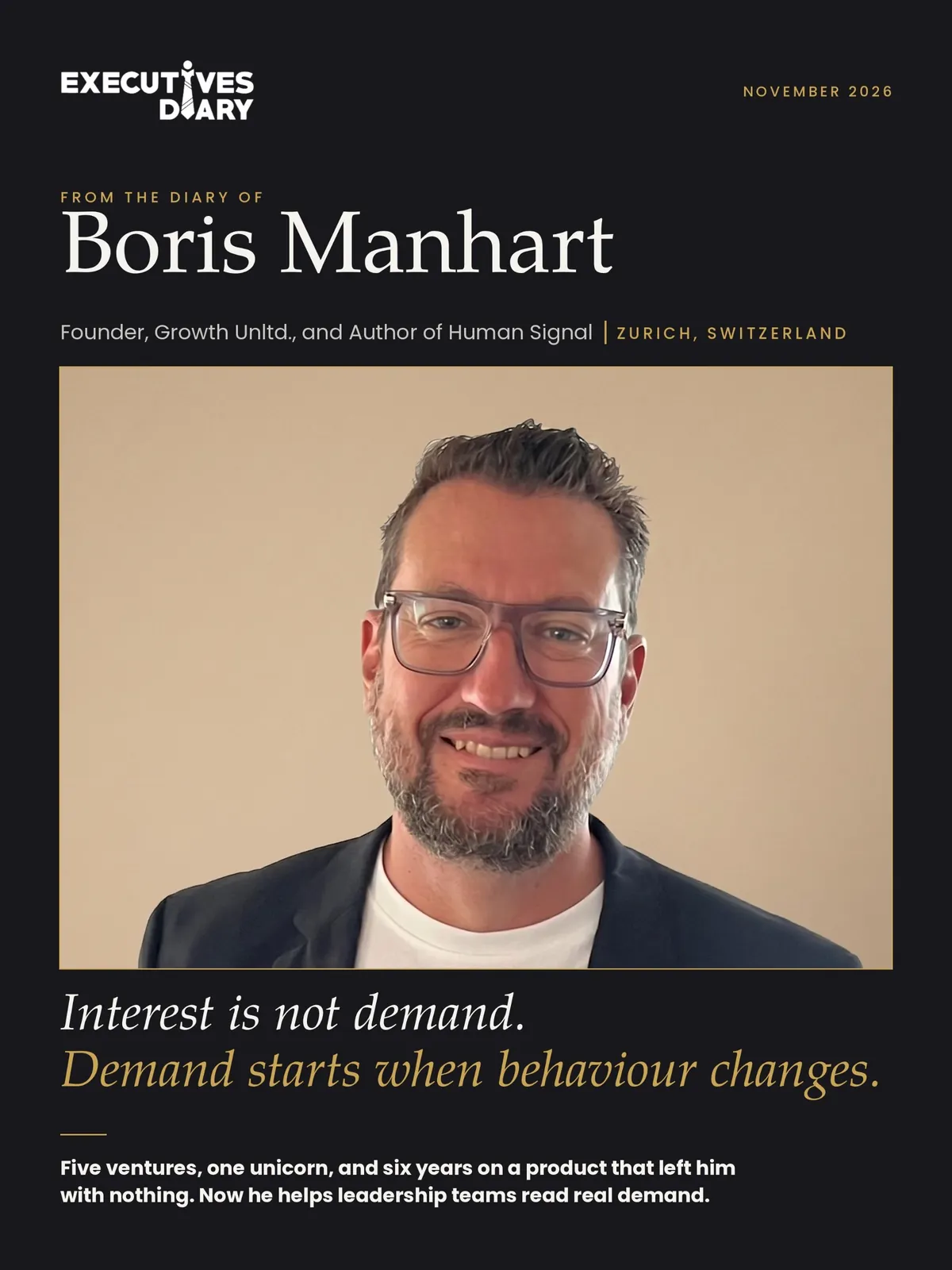
Boris Manhart
What 25 years of building companies taught him about reading real demand, and why yesterday’s product-market fit won’t save tomorrow’s business.
“The companies that succeed won’t necessarily be those with the best plans. They’ll be those that learn fastest when their plans meet reality.”
Building software has become fast and cheap. An idea can now turn into a working prototype in days rather than months.
The gain can be measured, at least on a narrow task. In a controlled experiment published in 2023 by researchers at Microsoft, GitHub and MIT, developers asked to build one specific piece of software, an HTTP server in JavaScript, finished it 55.8 per cent faster with an AI pair programmer than those working without one. The study measured that single task, not software development as a whole.
What the speed doesn’t change is the question underneath every product: does the market need this badly enough to pay for it? “Cheaper and faster development doesn’t make customer demand any easier to understand,” says Boris Manhart. “In fact, I believe it makes that understanding more valuable.”
Boris has spent 25 years building companies. He has co-founded five ventures, one of which reached unicorn status. Through Growth Unltd., which he founded in 2022, he works with founders and leadership teams on product-market fit, new business models and growth, and his book, Human Signal, brings together what those years taught him.
Increasingly, that work is with established organisations. “For startups, the challenge is finding product-market fit,” he says. “For established companies, it’s about continuously reassessing, adapting and defending it.”

Six Years and 10,000 Hours
Boris started building companies early. Over two decades he co-founded five ventures and went through different stages of growth with them. One of them reached unicorn status.
The turn that shaped him most was a painful one. He spent six years and more than 10,000 hours building a product that was downloaded by millions across Europe. The company was eventually sold, and he walked away with nothing.
“Millions of downloads looked like traction,” he says. “But traction alone didn’t make it a sustainable business.” Asked for a hard moment, he names the day the sale closed. “It forced me to rethink what I had considered success,” he says. “Looking back, I realised how many signals I had misinterpreted or ignored along the way.”
His is not a rare shape of story. In a 2026 analysis, CB Insights reviewed public post-mortems, founder interviews and shutdown announcements from 431 venture-backed startups that closed since 2023. Of the 385 where the reasons could be identified, 43 per cent cited poor product-market fit, often alongside other causes. Most were early-stage companies, but some had reached later funding rounds on traction that never grew into a lasting market.
Technology matters. Execution matters. But neither can compensate for a market that doesn’t need what you’re selling badly enough to pay for it.
That experience shaped the way he works with companies today and, much later, became part of the thinking behind Human Signal. It also gave him the question he now puts on his own profile.
Interest Is Not Demand
The question is this: “How do you know whether what you are seeing is actually demand?” His answer starts with a distinction that, he says, sounds obvious but is surprisingly difficult to apply.
“Interest is not demand,” he says. Customers telling you they like an idea is not demand. Neither is positive feedback after a presentation, or even a long list of potential customers. “Demand becomes visible when people change their behaviour.”
Demand becomes visible when people change their behaviour.
The questions he asks follow from that. Are people already trying to solve the problem? Have they invested time or money? Are they using imperfect workarounds? Will they commit resources to a better solution? And once they start using the product, do they keep coming back? “The stronger the commitment, the stronger the signal.”
This is where AI comes back in. When almost anyone can build a product, he argues, the advantage shifts to knowing what is worth building, for whom, and why customers will choose it over the alternatives. “That’s the central idea behind Human Signal,” he says.
Product-market fit, in his account, isn’t something you declare after a successful launch. It’s something you recognise through consistent customer behaviour, retention, willingness to pay and evidence that customers would genuinely miss the product if it disappeared. “And the same principle applies to established companies,” he says. “Yesterday’s product-market fit doesn’t guarantee tomorrow’s relevance.”
From Building Companies to Helping Others Build Them
After much of a career as a founder and CEO, Boris became increasingly interested in the patterns behind success and failure. Why do some companies find product-market fit while others struggle for years? Why do successful startups sometimes lose momentum when they scale? Why do established companies fail to recognise that their market is changing?
In 2022 he founded Growth Unltd. to focus on those questions. His partner there, Marc Pittner, comes from corporate innovation and understands how established organisations operate, make decisions and manage change. Boris brings entrepreneurship, product-market fit and scaling. “Together, we realised that the disciplines used by successful startups to discover and validate business models are becoming increasingly relevant for established organisations,” he says.
Today the firm works with startups, scale-ups and established businesses, and Boris also works with entrepreneurs through IMD Lausanne and other programmes. What he particularly enjoys is the intersection between entrepreneurial thinking and corporate leadership.
The book came out of that work. Across many companies he kept seeing the same fundamental mistakes. “Founders confused enthusiasm with demand. Teams measured activity instead of progress. Companies invested heavily in products before understanding the customers they were supposed to serve.” AI made the problem more urgent. “Building was getting dramatically easier, but deciding what to build was not.”
Building was getting dramatically easier, but deciding what to build was not.
He wrote Human Signal to make those lessons available beyond the companies he could work with personally. He describes it as a practical guide to recognising real customer signals, finding product-market fit and understanding what makes it sustainable, rather than another book of entrepreneurship theory. The more he works with established companies, the more he finds those lessons aren’t limited to startups.
Testing Strategy Against the Market
One leadership team Growth Unltd. works with belongs to a leading European accounting and advisory firm. It’s an industry facing significant change, particularly through AI: services that have been valuable for decades are becoming easier to automate, while customer expectations and business models are evolving.
Boris thinks the challenge goes far beyond AI. In his view, established companies need to adopt some of the learning discipline of startups. “Not because they should behave like startups in every respect,” he says, “but because AI, tariffs, geopolitical uncertainty and changing customer expectations make it increasingly difficult to rely on long-term assumptions.” None of that makes planning redundant. “That doesn’t mean strategy is becoming less important,” he says. “Quite the opposite. It means strategy needs to become more adaptive, with assumptions continuously tested against what is actually happening in the market.”
We don’t work as traditional consultants who analyse a problem, present a strategy and leave. We work closely with leadership teams, almost becoming part of them.
With the firm’s leadership, he and Marc explore new business models and ways to create additional value for customers. They challenge existing assumptions, develop hypotheses and test them directly with customers.
Measurement runs through every step. Before anything changes, they establish a baseline. Each hypothesis is then tested with real customers, and progress is measured at every stage: what has been learned, how customers respond and whether the evidence supports the assumptions. “We want leadership teams to make decisions based on evidence rather than assumptions,” he says.
The same discipline runs through their work with a major European technology and management consultancy that aims to double its revenue over the next few years. One of the challenges there is making marketing measurable in the first place. “Before you can decide where to invest more, you need to understand which activities actually contribute to business growth,” he says. That means establishing a baseline, identifying meaningful metrics and connecting marketing efforts to business outcomes. “It’s a different application of the same principle behind Human Signal: activity isn’t evidence of progress. Without that evidence, even a good growth strategy is partly guesswork.” That work is ongoing, and he isn’t claiming results yet.
The accounting firm engagement is still under way too. “I wouldn’t claim a measurable business outcome yet,” he says. What it reflects, in his view, is a shift in how established companies need to operate. Strategy stops being a plan executed over the next three to five years and becomes a set of choices and assumptions that must be continuously validated and sometimes corrected. “In many ways, that’s exactly how a good startup operates,” he says. “It has a clear ambition and direction, but it doesn’t assume it knows the path to get there.”
The evidence he points to for that way of working comes from younger companies, where results are often easier to observe.
Three Very Different Companies
Raumpioniere, a company featured in Human Signal, had to rethink its original approach and pivot when the market signals weren’t strong enough, and has since built a successful business. “It’s a good example of why product-market fit isn’t about defending your original idea,” he says. “It’s about discovering what customers actually need and being willing to change direction.”
Chiral Nano, a Swiss deep-tech company, has raised around $10 million in funding. Deep tech, as he describes it, has a particular challenge: breakthrough technology doesn’t automatically mean a market. “Funding is not proof of product-market fit, but it can provide the resources to pursue a well-defined market opportunity.”
The third is Besso, a Swiss AI company where Boris serves on the Board of Directors. Besso helps multinational companies uncover hidden tariff savings, quantify the opportunities and recover money they are unnecessarily paying. It works with global companies including Unilever and AB InBev and has raised CHF 4 million in seed funding. With tariffs, trade barriers and geopolitical uncertainty making an already complex problem more important, he calls it “a powerful combination: a real, costly customer problem and a solution that becomes increasingly relevant as the market changes.”
Besso is also where one of his own principles met an exception. He initially advised its founder and CEO, Philip Sieber-Gasser, to target smaller customers for faster traction. They explored that route and found that Besso’s problems were more valuable and better addressed at enterprise scale. “Philip reminded me that faster sales don’t necessarily mean faster learning,” Boris says. “And that being a good advisor sometimes means recognising when a sound principle has an interesting exception.”
Across the three, the common denominator he sees isn’t a framework or a growth tactic. “It’s the discipline of understanding what the market actually values and building the business around that evidence.” What changes with size is the cost of getting it wrong. “In a startup, getting this wrong can mean running out of money,” he says. “In an established company, it can mean slowly losing the market position you’ve spent decades building.”
Where Boris Is Now
This year his work runs through Growth Unltd., with the accounting and advisory firm and the technology and management consultancy, through his seat on the Besso board and his work with entrepreneurs at IMD Lausanne, and through Human Signal.
The question running through all of it is one many CEOs, founders and leadership teams now face: where will future growth come from, and how do they know they’re investing in the right opportunities? For the CEO of an established company that has built something successful, the harder part is that the market may be changing faster than the organisation.
Outside work, it’s the dog. “Long walks with my dog Klaus, ideally with no agenda and no podcast. Most of the ideas in Human Signal were untangled on those walks, not at a desk. I believe curiosity is one of the most underrated qualities in business, and it needs empty space to work. Klaus agrees, as long as the walks are long enough.”
For most of his career, Boris thought about product-market fit primarily as a startup challenge. Today he believes it may be just as important for established companies. “The difference is that startups know they’re searching for a business model,” he says. “Established companies often believe they’ve already found theirs.”
“The companies that succeed won’t necessarily be those with the best plans,” he says. “They’ll be those that learn fastest when their plans meet reality.”
The Playbook
Five Lines from Boris’s Diary
- “Interest is not demand.”
- “Conviction is a founder’s greatest strength and sometimes their biggest blind spot.”
- “Building was getting dramatically easier, but deciding what to build was not.”
- “Startups need to discover a market. Established companies need to keep rediscovering theirs.”
- “You can have a successful business today and still be solving yesterday’s problems tomorrow.”

