

A product that works is not the same as a product the market understands. Here is how that gap gets closed.
The product works. The founders know it. The market keeps walking past. In 2018, McKinsey tracked 300 listed companies for five years and found that the top quarter for design grew revenue 32 percentage points faster than their industry peers. The other three quarters were barely distinguishable from one another. Being fine is not rewarded.
Antonello Livrano has spent a decade on the other side of that gap: first as an architect, then as a graphic designer, and since 2023 as founder and Creative Director of Livrano.com, a digital studio with more than 100 projects behind it. The companies that reach him share a symptom. “Smaller companies often come to me with a product that works but no clear way to make it understood by the market,” he says. “They are too close to their own offer to see it from the outside.”
A newer complication sits on top. Getty Images surveyed more than 30,000 adults across 25 countries and reported in 2024 that nearly nine in ten respondents wanted to know whether an image was made with AI, while 98 percent said authentic images were pivotal to trust. Polish has become cheap. Coherence has not.
What follows is his method: why the usual approach to identity fails, what he does instead, and what a founder can check before commissioning anything.
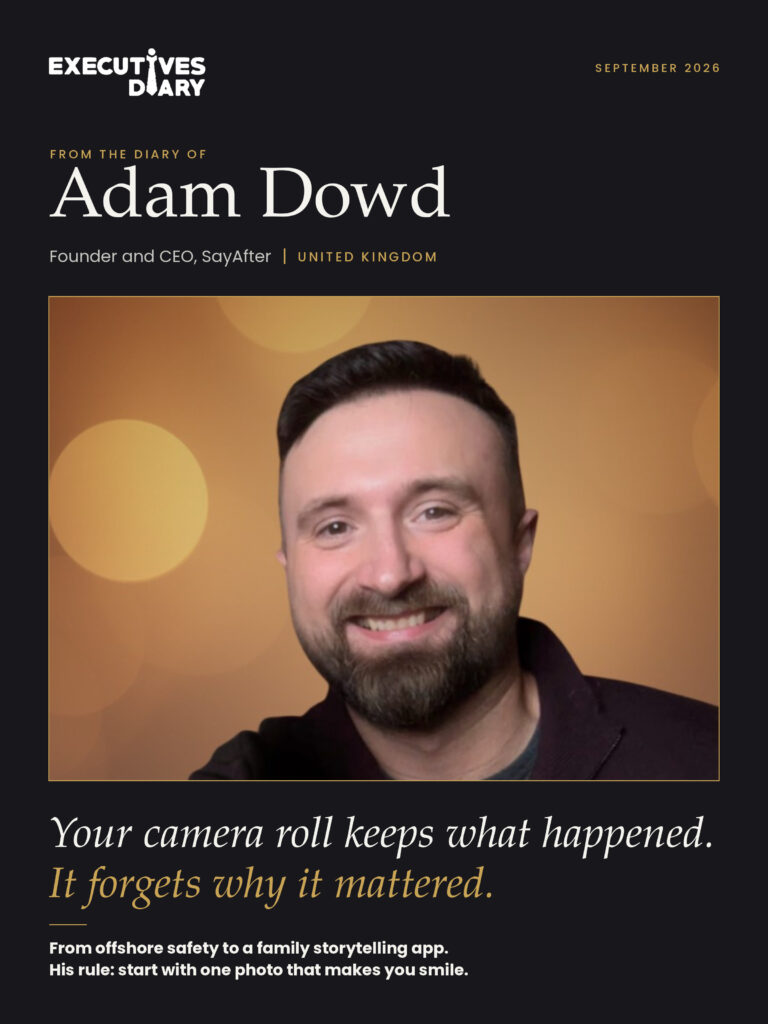
Leader in Spotlight: Read Adam Dowd Feature in Executives Diary
The Logo Is Not the Problem
He first recognized the pattern while working with his earliest clients in Italy. “In those early meetings, clients focused on the outcome, usually how the logo looked, rather than the purpose it was meant to serve,” he says. “Seeing that gap repeatedly taught me more than any brief could.” In 2018, necessity pushed him to write his first brand strategy. Curiosity did the rest.
Identity work, he found, fails for a reason nobody likes to hear.
Identity is difficult because most companies believe they already have one. Often, what they have is a costume. Character only emerges once the strategy is clear. And when that costume belongs on the wrong stage, the right client can walk past without recognizing the answer to their problem.
Antonello Livrano, Creative Director, Livrano.com
The fix begins before anything is drawn. “That’s why listening comes before drawing,” he says. “I work through the strategy with the client until the direction is clear to both of us. Only then do the logo, visual system and wider identity take shape. They are not decoration. They are the strategy made visible.”
Martin Lorenz’s work on flexible visual identity systems then changed what the word identity meant to him. “The familiar formula of icon plus logotype no longer felt sufficient,” he says. “The internet was pushing identity toward motion and adaptability, toward systems that could change shape without losing their character.” A brand, in other words, is a set of rules that can move, not a mark that must stay still.
One Hand from Strategy to Screen
The method has a root outside graphic design. Antonello trained as an architect in Milan, Madrid and Lisbon, and the studies, he says, “gave me a way of seeing before they gave me a way of designing.” From Massimo Vignelli he took the conviction that design is one discipline at different scales, and the line he repeats to clients and to his own team: if you can design one thing, you can design everything.
In practice that means refusing the usual handoffs. “Today, I work with companies and startups across Brand Strategy, Brand Design and Web Design,” he says. “I don’t treat them as separate services, but as stages of the same process: one idea carried clearly from strategy to identity to screen.” He adds: “AI can now produce almost anything within a single specialty. I focus on what happens between disciplines: connecting the parts, maintaining coherence and deciding what deserves attention.”
That confidence came early in Amsterdam. Work with Stokerkade and the Het Schip Museum taught him how to present ideas to corporate and institutional clients without waiting for permission.
At Het Schip, he designed a public installation on the Amsterdam School from concept to execution, then watched visitors use it. The experience taught him “something about design that no brand deck ever could: the audience finishes what the designer starts.” Its structures, made from more than ninety percent recyclable cardboard, also proved that “you can honor a legacy without repeating its materials by giving it identity through visual language.”
What to Check Before You Change the Name
Founders arrive convinced that one element is the problem. Often it is the name. Antonello’s most instructive case says otherwise: a small food business with a generic website and a name that said little about the company.
Customers already knew and trusted the name, so changing it would have meant discarding real value. What needed to change was the brand’s archetype and, with it, the feeling the business carried. We kept the name and rebuilt everything around it: a new identity and packaging system that transformed a product once presented as ordinary and limited into something playful and alive. It showed me how radically perception can shift without changing the one element the client assumed was holding the brand back.
Antonello, Creative Director, Livrano.com
After the rebrand, he says, sales grew by more than twenty percent and production increased with them. He returns to the project because the proof sits on a shelf. “Digital products are built to scale,” he says. “A jar has to earn every centimeter of attention on its own.”
The checks a founder can run come straight from that case. Is the thing you want to change the thing customers already trust? Is the strategy written down anywhere, or only assumed? Do the website, the packaging and the pitch deck speak the same language? If not, the customer notices the disconnect before you do.
A Disruptive Era in Design
Antonello also spoke about the use of AI in creative fields. His worry is what floods in behind it. “AI-generated content is flooding the field with visual noise, work that looks resolved without a single real decision behind it,” he says.
He sees the profession dividing along one line. “We are heading toward a split that will only sharpen: designers who can work without AI, or who use it as one layer inside a process they still control, against those who let the tool make the decisions for them.”
I keep thinking about what happened to vinyl. Most listeners assumed convenience had won for good, and then, years later, people came back for the quality and the feeling of the sound, something no compressed file carries. I believe craft in design is heading toward the same kind of return.
Antonello, Creative Director, Livrano.com
For a buyer, the consequence is simple: a flawless first draft is no longer evidence of anything.
The Architect in the Room
The training behind the method is on the record. Antonello studied at Politecnico di Milano and ETSAM in Madrid before finishing his Master of Architecture in Lisbon with a thesis titled “The space of silence.” He designed the 3D map of Expo City in Dubai along with Space Agency Design and worked on a pavilion for Arduino with Parasite 2.0. Before Livrano.com, he founded Murgiahub in Bari, whose platform for creative professionals, Createva, won a PIN award.
Teaching, for him, is a way to learn: students are an unexpected source of inspiration, and they help him reflect and process what happens in everyday work. Continuous learning is fundamental in such a fast era. At the Accademia di Belle Arti di Bari, Antonello and Gianvito Turi, Michele Santella, Paolo Azzella and Gigi Buonsante guided students in building an adaptable visual identity system for a music festival, the same challenge Lorenz’s work had posed to him, passed on as an assignment.
One client wrote on his profile that he and his team “only need one look at your design strategy to understand the entire vision.”
The steadiness took a bruise to learn. “One large project turned out to be far more demanding and protracted than the client had indicated,” he says. “It slowed the agency’s growth and bruised morale for a while. It also forced us to rebuild our process and how we vet a client before saying yes. Painful, but it’s the reason we grow more steadily now.”
Where Antonello Is Now
Antonello runs Livrano.com with a network of specialist collaborators and partners, offering brand strategy, brand design and web design for companies, startups, hospitality businesses and cultural institutions. His measure of good work has not changed with the tools. “To be remembered, good design must also be a beautiful, strategic surprise.”
The question is no longer whether a studio can produce, but whether someone inside it is still choosing.
The Antonello Livrano Playbook: How to Buy a Brand That Works
- Write the strategy before the brief. If the direction is not clear to both sides, the logo is decoration.
- Keep what customers already trust. Change the archetype and the feeling, not the name that carries the value.
- Buy a system, not a mark. An identity should change shape across touchpoints without losing its character.
- Use AI as one layer, never the decider. Curation is the skill that now separates studios.
- Vet the client before saying yes. One stretched project can cost a year of growth and morale.
From the Diary of Antonello Livrano
Antonello Livrano is a Creative Director and the founder of Livrano.com.
| Role | Creative Director & Founder, Livrano.com |
“Stay obsessed with outcomes, not the appearance of effort.”
Editor’s Note
Executives Diary features Antonello Livrano for the discipline behind his identity work: strategy first, the visual system built only once the direction is clear. His record spans architecture, brand and digital design, and the throughline is coordination, not specialization. The Het Schip and food-business projects show the same method applied at different scales, from a public installation to a product on a shelf. His view on AI, that the tool is one layer inside a process a designer still controls, matches how the editors weigh the work behind a finished result. He is a fit for readers deciding who builds their next identity.
Executives Diary, Editorial

