

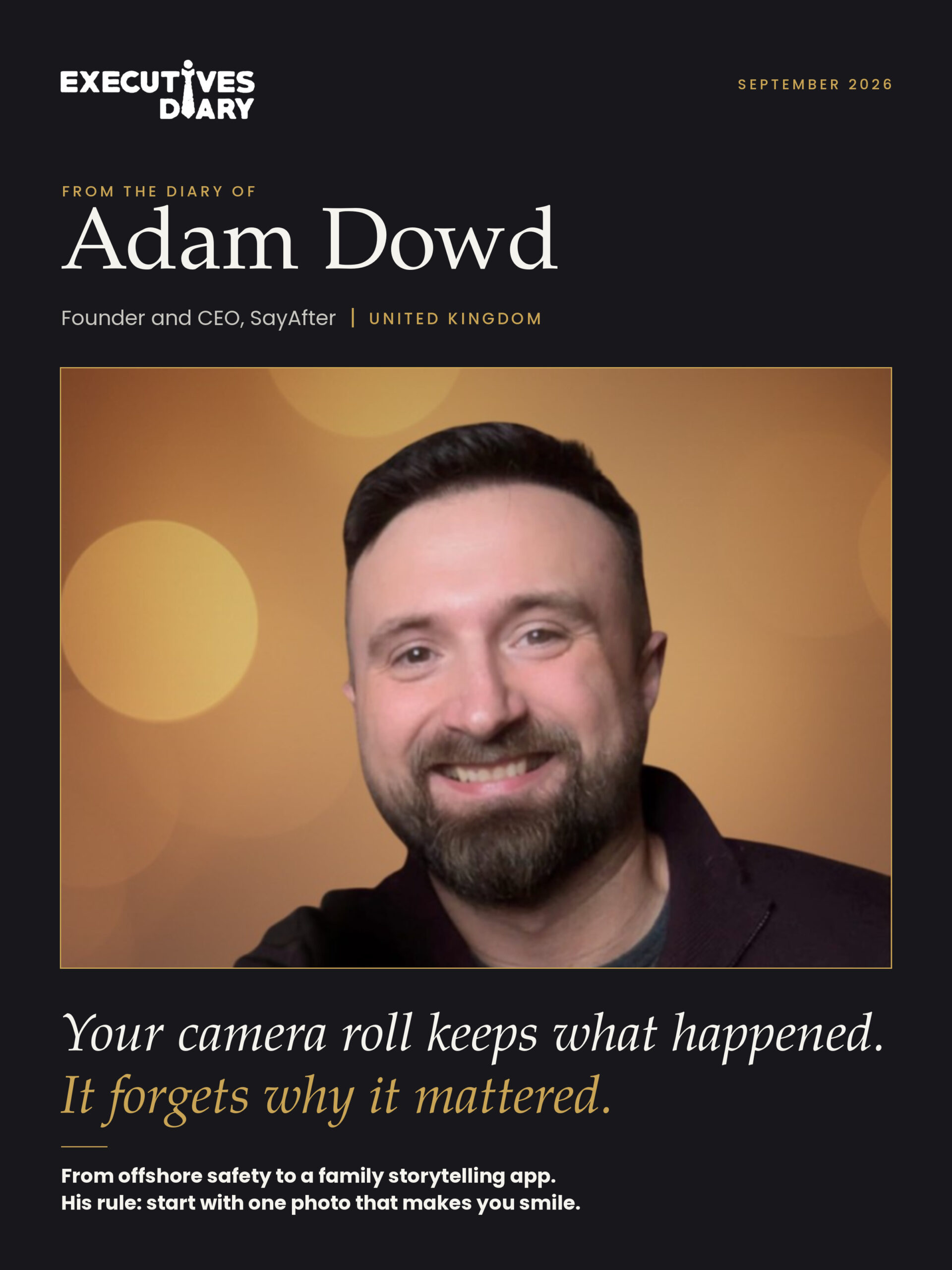
From the Diary of
Adam Dowd
For the hospices, charities, funeral providers and investors who could put a family storytelling app in front of the families it was built for.
“Your camera roll remembers what happened. SayAfter helps your family remember why it mattered.”
Somewhere on your phone there is a photograph that makes you smile. You know who was there and roughly when it was taken. What the photograph can’t hold is why everybody was laughing, what happened five minutes before, or what you were thinking as it was taken. That is the part Adam Dowd built SayAfter to keep.
SayAfter is a family storytelling app. You open your camera roll, pick a photo, and record the story behind it: a voice note, a video, a few written lines. The people closest to you can add the memories only they remember, so one person’s account becomes the family’s. Some stories are shared straight away. Others can be delivered years into the future, to a child who has grown up or a grandchild who hasn’t yet been born. Adam, who founded the company in the United Kingdom in June 2024, puts the idea in one line, and it’s the line he wants under his name: “Your camera roll remembers what happened. SayAfter helps your family remember why it mattered.”
The piece isn’t aimed at the person holding the phone. Families are who SayAfter is built for, but the people Adam wants reading this are the ones who could put it in front of them: healthcare organisations, hospices, charities, funeral groups, strategic partners, investors and journalists. What he wants them to understand is the size of the idea. “SayAfter is not simply somewhere else to store photos,” he says. “We already have plenty of places for that. The bigger idea is helping families understand each other properly.”

The Photograph Is the Doorway
Adam’s argument starts with a habit almost everyone shares. “I think we have become incredibly good at documenting our lives and surprisingly poor at preserving what those lives actually felt like,” he says. Most people carry thousands of photographs: birthdays, holidays, children growing up, parents, grandparents, completely ordinary days. A photograph shows what was visible for a fraction of a second, and no more.
“It cannot tell you what happened five minutes earlier,” he says. “It cannot tell you why everybody was laughing. It cannot tell you that someone had spent half the morning in a mood before something ridiculous happened and suddenly the day became one of your favourite memories. It cannot tell your child how proud you felt looking at them, or what you were thinking while the photograph was being taken.”
Those details, in his view, are the first to disappear, and the mistake behind losing them is one of confidence rather than neglect.
We believe we have preserved a memory because we have preserved the photograph. Really, the photo is often just the doorway into the memory. Everything that gives it meaning is still sitting inside somebody’s head.
SayAfter, he says, “is about getting that part out while we can.” The harder question is how you get anyone to start.
One Photo That Makes You Smile
The first thing Adam tells someone who says they’ll record their life story one day is to stop calling it that. “That sounds enormous and most people would not know where to begin,” he says. His instruction is smaller. “Just open your camera roll and find one photograph that makes you smile. Tell me who was there. Tell me what you were doing. Tell me what happened that day. Tell me why you still remember it and how it made you feel. That is a story.”
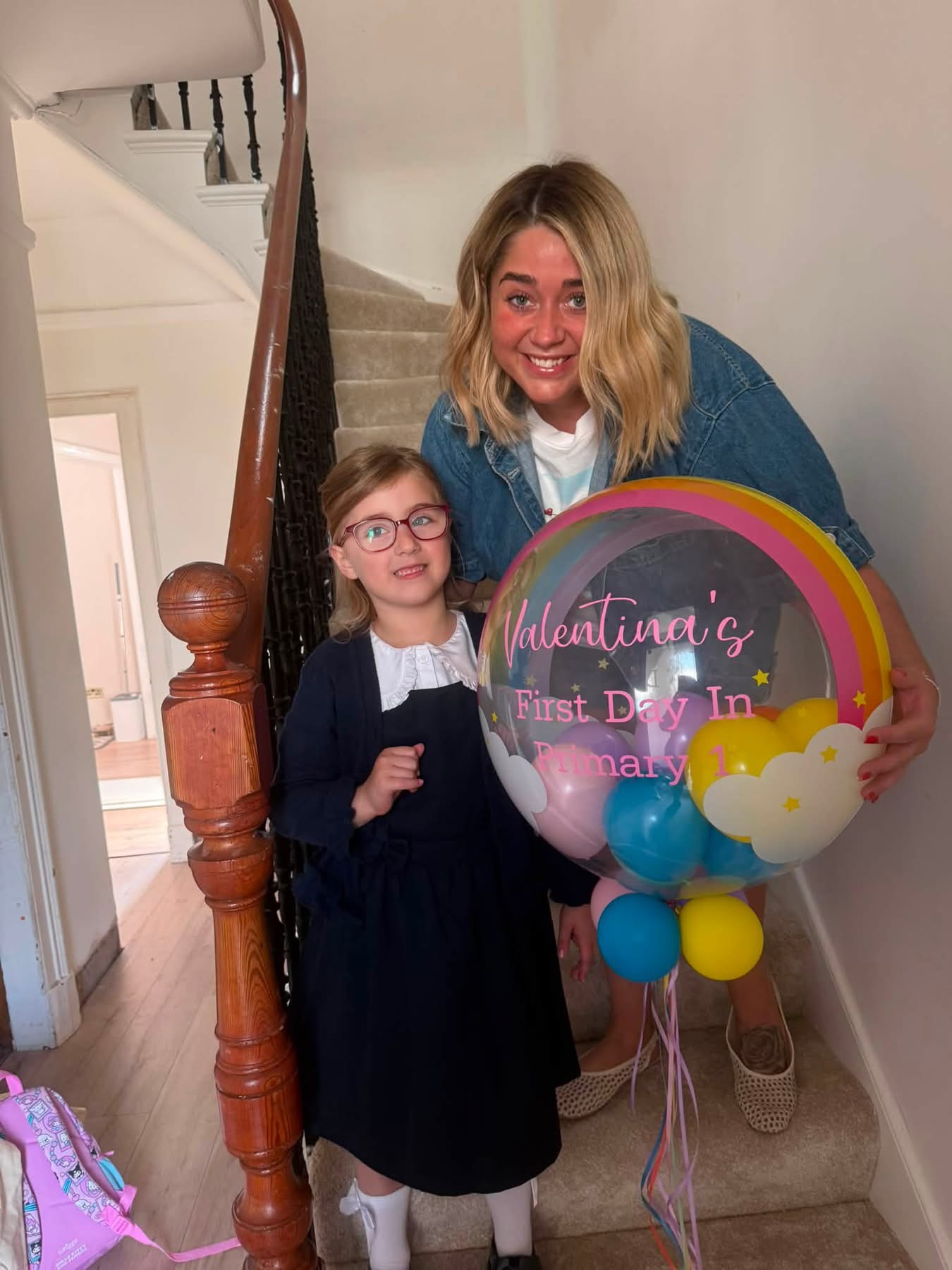


Do that occasionally, he says, and a record builds without it feeling like work. “You are not sitting down to write an autobiography. You are just remembering your life.”
You are not sitting down to write an autobiography. You are just remembering your life.
The same thinking sits behind the AI Storyteller that SayAfter is developing, and that Adam has been explaining in a run of short daily videos on his LinkedIn page. “Most people do not have a shortage of stories,” he says. “They have a shortage of good questions. Ask somebody the right thing and suddenly you get a story they have not thought about for twenty years.” The questions he has in mind are plain ones: what music they loved growing up, what their first job was like, who their best mate at school was, what their parents were like when they were young, what they remember about the day their first child was born. “One answer naturally leads to another. That is what I want SayAfter to make easy.”
What he has noticed, from conversations with families and with the professionals who work alongside them, is that people tend to start in the wrong place. “People initially assume the stories worth preserving are the major milestones. Weddings, births, graduations, big holidays and major achievements. Once people actually start talking, though, the stories that bring the biggest smiles are often much smaller.” How somebody met their partner. What their first car was like. The thing their gran always said. “The completely useless thing their dad was somehow famous for.”
Getting one person talking is half of the product. Getting the whole family talking is the other half.
One Story, Told by the Whole Family

“One story. Told by the whole family,” Adam has written, and it’s the thing he thinks separates SayAfter from a life-story app for one person. “No family member remembers someone in exactly the same way,” he says. “Your brother knows stories you do not. Your mum remembers things differently from you. Somebody else has photographs nobody has seen in years. Bringing those perspectives together creates something much richer than one person trying to document an entire life.” That, he says, is where SayAfter can become special: “It allows a family story to become something the family builds together.”
Asked for a family whose story shows this working, Adam declined, and his reason says something about how he wants the company described. “We are still early and I do not want to manufacture a neat family case study simply because it would make the article read better,” he says. “I would rather earn those stories properly as more families start using SayAfter through the work we are now doing with charities, hospices and other organisations.” He asks for the same care with partners. “If something is being discussed, call it a discussion. If testing is being explored, describe it that way. If something becomes a formal partnership, then we can shout about it.”
If something becomes a formal partnership, then we can shout about it.
Two years in, that is the stage the company has reached, and it isn’t the place he started from.
Two Years and a Camera Pointed at Himself
Adam founded SayAfter in June 2024. His profile lists nothing before it, and what it carries of his earlier working life comes from other people: a recommendation from Cameron Sword, who worked with him on offshore well-intervention projects from 2023, when Adam was a Human Factors Specialist and HSE Coach at Shell, and another from Gemma Rice, who worked with him when he was an Offshore Safety Officer at Kuiper. He still writes for that world. “When you work offshore or spend time away from home, you try to make the most of every minute when you’re back,” he posted this month. “Then before you know it, you’re away again.”
Building the company changed how visible he was willing to be. “I have also made myself become much more visible as the founder,” he says. “I post videos regularly now and talk openly about my family, memories and why I am building SayAfter. That did not come naturally at first, but I realised there was something slightly ridiculous about building a product encouraging people to tell their stories while I hid behind a logo.” On the page, the awkwardness is admitted rather than hidden. “Getting better at these videos by the day,” he wrote under one of them, “(I think anyway still feels a bit awkward).”
The other habit he’d want a colleague to recognise is impatience. “I am quite impatient when I believe in something. If I think there is somebody I should speak to, I generally just contact them. I would rather find out whether the answer is yes or no than spend three months wondering whether I should send the message.” A lot of the conversations SayAfter is having now, he says, started with exactly that kind of message.
What those conversations taught him is the advice he now gives to anyone starting out.
The Product Is Not the Business
To someone building a consumer app who wants to be where he is in five years, Adam’s first point is a distinction. “Building the product and building the business are two completely different things,” he says. “You can disappear into development for years if you let yourself. There will always be another feature you could add, another screen you could improve and another reason to wait before putting it in front of people. Eventually you have to find out whether anybody cares.”
The remedy, in his telling, is discomfort. “Talk to people earlier than feels comfortable. Show them things before they are perfect. Ask questions. Contact people you assume are too senior to answer. Listen when somebody does not understand what you are explaining rather than deciding they just do not get it.”
You can build something fantastic, but if nobody ever encounters it you have still got a problem.
That is why distribution, and partnerships in particular, have become the centre of SayAfter’s next stage. “Healthcare organisations, hospices, charities, funeral providers and other organisations already have trusted relationships with families,” he says. “If SayAfter can sit naturally within those relationships, we can reach far more people than we ever could by simply putting an app in an App Store and hoping they discover it.”
Where Adam Is Now
This year’s work is that distribution. As his profile puts it, SayAfter is hiring a Business Development and Partnerships Consultant. A campaign with Joe Leather and his podcast The Wind, Waves and Wells, aimed at offshore workers who want to stay connected with family while away, is due to start soon, with details to follow. And the conversations with charities, hospices and other organisations continue, described here, at Adam’s request, as exactly what they are. “The next stage is getting SayAfter into the hands of more families through healthcare, hospices, charities, funeral partners and direct users, while proving that telling our stories can become as normal as taking the photograph in the first place.”
The organisations he would most like this piece to reach are Marie Curie, MND Scotland and Prospect Hospice, along with leading organisations across healthcare, dementia, hospice care, bereavement and the funeral sector, and the investors and strategic partners who can see the wider potential of family storytelling.
Outside work, the reason for all of it is his children. “They are probably the simplest explanation for why I care about this so much,” he says. “I want them to know who I was before they knew me. I want them to know what I was like at school, who my mates were, what I was into, what I was proud of and the stories from my life they would probably never think to ask me about.” He was hyperactive at school and, for some reason, collected The Beano. “That is exactly the kind of completely insignificant detail that actually tells you something about a person.”
The vision he wants the piece to carry is wider than remembrance. “It is not simply about remembering people when they are gone,” he says. “It is about understanding and enjoying each other more while we are here, and carrying those stories forward so the people who come after us still know who we were.” The version he says most plainly is about his own children: “Most importantly, I want my children to know exactly how I felt about them. Children often do not think to ask those questions until they are older, but I am pretty sure they would love to know the answers.”
The Playbook
The Adam Dowd Playbook: getting a story out of anyone
- Start with one photograph that makes you smile. Not a life story. Who was there, what happened, why you still remember it.
- Ask a better question. Most people have no shortage of stories, only a shortage of good questions.
- Let the whole family in. Your brother knows stories you don’t. So does your mum.
- Contact them. If there’s somebody you should speak to, find out whether it’s a yes or a no rather than wondering for three months.
- Show it before it’s perfect. Talk to people earlier than feels comfortable, and listen when they don’t understand.
