
Who’s Who: Colin MB Cooper
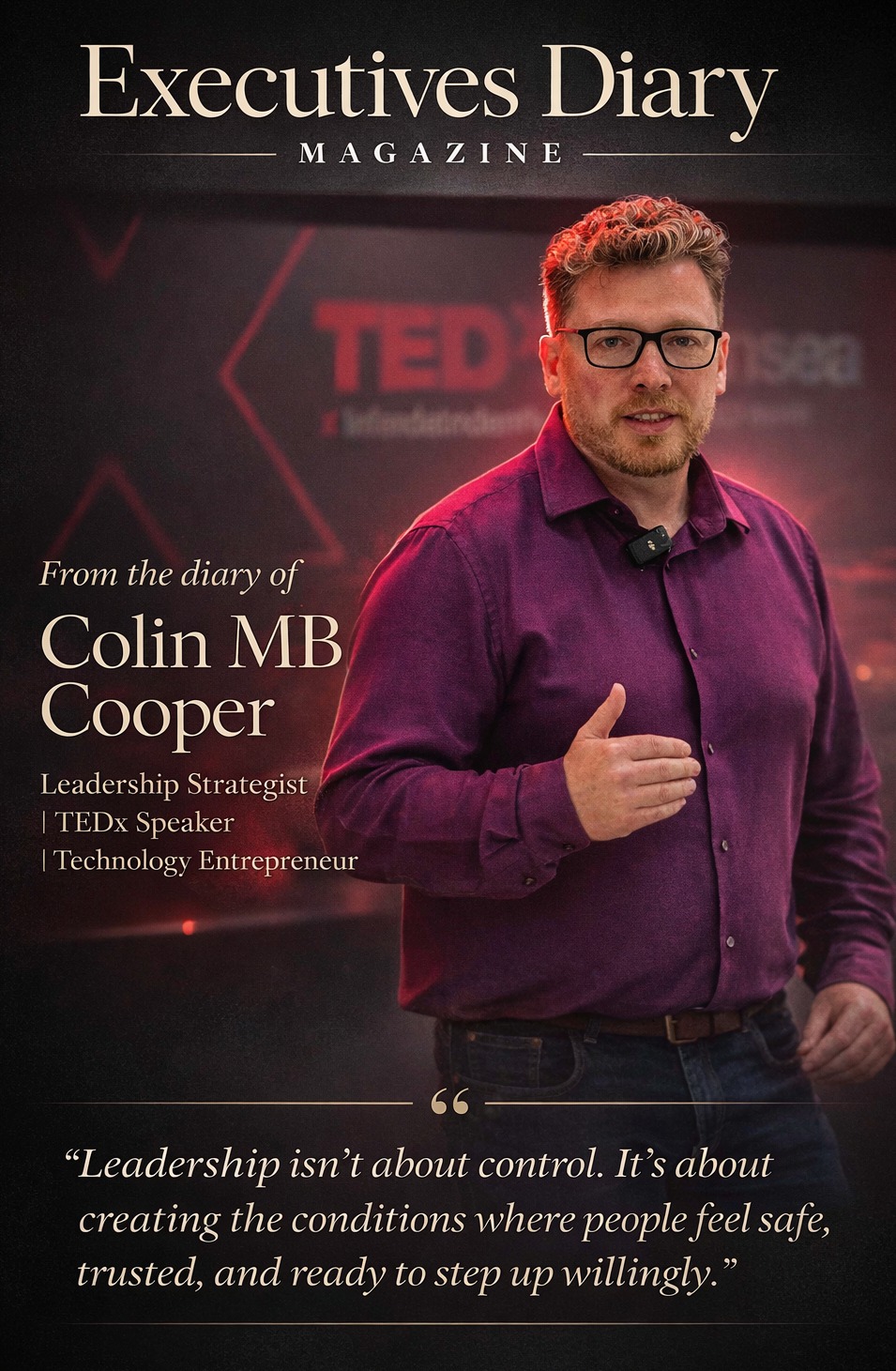
Colin MB Cooper is a UK-based leadership strategist, TEDx speaker, and technology entrepreneur working at the intersection of human behaviour, AI, and education reform. Known for his philosophy of “leadership without force,” he advises founders, boards, and global organisations on human-centred strategy in an AI-driven world. With experience spanning behavioural psychology, digital ecosystems, and emerging technologies, Colin champions critical thinking, emotional intelligence, and responsible innovation as the foundation of modern leadership.
For Colin MB Cooper, leadership has never been about control, volume, or position. It has been shaped instead by a philosophy he often summarises simply as “leadership without force.” It is not a phrase designed for effect, but a principle forged through lived experience, quiet observation, and an enduring respect for human behaviour, long before boardrooms or global stages became part of his world.
Some of the most influential lessons that define Colin’s leadership today did not come from institutions or executive playbooks, but from working with horses. In natural horsemanship, authority cannot be imposed. Horses are acutely sensitive to emotional states and intent. They cannot be bluffed, dominated, or persuaded by title alone. Any lack of clarity, emotional regulation, or consistency is met with immediate resistance, not out of defiance, but self-preservation. Through this work, Colin learned that force creates friction, while calm presence creates movement, a lesson that would later underpin his approach across business, education, and technology. As he often explains, “people perform best when they feel safe, understood, and trusted. When leaders create those conditions, individuals don’t need to be pushed, they step up willingly.”
Early Lessons in Responsibility and Restraint
Colin grew up in the United Kingdom in a working-class environment where resilience was not taught as a concept, but learned through experience. Responsibility was practical and visible. Commitments mattered, and excuses carried little weight. From an early age, he learned that reliability and follow-through were not optional traits, but expectations that shaped character and credibility.
School itself was a mixed experience. Some teachers inspired curiosity, confidence, and independent thinking, while others unintentionally demonstrated the difference between authority and leadership. What stayed with Colin was not the curriculum, but the contrast between control and influence, between being obeyed and being respected.
One defining lesson came through his father. After making a mistake, Colin expected anger or punishment. Instead, he was met with silence. The conversation followed the next day, calm and deliberate, with no emotional reaction, only accountability and reflection. That moment left a lasting imprint and shaped his understanding of leadership early on. As Colin reflects, “the strongest leaders don’t react emotionally. They respond intentionally.” Restraint, he learned, is not weakness. It is discipline.
Discipline Before Ambition
At thirteen, Colin took on his first job delivering newspapers. The pay was modest, but the lesson was enduring. If he did not show up, people did not receive their paper. Weather, fatigue, and circumstance were irrelevant. Responsibility began the moment he committed, not when someone was watching. That experience reinforced a belief he has carried ever since, that “responsibility doesn’t start when someone is watching. It starts the moment you commit and follow through, regardless of conditions.”
Around the same age, Colin discovered computers. By fifteen, he had built his first website. What began as curiosity quickly evolved into capability, and soon into a deeper fascination not only with technology itself, but with how people interacted with systems, how behaviour influenced outcomes, and why some ideas scaled while others failed.
Building at the Intersection of Behaviour and Technology
Colin’s professional journey has never followed a straight line. It has been shaped by experimentation, setbacks, wins, and reinvention. Over time, these experiences forged a broad and integrated skill set spanning business strategy, behavioural psychology, neuromarketing, digital ecosystems, and emerging technologies including artificial intelligence, virtual reality, and augmented reality.
He has founded and scaled multiple businesses, advised startups and Fortune 500 organisations, and worked hands-on with leaders navigating growth, transformation, and disruption. This first-hand entrepreneurial experience gives him a grounded credibility. He understands pressure not as a concept, but as a daily reality where decisions must be made with incomplete information and real consequences.
What consistently distinguishes his work is a refusal to separate technology from humanity. While others focus on tools, platforms, and speed, Colin looks beneath the surface to the human systems that determine whether progress actually holds. He is direct about the risks of superficial adoption, often noting that “AI without human judgment is just empty calories.” In his view, artificial intelligence is not a replacement for thinking, but an amplifier of it. It does not elevate weak judgment, because “brilliant thinking plus AI creates leverage, but poor thinking plus AI just creates faster mistakes.”
Rethinking Education in an AI-Driven World
A significant portion of Colin’s work sits at the intersection of education and emerging technology. He has become a clear and consistent advocate for closing the widening gap between how people are educated and how the world actually operates. Drawing on decades of experience across business and technology, he challenges systems that prioritise memorisation over thinking and compliance over curiosity.
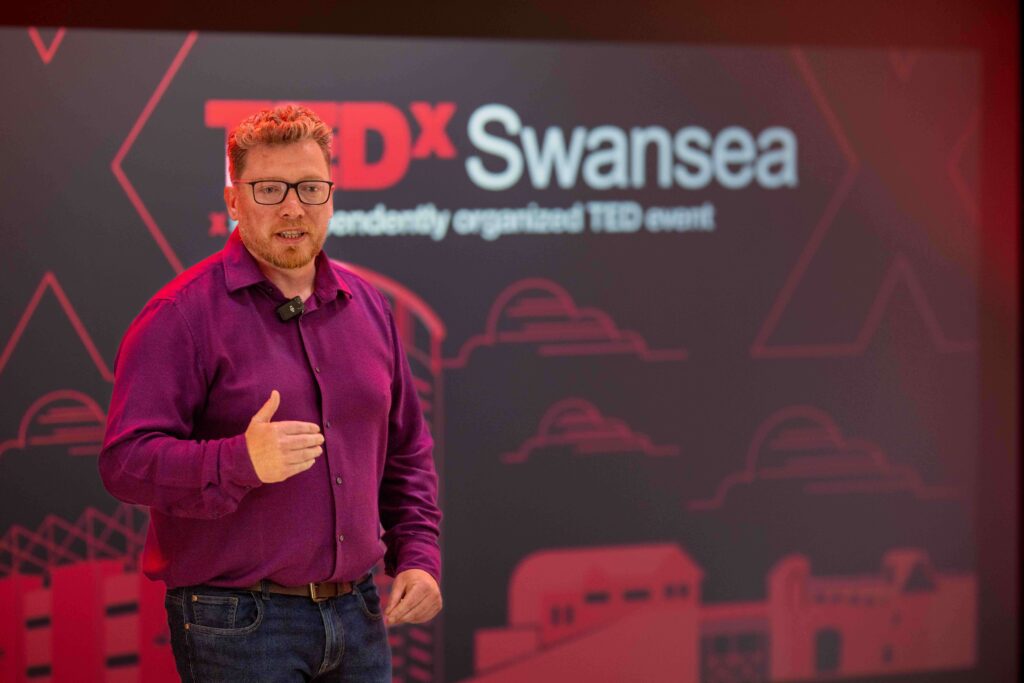
In an AI-enabled world, he argues, knowledge alone is no longer the differentiator. The skills that matter most are curiosity, critical thinking, emotional intelligence, adaptability, and judgment. His advice is clear and uncompromising: “don’t outsource your thinking.” As a TEDx speaker and global keynote presenter, Colin addresses education reform, AI literacy, and leadership in uncertainty with a grounded, unsensational voice, reminding audiences that “the future won’t reward those who follow instructions best. It will reward those who can think independently and lead through uncertainty.”
Leadership as Behaviour, Not Title
Across boardrooms, classrooms, and stages, Colin’s leadership philosophy remains remarkably consistent. Leadership without force means clarity over control, presence over pressure, and responsibility over reaction. Those who work with him often describe his presence as calm, grounded, and precise. He listens deeply, asks better questions, and translates complexity into action without losing sight of human impact. As he often says, “titles don’t create leaders. Behaviour does.”
Focus, Influence, and the Long View
Today, Colin MB Cooper focuses on strategic consulting, advisory work, and selective board involvement where long-term thinking, governance, and human-centred strategy genuinely matter. He currently holds a single board position and continues to advise organisations operating at the intersection of education, technology, and human behaviour. He is increasingly selective about where he invests his time, noting that “I’m less interested in titles and more interested in influence, integrity, and meaningful impact.”
As artificial intelligence becomes embedded into everyday systems, Colin continues to emphasise a simple but critical truth. “The race isn’t to use AI fastest. It’s to use AI best.” Beyond his professional work, he is a father of four, a committed philanthropist, and a lifelong learner who actively supports initiatives improving education and healthcare, guided by a belief that success carries responsibility.
A Human-Centred Legacy
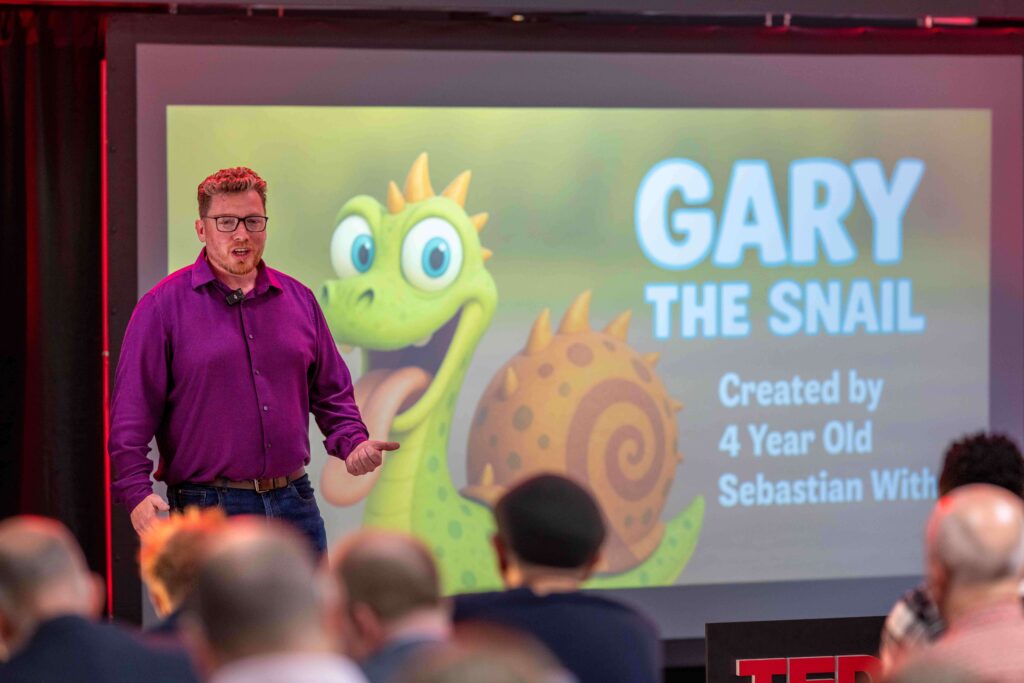
Looking across Colin MB Cooper’s journey, one pattern remains unmistakable. From a working-class upbringing to international leadership, from early experiments with technology to advising organisations on AI, his path has been guided by curiosity refined into clarity. Leadership, in his view, is not about control, but about trust, responsibility, and intentional response. In an age defined by automation and acceleration, Colin stands for progress guided by judgment, technology anchored in humanity, and leadership without force.