

Running a freight brokerage as one company, treating carriers as partners, and why operational discipline and people-centered leadership belong together.
A freight brokerage can run hard in four directions at once. Sales is chasing revenue. The carrier team is covering freight. Customer service is executing. Accounting is watching the result. Every department is working, and none of them is wrong. The customer, though, isn’t dealing with four departments. “The customer doesn’t experience those departments separately,” says Amber Romando. “They experience one company.”
Amber is Vice President of Operations at BWS Logistics, a freight brokerage she joined in February 2026 after more than two decades in supply chain and logistics. She started in transportation coordination at UPS, ran sales and operations at XPO Logistics, and spent more than six years at Spartan Logistics, where she served as Chief Operating Officer. What she brought to BWS was a focus on structure: who owns what, how it’s measured, and how each function’s decisions land on the others. “My approach has been to make sure everyone understands how their decisions affect the entire business,” she says.
That is also what she brings to the next chapter: operational leadership, organizational development, business strategy and relationship-building, the four things she would put on the table in a boardroom or on a stage. The reader she has in mind is a CEO, a board member or a senior leader who, in her words, “recognizes that strong operational experience and people-centered leadership aren’t competing priorities. They belong together.”
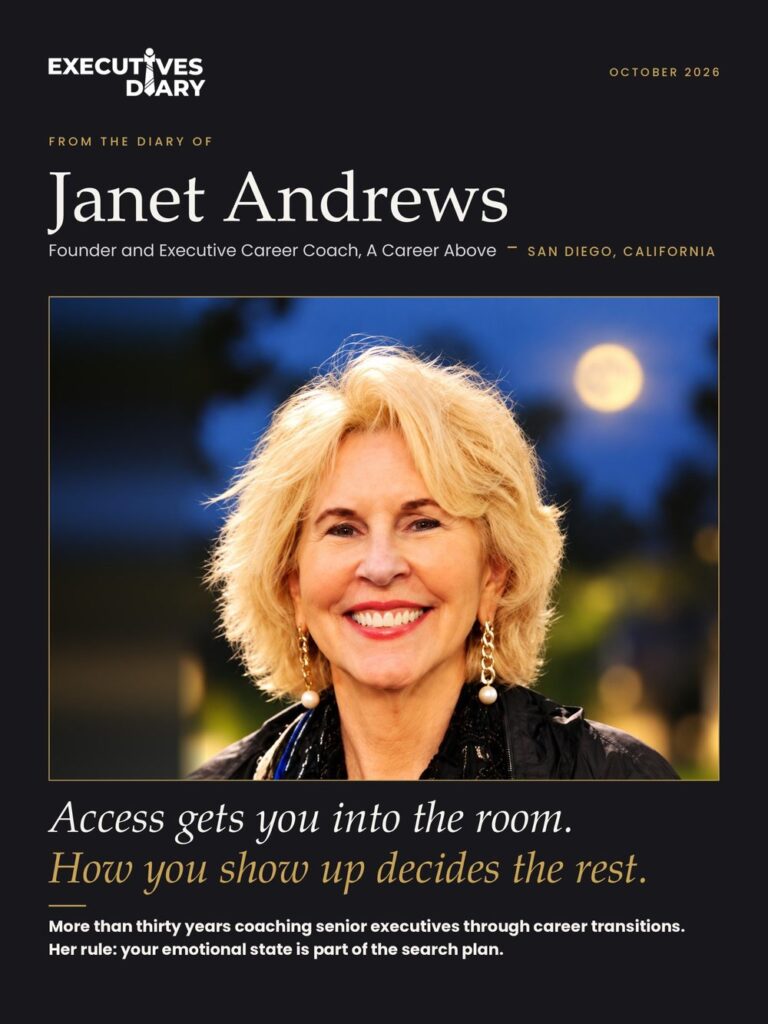
Leader in Spotlight: Read Janet Andrews Feature in Executives Diary
Look at the Environment First
“One of the most important lessons I’ve learned is that when an operation isn’t performing, the easiest thing to do is blame the people,” Amber says. “The harder, and usually more productive, thing to do is examine the environment those people are operating in.”
At BWS that has meant defining ownership, developing standard operating procedures, creating performance metrics that mean something, and making expectations clear. The first concrete piece is carrier assignment and load ownership: the processes have been strengthened so there’s less ambiguity about who is responsible for quoting, covering and executing a load. The second is measurement, with more structured performance metrics around margin, carrier development, service execution and productivity.
The part she calls most important sits underneath both.
I don’t believe accountability and empathy are mutually exclusive. I want my team to know that I care about them as people. I also want them to know that when we commit to something, we’re responsible for delivering it. I don’t expect perfection. I expect ownership, communication, and a willingness to improve.
Amber Romando, Vice President of Operations, BWS Logistics
Transformation, in her telling, isn’t about proving that everyone before you was doing it wrong. “It’s about understanding what’s working, identifying what’s getting in the way, and helping people build something better together.” She learned to understand the work before managing it in her first job.
From Transportation Coordinator to Chief Operating Officer
“My career began in transportation coordination at UPS, and I don’t think I could have asked for a better foundation in this industry,” she says. Transportation, in her account, teaches you quickly that there’s a difference between making a plan and executing one. “You learn that timing matters, communication matters, details matter, and when something goes wrong, someone has to take responsibility for figuring it out.” What stayed with her was a rule she still holds as an executive: “I learned the importance of understanding the work, not just managing the people doing it.”
Between UPS and Spartan came sales and operations roles, including Director of Business Development at NFI and Sales and Operations Manager at XPO Logistics, where she built and developed a team of logistics professionals and managed a branch P&L. She joined Spartan Logistics in 2019 and eventually served as Chief Operating Officer, helping lead a business operating at significant scale in what she calls “a highly competitive and challenging freight environment.” The job was the whole operation. “I was responsible for helping manage the business, developing teams, supporting customers, driving operational performance, and navigating the financial and strategic realities of running a logistics company,” she says. Behind every freight transaction, as she puts it, were customer relationships, carrier partnerships, operational decisions and a team of people responsible for making sure commitments were met every day.
“I learned that leadership sometimes means making decisions that aren’t popular. I learned that loyalty is important, but loyalty cannot replace sound business judgment.” And one that separates the two jobs she has held at the top of an operation.
As an operator, you’re often focused on solving the immediate problem. As an executive, you have to ask why the problem exists, what it costs the organization, and how to prevent it from happening again.
Amber, Vice President of Operations, BWS Logistics
Asked for the evidence of her work, she doesn’t reach for a growth figure. “Not every leadership accomplishment shows up as a record-breaking growth number,” she says. “Sometimes the accomplishment is stabilizing a situation, protecting customers, maintaining the confidence of your team, or making the decisions necessary to keep a business moving forward.”
After more than six years there, the next step was about growth. “I’ve come to believe that growth sometimes requires being willing to leave something familiar, even when you’ve worked incredibly hard to build it,” she says. “You can be grateful for what a chapter gave you without feeling obligated to stay in it forever. Sometimes the most important leadership decision you make is the one that requires you to bet on yourself.”
In 2026 she joined BWS Logistics. “I wanted the opportunity to bring everything I’d learned into a new environment and help shape the next stage of a business.” Her own summary of the three chapters is shorter still: “UPS taught me the business. Spartan taught me what it means to lead a business. And BWS is giving me the opportunity to apply those lessons while continuing to grow as a leader.” One belief came with her through all three.
Face Time With Carriers
The carrier side of the business carries a conviction she has held throughout her career: “Our carrier partners deserve the same attention and relationship-building efforts that we devote to our customers.”
She tested it this year in the Louisville area, where she spent two days meeting carrier partners. Drayage, she wrote afterward, was an area where she was missing firsthand operational knowledge, so she went in with what she calls a student mindset and asked questions. “What I absorbed in two days sitting across the table from our carriers was more than I could have absorbed in months from behind my desk.”
The takeaway she posted had nothing to do with drayage. “We talk a lot about getting face time with our customers, but getting face time with our carrier partners is every bit as important.” Asked about it, she doesn’t soften it. “Carriers aren’t simply a capacity source. They’re business partners. They represent us in the marketplace and play an essential role in delivering on the promises we make to our customers.”
Outside BWS, she makes a similar argument about a different room.
Decisive, or Difficult
“I think one of the biggest challenges women still face is that we sometimes have to work harder to establish credibility in rooms where our male counterparts are assumed to belong,” Amber says. She is careful about how she says it. “I don’t say that to diminish men or the contributions they’ve made. I’ve worked alongside incredible male leaders, mentors, colleagues, and friends throughout my career.” But she thinks women experience certain expectations differently. “A confident man is often described as decisive. A confident woman can be described as difficult.”
The rooms she means aren’t evenly populated. The 2025 AWESOME/Gartner Women in Supply Chain Report found that women make up 41% of the supply chain workforce and 11% of chief supply chain officers, the lowest share since 2019.
Her answer starts with the individual. “I’ve learned that you cannot build your leadership identity around making everyone comfortable,” she says. “You have to know your business. You have to be prepared. You have to make difficult decisions. And you have to become comfortable with the reality that not everyone is going to agree with you.”
It doesn’t end there.
It’s easy to talk about empowering women. It’s another thing entirely to recommend a woman for an opportunity, introduce her to someone influential, advocate for her when she’s not in the room, or encourage her to pursue something she doesn’t yet believe she’s qualified to do. That’s where real change happens.
Amber, Vice President of Operations, BWS Logistics
Amber is President of the CSCMP Chicago Roundtable, and the Roundtable’s Women Empowering Women event is where she wants that conversation to happen honestly. “Not just polished success stories,” she says. “I want us to talk about mistakes, insecurity, difficult decisions, criticism, boundaries, and the moments when we questioned ourselves.” The third annual event, on October 29 at the NIU Naperville Conference Center, is themed Main Character Energy. “It’s about taking ownership of your own story. Not waiting for permission. Not apologizing for ambition. And not allowing someone else’s perception of you to become your definition of yourself.”
“I don’t want women to simply be invited into the room,” she says. “I want them to know they belong there, have something valuable to contribute, and eventually be in positions to open the door for someone else.” Her newest project is built on the same idea.
I Got a Girl
“The idea comes from something we’ve all heard a thousand times: ‘I got a guy,’” Amber says. “Well, why can’t you have a girl?”
I Got a Girl is a personal networking and consulting concept she is developing alongside her executive role. “It’s about knowing someone who can get things done, make an introduction, solve a problem, offer advice, or open a door. It’s about building a network of capable people who genuinely want to see one another succeed.” The name celebrates women. The network, she is clear, isn’t meant to exclude men. “Some of my greatest professional relationships are with men who have supported, challenged, and championed me throughout my career.”
She announced it on LinkedIn this month as “something fun” and “something very me,” built around “connecting good people with good people.” It’s one of several things on her list for the year.
Where Amber Is Now
At BWS Logistics, Amber’s focus is on building the processes, organizational structure and performance accountability needed to support sustainable growth. In October she hosts the third annual Women Empowering Women through the CSCMP Chicago Roundtable, which began as an effort to bring women together and has become a recurring industry event focused on connection, visibility, leadership and professional development. I Got a Girl is taking shape behind it.
Over the next twelve months she wants this piece to open doors beyond her current role, to corporate and advisory boards and to speaking engagements, on the strength of what she has run: operations at scale, the development of teams and organizations, business strategy, and the relationships that hold a logistics business together. She knows what she wants the right reader to think when they finish. “That’s someone I’d want at the table.” And she has a second reader in mind: “If a young woman starting her career in supply chain reads it and sees a little of herself in my journey, that would mean just as much.”
Away from work, relationships still come first, and golf has become the way she steps back from the demands of the job. “I love that it challenges you, requires patience, and gives you an opportunity to connect with people in a completely different environment,” she says. It reminds her of business, too. “You can prepare, practice, and have a plan, but you still have to adjust to what’s in front of you. You can’t control every shot. You can control how you respond to the next one.”
The line she lives by is about the table she is asking for a seat at, and what to do once she has it: “Don’t just work to earn a seat at the table. Work to become someone who opens the door for others.”
“I don’t think success should be measured only by how far you’ve climbed,” she says. “It should also be measured by how many people you’ve helped along the way.”
Five Lines from Amber’s Diary
“You cannot build your leadership identity around making everyone comfortable.”
“I don’t expect perfection. I expect ownership, communication, and a willingness to improve.”
“Loyalty is important, but loyalty cannot replace sound business judgment.”
“Carriers aren’t simply a capacity source. They’re business partners.”
“Sometimes the most important leadership decision you make is the one that requires you to bet on yourself.”
From the Diary of Amber Romando
Amber Romando is a Chicago-area supply chain executive and the Vice President of Operations of BWS Logistics.
| Role | Vice President of Operations, BWS Logistics |
| Based in | Greater Chicago Area, United States |
| Previously with | Spartan Logistics Services (2019 to 2026), XPO Logistics (2016 to 2019), NFI (2014 to 2016), UPS |
| Also with | President, CSCMP Chicago Roundtable |
“Do not just work to earn a seat at the table. Work to become someone who opens the door for others.”
Editor’s Note
Amber Romando runs operations at a freight brokerage and describes the job in terms of who owns the load and what the customer sees. Her answers hold operational structure and care for people in the same paragraph without treating them as a trade. What convinced the editors is the record behind it: transportation coordination at UPS, the executive floor at Spartan Logistics, and a decision in 2026 to start again at BWS Logistics. The third Women Empowering Women event, and the I Got a Girl idea, carry the same argument outside her own company.
Executives Diary, Editorial
