

From the Diary of
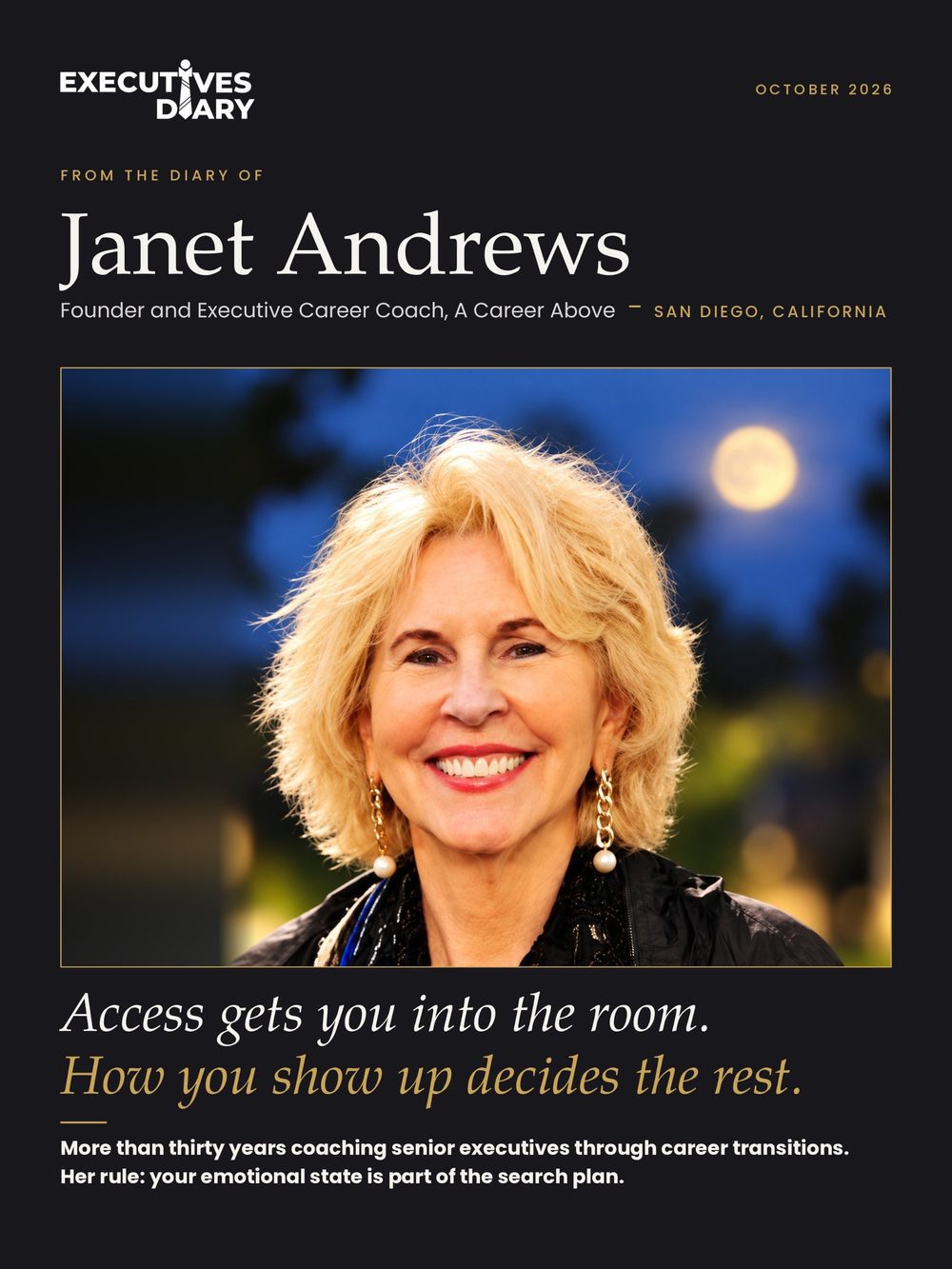
Janet Andrews
What an Executive Career Coach heard when a senior executive finalist wasn’t selected after a long process with many online and on-site interviews, including that he felt relieved, and why she treats how an executive feels as part of the search plan.
““Mindset doesn’t replace strategy. It directly influences how successfully you execute it.””
When she asked why, he had specifics. During the final waiting period, he watched the company’s decision-making and communication slow. He described a stagnant culture and leadership practices that didn’t align with his values. “His relief wasn’t just consolation,” Janet says. “He could point to specific warning signs he’d noticed throughout the interview process.” Shortly after, he accepted a position at a company with a better culture, she wrote in a September post. Janet adds that the company also offered greater leadership agility and a stronger compensation plan.
Janet helped him move from “They didn’t choose me” to “This wasn’t the right opportunity for me.” She says that shift “restored his sense of control.”
He isn’t the only candidate to treat the hiring process as evidence. Greenhouse’s 2024 Candidate Experience Report found that one in five candidates (20%) rejected an offer because of a poor interview experience.
Janet, based in San Diego, California, is the Founder and CEO of A Career Above, a nationwide executive career coaching practice focused on healthcare, biotech, life sciences, pharma, medtech, and tech. She has coached senior executives for more than 30 years and believes an executive’s emotional state is part of the search strategy, given a level playing field. “Your Emotional, Energetic State IS Strategy,” she wrote in a September post.
Her case

“I’ve seen individuals with comparable credentials and experience achieve very different job-search outcomes,” Janet says. “Often, the differentiator is mindset, confidence, and the positive emotional energy they bring to conversations.”
Her explanation starts with the people across the table. Senior leaders, she says, weigh executive presence, enthusiasm, and judgment, and whether they can picture working with the candidate. On a level playing field, she says, the variable was whether executives “believed something was possible” and maintained a “heart-centered growth mindset” throughout networking and interview conversations.
Mindset doesn’t replace strategy. It directly influences how successfully you execute it.
Her September post outlines four reasons an executive’s mindset shapes a search: clarity amid doubt, how an executive comes across in conversations, whether they pursue adjacent opportunities or spiral after a “no,” and whether they recover quickly enough to keep going. “Job search is many months of variable feedback,” she wrote. She cites HeartMath Institute’s research on positive emotions as the basis and says it “isn’t motivational fluff.”
The strongest objection
Executive search is often described as a game of access and numbers: pipeline, referrals, and recruiter relationships. A hiring committee never sees how a candidate feels. On that view, focusing on an emotional, energetic state only delays practical steps. We put that to Janet.
She doesn’t dispute the first half. “Absolutely, access matters,” she says. In her words, networking, referrals, recruiter relationships, and a strong pipeline are “foundational.”
Access gets you into the conversation, and how you show up determines what happens next.
She says she has seen “executives with smaller pipelines outperform those with stronger networks because they demonstrate confidence, curiosity, positive energy, and a clear understanding of the organization’s challenges.” She adds that hiring decisions “hinge on trust, chemistry, and leadership presence.”
Her own advice covers both. In an October post, she tells executives to identify 20 influential relationships, including former colleagues, executive recruiters, alumni, and trusted advocates. “Reconnect by asking how they are doing first,” she writes. “Then share your direction and ask for warm introductions.” A former client, Rick Dewhirst, wrote in a LinkedIn recommendation that she “pushed me to focus on relationships rather than applications, and to reflect more deeply on what I wanted and how I was showing up.”
After a layoff
For an executive who has just been laid off, Janet says the first step is to make a distinction. “I first help the executive distinguish between reacting emotionally and moving forward strategically.” Being laid off, she says, “can trigger anger, frustration, and a loss of professional identity,” and “these feelings deserve acknowledgment.” Applying for jobs indiscriminately “rarely yields the best executive-level results.” She encourages clients to take time to decompress, regain perspective, and clarify what they want next. “The turning point comes when they stop reacting to what happened and start intentionally creating what’s next.”
The turning point comes when they stop reacting to what happened and start intentionally creating what’s next.
Her view of anger has changed. “Earlier in my career, I viewed anger as an obstacle to be resolved quickly,” she says. “Today, I recognize that helping executives develop tools to manage those emotions and process their feelings is part of effective coaching.”
Thirty years in Career Transition
Janet’s background is in psychology. She holds a Master’s Degree in Psychology from Pepperdine University’s Graduate School of Education and Psychology and a Bachelor’s Degree in Psychology from Centenary College of Louisiana. She founded A Career Above in December 1993 and has run it since. She now works one-on-one with executives nationwide in her private practice as an Executive Career Coach and has 131 LinkedIn recommendations.
In the past, she has provided contract work in outplacement and career-transition programs. At Right Management in the Atlanta area, she provided career-transition services to Fortune 500 and 1000 companies in the Southeast, taught workshops on job-search strategy, networking, interviewing, and salary negotiation, and conducted on-site corporate layoff notifications with HR teams. At San Diego State University, she oversaw a two-year Career Transition & Development Grant Program for executives and led five eight-week cohorts. Later, at the Los Angeles office of the U.S. Securities and Exchange Commission, she coached attorneys and staff accountants on leadership development, communication, and onboarding, and helped employees prepare for interviews for internal roles.
How a program runs
Clients in her executive job search programs receive weekly live coaching sessions with handouts, strategies, and tools, along with branding and leadership assessments. The work covers goal setting, résumés and LinkedIn profiles, networking strategies, introductions to decision-makers, interviews, negotiation, and more. She also provides tools to boost positive energy and align intentions “from the highest to the most practical level.”
Her October post outlines five ways to optimize a search: clarify your executive value proposition, optimize your executive brand, align your career narrative, activate your network, and define your decision criteria. Before an offer arrives, she writes, get clear on what matters most. Culture and values alignment is included on that list.

What hiring leaders miss
On the hiring side, Janet’s answer centers on pedigree. “The biggest mistake is focusing too heavily on pedigree rather than on how an executive thinks, connects, and leads,” she says. In her words, an impressive résumé “gets you considered, but it doesn’t reveal everything about how you’ll perform under pressure.” She encourages hiring leaders to assess curiosity, self-awareness, adaptability, judgment, EQ, and candidates’ handling of tough questions.
For executives conducting their own searches, the message is the mirror image. “Don’t just communicate what you’ve accomplished. Demonstrate how you think, the value you create, the relevant problems you’ve solved, and what it’s like to work with you.” The finalist’s reframe carried its own lesson, she says: it “reinforced the importance of evaluating employers as carefully as they evaluate candidates.”
“Credentials establish credibility,” she says. “Emotional intelligence, sound judgment, and executive presence help build confidence in your leadership.”
Where Janet Is Now
Janet’s recent posts target executives considering a move. “The best time to prepare for your next executive opportunity is BEFORE it appears,” she wrote in October, adding that the month is a good time to position for first-quarter opportunities. Her readiness check asks whether an executive can clearly communicate their value proposition and whether they have trusted advocates who can open doors. She writes that being prepared, visible, and proactive means you “recognize opportunities sooner” and “respond with greater confidence.” A September post explains how LinkedIn Recruiter’s “Spotlights” surface candidates. She advises executives to follow their target employers’ pages and keep their profiles current, using the language of the leadership roles they want.
She has been a member of the Sales & Marketing Leadership Alliance since December 2016 and has received its Member of the Year award for two consecutive years. Her invitation to executives in healthcare, biotech, life sciences, pharma, medtech, and tech is the one she closes her posts with: “DM if you are ready to get this done.”
She says the goal isn’t simply to be ready when opportunity knocks. “It’s about building the visibility, relationships, and momentum that help opportunities find YOU.”
It’s about building the visibility, relationships, and momentum that help opportunities find YOU.
The Playbook
Five Reflections from Janet
- Separate reacting from moving forward. Before the next application, ask whether you’re responding to what happened or building what’s next.
- Take time to decompress. Give yourself space to regain perspective and clarify what you want next.
- Show how you think. Go beyond what you’ve accomplished and highlight the relevant problems you’ve solved and what it’s like to work with you.
- Evaluate the employer, too. Weigh how a company treats you during the interview process as carefully as it weighs you.
- Reframe before you conclude. Ask yourself: is there another way to see this?
