

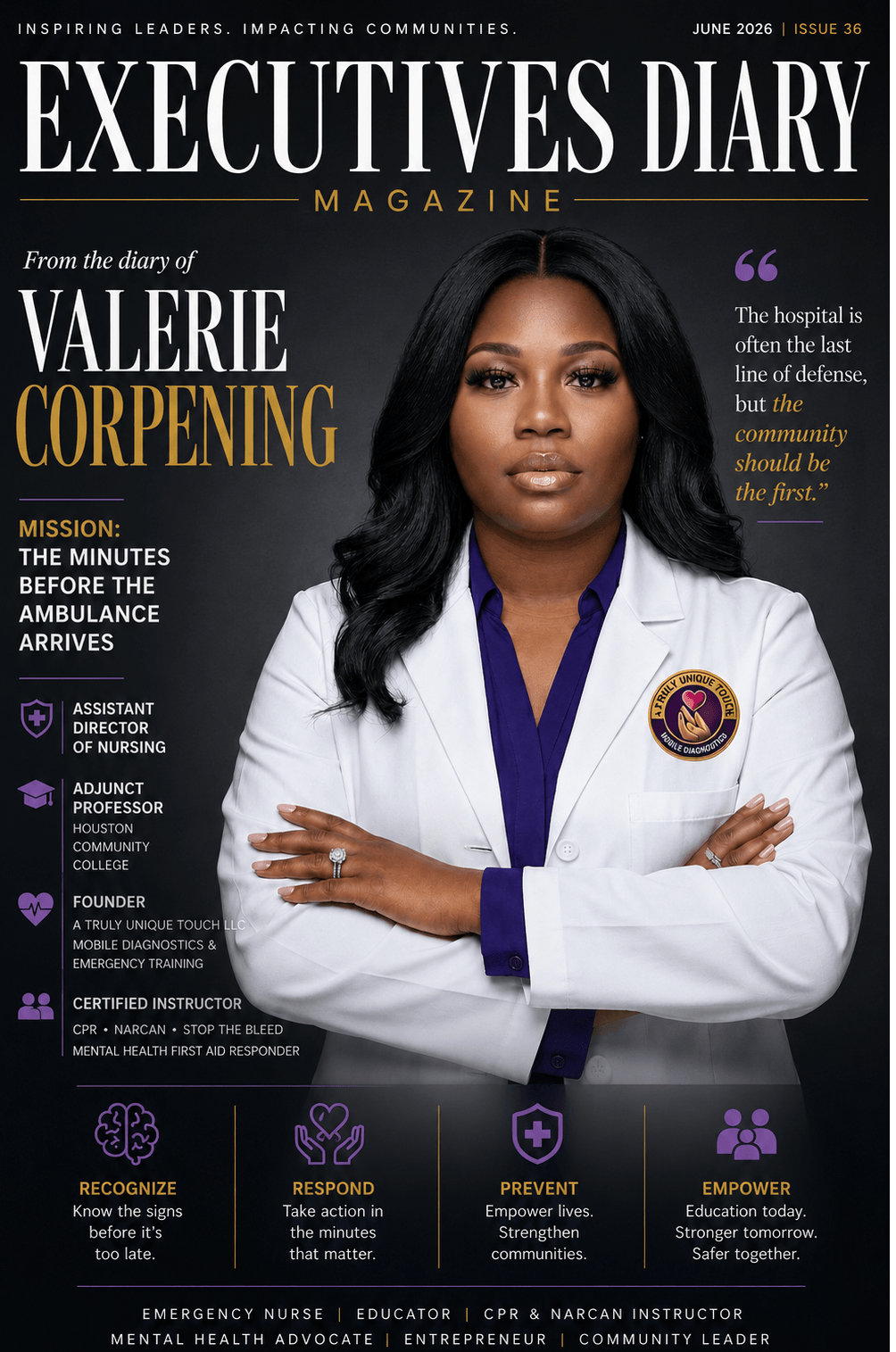
Valerie Corpening’s Mission: The Minutes Before the Ambulance Arrives
The Hospital is often the last line of defense, but the community should be the firstThe phone rings at 2 a.m. A man is on the floor. His wife is screaming. She doesn’t know what to do with her hands. She doesn’t know if what she’s seeing is a stroke or a seizure. She doesn’t know that the next four minutes will define the rest of her life.
In most hospitals, this moment arrives too late. By the time the ambulance pulls up, by the time the doors swing open, the window for saving brain tissue has already closed. The family stands at the threshold of irreversible damage, watching a life narrow into permanence.
But what if someone had been there before the collapse? What if she had known the signs? What if she had known how to move?
Meet Valerie Corpening
Valerie Corpening is a Registered Nurse certified as a Mental Health First Aid responder, former charge nurse at Harris Health and now assistant director of nursing, an adjunct professor at Houston Community College, and the founder of A Truly Unique Touch, a mobile diagnostics and emergency training company serving the Greater Houston area. She holds certifications as a CPR Instructor, Narcan Instructor, and Stop the Bleed Instructor.
But those credentials miss the point entirely. She is someone who understood that prevention must happen before the hospital, and built her entire life around making that real.
The Education That Taught Her How Systems Fail
Valerie’s path was deliberate, each step revealing the same gap.
She started as a medical assistant at Baylor College of Medicine, rotating between infectious disease and neurosurgery clinics. Those two spaces taught her something crucial: understanding disease process and treatment meant nothing without understanding prevention. She watched patients arrive with conditions that could have been caught earlier. She saw how a regular checkup could change a trajectory.
While working as a medical assistant, Valerie earned her Master of Public Administration with an emphasis in healthcare management. She wasn’t stepping away from patient care. She was learning how healthcare systems operate, how prevention could be scaled, and how communities often fall through the cracks before crisis ever begins.
At Baylor College of Medicine, she worked in both infectious disease and neurosurgery clinics. Those experiences gave her a deeper understanding of disease processes, treatment, and the critical role preventive care and routine checkups play in long-term outcomes.
But eventually, she realized she wanted to do more as a healthcare professional. That realization led her to nursing school.
As soon as she had her nursing license, she moved to the emergency department. Years at HCA Healthcare meant she was working the relentless pace where the truth was inescapable. Trauma cases. Cardiac emergencies. Strokes arriving hours too late. She was skilled at managing the chaos. But every shift was a confirmation of the same terrible fact: she was always treating the ending, never preventing it.
Valerie identifies first and foremost as an emergency room nurse. Her foundation is acute care, crisis intervention, and rapid response in high-pressure situations. Alongside that work, she also developed expertise in psychiatric nursing and became certified as a Mental Health First Aid responder, strengthening her ability to recognize and respond to mental health crises with the same urgency and compassion.
Then came the loss that crystallized everything.
Her uncle suffered a hemorrhagic stroke. It wasn’t random. It was the consequence of unmanaged hypertension, a condition that whispers rather than shouts. No one in his home recognized the early signs. When the moment came, no one knew CPR. By the time emergency medicine could intervene, the minutes had already erased what might have been saveable.
At that moment, staying in the hospital stopped being enough.
Building the First Line of Defense
In November 2024, Valerie launched A Truly Unique Touch. The name itself tells you something: she refuses the clinical sterility that keeps people afraid of healthcare.
The business does three things simultaneously. Mobile biometric screenings bring the clinic to living rooms in the Greater Houston area. They measure blood pressure, glucose, weight, and girth—the early warning signs of hypertension and diabetes that most people never check until they’re already in crisis. Concierge phlebotomy means no waiting rooms, no insurance delays, just professional blood draws in the place where someone actually lives.
But the centerpiece is emergency training. Valerie is certified as a CPR Instructor, a Narcan Instructor, and a Stop the Bleed Instructor. She teaches the four-minute window where intervention still matters. She teaches recognition. She teaches action.
Here’s what makes this work: she’s not trying to replace the hospital. She’s trying to make sure fewer people need the hospital in the first place.
This distinction matters. Most healthcare entrepreneurs focus on access to treatment. Valerie focuses on access to prevention and recognition.
She’s teaching families the warning signs of silent killers. She’s teaching teenagers that Narcan isn’t just for “drug addicts”—it’s for anyone experiencing an overdose, including from pain medications at home. She’s putting people in positions where they can actually do something before disaster arrives. She’s building what she calls the “first line of defense”—the person in the home who knows what a stroke looks like, who knows how to use Narcan and stop bleeding, who understands that hypertension is a threat, not just a number on a chart.
What strikes you about talking to Valerie is that she moves between distinct roles without a trace of compartmentalization. She works as an ER nurse in the hospital. She teaches the next generation at Houston Community College. She certifies people in life-saving skills through her business. She oversees psychiatric inpatient operations as a charge nurse.
She sees it as unified.
The ER nursing keeps her sharp on acute crisis intervention and clinical assessment. The charge nurse role keeps her connected to operational systems and patient safety at scale. The teaching keeps her in front of the next generation she’s trying to influence. The business is where she actually implements prevention. These aren’t competing demands on her time. Together, they form a unified approach to community health education, prevention, and emergency preparedness.
Her colleagues have noticed. Christopher Larrinaga, an Advanced Registered Nurse Practitioner who worked with her at Baylor, called her “a forerunner for the nursing profession,” someone who doesn’t just provide care but “makes lasting contributions to the community at large.” Chrystyan D., who graduated with her from the Nasdaq Milestone Circles Cohort in business, emphasized her rarest quality: “Her extensive medical expertise coupled with her business acumen.” Most ER niches don’t have MPAs. Most business owners don’t have psychiatric certifications and emergency medicine backgrounds. Valerie has both, and she uses them to think about community health in a way that most people in either field cannot.
The Corpening Playbook: 5 Lessons
- 1. Learn disease process through the lens of prevention, not just treatment. Rotate through clinics that show you how conditions develop. Understanding what happens in infectious disease and neurosurgery teaches you where early intervention matters most.
- 2. Get the credentials that give you authority to act on what you’ve learned. Knowledge is powerful, but credentials provide the platform to make a lasting difference. Whether you’re in the healthcare field or dedicated to community wellness, gain the expertise you need to lead change, advocate for others, and teach the life-saving skills that protect those you love.
- 3. Your advanced degree should translate clinical knowledge into systems thinking. An MPA in healthcare management isn’t an escape from clinical work. It’s the infrastructure that lets you build something that scales beyond your own exhaustion.
- 4. Life-saving skills matter more than clinical titles. CPR, Narcan, Stop the Bleed—these are the interventions that happen before the hospital exists. Train yourself and your community in them relentlessly.
- 5. Solve the problem you have felt personally. Don’t start a business to optimize margins. Start it because you stood by helplessly while someone you loved died from something preventable. That pain is your compass.
The Difference Between Waiting and Preventing
The shift Valerie is pushing for isn’t small. It’s a fundamental reorientation of when healthcare happens.
Most of us have accepted that the hospital is where life-and-death happens. We think of it as a failure if we end up there, but we also think of it as inevitable. That’s where the real doctors are. That’s where the equipment is.
Valerie thinks about it differently. The hospital is necessary. But it’s not where the real work happens. The real work happens four minutes before someone collapses. It happens in a spouse learning to recognize the slurred speech of a stroke. It happens in a teenager understanding that opioids can kill anyone, not just people they imagine as distant from their lives. It happens in someone knowing how to apply a tourniquet when seconds matter.
This isn’t sentimental. It’s operational. It means that when she’s in someone’s home doing a blood pressure screening, she’s not rushing through a checklist. She’s looking at their face, listening to their story, teaching them what that number means and why it matters. She’s creating the moment where prevention becomes real.
She’s also trying to build something that persists. The CPR training she does, the Narcan instruction, the Stop the Bleed certification, the health literacy she’s developing in communities—these are investments in what happens in the minutes before the ambulance arrives. This is where lives get saved. Not in the crisis. In the recognition that a crisis is coming, and the knowledge to intervene.
The Closing
The woman in the story at the beginning—the one screaming at 2 a.m.—exists in thousands of iterations across Houston right now. She doesn’t have to.
Valerie is building a different possibility. Not a future without strokes or heart attacks or emergencies. But a future where someone in that home knows what’s happening. Where she has her hands. Where those critical four minutes aren’t lost to confusion.
This is what it looks like when someone refuses to accept the gap between prevention and crisis.
She brings the first line of defense directly into people’s homes because prevention, recognition, and life-saving knowledge should begin long before the ambulance arrives.
The Operator Behind the Method
Valerie Corpening, a Registered Nurse and Assistant Director of Nursing with extensive experience in emergency medicine, psychiatric mental health nursing, and healthcare education. She has served as a psychiatric and mental health charge nurse at Harris Health and currently works as an Assistant Director of Nursing and Medical Assistant adjunct professor. Valerie is also the founder, lead educator, and CEO of atrulyuniquetouch.com, where she provides community-focused healthcare education and training.
