
Transforming strategy into stewardship: I help $25M+ organizations and faith leaders align purpose with performance to build legacies that outlast the leader
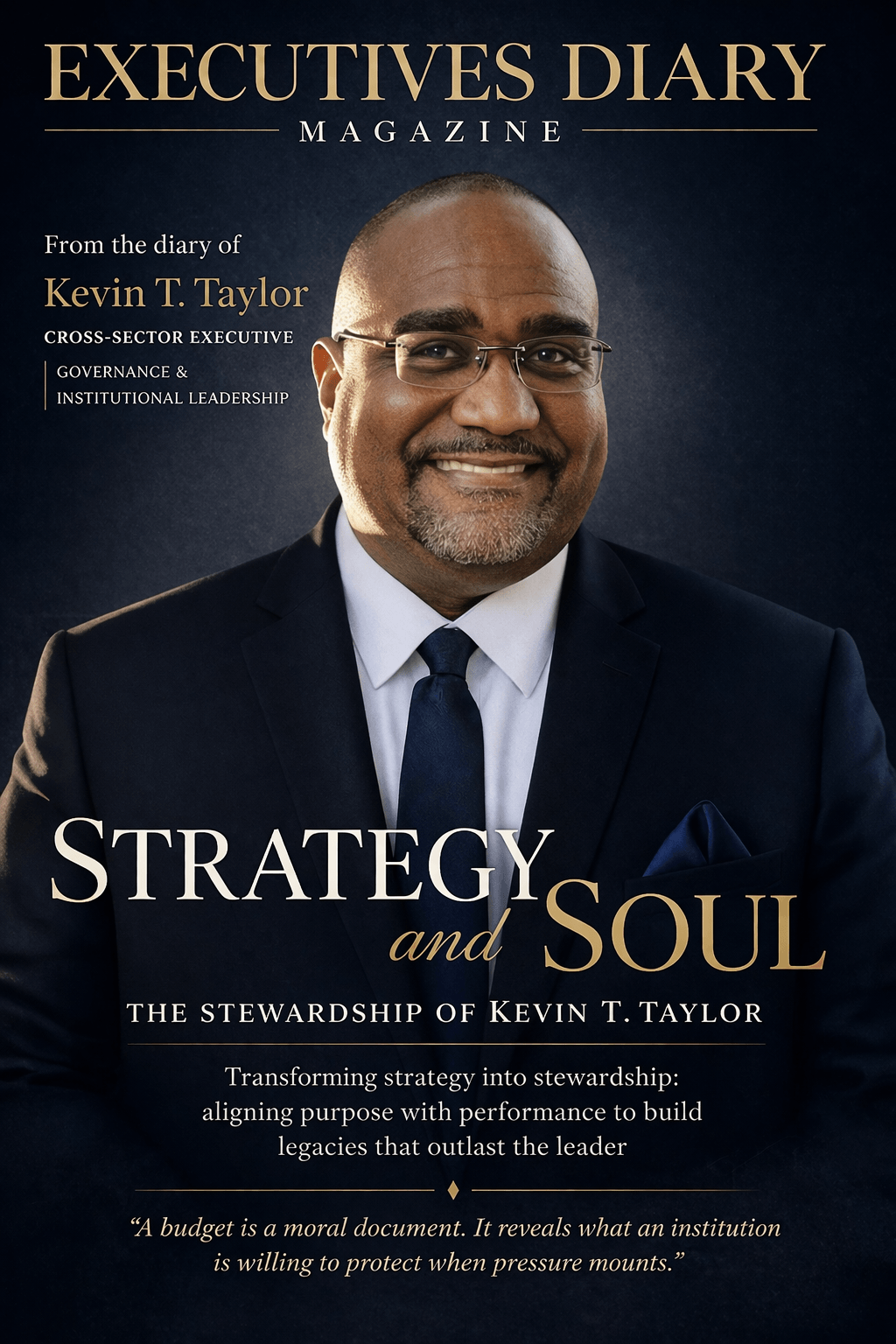
Kevin T. Taylor – A Guardian of Institutional Integrity
Kevin T. Taylor is a transformative executive and author who operates at the vital intersection of strategy and soul. With over two decades of experience leading multi-million-dollar turnarounds and climatetech innovation, he champions leadership as an act of stewardship. Known for his award-winning work, A Charge to Keep, Taylor helps $25M+ organizations and faith leaders align fiscal discipline with moral conviction to build systems that endure.
A cross-sector executive whose leadership centers on governance discipline, institutional durability, and the moral responsibility of strategy.
In executive leadership circles, budgets are often described as technical instruments. Kevin T. Taylor sees them differently. To him, a budget is a moral document. It reveals what an institution is willing to protect when pressure mounts.
“Spending patterns reveal priorities more honestly than vision statements ever will,” Taylor says. “If a value disappears the moment revenue tightens, it was never a value. It was an aspiration.”
This conviction has shaped more than two decades of cross-sector leadership. Across education, climate innovation, nonprofit governance, and pastoral leadership, Taylor’s work centers on a single premise: institutions endure not because of ambition, but because of disciplined stewardship.
Formation Before Title
Taylor’s formation began long before he held executive authority.
Growing up in Ann Arbor, Michigan, he absorbed a culture of inquiry and civic seriousness. A middle-school exchange program to Japan left a lasting imprint. Standing in Hiroshima, he encountered the weight of leadership decisions made far from those who would live with their consequences. History, he learned, is not abstract. It is the accumulation of human choices.
At Huron High School, his peers elected him Class President before he had mounted a traditional campaign. It was an early signal that credibility often precedes position.
That understanding deepened at Tuskegee University, where he attended on a Presidential Scholarship. As a freshman, a letter he wrote describing campus life was mailed to thousands of prospective families. Responses arrived from parents making life-altering decisions based on his words.
“I held no office and no title,” he recalls. “Yet I had been entrusted with influence. Leadership is first about stewardship.”
Entering the Hard Rooms
Taylor is often called into institutions at moments of strain, when clarity is scarce and leaders need steadiness more than spectacle.
As CEO of City on a Hill Charter Public School, he oversaw a difficult organizational reset that included right-sizing the network and negotiating labor agreements that balanced fiscal sustainability with staff protections. The work required aligning financial reality with institutional mission without collapsing morale.
At Greentown Labs, North America’s largest climatetech incubator, he guided a $5 million structural reorganization during a period of rapid sector growth. There, he advanced a controversial but deliberate position: legacy energy producers must be part of the climate transition. The stance generated professional cost. He maintained it nonetheless.
“Innovation does not replace integrity,” he has written. “Stewardship is the discipline of caring for systems you may not have created.”
The through-line in these episodes is not disruption, but disciplined engagement. Taylor does not approach institutions as an external critic. He works within them, where trade-offs are real and decisions carry durable consequence.
Governance as Practice
Taylor’s leadership extends beyond headline roles.
At the Connecticut RISE Network, he identified $500,000 in savings within a $7 million budget while enhancing staff benefits. The result strengthened both fiscal stability and human capital, reflecting his view that stewardship must protect balance sheets and people simultaneously.
In March, he will join the boards of two nonprofit organizations, SELF — Special Education Leader Fellowship — and the SUPERGirls SHINE Foundation, extending his governance work into leadership development and youth advancement.
His writing further codifies this philosophy. In A Charge to Keep, drawing on more than 15 years in education and nonprofit leadership, Taylor examines how leaders sustain excellence under pressure, raise standards without diminishing people, and maintain integrity when expectations intensify. The book addresses union negotiations, organizational contraction, and the personal cost of conviction. It argues that leaders must be willing to protect institutional clarity even when doing so narrows their own options.
Counsel for a New Generation
As artificial intelligence reshapes executive decision-making, Taylor’s focus remains anchored in judgment.
“The question is not whether you can adapt to change,” he notes. “It is whether you can shape it responsibly.”
His counsel to emerging leaders centers on disciplined innovation. Technical fluency is necessary, but insufficient. Institutions require leaders who understand systems, accountability, and long-horizon consequence.
Throughout his career, Taylor has returned to a simple test: What will endure after the leader steps aside?
His legacy is not measured in titles, but in strengthened systems and restored trust. In an era of velocity and visibility, he advances a quieter thesis. Institutions do not erode because leaders lack ambition. They erode when discipline yields to convenience.
Stewardship, in his view, is not a posture. It is the discipline leaders rely on when the future of their institution depends on the next decision.
Editorial Note
This profile is part of Executives Diary’s ongoing series highlighting leaders whose work reflects long-horizon institutional stewardship across sectors. Taylor’s recent book, A Charge to Keep, further explores his framework for disciplined leadership and institutional endurance.