
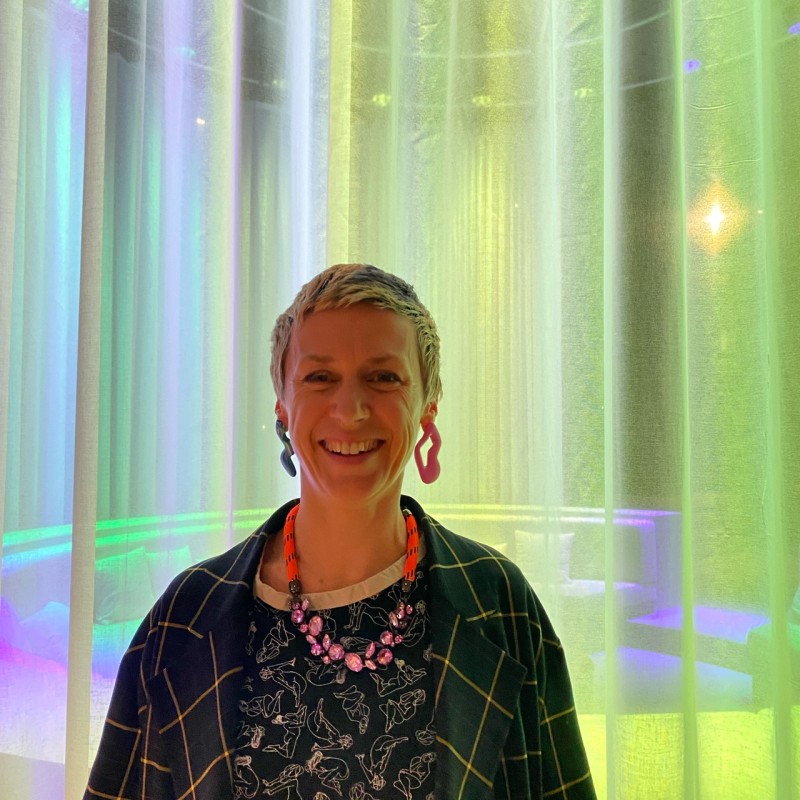
Who Is Mirjam Heldmann?
Mirjam Heldmann is a Netherlands-based facilitator, cultural change leader, and ultramarathon trail runner, best known as the Co-Founder of Vox Agora, a facilitation agency supporting organizations in navigating conflict, power dynamics, and complex decision-making. Grounded in Deep Democracy and participatory methods, her work focuses on helping teams listen more widely, build psychological safety, and create cultures where inclusion is practiced through how decisions are made. With a background spanning human rights, activism, and organizational change, and a parallel life in endurance running, Mirjam brings a rare combination of presence, discipline, and courage to her work, guiding leaders and teams toward braver conversations and more human ways of working.
Mirjam Heldmann has built her life and work around a deceptively simple decision: to stay. To stay with discomfort rather than outrun it. To stay present when conversations tighten, when fear surfaces, when silence grows heavy. Whether on a mountain trail deep into an ultramarathon or in an organizational room thick with unspoken tension, her instinct is the same, slow down, listen wider, and create the conditions for truth to emerge.
It is a practice shaped as much by movement as by facilitation, as much by activism as by leadership. And it is the throughline of her work today as Co-Founder of Vox Agora, where she helps teams and organizations face the conversations they keep avoiding, and come out stronger for it.
Movement, Justice, and the Power of Being Together
Long before she facilitated boardrooms or guided cultural change processes, Mirjam was paying close attention to what moves people, literally and figuratively. Her early career unfolded across activism, communications, and human rights, informed by an academic foundation in International Relations and Human Rights, and later by doctoral research in law, which she has temporarily paused to focus where she believes her impact is most needed .
Yet one of her earliest leadership classrooms was far less formal: the streets and trails of Amsterdam.
In 2015, Mirjam began leading running groups, primarily for women who arrived carrying quiet assumptions about what they could and could not do. Distance, for many, felt predetermined. Capability felt conditional. But run after run, she watched something shift.
“That moment when someone realizes, ‘Oh… I can do this,’ is electric,” she reflects. “It doesn’t matter whether it’s five kilometers or a hundred. The power is the same.”
What stayed with her was not the performance, but the collective experience around it, the encouragement, the side-by-side conversations, the absence of hierarchy. In running gear, titles dissolve. Status softens. Breath becomes the great equalizer.
That sense of human sameness would later become a cornerstone of her facilitation philosophy: people move further when they feel safe, seen, and not alone.
From Activism to Facilitation and Cultural Change
Mirjam’s professional path reflects a steady expansion of that early insight. At organizations such as Oxfam Novib, she worked at the intersection of mobilization, brand activation, and internal cultural change, contributing to initiatives around climate justice, gender equity, and inclusion. Over time, her role evolved beyond campaigns toward something deeper: how organizations themselves listen, decide, and wield power.
In 2025, she co-founded Vox Agora, a facilitation agency built for teams navigating conflict, tension, and complexity. The name itself signals intent, Agora, the ancient gathering place where civic life unfolded through dialogue.
At Vox Agora, Mirjam works primarily with Deep Democracy, a facilitation method developed in post-apartheid South Africa to ensure that decisions include not only the majority voice, but the minority perspective, the dissent, the hesitation, the “no” that often carries essential information.
“The loudest voice can feel like a shortcut,” she says. “But when that voice becomes the decision, the undercurrent doesn’t disappear. It just goes underground.”
Those undercurrents, she explains, resurface later as disengagement, passive resistance, or quietly failed implementation. Her work, therefore, is less about smoothing conflict than about listening it into the open.
“Tension isn’t a problem to get rid of,” she notes. “It’s intelligence.”
This stance has positioned her as a trusted facilitator for organizations seeking not performative inclusion, but structural change—where listening becomes an action, not a posture, and power is redistributed through how decisions are made.
Endurance, Equity, and the Practice of Staying
If facilitation sharpened Mirjam’s listening, ultramarathon running taught her how to stay when everything in the body, and the mind, demands escape.
As a trail ultrarunner, she has covered distances well beyond the marathon mark, training for months to endure sustained discomfort. The lessons translate seamlessly into her work.
“After a few hours on the trail, discomfort isn’t an exception,” she explains. “It’s part of the landscape.”
Instead of fighting it, she learned to regulate fear, breathe through doubt, and take the next step anyway. That same discipline shows up in organizational settings, where discomfort is often rushed, fixed, or avoided altogether.
Mirjam brings a somatic awareness into every room she facilitates. She listens not only to words, but to bodies—her own and others’. Tight shoulders, dropped eyes, sudden restlessness or numbness: all of it signals what has not yet been said.
“The way through isn’t force,” she says. “It’s presence.”
Her outspoken commitment to equity and inclusion has extended beyond facilitation into advisory roles. She was invited by lululemon to serve as Run Brand Ambassador for the Netherlands and to contribute to the brand’s global Ambassador Advisory Board, supporting its Diversity, Equity, Inclusion, and Action commitments. Through community-building runs and advisory work, she has consistently modeled inclusion as a lived, embodied practice, not a slogan.
Vision for the Future
When Mirjam speaks about legacy, she borrows an idea from sport: you never own the jersey—you borrow it, and your responsibility is to leave it better than you found it.
That philosophy guides her vision for the years ahead. She wants to help create cultures where equity is practiced daily through who gets heard, protected, and invited into decision-making. Where leadership is measured not by certainty, but by the capacity to stay with complexity.
“I want people to feel more present in their own lives,” she says. “More connected to their bodies, to each other, and to the bigger ‘why’ underneath their work.”
She has seen what disconnection does—to teams, to mental health, to courage. And she has seen what connection makes possible: braver conversations, wiser decisions, and lighter lives.
Editorial Note
Mirjam Heldmann’s work reminds us that leadership is not about having the fastest answer, but about having the steadiness to stay when answers are unclear. In a polarized world hungry for shortcuts, her practice offers something rarer and more durable: the courage to listen longer, move together, and leave every room a little more human than we found it.
For leaders, teams, and organizations navigating tension today, her message is clear: the hard part is not something to escape, it is often where real change begins.