From the Diary of
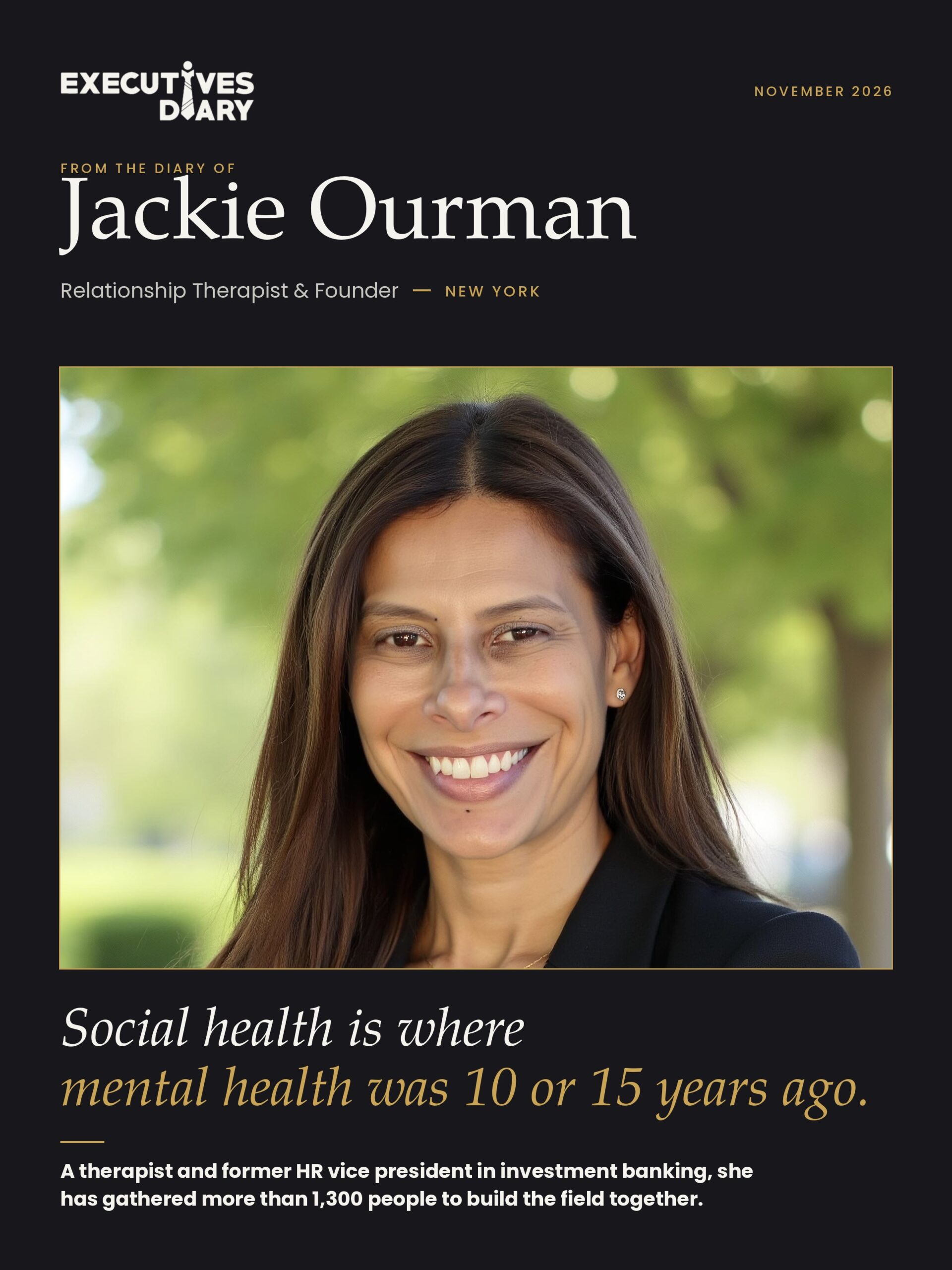
Jackie Ourman
For anyone who funds, builds or leads in health, technology or the workplace: why social health is the next field to take seriously, from a therapist and former HR vice president in investment banking.
“We’ve never had more ways to connect, and yet we’ve never felt more alone. That’s the human connection paradox.”
Couples come to Jackie Ourman’s practice saying, “We need to communicate better.” Sometimes they do. But when she looks more closely, communication isn’t always the fundamental problem.
They may both be working demanding jobs, raising children, living far from extended family and relying almost entirely on one another for emotional support, companionship, parenting, household responsibilities and connection. “As Esther Perel often says, we are asking two people to do what a village once used to do,” Jackie says. “We’re tribal human beings, but many of us have lost our villages.”
Sometimes what looks like a relationship problem is a social health problem.
The scale behind that observation is now on the public record. In June 2025, the World Health Organization’s Commission on Social Connection reported that 1 in 6 people worldwide is affected by loneliness, and that loneliness is linked to more than 871,000 deaths a year. WHO called on governments, communities and individuals to make social connection a public health priority.
Jackie works on both ends of that problem. A New York-based relationship therapist, she sees individuals and couples in her private practice, Values Aligned Therapy. She is also the founder of the Social Connection Collective, a global network for connection-centered change that brings together people across disciplines and geographies who are advancing the emerging field of social health. Before either, she was a vice president in human resources at Citi and Bank of America.
Where Mental Health Used to Be
Jackie has said that social health is where mental health was 10 or 15 years ago. Her reason is practical. “We are still developing the shared language, awareness, measurement, infrastructure, and investment around it,” she says. That’s changing quickly, particularly with the work of organizations like the WHO, but most people still don’t think about their social health the way they think about their physical or mental health.
“We spend so much time talking about healthcare as something that happens in clinical settings,” she says, “but so much of what determines our health and well-being happens outside of those spaces. It happens in our homes, our workplaces, our neighborhoods and our communities.”
She sees the urgency in what she calls the human connection paradox. Technology, and AI in particular, is advancing quickly at the same moment that loneliness and disconnection have become major public health concerns. “I don’t see these as separate conversations,” she says. “They are intertwined. As we invest in technologies that will shape the future of human life, we also need to invest in the human relationships and communities that allow us to thrive.”
From Investment Banking HR to the Therapy Room
Jackie’s route into this work runs from HR into therapy and then into social health. “Moving from HR into therapy and then into social health wasn’t something I could have mapped out at the beginning of my career,” she says, “but looking back, the thread connecting all of it is very clear: I’ve always been interested in people, relationships, and what allows human beings to thrive.”
Her years in human resources taught her to see connection at a systems level. Working inside large organizations showed her that the environments people create can either support relationships or undermine them. “Leadership shapes culture,” she says. “Managers shape people’s day-to-day experience of work. Teams can create belonging or isolation.”
When someone disengaged or left, she noticed, relationships were often part of the story: with a manager, colleagues, the team, the culture or the work itself. She carried one lesson out of banking with her. “People work for people. They don’t work for companies.”
People work for people. They don’t work for companies.
She then trained as a mental health counselor and built a practice centered on couples and relationships. The two careers, she says, now work together. “My HR career taught me to look at the system. My clinical career taught me to look at the individual and their relationships. Social health requires us to do both.”
A Room Full of People Who Wouldn’t Otherwise Meet
Jackie founded the Social Connection Collective in 2025, and in practice it is a collaborative community for people who are building the field of social health or want to contribute to it. Its members include researchers, policymakers, clinicians, people working in social prescribing, founders building mental health and pro-social technology, community builders and placemakers. “What makes it exciting is that many of these people would not naturally end up in the same room,” she says.
“A researcher may be studying loneliness. A physician may be thinking about social prescribing. A founder may be building technology designed to facilitate real-world connection. A community organizer may already know from experience what gets people out of their homes and into relationships with one another. They all hold different pieces of the puzzle.”
People tend to arrive for one of two reasons: they have knowledge, research or a project to share, or they are trying to solve a problem related to social connection and want to learn from people already doing the work. Often, Jackie says, the Collective’s role is to connect the people who could be solving it together. “My co-founders Christian Altenius, Maya Pieske and I, along with our ambassadors and members across the world, are all contributing knowledge, relationships, time, and ideas,” she says. “We are building the community in the same way we believe the field itself needs to be built: collectively.”
In roughly a year, the Collective has grown to more than 1,300 members, with an ambassador community of more than 80 people representing all six inhabited continents. “Those numbers represent real people choosing to contribute their time, knowledge, and expertise to this emerging field,” she says. To her, that says there was a need, both for more attention to social health and for connection among the people doing the work.
It is also, she adds, a habit of hers. She has been called a “super connector,” because when she meets someone, she is almost always thinking, “Who else needs to meet this person?” “In many ways,” she says, “that’s exactly how the Social Connection Collective came to be.”
AI in the Therapy Room
The same paradox runs through Jackie’s work on technology. Her paper, “Navigating AI in Mental Health Care and Psychotherapy: Proposing the GUIDE Framework,” written with three co-authors, was published in JMIR AI in September 2026. “AI is already showing up in the therapy room, whether we invite it in or not,” she wrote when she announced it. The paper proposes a phased clinical framework, from pre-intake through termination, built around the GUIDE mnemonic: Gather, Understand, Inform, Document, Evaluate.
She also advises two organizations that sit where social health, mental health and technology meet. Entrelacs has built a tool to measure social health, and she brings a practicing clinician’s perspective to its product strategy. At Mental Health Media Group, she supports create/M and its film festival, which premieres in December 2026.
You Never Know Until You Ask
There is a line in Jackie’s family that came, unexpectedly, from a taxi driver they met on vacation: “You never know until you ask.” She thinks about it every time she pitches a big idea or reaches out to someone she admires. “I’ve had to get comfortable hearing no,” she says. “But I get so many yeses just because I asked.”
The hard part of the work right now is resources. There is a great deal of enthusiasm for social health, and the funding hasn’t caught up. The Collective is entirely volunteer-run. “I’m constantly reminding myself that we can’t burn ourselves out building a field about human well-being,” she says. “We have to build it in a way that allows us to stay with the work for the long term.”
Where Jackie Is Now
Over the next twelve months, Jackie wants to raise awareness of social health and help bring investment into the field. For the Collective, that means relationships with aligned partners who can help it grow, sustain and fund the community. The vision is a global home for people working in social health, where researchers, clinicians, policymakers, social prescribing leaders, community builders, pro-social tech founders and others can find one another, share knowledge and move the field forward together. For herself, she would like more opportunities to speak, advise and collaborate.
One idea has been on her mind lately. A dream of hers is to have the large tech companies building in the AI space, such as Anthropic and OpenAI, fund the community and its researchers, similar to how the AI Collective is sponsored.
Outside work, she points to her children. “My children have shaped so much of who I am and the path my career has taken,” she says. “When they were young and navigating significant food allergies, I experienced firsthand how important community, shared knowledge, and connection can be. Looking back, I realize those experiences were some of my earliest lessons in social health, long before I had the language for it. In many ways, that experience helped shape how I think about relationships, community, and the importance of creating spaces where people feel supported and connected today.”
The people she most hopes will read this are leaders in philanthropy, healthcare, technology, workplaces, government and community organizations. She wants more of them asking how to create the conditions for people to be socially healthy in the first place.
“The field is emerging,” she says. “The people are here. The evidence is here. What we need now is the investment and infrastructure to help the field mature.”
What we need now is the investment and infrastructure to help the field mature.
The Playbook
Five Lines from Jackie’s Diary
- “We’re tribal human beings, but many of us have lost our villages.”
- “Sometimes what looks like a relationship problem is a social health problem.”
- “People work for people. They don’t work for companies.”
- “We can’t burn ourselves out building a field about human well-being.”
- “You never know until you ask.”
Sources
World Health Organization, “Social connection linked to improved health and reduced risk of early death” (WHO Commission on Social Connection report release), 30 June 2025, https://www.who.int/news/item/30-06-2025-social-connection-linked-to-improved-heath-and-reduced-risk-of-early-death