

From the Diary of
Keely Woolley
For the woman everyone relies on and still overlooks: what more than two decades inside a FTSE 100 company taught her about the difference between being valued and being positioned.
“Being dependable is not the same as being visible, influential or strategically positioned.”
Mark was a good boss. He promoted Keely and trusted her to lead a system rollout across five paper mills. Later, when his own role was made redundant, he apologised to her. He had recognised, she says, that she had been so valuable to his department that her dependability had kept her where she was.
“He was a good leader, which is exactly why it stayed with me,” she says. “Being needed is different from being elevated.”
Her story is not a rare one. In Women in the Workplace 2025, the annual study by McKinsey and LeanIn.Org, women held 35% of vice president roles, 32% of senior vice president roles and 29% of C-suite roles, an average of 32% across the three most senior leadership levels. The higher the ladder rises, the fewer women remain.
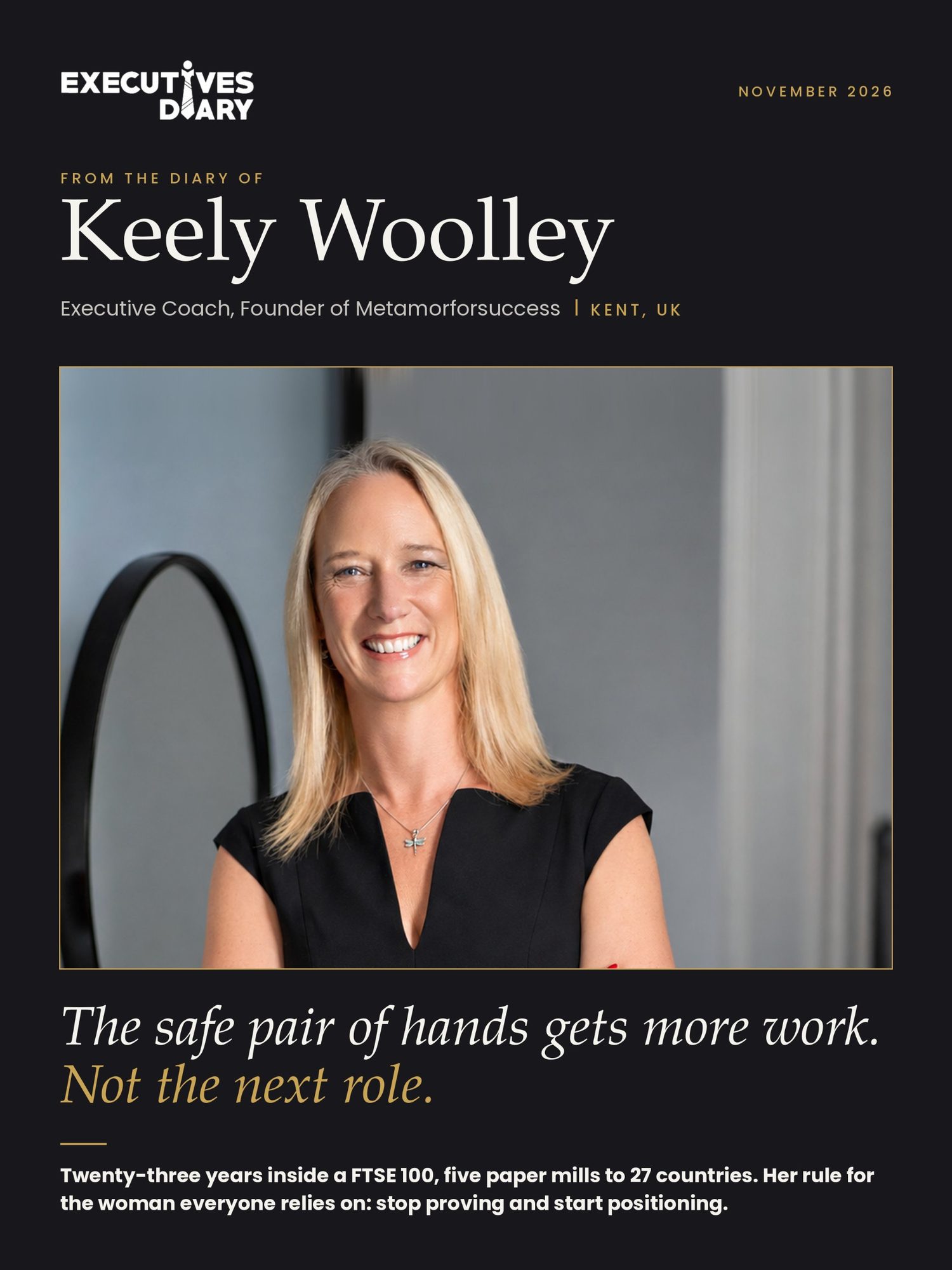
Keely Woolley is an executive coach, trainer and speaker, and the founder of Metamorforsuccess. She works with high-achieving women in manufacturing, logistics, STEM and corporate environments: senior leaders and emerging executives who are respected and relied upon, and who are quietly carrying more than they should. The work is corporate training, speaking and executive coaching, and the problem it addresses is the one Mark apologised for.
The Sand Around the Rocks

One woman Keely worked with had spent ten years trying to progress in a male-dominated environment. She was highly capable, experienced and deeply committed, and she had started to make herself smaller in order to survive the culture around her. The woman had her own image for it. She had become “the sand around the rocks”: filling the gaps, smoothing things over, making things work. “Sand is useful,” she told Keely, “but it never shapes the glass.”
The environment she had adapted to is a common one for Keely’s clients. In UK manufacturing, women were 28.4% of the workforce in 2024 and held 24.8% of senior roles, according to the Women in UK Manufacturing 2025 report.
“When she came to me, the issue was not capability,” Keely says. The woman had adapted to resistance by softening herself, holding back and waiting for permission from people who were never going to give it. For about six months she had quietly quit in everything but name. She was burnt out. Her sleep had deteriorated, her lifestyle was less healthy than it had been, and she had far less patience with the people around her, at work and at home.
What they did first, Keely says, was help her see the pattern, “not from blame but from awareness”: how the environment had shaped her behaviour, and where her self-protection was now costing her authority, visibility and progression. The shift came when she stopped trying to win over the same local resistance and took her ideas to the global team, where her expertise was recognised.
“Not louder. Not harder. Not trying to become someone else,” Keely says. “She became more anchored and more willing to be seen as the expert she already was.” She was promoted two levels up, beyond the role she had spent ten years waiting for. Keely tells her story, with her name, in her forthcoming book The Invisible Rules of Leadership: How High-Achieving Women Can Rise, Lead and Be Recognised Without Self-Erasure.
Keely has a name for the rule that had kept her waiting.
The Rule Worth Challenging
She calls them The Invisible Rules of Leadership: the unwritten instructions, as she wrote when her article of that name appeared in the London Standard, that many women learn on the way up. “Be dependable. Don’t let anyone down. Have the answers. Work harder to prove your value. Adapt. Fit in.”
Asked which rule most deserves to be challenged, she picks one. “If you work hard enough, stay dependable enough and keep proving yourself, the right people will eventually notice.” It is, she says, one of the invisible rules many women have been taught to follow. Be good. Be reliable. Do not cause too much disruption. Keep delivering. Keep showing you can cope.
If you are always the safe pair of hands, people will trust you with more work. That does not mean they will see you as the person for the next opportunity. There is a difference between being valued for what you deliver and being positioned for the level of leadership you are capable of.
What she tells a client to do instead is short. “Stop proving and start positioning. Tell people what you led, why it mattered and where you want it to take you.”
She is particular about what the work is and isn’t. “I don’t coach performance or confidence as an act,” as she puts it on her profile. “My work is about leadership recalibration, restoring clarity, presence, and authority from the inside out.”
And she holds the organisation to the same standard as the woman. If the reader recognises herself in the piece, Keely would like the leaders around her to recognise her too, “because she is the person their organisation is most at risk of losing without ever seeing it coming.”
She knows the rule because she followed it.
Five Paper Mills, 27 Countries
Keely spent more than two decades at DS Smith, a FTSE 100 company with over 27,000 employees. She joined as a Planning Assistant and rose to Programme Delivery Director in Group Procurement, delivering complex programmes across functions and across 27 countries.
The first turn, she says, was one she did not choose for herself. She had worked her way up from Planning Assistant to Planning Engineer when Vicky, an external project manager, saw that she should lead a system rollout across five paper mills. “I never applied. I said yes because someone I respected had seen it in me first.”
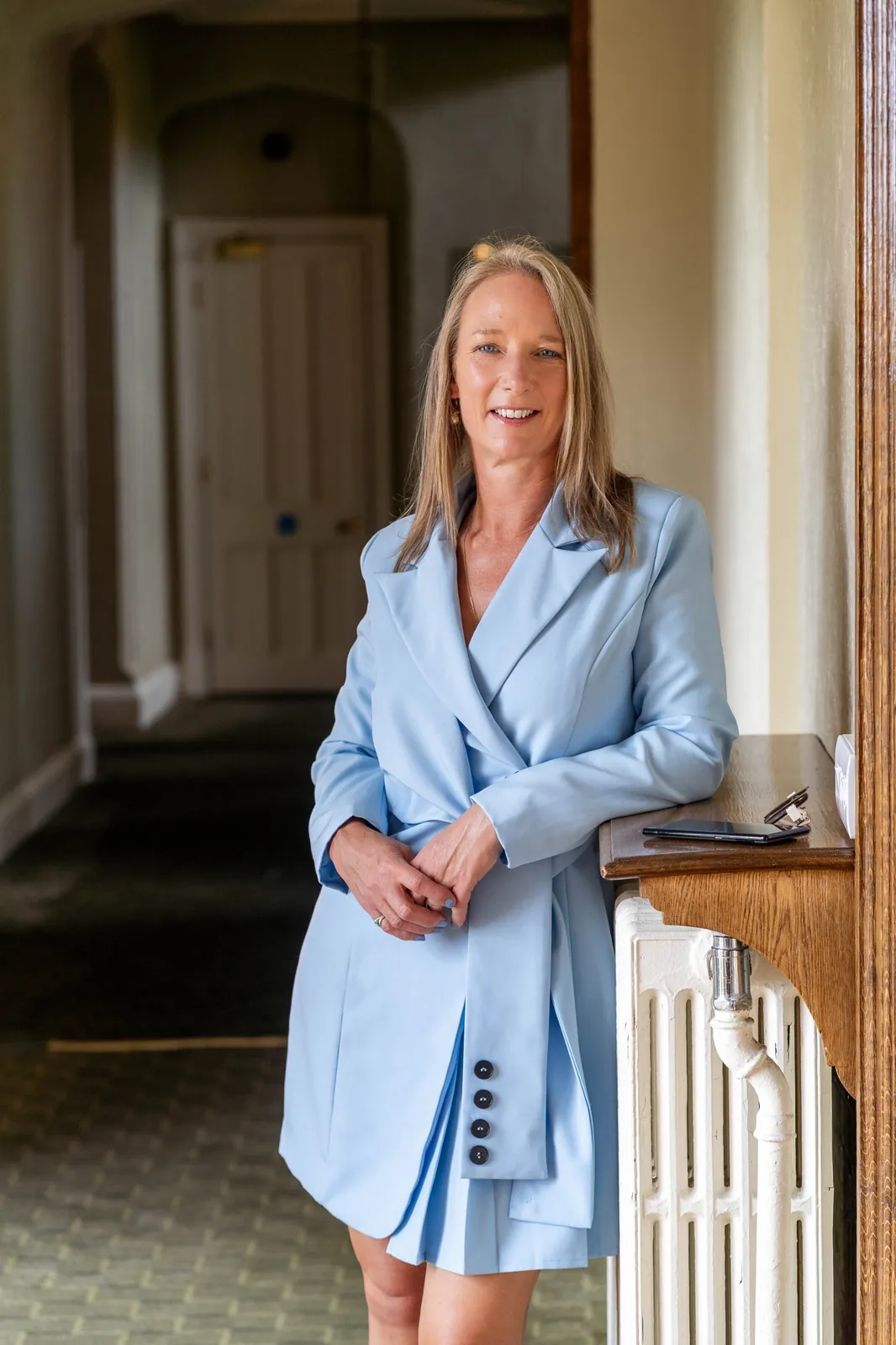
I never applied. I said yes because someone I respected had seen it in me first.
She has written about what those early rooms were like. In her late twenties she walked into a packaging plant to lead a project kick-off, the only woman in the room, having spent days preparing to be taken seriously by a team of male managers who didn’t want the system she was there to introduce. She wore a pinstripe suit. “It was my armour, and it worked,” she wrote. “It also kept everyone at arm’s length. It took me years to understand why.” One of the managers later told her he’d initially assumed she was “a stuck-up cow with a silver spoon in her mouth” before getting to know her and realising she was nothing like the person he had imagined.
The second turn happened the same way as the first. She was directing a Continuous Improvement Programme at a paper mill, achieving a saving of £3.9 million over three years, when a colleague supporting the project saw her in action and recommended her to his boss. That took her into Group Procurement as Programme Delivery Director.
“I became known as someone who could be relied upon,” she says. She also learned that being capable, hard-working and resilient was not always enough. “If you are not visible in the right rooms, if your contribution is not understood strategically, or if people benefit from keeping you where you are, progression can become slower than your capability deserves.”
The third turn she didn’t choose either.
Schiphol, December 2019
In December 2019, Keely collapsed at Schiphol Airport.
“At the time, I had built so much of my identity around being strong, capable, and able to cope,” she says. “I had normalised pushing through.”
I thought resilience was one of my greatest strengths, but I now understand that the problem with being endlessly resilient is that you can keep bouncing back into the same pattern without ever asking whether the pattern itself needs to change.
An organisational change in Group Procurement made her role redundant, and the alternative she was offered was not the role she had helped to shape. “I spent years pushing through, being resilient and carrying responsibility, and it finally caught up with me. I shut down, mentally and physically.” At first she thought she was recovering from a redundancy. “In time I saw that I was recovering from the way I had been leading.”
In time I saw that I was recovering from the way I had been leading.
What she did next, in her words, was begin to rebuild. She looked at the invisible rules she had been following: keep going, prove yourself, do not let people down, be strong, be dependable, do not show the cost. “I began to understand that success without self-connection is not sustainable leadership.”
The person who showed her the cost most plainly was her daughter, Aisha. Keely used to sit in the car and cry before walking into the house as though everything was fine, because she thought she was protecting her family, who had enough health problems of their own to deal with. Aisha told her: “By protecting us from your struggles, you’re also protecting us from the opportunity to love you.”
“Her words stayed with me because they made me realise that the way I was living was not only affecting me,” Keely says. “It was also shaping what the people closest to me were witnessing. That changed something in me.” Leadership, she came to understand, is not just about achievement, job titles or how much responsibility we can carry. It is also about what we model, what we tolerate, and what we unconsciously teach others to accept.
She began to recognise the same patterns in the women around her. “I realised I did not want other women to have to break before they gave themselves permission to lead differently.” In 2022 she founded Metamorforsuccess.
Where Keely Is Now
Keely’s practice today is corporate training, speaking and executive coaching for high-achieving women in manufacturing, logistics, STEM and corporate environments. Her thinking has been travelling beyond her own newsletter. Her article The Invisible Rules of Leadership has run in the London Standard, and a philosophy she had been developing for years reached a national audience through The Telegraph Business Guide and the Best of Law Firms 2027 feature in The Times. She has written about where the philosophy comes from, Anchored Leadership Without Self-Erasure, and about the space she has created in Montenegro, April 2027, for women to step away, reconnect and question some of those rules for themselves.
Over the next twelve months she wants this piece to open more conversations with organisations that are serious about retaining, developing and elevating high-performing women, particularly in male-dominated or male-led sectors. For Metamorforsuccess, she says, that means more corporate training, more speaking, and more senior women finding their way into her work on visibility, positioning, self-erasure and leadership identity.
The reader she most wants to reach is specific: “the high-achieving woman who is capable, dependable and respected, but privately knows she is still being overlooked, undervalued or not positioned at the level she is ready for.” That woman is not lacking ability, Keely says. “She is often carrying too much responsibility, proving herself repeatedly, and wondering why being excellent has still not translated into the influence, progression or recognition she expected.”

Outside work there is walking, near the lake or the woods, especially with her dogs. “When life became too noisy, walking gave me space to breathe, think and reconnect with myself.” And there is the dragonfly, the symbol of her brand and of the framework she works with. It stands, she says, for transformation, new beginnings and living life to the fullest. “That is what I found on the other side of my own recovery, and it is what I want for the women I work with.”
The sentence she wants readers to take away is this one. “You do not have to become someone else to rise, but you do have to stop proving your value in ways that keep you invisible.”
The Playbook
Five Lines from Keely’s Diary
- “Being dependable is not the same as being visible, influential or strategically positioned.”
- “Being needed is different from being elevated.”
- “Stop proving and start positioning.”
- “Success without self-connection is not sustainable leadership.”
- “There is a difference between adapting your approach and editing your identity.”

