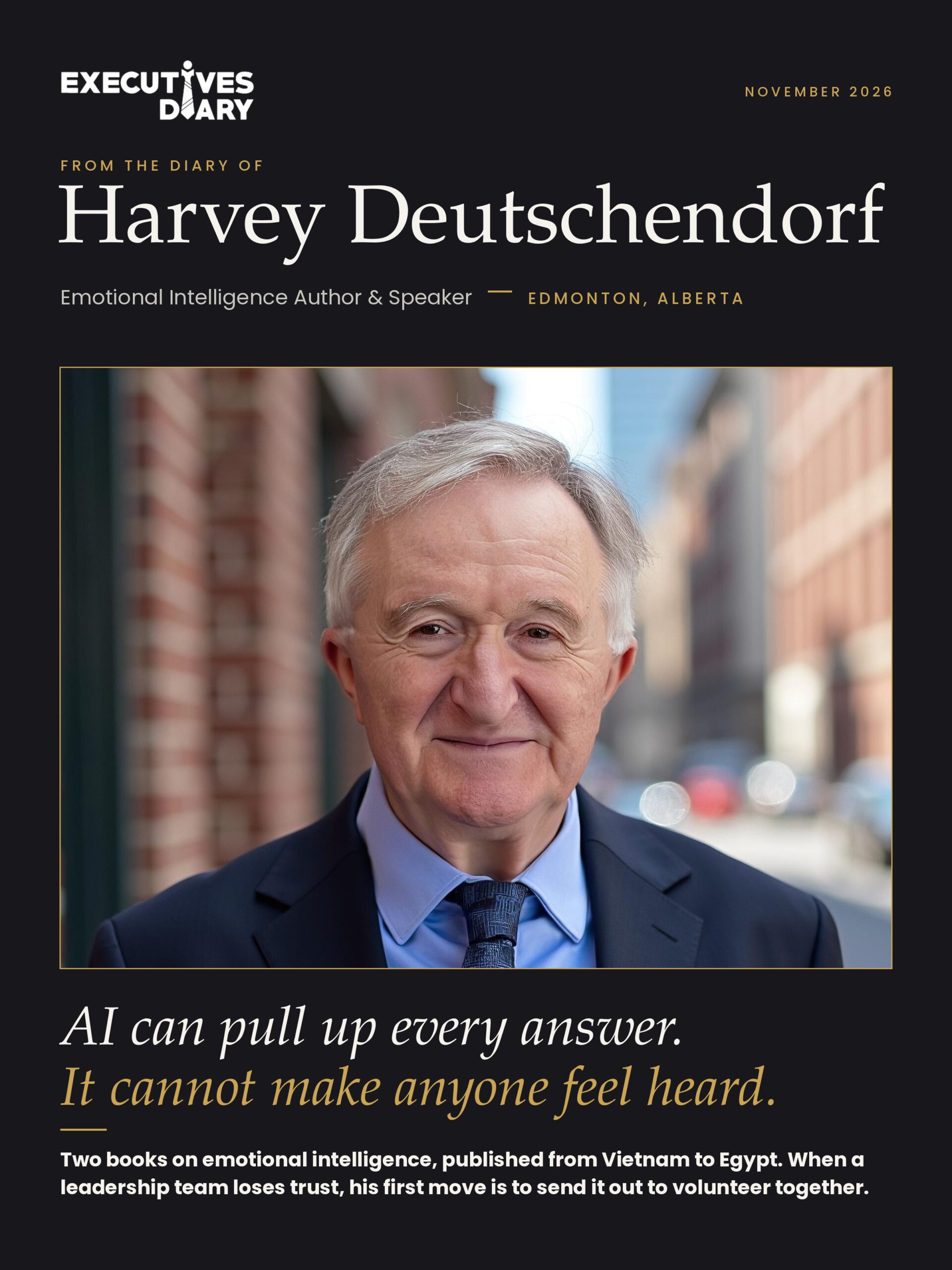
From the Diary of
Harvey Deutschendorf
What a leader can still give that artificial intelligence can only imitate, and the exercise he hands a team when trust has gone.
“My life changed when I realized that being smart wasn’t enough, not nearly enough.”
An employee had given her organization 20 years. An email arrived recognizing her time there. When she read it, she discovered that it had been generated by AI.
Harvey Deutschendorf read about her recently and put the question to his readers on LinkedIn. “Imagine how you would feel,” he wrote, “if after giving your organization 20 years of your life, your leader couldn’t be bothered to take the time to let you know in his/her own words how much you were appreciated.”
The email is one case of a larger point he makes. “We know that people don’t necessarily leave organizations because of factors such as salary, workload, or lack of advancement,” he wrote in the same post. “Often, they leave because they don’t feel recognized and appreciated.” Gallup’s research points the same way. When Gallup and Workhuman tracked nearly 3,500 employees from 2022 to 2024, those who were well recognized were 45% less likely to have left their organization two years on.
Often, they leave because they don’t feel recognized and appreciated.
Harvey is the owner of Harmony House Press in Edmonton, Alberta. Through it he writes, speaks and does leadership development work, all of it on emotional intelligence, and he’s the author of two internationally published books on the subject, The Other Kind of Smart and Emotional Intelligence Game Changers. His case to senior leaders begins with what AI has done to the value of being clever. “Being the smartest person in the room has little value if artificial intelligence can pull up more accurate information than the entire room has, and assess that information in moments,” he wrote. “There is, however, an aspect that we humans possess that AI does not: It cannot authentically care about others and make them feel heard.”
Three types of empathy
Harvey defines empathy as “the ability to see things from another’s point of view.” Agreement isn’t part of it, he writes, only the understanding that the other person is coming from a different place, with different life experiences, backgrounds and beliefs. He sets out three basic types.
The first is cognitive empathy where we can understand what it would be like to be in someone else’s shoes. The second is actually feeling what the other might be experiencing. The third level is feeling someone else’s situation to the degree that we are moved to do something about it.
Asked which of the three people can’t fake, he names the third. “The one that is the most difficult to fake is the one where you feel to the degree that you are moved to do something about it,” he says.
This is where he places AI. “Empathy is one of the last things that AI will be able to take over from humans,” he wrote. “It can be very good at mimicking it, but it will never be the same as human to human experience.”
Researchers have tested a version of that claim. In nine studies with 6,282 participants, published in Nature Human Behaviour in 2025, people received empathic replies that had all been written by AI. Some replies were labelled as coming from a person and some as coming from AI. The replies labelled human were rated as more empathic and more supportive, and where participants came to believe that AI had helped the person write, those ratings fell. The employee with the 20-year email was on the receiving end of something similar.
For a leader, Harvey puts the stakes this way: “When we feel that leaders care about their people and appreciate them, they will give more discretionary effort, more loyalty and remain with the organization longer.” He has an example from his own work of the opposite.
The young employee who left
“A large organization had a very talented young employee, who was creative, energetic and had great people skills,” Harvey says. People in senior positions above him, who had been there for a very long time, felt threatened by him. “In meetings they were uncomfortable with him expressing fresh ideas, which they never seemed to have.”
The young man felt stifled and frustrated, and he left. “A competitor, seeing his potential hired him.” Harvey is specific about what the senior people failed to see.
The people who were threatened by his progress missed that his energy and ideas would help reenergize the organization and make their own work more interesting, meaningful and rewarding.
What was absent in those meetings is what he calls one of the essential ingredients of a workplace. “It is trust that allows people to feel safe to voice their opinions and take risks, knowing that their leaders will have their backs if things don’t work out as planned,” he has written. When an organization comes to him with trust issues in its leadership team, he starts with an exercise.
What he does first when trust has gone
The exercise is volunteer work. “I suggest the team come up with a worthwhile cause as a group, then agree to go out as a team and do some volunteer work with that group,” he says.
The conversation comes afterwards. “After doing this, I advise them to get together and share with each other how it felt to do this work and how they felt before doing it and after. I suggest that they ask each other if anything changed, if they gained any more awareness after doing the work.”
He describes the exercise in the same answer in which he names the third type of empathy, the one where a person is moved to act, as the hardest to fake. The second half of it asks the team to do something he was trained in himself, which is to listen.
What social work taught him
Harvey’s degree is a Bachelor of Social Work from the University of Calgary. “The most valuable thing that came out of my social work training was learning to listen,” he says. “We would practice it in class.”
“Most of the time when people talk, the person they are talking to is formulating a response and not really listening to what they are saying,” he says. “Even if we don’t agree with them, when we really hear someone, we will stand out to them and they will be more likely to trust and respect us, regardless if we agree or not.”
The person who shaped how he works, he says, was his high school principal, who told him in front of the class: “Harvey you have a good head on your shoulder, just don’t let it go to your head.” The line he wants to be remembered by is close to it. “My life changed when I realized that being smart wasn’t enough, not nearly enough.”
Asked for a hard moment at work, he describes a job in which he “stood up and called out” a bullying situation and discovered that management “was afraid to deal with it and wanted to sweep it under the rug.” He stayed in the position a short time. What he lost, he says, was “respect for the people who did not deal with the situation.”
Two books and a note from Milan
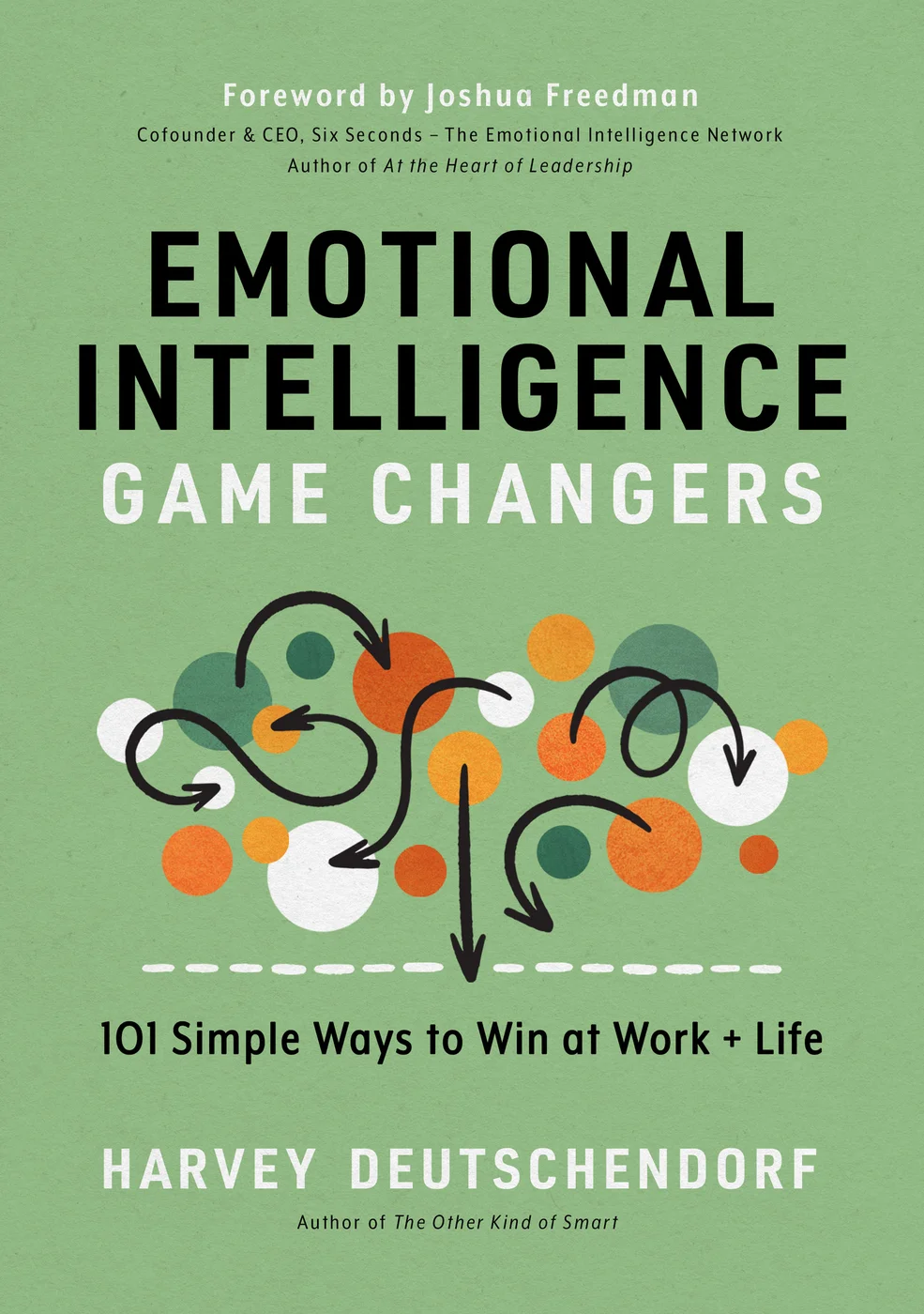
Harvey has been the owner of Harmony House Press since January 2003. The Other Kind of Smart has been published in Vietnamese, Arabic and Chinese. His latest book, Emotional Intelligence Game Changers: 101 Simple Ways to Win at Work+Life, has also been published in Portugal, Mexico, India and Egypt.
Asked for the evidence that the work lands, he goes to a reader. “I still hear from people that have purchased my first book The Other Kind of Smart on how it has impacted their work and lives,” he says. “One thing that is most memorable is a note I received from a factory manager in Milan, Italy telling me how much he valued the book and was practicing the suggestions in it daily.”
He became a Jack Canfield Certified Success Principles Trainer in 2014. In 2015 he was recognized as one of the Top 100 Thought Leaders from Trust Across America, and in November of that year he was certified by MultiHealthSystems to administer the EQ360 and the EQi2.0. In May 2020 he gave a TEDx talk at Beacon Street in Boston.
Where Harvey Is Now
The argument about AI and empathy runs through what Harvey is publishing now. He is a Fast Company contributor, he posts regularly on LinkedIn, and his website carries a free, five-minute, self-scoring quiz for anyone who wants to check their own emotional intelligence.
He is also a speaker, and he doesn’t pretend it was always comfortable. “I used to be terrified of public speaking, 90% terrified and 10% excited,” he wrote recently. “After forcing myself to keep going I find myself now 90% excited and 10% a bit anxious.” He says the same of the subject itself. “When I began to develop my emotional intelligence years ago, there were many days where I felt that I was making little or no progress. Today, I shudder to think of where I would be if I had not kept going.”
After forcing myself to keep going I find myself now 90% excited and 10% a bit anxious.
The readers he most wants for this piece are, in his words, “Senior leaders, Heads of HR Departments and People who book speakers.” Over the next year, he says, he will be focusing on “leadership development, speaking” and “reaching out to Human Resource Leaders about using Emotional Intelligence Game Changers in their work.”
Asked for a rule a colleague would call very him, he gives this one: “Always believe in yourself and never give up on your dreams.” Of himself he says, “I always need a new challenge, discovery or purpose to keep my life growing, evolving and exciting.”
“Outside of my work, I enjoy travelling, learning about history, new cultures and having new experiences,” he says. “I see myself as a global citizen.”
Asked what comes next, he answers in one line. “I will continue to share the power and beauty of emotional intelligence with as many people as I can for as long as I can.”
The Playbook
Five Lines from Harvey’s Diary
- “Empathy is one of the last things that AI will be able to take over from humans.”
- “The most valuable thing that came out of my social work training was learning to listen.”
- “All of our growth happens outside of our comfort zone.”
- “Enjoying the moment and the journey is as important, if not more so than the destination.”
- “Always believe in yourself and never give up on your dreams.”
Sources
Gallup and Workhuman, “Employee Retention Depends on Getting Recognition Right”, 2024. https://www.gallup.com/workplace/650174/employee-retention-depends-getting-recognition-right.aspx
Rubin, M. et al., “Comparing the value of perceived human versus AI-generated empathy”, Nature Human Behaviour, 2025. https://www.nature.com/articles/s41562-025-02247-w