From the Diary of
Jennifer Loh Drysdale-Banks
For CEOs whose performance problems keep coming back after the usual fixes: where to look first, and what changed when one business looked there.
“My Boundaries are Non-Negotiable. So is My Integrity.”
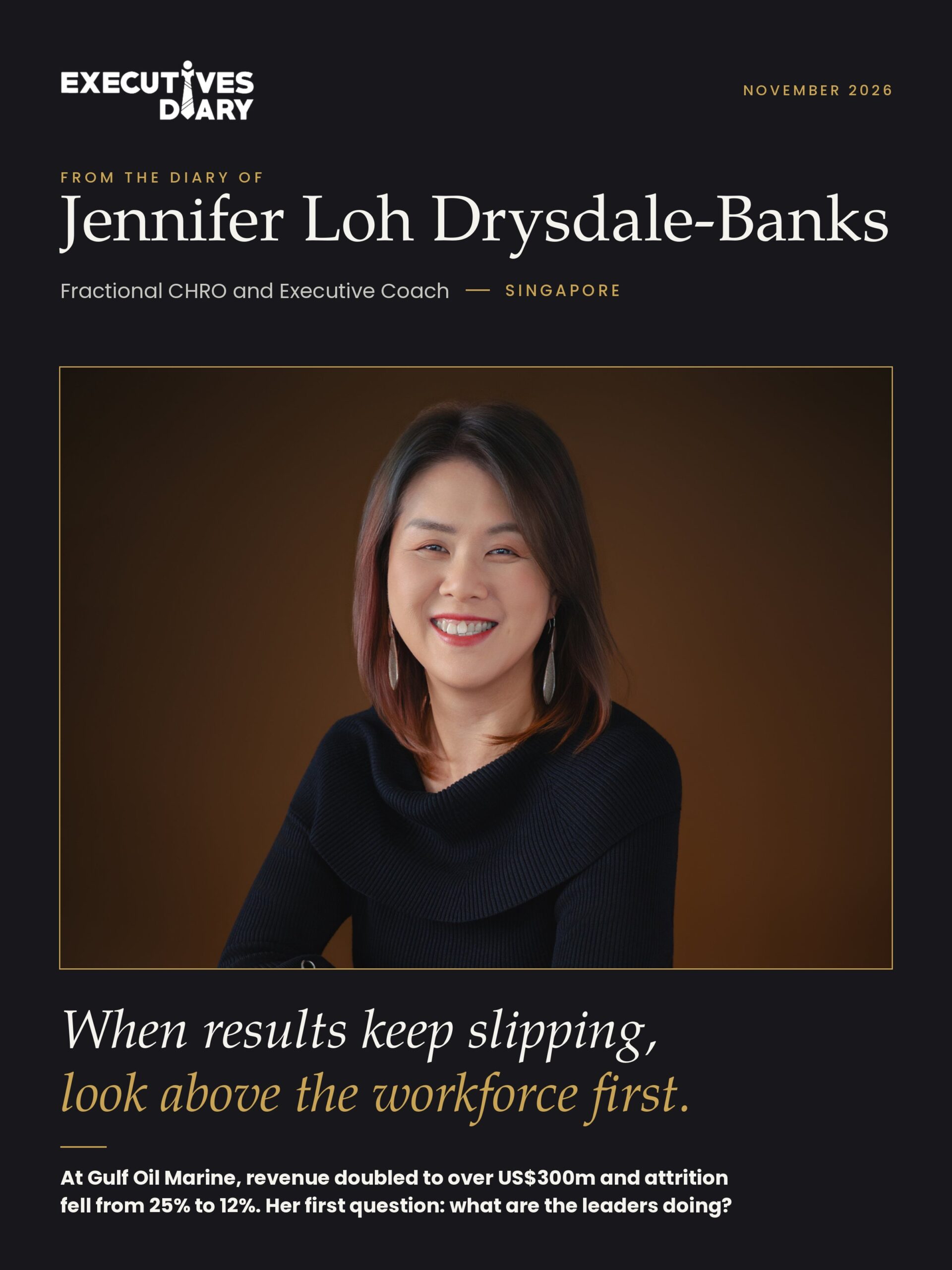
When a business keeps falling short of its plan, most companies look first at the workforce. They fire and hire again, retrain, restructure. Sometimes the problem survives all of it, because it was never sitting with the people doing the work. “Unclear instructions cause mistakes and rework. Slow decisions hold teams back. Double standards damage trust and drive good people away,” says Jennifer Loh Drysdale-Banks.
Research points the same way. Gallup has found that “70% of the variance in team engagement is determined solely by the manager.”

Jennifer, a Singapore-based fractional CHRO, organisational performance advisor and executive coach, works with CEOs and leadership teams on that layer of a business: how leaders direct, decide and take responsibility, and what that does to the numbers. At Gulf Oil Marine, where she was Global Human Resources Director from 2021 until January 2026, revenue grew from about US$150 million in 2021 to over US$300 million in 2023, and employee attrition fell from about 25% to 12%. “I am not simply an HR specialist,” she says. “I connect people, leadership and culture with business performance.”
Five questions before blaming the team
Most performance problems, as she puts it on her profile, “are leadership behaviour problems in disguise.” In practice, that means a short list of questions she asks before reaching any conclusion about employees:
- Have leaders given clear direction?
- Do they make decisions promptly?
- Do they take responsibility when things go wrong?
- Do they excuse bad behaviour from strong performers?
- Can employees speak up safely?
Each one has a cost. The financial consequence, she says, “appears in productivity, service quality, staff turnover and, eventually, profit & loss.” At global scale, Gallup’s 2026 State of the Global Workplace report estimates that low engagement cost the world economy approximately $10 trillion in lost productivity the year before.
She doesn’t claim the list explains everything. “Not every problem comes from leadership: markets, strategy and operations matter as well,” she says. “But leaders determine how the business responds.”
Culture is not a soft HR topic, because it affects how well a business performs, or how badly.
Behind the questions sits the belief she returns to most often: “Culture is the mirror of leadership behaviour.” It took shape across several countries, and the first of the turning points she names began in a company of 60 people.
Sixty staff and five new markets

When Jennifer joined Sunseap Group, it was a homegrown Singapore company with only 60 staff. As Group Head, Human Resource (APAC), from 2016 to 2021, she worked through its expansion by organic growth, acquisitions and joint ventures into Vietnam, Taiwan, Japan, Thailand and China. In Vietnam, her profile records, she aligned the newly acquired Sunseap Vietnam with group practices and worked with project heads to build the team for a 168MW solar farm project acquired in 2018.
She spent time with employees in each market to understand their business environment, working habits and local culture. The HR goals stayed common across the company. How she worked with people, and the initiatives she introduced, changed from country to country.
“What works in Singapore may not work elsewhere,” she says. “Successful expansion needs local understanding, not a Singapore approach replicated across borders.”
The second turning point came with a commercial brief.
The mandate at Gulf Oil Marine
Jennifer joined Gulf Oil Marine in 2021, during COVID-19, “with a mandate to help transform the business and achieve twice its EBITDA target by the end of 2023.” With six direct reports, she managed HR operations across more than ten countries, from Singapore, Hong Kong, China and Korea to the Middle East, India, the USA and Europe.
The problem, as she describes it, was that old ways of working no longer supported the company’s growth plans. Across markets, priorities were interpreted differently, decisions were unclear and accountability varied. Her first step was to talk with leaders and employees to understand how decisions were made, where work stalled and what employees experienced. From there she worked to align leaders, clarify expectations and accountability, and strengthen performance and people systems across markets.
By 2023, revenue had reached over US$300 million, and attrition fell from about 25% to 12%, which she says helped stabilise the workforce during growth. The transformation received a Gold Award for Business Transformation at the 2023 HR Excellence Awards. She is specific about the credit. “Results came from the wider group, not HR alone,” she says. “My contribution was to build the leadership and people foundations that helped the business execute its strategy.”
HR earns its place in business leadership by helping the company perform better, not by simply running common HR programmes.
The hardest moment she describes came earlier in her career, and it had nothing to do with targets.
The decision she refused
Jennifer was once pressured to carry out a management decision she believed was unlawful. She refused. The refusal left her professionally isolated, and as her family’s sole breadwinner, she couldn’t simply walk away. She kept doing her job while planning her departure on her own terms, and eventually left.
She has written about that period publicly. “I held my ground; Not because I was fearless,” she wrote. “But because I knew that if I crossed that line once, I would never be able to stand on it again.” When she left, colleagues came forward with support she had not asked for. “People may stay silent in the moment; But they are always watching,” she wrote.
The lesson she takes from it is short: “Integrity matters most when doing the right thing has personal consequences.”
Integrity matters most when doing the right thing has personal consequences.
What she takes from Alan Mulally and Steve Jobs
Two leaders inspire her. From Alan Mulally, she takes the habit of bringing people together around clear goals, open communication, shared accountability and disciplined execution. From Steve Jobs, strong commercial vision, high standards, focus and the courage to challenge conventional thinking. She admires their strengths without emulating every aspect of their leadership styles, and wants to combine those qualities with her own understanding of people, culture and organisational behaviour.
“I want to be known as a business leader who uses a deep understanding of people to augment business performance,” she says, “not just as a typical HR practitioner.”
Where Jennifer Is Now
In 2026, after more than 20 years in HR and a decade in senior HR leadership, Jennifer started an independent advisory and coaching practice to support different businesses facing growth and performance challenges. She advises CEOs and leadership teams and coaches executives. She is an ICF Associate Certified Coach, a Certified Neuroleadership Brain-Based Coach, as well as she holds the SHRM-SCP, IHRP-SP and ACLP credentials. Since May 2026, Jennifer has sat on the Industry Advisory Council of Kennedy University of Leadership. Her views on setting boundaries at work have featured in askST Jobs and on Money FM 89.3.
Her aim with each client is clear. “To leave them stronger and able to sustain results, not to serve as another outsourced HR department.” The work she wants next is advisory and fractional CHRO engagements with CEOs and founders who are dealing with repeated performance problems, whose usual solutions are not working, and who are willing to examine leadership behaviour.
Outside work, she enjoys solitude and quiet time to think. She believes in kindness rather than simply being nice, which to her means being respectful but honest, even when the truth is uncomfortable.
Jennifer drives her existence by an unyielding moral compass: “My Boundaries are Non-Negotiable. So is My Integrity.”

The Playbook
Five Lines from Jennifer’s Diary
- “Culture is the mirror of leadership behaviour.”
- “What works in Singapore may not work elsewhere.”
- “I believe in kindness, not simply being nice.”
- “I do not need external approval to feel confident in my decisions.”
- “I welcome different views, but I do not abandon my principles or boundaries to gain acceptance.”