

From the Diary of
Kelly Nash
Your career story is being written. The question is: who’s holding the pen?
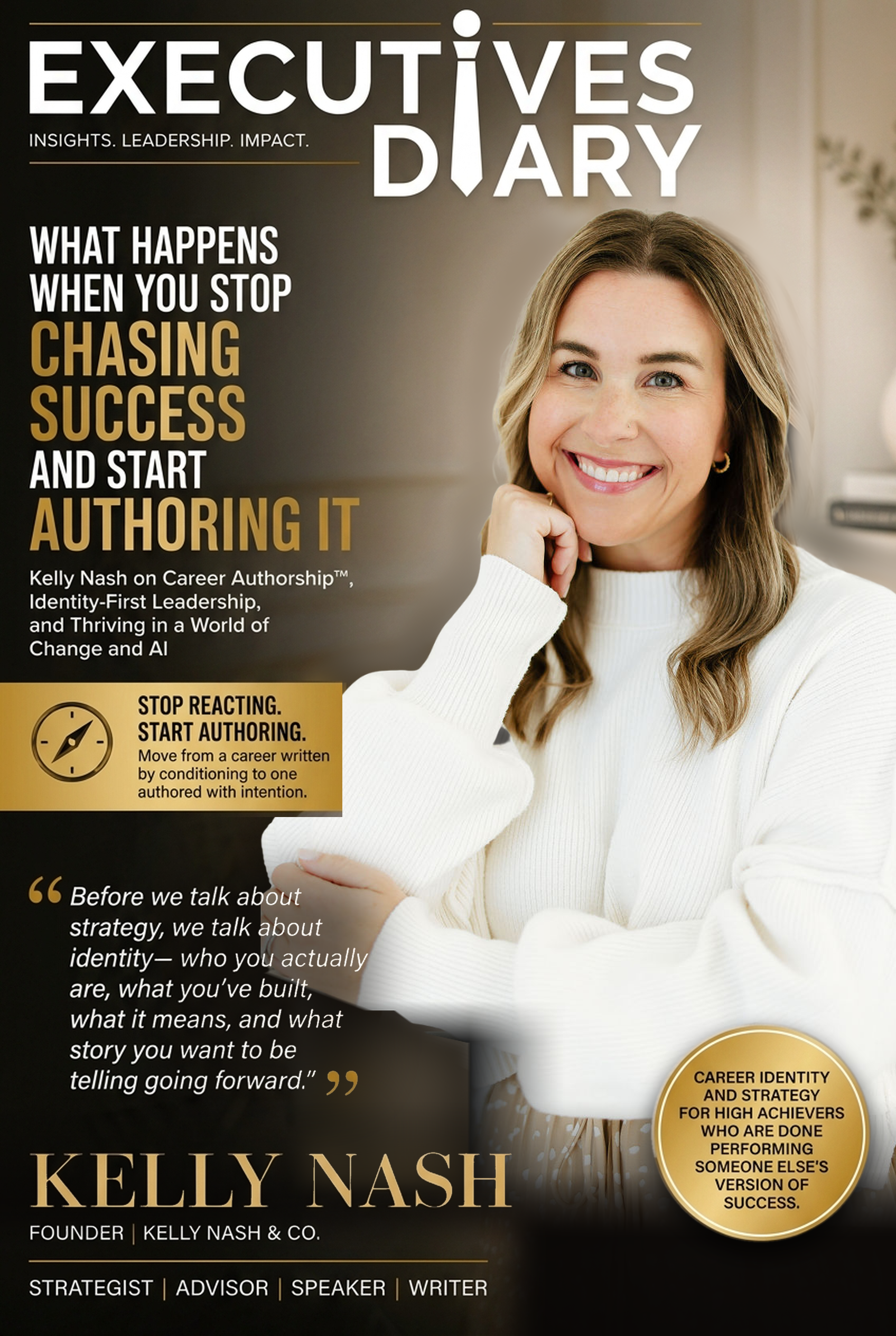
“Before we talk about strategy, we talk about identity: who you actually are, what you’ve built, what it means, and what story you want to be telling going forward.”
The fluorescent lights of the conference room hum with a clinical, unfeeling rhythm. Around the table, people in charcoal suits trade numbers and projections, speaking the language of efficiency while the air feels heavy with exhaustion. You look down at your notes. They are filled with color-coded charts and strategic objectives you spent weeks refining. You have hit every target. You have checked every box. You have followed the map provided by the organizational handbook to the letter.
But beneath the polite nods and the routine approval of the quarterly results, there is a quiet, persistent tremor. You realize the path you are walking, the one that looked so promising on paper, leads to a room you never actually wanted to enter. The prestige is real, but the personal resonance is absent. You wonder how much longer you can exchange your time and your energy for a narrative written by someone else, for a role that treats your career as a logistical variable rather than a life’s work.
You look at the person sitting opposite you. They appear to be doing the same mental math. They are successful by every external metric. Yet, they look just as hollow as you feel. The meeting concludes. You stand up, straighten your blazer, and walk out into the hallway, realizing that success without ownership is just a well-paid trap. You have been waiting for someone to tell you that you can write your own story, but you are finally starting to suspect that the only person who can hold that pen is you.

The Author of Her Own Evolution
Her path to this work was not linear, nor was it planned. Nash spent the better part of fifteen years immersed in the engine room of the corporate world, serving in enterprise-level account management within advertising before spending over a decade at Salesforce. That tenure gave her a firsthand understanding of how large organizations operate, what they demand from their people, and where the distance between leadership decisions and employee reality tends to grow. She watched as Fortune 500 companies implemented new technologies, and she studied how those systems dictated the movement and mindset of thousands of people.

Early in her career, she did not wait for permission to start building. She launched a blog and hosted events for professional women during her off hours. She wrote about self-advocacy and brand strategy because those were the tools she wished she had been handed on day one. She was living a dual life. By day, she managed massive corporate accounts; by night, she was laying the foundation of what would eventually become Kelly Nash & Co.
The transition from corporate employee to consultant was not a sharp break. It was a formalization of a reality she had already been constructing in parallel for years. She saw the friction points inside the largest organizations in the world. She noticed that companies often promised employees a clear path to growth, but those employees experienced a fragmented, confusing reality instead. The gap between what organizations promised and what employees actually experienced was the inevitable result of systems built around business outcomes, not people.
She became the person who worked to close that distance. As an architect of employee experience and development, she designed programs and internal mobility structures that prioritized human growth. She found that when you treat employees as people with careers rather than units of production, the entire system functions better. The results were measurable. The sentiment shifted. But she also realized that the problem was systemic, and solving it required a different kind of focus than a single corporation could provide.
The Philosophy of Authorship
The professional world treats career development as a series of tactical moves. Update the resume. Practice the interview. Climb the next ladder rung. Nash rejects this premise entirely. She believes that most career misery stems from a lack of identity, not a lack of strategy. If you do not know who you are or what you value, no amount of tactical optimization will save you.
Career Authorship starts at a different place entirely. Before we talk about strategy, we talk about identity: who you actually are, what you’ve built, what it means, and what story you want to be telling going forward.
This is the core of her work. She argues that the modern job market, with its rapid shifts caused by artificial intelligence and sudden restructurings, makes identity-level clarity the ultimate competitive advantage. When a leader knows exactly what they stand for, they stop reacting to the market and start dictating their own terms. They become less prone to the anxiety of a layoff and more capable of seeing opportunities that others, blinded by fear, miss entirely.
This is not just for the individual. Nash applies this same lens to organizational consulting. She helps leaders see the disconnect between their corporate communications and the actual reality of their workforce. The most dangerous moment for a company is when a leadership team makes a significant decision but fails to explain what that decision means for the people on the ground. When the message is missing, fear fills the void.

The most consequential workforce moment is that gap between when a strategic decision is made at the leadership level and when the people affected by that decision actually understand what it means for them.
Nash helps organizations build the bridge across that gap. She advocates for a translation layer where managers do not just deliver news, but help employees understand their future within the company. This requires a shift in leadership style. It requires leaders who are willing to have honest conversations about career goals rather than staying stuck in the comfort of performance reviews.
She pushes leaders to look at their own practices. If they preach flexibility but punish those who take time to rest, the culture will fail. If they talk about internal growth but provide no infrastructure for it, their best talent will leave. Career alignment isn’t a perk you offer employees. It’s a condition of sustained performance.
Career alignment isn’t a benefit you offer employees. It’s a condition of sustained performance.
When individuals feel they are building something that belongs to them, they contribute differently. They stop operating from obligation and start operating from ownership. This is the difference between an employee who is merely executing a vision and one who is actively contributing to the foundation of the firm. Nash wants companies to stop treating this as a human resources issue and start treating it as a core business strategy.
She remains critical of the common assumption that high-achieving professionals simply need a better resume. Many of her clients arrive after years of performing at a high level, feeling successful but fundamentally unsatisfied. They have followed every rule, only to find the game was never designed for their personal fulfillment. They need to stop seeking approval and start asserting their own narrative.
Leaders who know exactly who they are and what they stand for make better decisions faster, attract the right opportunities, and don’t get rattled when the market shifts.
This shift in perspective is what Nash calls the meaningful middle, her reframe of the cultural narrative that treats career transitions as messy, chaotic, and something to survive as quickly as possible. It is in the middle, in the space between the last role and the next, where the identity of the author is truly forged. If you rush through it, you bring the same scripts into your next chapter, instead of writing new ones.

She brings this rigor to her clients because she has lived it herself. After over a decade at Salesforce, her own role was eliminated. She could have panicked. She could have rushed to find the first job that would take her. Instead, she chose to use the time to cement the shift she had been planning for years. She treated her own transition with the same professional care she provides to every person she works with.
Her current work bridges the gap between individual coaching and organizational consulting. She sees them as two expressions of the same truth. Whether you are an executive trying to keep your team engaged or a professional trying to figure out your next chapter, the requirement is the same. You must stop waiting for someone else to tell you what your value is. You must define it yourself.
The Career Authorship™ Playbook: 5 Lessons on Authoring Your Career
- Lesson One: Identity comes before strategy. Clarity about who you are and what matters to you has to anchor every decision you make about where you’re headed. A resume cannot fix misalignment.
- Lesson Two: The meaningful middle is where the real work happens. Career transitions aren’t the messy, chaotic obstacles most people treat them as. They are the space where you actually get to choose, if you’re willing to slow down enough to reflect instead of rushing toward the next thing.
- Lesson Three: Your target has to be yours. External success measures, title, compensation, what other people can see and validate, will never sustain you. What sustains you is work that feels like it belongs to you.
- Lesson Four: Career alignment drives lasting performance. Organizations that develop their people don’t just retain talent, they create the conditions for talent to want to stay and grow. Career alignment isn’t a benefit. It’s a condition of sustained performance.
- Lesson Five: Intentional steps forward beat reactive ones every time. You don’t need all the answers; you need clarity on who you are and the willingness to move from that place.
The Author of Agency
Nash’s approach is a direct rejection of the passive career. We are trained from the beginning to find a box, fit inside it, and hope the people who built the box are pleased with our performance. That era is over. The individuals who will thrive in the coming years are not those who are most obedient. They are those who understand that they are the primary authors of their own professional reality.
She does not promise that this path is easy. It is far simpler to follow a script than to write your own. It is more comfortable to wait for a promotion than to risk a pivot into a space that reflects your actual interests. But the comfort of the script is an illusion. The safety of the traditional ladder is fading. In the end, the only stability you can truly count on is the one you build for yourself.
You are the one who has to live inside the career you construct. You are the one who has to wake up every morning and decide if the work serves your life or if your life is merely an extraction for the work. Kelly Nash is the person holding up the mirror, the guide who reminds you that you have had the pen the entire time.
When the conference room clears and the lights dim, the choice remains yours. You can return to the same rhythm, waiting for a signal that will never come, or you can begin the process of authorship. You can start by asking yourself the questions you have been avoiding. You can begin to treat your career with the same intentionality you demand from the organizations you serve.
Your career is not a collection of titles. It is a body of work. It is a reflection of your choices, your values, and your willingness to own the narrative you are living. The room you were worried about entering was never the destination. The destination was always the person you become while building the way there.
To connect with Kelly or learn more, visit kellynash.co or reach out on LinkedIn.

