

From the Diary of
Fiona Campbell Arrand
Why capable leaders end up with every problem on their desk, and the change in a conversation that hands the thinking back.
“When leaders change their conversations, trust changes. And when trust changes, people take ownership.”
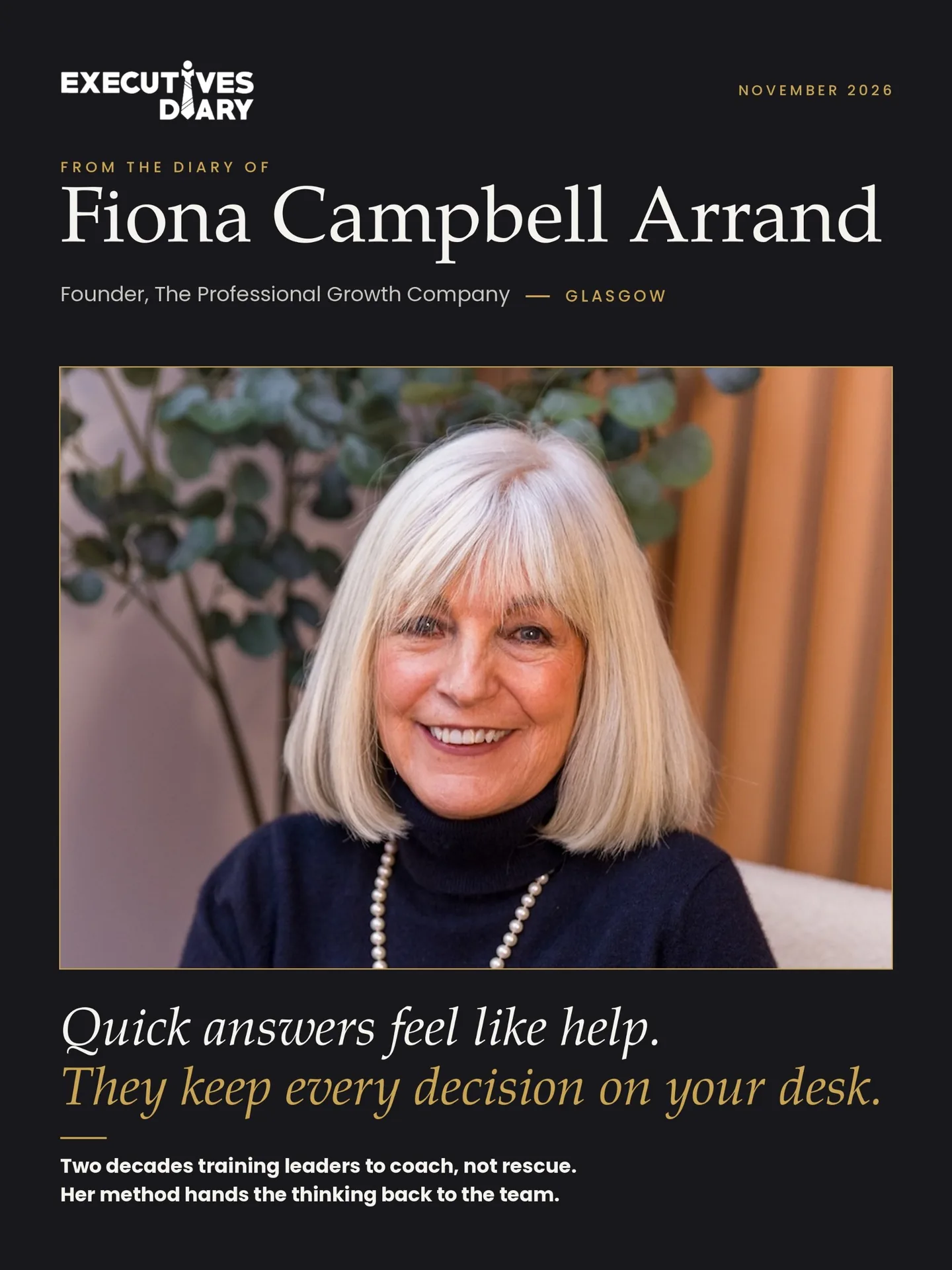
When someone brings a leader a problem, the quickest response is often to offer an answer. It feels helpful and efficient, particularly when the leader was promoted because of technical expertise and a strong record of solving problems. Yet each quick answer can teach the team to return with the next problem instead of thinking it through.
Fiona Campbell Arrand calls this the Leadership Trap: this is when leaders repeatedly fix, advise and rescue rather than helping people think for themselves. Their intention is positive. They want to maintain standards, support their people and keep work moving. Over time, however, the leader becomes overwhelmed while team members lose confidence in their own judgement and become less willing to take ownership.
What are you teaching people to do when they bring you a problem?
That question is at the centre of Fiona’s work. An author, speaker, executive coach and leadership development trainer, she founded The Professional Growth Company to help leaders and organisations build trust and develop confident, accountable people through practical coaching, leadership and NLP skills.
Why Capable Leaders Fall into the Trap
Many managers receive their first leadership role because they are knowledgeable, dependable and good at finding solutions. They are then expected to lead people without necessarily being taught how to listen, ask effective questions, give feedback, build trust or help others take responsibility.
It is natural for them to rely on the skill that earned them promotion. When a team member brings a problem, saying “Here is what I would do” feels familiar. Sometimes the leader goes further and takes the problem over completely. The immediate issue may be resolved, but this type of conversation also teaches the team member to wait for direction the next time.
Fiona sees the consequences in leaders whose teams bring them almost every operational problem. The leaders end up working harder as they are doing more and more work. Meanwhile, the people around them bring fewer ideas, make fewer routine decisions and grow less confident about acting for themselves.
The alternative is not to withhold support. It is to change the form that support takes. Instead of immediately supplying an answer, a leader can ask, “What have you considered?” or “What do you think needs to happen next?” Then give the team member time to think and reply. The leader stays engaged, while encouraging their team members to think things through, make decisions and take ownership of their tasks.
Helping too quickly can hold another person back. Sometimes the most useful response is a better question, followed by the time and space to answer it.
Coaching as an Everyday Leadership Skill

Fiona wants business leaders, HR and learning and development professionals responsible for supporting leaders, to see coaching as an everyday leadership skill rather than something reserved for a formal coaching session.
Her two-day Coaching with Impact programme, delivered in person or online, begins with the conversations participants are already having. They examine what happens when somebody brings them a problem, how quickly they step in with a solution and what they fear might happen if they do not. This helps participants notice that a genuine desire to help, can inadvertently reduce another person’s confidence and ownership.
The programme draws on the advanced communication skills Fiona has developed while delivering accredited Neuro-Linguistic Programming training for business and coaching since 2005. Participants learn to ask precise questions, listen without mentally preparing an answer, and pay attention to non-verbal behaviour as well as the words being spoken.
These skills come together in Fiona’s OWNERS coaching model: Observe, Work, Notice, Explore, Refocus and Support. She developed the model to give leaders a practical structure for helping people take back ownership of their tasks, decisions and responsibilities.
The aim is not to turn every exchange into a lengthy coaching conversation. Leaders still need to give clear direction when it is genuinely required. The skill lies in recognising when direction is necessary and when a well-placed question will help another person think more clearly and act with greater ownership.
What Changes When Leaders Ask Better Questions
Fiona has worked with thousands of leaders, managers and business professionals in the UK and internationally. Across organisations, industries and cultures, she sees the same pattern: capable leaders become overloaded because the people around them rely on them for answers.
The first change can be small. When a leader notices the impulse to fix or advise, instead of rescuing, they take a moment and ask a question such as “What needs to happen to resolve this?” As that becomes a habit, team members start arriving with ideas and possible solutions rather than bringing problems alone. They make more routine decisions, take greater responsibility for their work and become more confident in their judgement.
Leaders experience the difference as well. They spend less time solving other people’s problems and have more capacity for their own leadership responsibilities. The quality of conversations improves, relationships become more trusting and ownership grows across the team. These changes show that this approach helps leaders reduce dependency and build greater confidence and ownership within their teams.
The Journey into Coaching
Speaking on the Scotland’s Women podcast in August, Fiona described her career as “quite a journey”: from working in a bar in Abu Dhabi in the 1980s, through 25 years in international sales, to coaching, NLP and leadership development. Her sales career included roles with Xerox in the Middle East and Yellow Pages in Scotland, before she founded The Professional Growth Company in 2001.
The move into coaching was shaped by a deeply personal turning point. Fiona’s father was a fishmonger who had worked for the same company since he was thirteen. Two years before he was due to retire, Fiona’s mother died suddenly. The loss prompted Fiona to make a conscious decision not to postpone the things she wanted to do and to develop a profession that depended on her rather than on an employer, and that she could take anywhere in the world.
That decision led her to train as a clinical hypnotherapist, coach, NLP trainer and corporate facilitator. She became an accredited NLP Trainer in 2006 and an NLP Business Coach Trainer in 2013. She has delivered accredited NLP training for business and coaching since 2005, in the UK and internationally, including Dubai and Bangalore.
The programme she first developed in 2005 focused on applying NLP in business. Over time, it moved increasingly towards business coaching, both as a discipline and as a practical leadership skill that helps managers and leaders enable people to think for themselves.
How Working with Trust Took Shape
Fiona’s book, Working with Trust, began with a question to her late husband, Duncan: “What do you think is the number one quality of a leader?” Duncan had spent his career in the construction industry as an international CEO and senior leader. He answered immediately: “Trust.”
Fiona began modelling how Duncan had built and sustained trust throughout his career. She recognised many of the same behaviours in other successful senior leaders and used them to examine more than 35 years of experience in international business, NLP, coaching and leadership.
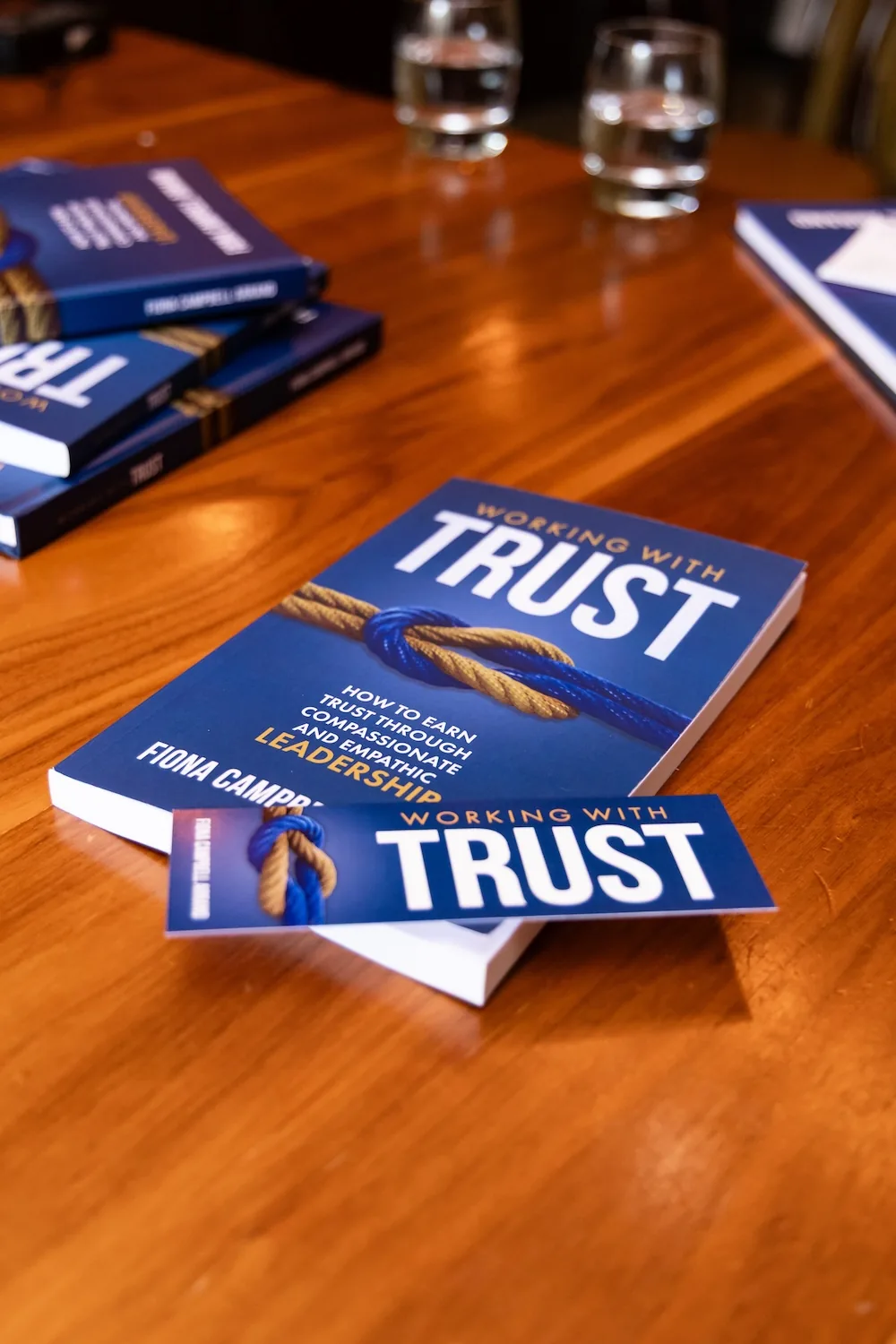
Coaching allows her to respond intuitively to the person in front of her. Writing the book required her to slow down and explain what she noticed, why certain questions and behaviours worked, and why one interaction built trust while another damaged it. The result was a set of practical frameworks that leaders can use in everyday conversations.
The TRUST Framework explains how leaders build trust through truthfulness and transparency, respect, understanding others, support through coaching, and consistency between what they say and do. The CIRCLE Framework focuses on sustaining trust when people are under pressure, experiencing change or managing disagreement. The book also includes Fiona’s RAFT and SPLATR coaching models, which help people explore the relationship between thoughts, feelings, behaviour and results and ask questions that create clarity.
For Fiona, coaching and trust are closely connected. A leader who listens carefully, asks thoughtful questions and resists taking over demonstrates confidence in another person’s ability to think. Those everyday interactions shape whether people feel trusted and whether they are willing to take responsibility.
Where Fiona Is Now
Fiona’s aim for the next twelve months is to establish the Leadership Trap as an idea leaders immediately recognise and to introduce more organisations to her Coaching with Impact programme and her book, Working with Trust: How to Earn Trust Through Compassionate and Empathic Leadership, published in 2026.
Her podcast, Working with Leaders and Coaches, is due to launch in early 2027. Through the podcast, her programmes and her writing, she wants to help more leaders escape the Leadership Trap and make coaching conversations part of everyday leadership.
Outside work, Scotland is now home. Fiona values her family, friends and the conversations, connections and humour of the community she has returned to. She regularly goes to the gym and enjoys walking and spending time in her garden.
When she was recently asked about retirement twice in one week, she reflected on her father, who took what he called his “early retirement” at 81 and continued to thrive until he was 96. Fiona knows there may eventually come a time when she no longer wants to deliver leadership programmes or coach business owners, but she is clear that she has not reached it yet.
Her answer to the retirement question is simple: “I’m only warming up.”
I’m only warming up.
The Playbook
Five Reflections from Fiona
- 1. When someone brings me a problem, what does my response teach them to do next?
- 2. Before I offer a solution, have I asked what they have already considered?
- 3. Does this situation genuinely require direction, or would a question help the other person think it through?
- 4. Am I stepping in because it is necessary, or because giving the answer feels quicker and more comfortable?
- 5. What could I change in my everyday conversations to build greater trust, confidence and ownership in my team?

