What a non-fiction author gets from an editor who reads the whole manuscript first, explains every suggestion, and makes sure the book still sounds like them.
The manuscript was about somatic healing. Somewhere in it, the author reached for an example from aviation to make a point in a paragraph, and the lingo had to be right. Raksha Daryanani Thani checked it with a pilot before suggesting edits. “The author was immensely impressed by that effort,” she says. It was one small part of an edit that also went as far as to fact-check every quote referenced in the book, because, as she puts it, “not everything we see on the internet is correctly attributed; especially quotes may have different sources.”
That’s the kind of care a non-fiction author is looking for when they bring a finished draft to an editor. Most of Raksha’s authors have been coaching, teaching or leading for years. They have clients who want the book, which is why they go the self-publishing or hybrid route rather than wait on a publisher. What they’re protecting is the voice. Raksha, a Barcelona-based freelance writer, certified editor, presenter, and voiceover artist, edits and proofreads non-fiction for exactly those authors: the ones going down the self-publishing route, or giving a manuscript a full edit before they pitch it to an agent. “My goal is to work with the author rather than against them, so I don’t force my edits or views on them,” she says. “And they should definitely feel that the writing sounds like them and not me.”
She’s also a ghostwriter for CEOs and senior executives, and is currently working on her first full-length manuscript, a memoir about growing up abroad as a Sindhi girl. The editing and the memoir turn out to be the same discipline, practiced from two sides.
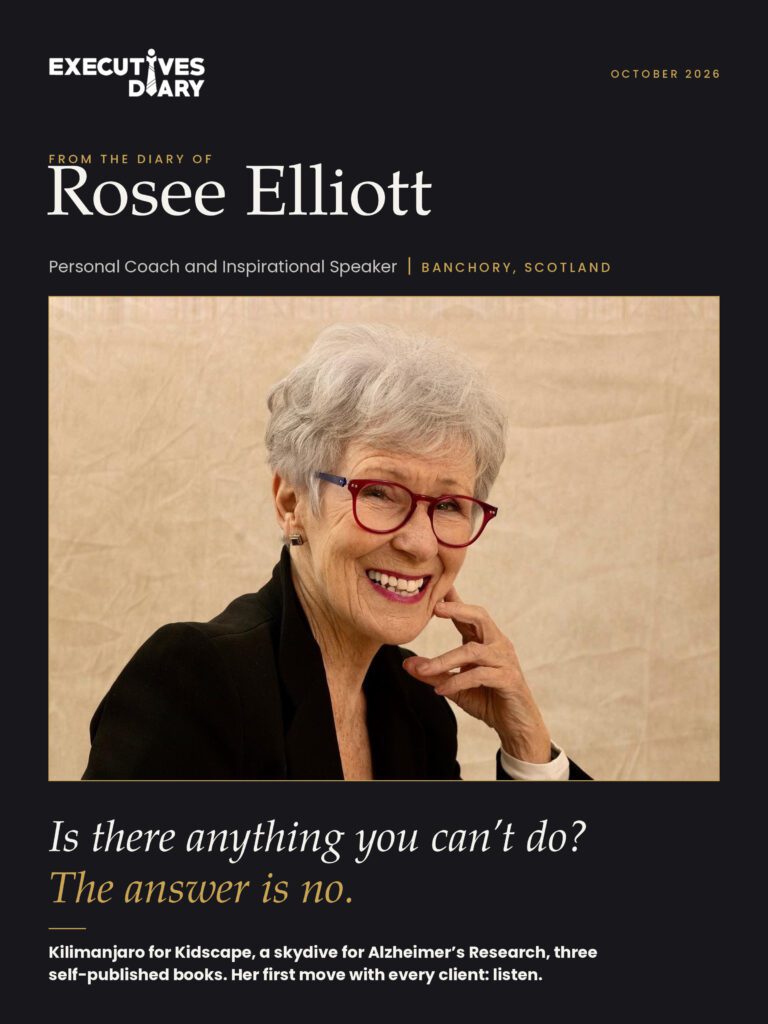
Leader in Spotlight: Read Rosee Elliott Feature in Executives Diary
Three Questions Before Any Contract
“I get to know the author and their goals,” Raksha says. “My rule of thumb is: when you learn about and understand the person, you can gauge their expectations and deliver your best work.” She asks the author to walk her through their vision of the book, and the questions are always the same three: what is the story you want to tell, what is the takeaway for your readers, and who are your target readers.
Then she decides whether to take the job. “Once I have this information, I assess if the client and I can work together. Sometimes the topic, deadline, or budget may not be aligned, and I prefer to be honest upfront.”
If they do work together, she reads the manuscript in its entirety first, then gives the author an estimate of what it needs: copy editing and proofreading for some, developmental, line, and copy editing plus proofreading for others. Her suggestions go in as comments the author can accept or decline, each with a reason why something does or doesn’t work. On rare occasions she’ll suggest a total rewrite of a chapter, or ask for the missing details in a paragraph that feels incomplete.
The books she mostly edits are self-help. “In-depth guides on somatic healing for people who’ve experienced complex trauma, handbooks on self-awareness for business leaders, and positive psychology-backed guides for increasing resilience and cultivating wellbeing for teachers, trainers, and leaders,” as she lists them. “Most of the time, the authors include snippets of their own stories/experiences in these books, so the genre becomes blended.” One of those blended books shows how far the work goes.
The Colons Came Out in Round Two
The author used colons and semicolons in every paragraph. Raksha’s first instinct was to leave them. “At first, I didn’t feel it was necessary to change their style because it made sense given the points they were making,” she says, based on the exercises interspersed with personal examples. “But after the first round of edits, I felt it was better to remove the majority of colons and semicolons so that the reading experience became smoother. And since form should complement the story, the fluid reading experience paved the way for the gentle, meditative exercises the author had included for trauma release.”
She separated the author’s personal stories from the advice they offered readers, shortened certain sentences, cut repetition of facts, and simplified the medical terminology so that anyone could follow the author’s intentions. The author had no style guide. Since they were in the US and the book was about healing, Raksha suggested and applied APA, which suited both the medical and the psychological sides of the book and gave the layout clarity. The author took the rest of her suggestions on board too: heading rewrites, chapter splits, and moving guides into the annex. Every quote and personal interaction was checked and attributed. Then came the paragraph about aviation she fact-checked with a pilot.
“The result was a book that not only spoke of the author’s advice and experience but clearly illustrated their authority and intentions to help the reader move past their traumatic experiences,” she says. The beta readers were pleased with the changes, and the author came back with their compliments. The hybrid publisher’s verdict, as the author relayed it: “She loved it and can’t wait to publish it.” The book is now in cover design.
I believe in their stories as much as in my own work, and have celebrated their successes just as I would celebrate mine.
Raksha Daryanani Thani, freelance writer, certified editor, presenter and voiceover artist
That belief has a source outside editing. For the past five years she has also been writing in other people’s voices, and she says it changed how she listens.
What People Don’t Say
The ghostwriting covers podcast and interview responses, social media posts and leadership stories for CEOs and senior executives. “I can confidently say that ghostwriting has taught me to pay attention to what people don’t say and where they naturally pause,” Raksha says. “I learned how to ask for more information when I feel details are missing or vague, and emulate sentence length.” She also learned how an individual’s voice, style and vocabulary set them apart from the next person. “Once you get the hang of someone’s style and tone of voice, you don’t get confused and deliver stories that mirror the clients’ intentions and ways of speaking and writing.”
The practice has paid into her own book. “My memoir includes several characters, and keeping their voices intact has been easier because of all the practice I got as a ghostwriter.” Behind that sits an earlier career. “I come from an HR background spanning multinationals in mining and BPO,” she says, and she spent three years as a content manager at a B2B SaaS start-up. “These experiences have helped me understand contexts when writing, fact-check before publishing, and target the reader with the right tone and style.”
The memoir is where all of that listening is being tested on her own family.
A Sindhi Childhood in the Caribbean
Raksha has been sharing the process on LinkedIn as she writes. When she set out on the book, she wrote, she was inundated with memories: how people dressed, what they said, how they walked, the subtleties of their speech. The problem was what to do with them. Her example is her Nani. An infodump, she wrote, would read: “Nani was a great cook who made the most delicious alu rotis and nankhatais. She complained a lot and was a very critical person in general.” Instead she wrote Nani’s peculiarities into the scenes, “such as ‘Ay Rakshu, mitti!’ Nani would cry when I brought sandy feet into the house after playing in the garden.” The list of traits didn’t go to waste. It became a character sheet.
Some memories don’t surface on demand. One arrived when her husband said he was bored of coffee and asked what else he could have that evening. “Milk rose. There is sharbat in the fridge and Nani used to make us a glass when we’d visit,” she heard herself say, and realized it had been missing from the book. “And in it went as another detail of my Sindhi childhood in the Caribbean,” she wrote.
Her Nana is in the book too: the man who came from Sindh to Barbados before partition, before he was a teen, to fend for his mother and siblings after his father’s sudden death, and who never spoke about it. He had three daughters and told them to study first. He was the only one who read her thesis, she has written, and celebrated every degree as if it were his own, though he had no education himself. “Every time I wanted to give up, I remembered him.” The route that line covers runs through Suriname, Lancaster and Leeds to Barcelona, where she has now lived for eight years, eleven in Europe altogether.
As I write my memoir, I realise it will commemorate him too. How else do we keep the love, lessons, and words alive?
Raksha, freelance writer, certified editor, presenter and voiceover artist
The Cambridge MSt in Creative Writing sits alongside the editing certification on her list of credentials, and the shorter work has already found readers. Her creative essays and poetry on life as Sindhi diaspora have appeared in literary magazines, and her travel essays in diaspora magazines. Her advice to anyone writing non-fiction, from her own experience: “Keep a notebook by your side so the thoughts and ideas don’t escape.” Some of those essays she then reads aloud, which is the other half of her working life.
Reading It Out Loud
In November 2025, Raksha recited her non-fiction essay The Weight of Wrinkles, first published in The Leaves, a Cambridge literary journal, in front of an audience of 70 at an artists’ event in Barcelona. “Attendees came to me to share how vivid the details of my story were, and how it made them understand the plight of women across cultures,” she says. “All these moments prove to me that my work in writing and editing is making an impact, which aligns with my dream of sharing stories that change the world.”
The stage is familiar ground. Her profile lists live keynotes at global summits, storytelling and writing workshops at universities in the EU and UK, more than 25 masterclasses and panel discussions for European business schools, and live storytelling events in Barcelona and the UK. What she wants more of is specific. “I’d love to present more live events, host storytelling workshops, and perform my own work at literary events.”
Where Raksha Is Now
The memoir is the big project, and she’s open about the fact that it hasn’t moved at the pace she planned. “Facing a difficult personal challenge last year meant I had to say no to some work, couldn’t write my memoir at the pace I had envisioned, and had to take time off,” she says. “It taught me not to underestimate the personal in the professional. I sought help, worked on the matter, and returned after a few months with fresh energy.”
This year she also made herself a promise. Journaling on a hotel balcony in Platja d’Aro in March, she asked herself what one thing she would change as a writer. The answer, she wrote, arrived almost immediately: “Giving up on an idea or a story just because someone didn’t commission it.” The first of those stories, an artist in Barcelona, is already interviewed.
The people who read her work first are at home. “It would be unfair to name just one, so I’ll say my husband and my best friend, my habibti,” she says. “Both of them read my silliest and most serious pieces of writing and give me honest feedback, encouraging me to keep doing what my heart says. I am very fortunate.” Outside work: “I am a voracious reader and believe there are never enough books. But then, which writer isn’t a reader first?”
Her own diary entry outside work, in her words: “The first thing I do after waking up is look out of the window, up at the sky, to thank the creator for a beautiful new day. It sets the tone for the day, and reminds me to be grateful for this life, no matter what. Everything I am today is because of my faith in the creator and the beauty of his creation. It is with this beauty in mind that I write and share stories.”
Over the next twelve months, she wants more editing and proofreading clients who are self-publishing non-fiction books and articles, more opportunities to present webinars and facilitate storytelling workshops, and engaged readers who want to follow how she finds and develops the stories in the memoir. What’s next, in her words: “Get that memoir out. Stand on stage to perform all over the world.” And, she adds, make more clients happy with her work.
Her line for the authors she edits is the one she writes by herself. “Write from your heart and the right readers will want it.”
Five Lines from Raksha’s Diary
“Write from your heart and the right readers will want it.”
“Ghostwriting has taught me to pay attention to what people don’t say.”
“Writing taught me not to underestimate the personal in the professional.”
“Your best memories won’t be waiting for you.”
“‘Tell them more often’ is my new motto for showing appreciation to anyone who has supported, collaborated with, or guided me.”
From the Diary of Raksha Daryanani Thani
Raksha Daryanani Thani is a Barcelona-based freelance writer, certified editor, presenter, and voiceover artist.
| Role | Freelance writer, certified editor, presenter, and voiceover artist |
| Based in | Barcelona, Spain |
| Also | Cambridge MSt in Creative Writing; Certified editor and proofreader, College of Media and Publishing, UK |
“Write from your heart and the right readers will want it.”
Editor’s Note
Executives Diary features Raksha Daryanani Thani because her account of one edit answers the question a self-publishing author actually has: what happens to my book in someone else’s hands. She describes reading the whole manuscript first, explaining every suggestion, and checking a paragraph about aviation with a pilot, and the author’s hybrid publisher confirms the result. Her memoir posts show the same attention turned on her own family. The editors are convinced by the detail, not the titles.
Executives Diary, Editorial