

From the Diary of
Monica Tomasso
What it takes for an AI system to understand a business well enough to recommend it, and how to tell whether it does.
“Measurement without a path to action is just reporting.”
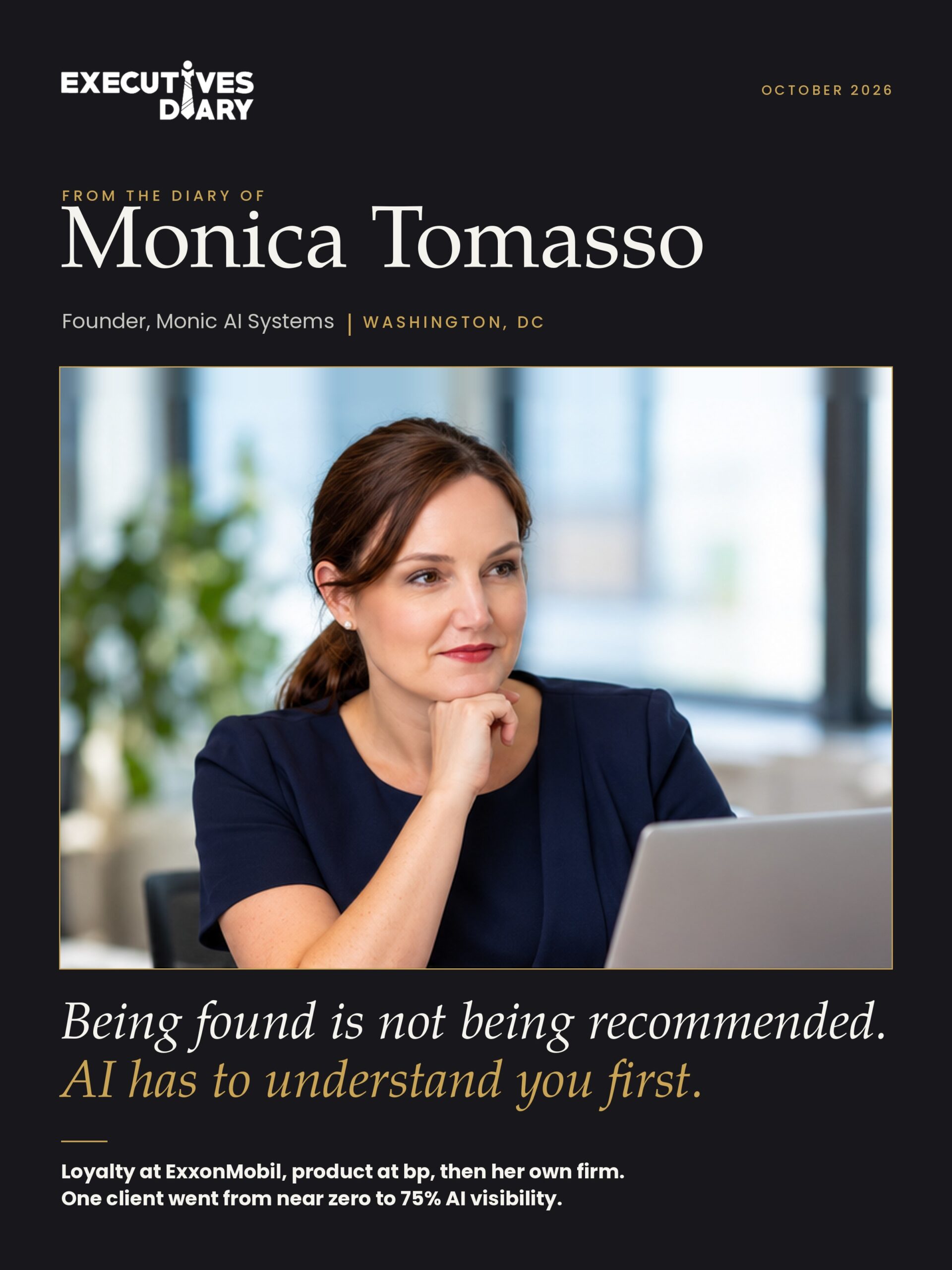
“Google ranking tells you where you appear in search. AI recommendation tells you whether a system understands your business well enough to include you in the answer.” Monica Tomasso wrote that on LinkedIn, and the distinction behind it is the one she keeps returning to. Being findable and being recommendable, she wrote, are different outcomes, and they need different measurement.
As she puts it on her profile, buyers increasingly ask ChatGPT, Gemini, Claude, Perplexity and AI-powered search whom to trust, who is best for this and which company to choose. A business can have real expertise, strong customers and a solid reputation and still be poorly understood by those systems.
Monica founded Monic AI Systems in 2025 to work on that problem. She helps businesses become understood, cited and recommended by AI systems, and in one engagement she describes, a client’s AI visibility moved from essentially zero to roughly 75%. She says the number was not the only thing that mattered.

A Business the Web Doesn’t Show
The business Monica describes had deep domain expertise, a long operating history and a strong reputation in its industry. AI systems still didn’t consistently understand what made the company different.
When she looked at the digital footprint, the problem became clearer. The expertise lived inside the company, she says, in conversations, customer relationships, proposals and years of experience, and the web reflected very little of it. The website was thin, the language was generic, and there wasn’t enough third-party corroboration.
The work began with a baseline. She and her team tested real buyer questions across multiple AI systems, looked at which competitors appeared, and examined the sources shaping those answers. Then they worked on entity clarity, machine readability, the questions buyers actually ask, and the supporting evidence around the business.
The biggest change, she says, was not simply “more mentions.” The company “became easier for AI systems to understand in context,” and that, in her words, “is the distinction I care about most.” She tells clients that getting there happens in a particular order.
Understood, Verified, Cited, Recommended
AI visibility, she tells clients, is not one thing. “It is a progression.”
First, a business has to be understandable. An AI system should be able to determine who it is, what it does, who it serves and what makes it different.
Then it has to be verifiable. “Your own website is not enough,” she says. Reviews, media coverage, directories, research, expert mentions, communities and other third-party sources help corroborate what a business says about itself.
Then it has to be citable: useful, accessible information that AI systems can retrieve when they answer real buyer questions. And finally it has to be recommendable. “Being mentioned is not the same as being chosen.”
That is why I tell businesses to train the web, not just their website.
She says learning to think in systems began at ExxonMobil.
ExxonMobil, bp and Then Her Own Company
At ExxonMobil, Monica spent years across loyalty, pricing, promotions, data, category strategy and customer behavior. One of the largest programs she worked on was Plenti, a coalition that brought together major brands and enrolled more than 15 million people in its first five weeks. It taught her “how complex customer ecosystems actually work.” What looks simple to the customer, she says, “usually results from data, product, partnerships, technology, and operations working together.”
At bp she worked on global product management, customer engagement technology and large-scale transformation. The lesson she took from it was that “new technology doesn’t create value simply because a company adopts it.” The value comes, in her words, “from understanding how customer behavior, workflows, and measurement change around it.”

The third turn came in 2025, when she founded Monic AI Systems. AI was changing how buyers discover and evaluate businesses, she says, while most companies still measured visibility as though search behavior hadn’t changed. “I wanted to build a business around that gap,” she says, and show companies “what to do next.” AI Recommendable grew out of that work, in her words, “as a way to make the process more measurable and systematic.”
I wanted to build a business around that gap.
How she knows any of it is working is a question she answers with measurement.
What the Evidence Looks Like
One of the clearest examples from her work, Monica says, was the client whose AI visibility moved from essentially zero to roughly 75% after her team clarified the business entity, strengthened its web presence and made the company’s expertise much more explicit.
“What mattered to me was not just the number,” she says. The improvement wasn’t uniform across every model, which reinforced something she sees repeatedly: AI visibility has to be measured across multiple systems and repeated buyer questions.
Usage data points the same way. In Comscore’s panel data, ChatGPT’s share of total AI prompt volume fell from 70% in January 2026 to 50% in June, while Gemini rose from 17% to 30% and Claude from 2% to 11%. Monica pointed to the same Comscore data in a recent post and wrote that the overall market is still expanding, with people spreading their questions across more platforms.
She tracks her own company across ChatGPT, Gemini, Perplexity, Google AI Overviews and Copilot, and she has published what she sees. In a recent post she wrote that her own AI visibility dropped from roughly 75% to 50%. A few months earlier, she wrote, she would have asked “What broke?” Now, she wrote, “the more interesting question is: What changed around me?”
“We never treat one screenshot or one favorable answer as proof,” she says. She looks at recommendation rate, citations, competitor displacement, and whether the business keeps appearing as the user adds follow-up questions and constraints. She ties that standard to what she calls one of the hardest lessons of her career.
We never treat one screenshot or one favorable answer as proof.
Start With the Decision, Not the Tool
She puts the lesson this way:
One of the hardest lessons of my career has been learning that a technically successful project can still fail if the people around it don’t understand the change it creates.
It has stayed with her. Whether she is working on AI visibility or product strategy, she says, she spends as much time thinking about behavior, adoption and communication as she does about the technology itself.
The people who shaped how she works, she says, didn’t give her a slogan or a single piece of advice. They were the strong leaders she worked for early in her career, who expected her to understand the business problem before proposing a solution. “That discipline still guides me today: start with the decision that needs to be made, not the tool.”
Context, she says, is something she learned early. She grew up living in different parts of the world, including Africa and South America, and she thinks it shaped how she sees systems and people. “The same thing can be interpreted very differently depending on where you are standing, and that idea shows up constantly in my work with AI and customer behavior.” Today that thinking sits inside a company of her own.
Where Monica Is Now
Monic AI Systems works with businesses on AI visibility, and AI Recommendable is the platform Monica built to make that process measurable and systematic. Over the next twelve months, she wants this article to help more business leaders understand that AI visibility is becoming “a business problem, not just a marketing tactic.” The outcome she cares about most is more clients for the AI visibility work, followed closely by more adoption of AI Recommendable and more opportunities to speak about how AI is changing discovery and recommendation.
The question occupying her now shows up in her recent posts. Did a LinkedIn post actually change what AI says about her company? She wants to take one post and compare the answers before and after it goes up: whether the post itself got cited, whether a new phrase or claim started appearing, and which AI systems reacted and how long it took. “That is the measurement layer I think we’re missing,” she wrote.
That is the measurement layer I think we’re missing.
The reader she most wants to reach is a founder, CMO or business leader at a growing company, someone who knows buyer behavior is changing but hasn’t yet figured out how to measure whether AI systems actually understand and recommend the business. She has a line of her own for that reader, and she says it sums up how she thinks about AI visibility, product strategy and almost every transformation project she has worked on: “Measurement without a path to action is just reporting.”
The Playbook
The Monica Tomasso Playbook: From Understood to Recommended
- Start with real buyer questions. Test them across several AI systems, and note which competitors appear and which sources shape the answers.
- Make it clear who you are. An AI system should be able to tell what you do, who you serve and what makes you different.
- Look beyond your own website. Reviews, media coverage, directories, research and expert mentions help corroborate what you say about yourself.
- Measure across systems, and ask again. One screenshot or one favorable answer is not proof. Track recommendation rate, citations and competitor displacement, and add follow-up questions and constraints.
- Connect every measurement to an action. A number with no next step is reporting.
