

From the Diary of
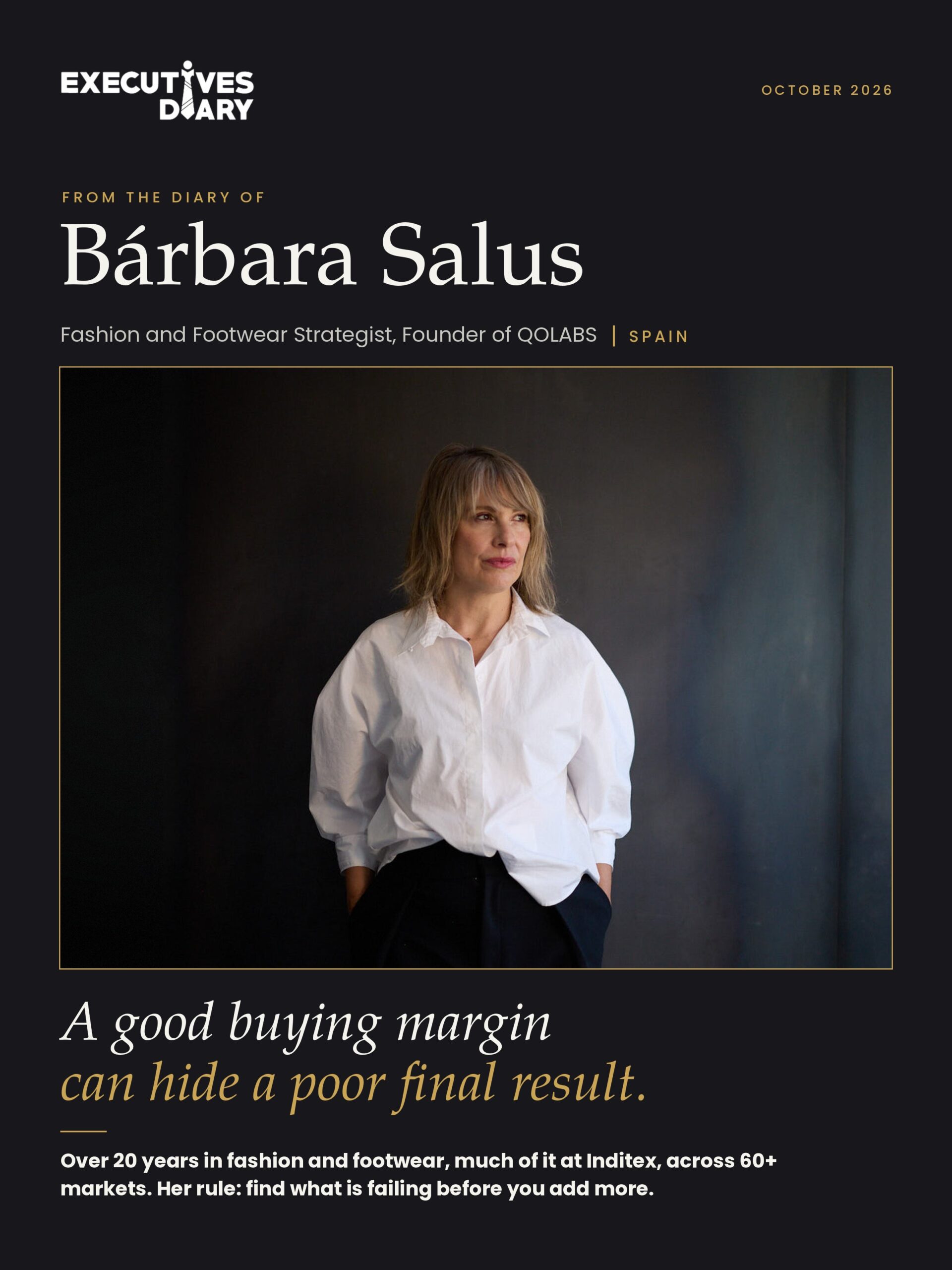
Bárbara Salus
Founder, QOLABS | Fashion & Footwear Strategist | Fractional & Interim Leadership
“A good buying margin can hide a poor final result.”
When More Is Not the Answer
Bárbara Salus helps fashion and footwear companies turn strategy into product , and product into a more focused, coherent and profitable business, through strategic advisory, fractional and interim leadership, and project-based expert teams.
A company can have a strong product, talented people, good data, and growing sales, yet still struggle to perform.
For Bárbara Salus, that contradiction is where the real work begins. After more than 20 years across fashion, footwear, product, buying, sourcing, retail, strategy, and international markets, she began seeing the same pattern across different businesses: companies were often trying to solve visible problems without understanding what was actually causing them.
They hired more people. Added tools. Expanded collections. Pushed for more sales.
But the decisions underneath remained disconnected.
That realization led Bárbara to create QOLABS, a strategic firm focused on helping fashion and footwear companies connect customer, product, people, and business. Her work begins before the proposed solution, with a more fundamental question: What is really happening inside the business?

The Experience Behind the Question

Bárbara’s perspective was shaped over more than two decades inside major fashion organizations, including a significant part of her career at Inditex, where product decisions were closely connected to commercial consequences.
Throughout her career, she worked across product management, buying, category management, sourcing, retail, wholesale, and international operations. She managed categories with budgets exceeding €100 million, businesses above €200 million, and operations across more than 60 markets.
Those experiences gave her a close view of what happens when product decisions carry significant business consequences.
She learned that a successful collection is not simply about having good products. Customer, product, pricing, sourcing, buying, collection architecture, brand image, channels, budgets, and data all need to support the same direction.
When they do not, even highly capable teams can work hard without moving the business forward.
Bárbara’s response was to develop a more connected way of reading the business, one that brings together specialist expertise while ensuring that product decisions, customer needs, and commercial objectives support the same direction.
Finding the Problem Before Adding the Solution
One of the clearest distinctions in Bárbara’s work is between a symptom and a root cause.
When a company says, “We need more designers,” she does not automatically accept that diagnosis. She looks at the collection, sales, margin, stock, buying budget, processes, responsibilities, and the points where decisions become blocked.
A collection may be underperforming because there are too many references, insufficient depth behind the strongest products, unclear roles within the collection, or a buying budget spread too thinly.
Adding more designers in that situation would create more product, but not necessarily a better business.
Bárbara puts the idea simply:
Before adding resources, you need to understand what is actually failing. Sometimes the company does not need more. It needs focus.
That philosophy changes the starting point. Instead of asking which resource is missing, she asks what decision, process, or connection is failing.
For growing companies, that distinction can save more than money. It can prevent months of activity directed at the wrong problem.
When a Good Decision Produces a Bad Result
Bárbara’s thinking becomes particularly clear when she talks about buying.
Consider a company purchasing 10,000 units instead of 6,000 because a supplier offers a better price. The initial numbers look attractive. Unit cost falls. The buying margin improves.
But if real demand is closer to 6,000, the remaining inventory consumes capital, creates markdown risk, takes up space, and reduces the company’s ability to react during the season.
The same principle appears in other decisions: adding references simply to create more variety, automatically repeating a former bestseller, expanding a category because historical sales were strong, or selecting a product because its theoretical margin looks attractive.
Each decision can make sense when viewed alone.
The problem appears when its consequences are not considered across the wider business.
As Bárbara puts it:
A good buying margin can hide a poor final result.
For her, the right decision is not simply the one that produces the lowest cost or highest theoretical margin. It is the one that balances cost, price, volume, rotation, timing, risk, demand, and the company’s ability to react.
That is why she sees the product’s commercial life as extending far beyond design or purchasing. The real result comes when the product sells at the intended margin and within the intended timeframe.
The Right Expertise at the Right Moment

This way of thinking also explains why Bárbara built QOLABS around flexible access to senior expertise rather than simply encouraging companies to build larger permanent teams.
Large organizations can support important decisions with senior leadership, design, buying, merchandising, planning, sourcing, data, operations, and commercial teams. Growing companies may not need that entire structure permanently, but there are moments when they need access to that level of experience.
Bárbara has also seen the opposite problem: companies placing junior professionals in situations that require senior judgment, or hiring senior executives before the organization is ready to make effective use of their experience.
Hiring a senior professional does not automatically transform a company.
The organization needs reliable data, clear processes, decision-making authority, resources, and a genuine willingness to change.
Depending on the challenge, QOLABS can work as a strategic advisor, step into a fractional leadership role, provide interim management during a specific period of transformation, or assemble a project-based team of senior specialists. This flexible model allows companies to access the level of expertise and execution they need, for as long as they need it, without immediately building a permanent structure.
The work can therefore extend beyond recommendations. QOLABS can also become involved in providing direction and supporting execution, helping the company move from diagnosis to action.
Sometimes a temporary intervention is enough. In other cases, it prepares the company for a permanent appointment by clarifying the role, responsibilities, and right timing.
The objective is to bring in the right capability at the right moment and leave the organization with stronger judgment, clearer structure, and greater autonomy.
Building a Business Around Clarity
Today, Bárbara wants CEOs to think of QOLABS when they need to stop, understand what is really happening, and decide what comes next.
That could be during rapid growth, when product, brand, customer, and strategy have started moving in different directions. It could be when talented teams are working hard but operating in silos. It could be when sales are increasing without translating into profitability, sell-through, inventory turnover, or cash.
It could also be a much earlier question: Should we hire, invest in a tool, restructure the team, or change the strategy?
QOLABS is designed to help answer that question before the company commits to the wrong solution.
Its work currently spans product strategy, collection architecture, buying, merchandising, sourcing, brand strategy, retail and wholesale, AI, data, and sustainability, with the specific combination shaped around each business challenge.
Bárbara is also expanding the reach of that expertise through QOLABS Academy and Editorial, creating practical education and contributing to conversations around the fashion and footwear industry.
Her international priorities currently include Spain, France and other European markets, Mexico and Latin America, with Canada and the United States forming part of the next phase of development.
Technology is part of that future as well. AI and data are already being used in active projects, while 3D and digital-twin capabilities are being developed through specialist collaborations.
But technology is not the point.
Better decisions are.
What Bárbara Wants Companies to See Differently
The unifying idea behind Bárbara’s work is connection: connecting customer insight with product decisions, data with action, creative direction with commercial performance, and individual teams with the wider objectives of the business.
It is about connection.
A company can have the right people and still lack alignment. It can have data and still lack a shared view. It can have sales and still lack profitability. It can have a strong product and still struggle because product, customer, brand, and business are moving in different directions.
Bárbara wants QOLABS to help companies recognize those gaps earlier.
Her role is to look across the organization, identify where focus, time, or profitability is being lost, and help reconnect the decisions that have drifted apart.
That is ultimately what makes her perspective valuable. She is not asking companies to do more simply because growth creates pressure to do more.
She is asking them to understand first.
Because when a business knows what is actually wrong, the next decision becomes clearer.
And when the right decision is made at the right moment, a company may discover that the growth it was searching for was never about adding more. It was about finally making everything it already had work together.
To connect with Bárbara or learn more about QOLABS, visit: https://qolabs.studio
