

From the Diary of
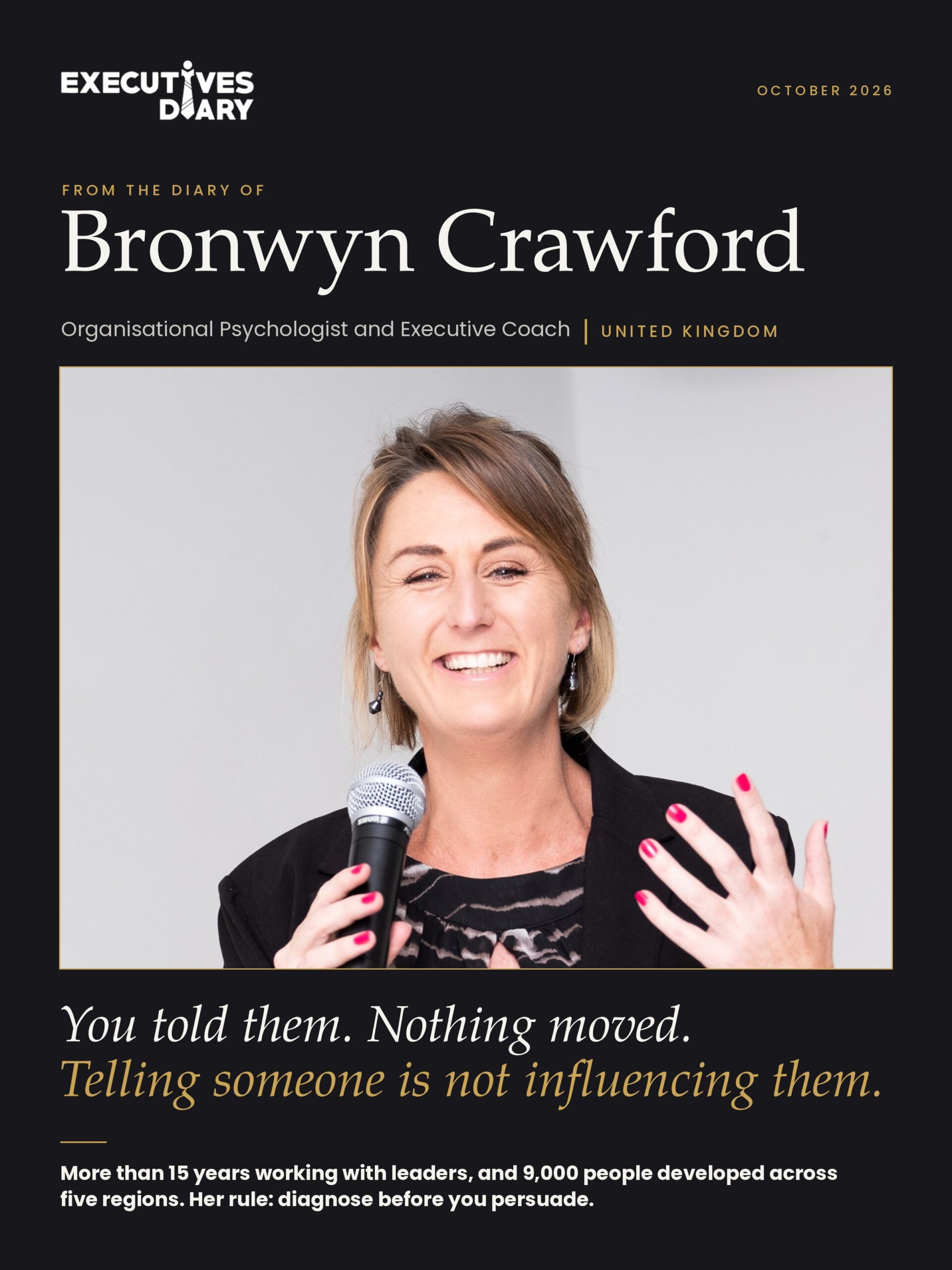
Bronwyn Crawford
Organisational Psychologist & Executive Coach | Creator of The Influential Leader Method | Executive Coaching | Leadership Development & Organisational Performance
“Your value increasingly comes from what you enable other people to achieve.”
For many professionals, expertise is what builds a career. They solve difficult problems, produce strong work, develop deep knowledge, and earn credibility by knowing what to do.
Then they become more senior and discover that the rules have changed.
The strongest analysis does not always win the decision. A well-supported recommendation does not automatically gain support. Having the right answer does not mean people will act on it.
For Bronwyn Crawford, Organisational Psychologist and Executive Coach, this is one of the most important transitions leaders need to understand.
After more than 15 years working with managers and leaders and developing more than 9,000 people across the UK, Europe, the Middle East, Africa, and the USA, Crawford has repeatedly seen highly capable professionals struggle not because they lack expertise, but because they have not yet learned how to turn that expertise into influence, support, and action.
That observation now sits at the center of The Influential Leader Method, the body of work Crawford is developing into practical coaching tools, assessments, and resources for experienced leaders.

The Lesson That Started With Herself

Crawford’s thinking about influence began with a lesson she experienced personally.
Earlier in her career, she describes herself as driven, direct, and eager to grow. She believed she was simply being honest and straightforward. Yet there were moments when her communication style meant she was perceived as rude or overlooked.
The lesson was not that she needed to become less honest.
I didn’t need to become less honest; I needed to think about how I framed the message.
That distinction became increasingly important as she worked with other leaders.
She saw capable professionals become frustrated when a proposal they believed was clearly the right one failed to gain support. Their response was often predictable: gather more evidence, explain the argument again, and work harder to prove they were right.
Crawford repeatedly heard one phrase that captured the problem: “But I’ve told them.”
But I’ve told them.
For her, telling someone something and influencing them are not the same thing. A leader can have the evidence and a strong recommendation while missing the priorities, relationships, concerns, or organisational dynamics shaping the response.
Those patterns eventually led Crawford to develop a practical framework for helping leaders understand what is really happening around their work, identify what is preventing progress, find where they have leverage, adapt their approach, and build momentum.
Beyond the Strength of the Argument
Crawford encourages leaders to look beyond the formal decision.
Who actually influences the outcome? What matters to each stakeholder? Where is resistance coming from? Which conversations have not happened? Is there another route to the person who can move the decision forward?
Her approach also challenges leaders to examine their own assumptions.

A professional may think, They should see this. This is the logical answer. My manager should behave differently.
But those beliefs can become obstacles in themselves.
Part of influence is being willing to ask: ‘What is actually going to work here?’ rather than ‘What do I think should work?’
For Crawford, the obstacle is not always another person or the organisation itself. Often, part of the blockage lies in how a leader is interpreting the situation, and how that interpretation shapes the way they think, feel, and act.
That is why she sees influence as beginning with diagnosis rather than persuasion.
Finding the Route That Creates Movement
One coaching engagement captures Crawford’s approach particularly well.
A highly experienced leader came to her frustrated with his line manager and the way the organisation operated. He believed he was struggling to make an important decision and was becoming increasingly frustrated with his own productivity.
As Crawford explored the situation with him, they discovered that he had actually already made the decision.
He simply had not communicated it.
He had done the research and had years of experience in both his industry and role. What was getting in the way was fear that his recommendation would be dismissed or shut down, along with some self-doubt about whether he would achieve the outcome he wanted.
Instead of strengthening the argument, Crawford helped him examine the organisational environment around the decision.
His usual route was through his line manager, but that route was not working. Together, they identified another route to a senior leader who could make the decision, considered what mattered to that person, and adapted how the recommendation was communicated.
The evidence did not change.
The recommendation did not change.
The route changed.
The result was an increase in staffing resources, the outcome the leader had been trying to secure. The senior leader was supportive, and the resistance he had anticipated did not materialise.
The coaching also changed the leader more broadly. He became more adaptable, more willing to consider different perspectives, and clearer about expressing his needs to senior leaders. Those changes were reflected in organisational feedback at the end of the engagement.
For Crawford, this is the essence of influence: understanding what is actually getting in the way, rather than simply pushing harder against what appears to be the obstacle.
From Doing the Work to Enabling Others

Crawford sees another important transition when technical experts become senior leaders.
The qualities that helped them progress can eventually become limitations. They were rewarded for expertise, high standards, solving problems, and getting things done. Once responsible for other people, they may continue relying on those same behaviours.
But senior leadership requires a different definition of value.
Your value increasingly comes from what you enable other people to achieve.
Delegation is a simple example. A team member struggles with a task and the leader thinks, It will be quicker if I just do it myself.
It may be quicker in that moment. But repeated intervention prevents the other person from learning and can create dependence on the leader.
Crawford sometimes demonstrates the alternative literally by putting her hands behind her back.
Don’t do it for them.
Ask the next question. Help them think. Clarify expectations. Hold them accountable. Let them work through the problem.
The goal is not to withdraw support. It is to create the conditions in which other people can develop judgment and ownership.
That also requires leaders to look beyond the task itself. Can people challenge an idea? Can they admit they do not know something? Can they make a mistake without fearing the consequences?
For Crawford, becoming more senior does not mean having fewer answers. It means recognising that expertise alone is no longer enough.
A Practical Framework for Influence
These recurring patterns became The Influential Leader Method, which Crawford now uses in her executive coaching and is developing into a wider collection of practical resources.
The five-step approach helps leaders:
Discover Dynamics: Understand what they are trying to achieve, how progress happens, who can shape it, and the pressures surrounding it.
Find Friction: Identify what is limiting support, slowing progress, or preventing others from recognising the value they bring.
Locate Leverage: Find where better information, involvement, relationships, visibility, or timing could make the greatest difference.
Adapt Approach: Consider what they may need to do differently and adjust how they communicate, involve, or influence others without compromising their values or intended outcome.
Mobilise Momentum: Put their actions in the right order, learn from each engagement, and continue adapting until they gain support, move important work forward, or receive recognition for the value they bring.
The method reflects Crawford’s wider philosophy that influence is not about becoming someone else. It is about becoming more aware of the environment, understanding what is within your control, and developing the judgment to respond effectively.
Leadership When the Environment Keeps Changing
That thinking is becoming particularly relevant as organisations face AI, restructuring, and significant change.
Crawford does not believe technical expertise is becoming less valuable. But she sees the balance changing.
AI can increasingly analyse information, generate options, and show people how to accomplish something. Leadership still requires the ability to understand and navigate people and context, bring clarity and calm in uncertain situations, build trust, and remain resilient when faced with resistance.
During restructuring, employees may be worried about their jobs, authority, resources, or ability to succeed in a changed environment. More information alone may not resolve those concerns.
Leaders need to understand what sits underneath resistance. They need to know when to support, when to challenge, and when to give someone space to think. They also need to influence when they themselves do not have complete certainty.
That makes psychological safety particularly important. People need to be able to say they do not understand, disagree, or believe something is going wrong without fearing the consequences.
Crawford’s argument is not that expertise matters less.
It is that expertise is only the starting point.
As leadership becomes more complex, the differentiator is increasingly what a leader can accomplish with and through other people.
AI can increasingly show us how. Leadership still has to help people understand why, and influence them to move, change, agree and act.
For Bronwyn Crawford, that is the real shift in leadership: moving beyond proving that you have the right answer and learning how to make that expertise count.
Expertise may earn you a place at the table. Influence determines what you can accomplish once you are there.
