

From the Diary of
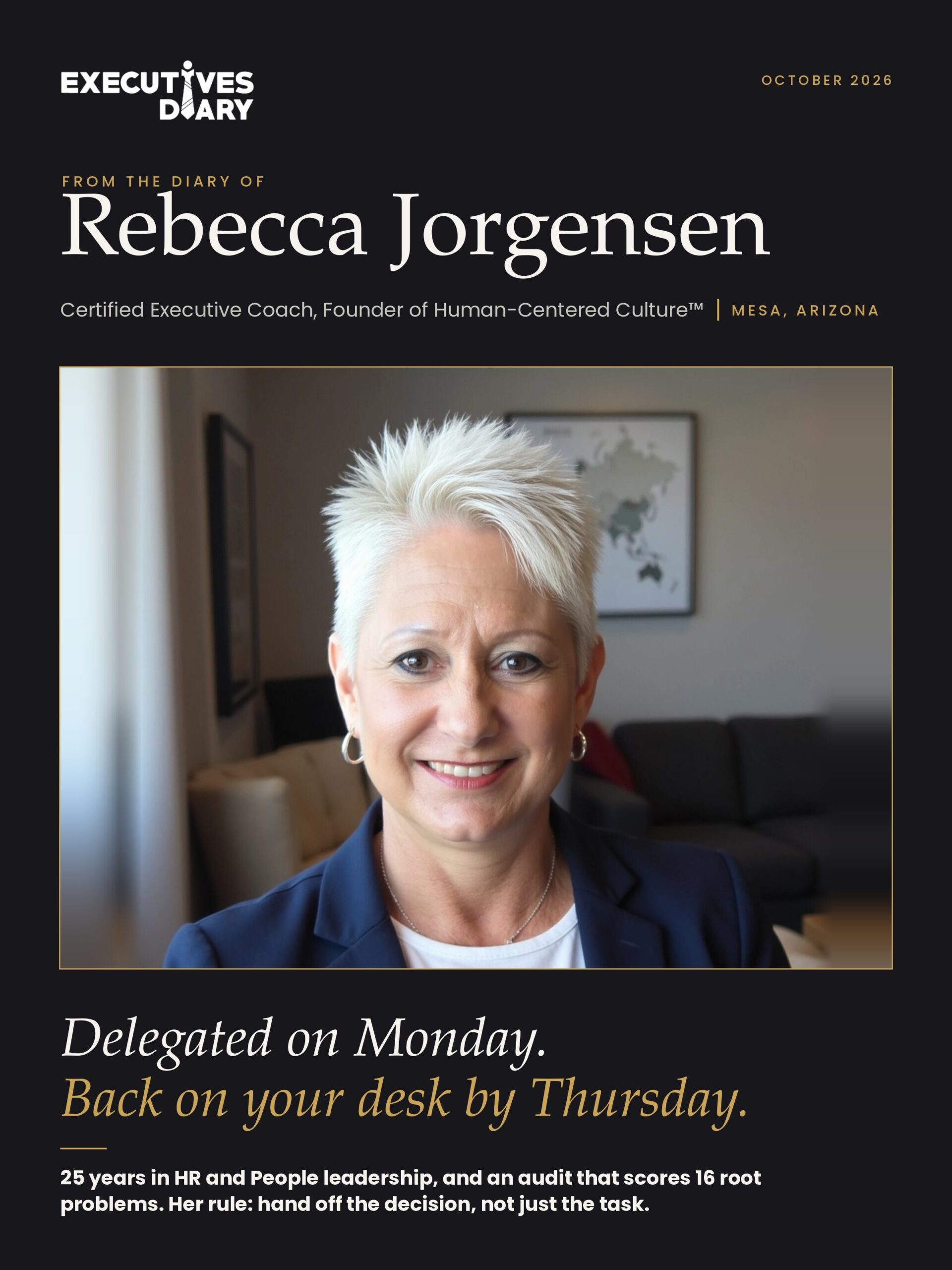
Rebecca Jorgensen
Why delegated work boomerangs back, and the system that stops it.
“When the decision travels with the work, the work stays where you put it.”
You delegated it on Monday. By Tuesday a question had come up, and the only person who could answer it was you. Wednesday brought a “just a quick check.” By Thursday the work was back on your desk, and at 9 p.m. you were wondering why nobody on your team takes ownership. Rebecca Jorgensen’s answer is simple: “The work comes back because the decision didn’t travel with it.”
The work comes back because the decision didn’t travel with it.
It isn’t a people problem, she says. It’s a clarity problem. Nobody said out loud what “done” looks like, who gets to make the call, or what happens when something goes sideways. So the work goes looking for the person who knows. That person is you.
Rebecca is a Focal Point Certified Executive Coach and the founder of Human-Centered Culture™, a coaching practice for HR and People leaders. Every engagement starts with the CliftonStrengths + Leadership System Audit™, a diagnostic that scores 16 root problems from 0 to 100. “It’s where a leader sees, often for the first time, that what they’ve been calling a personal failing is actually a system gap,” she says. The scores move, too. One client’s audit opened with two root problems at 95 out of 100. Four months later, her Leadership Scan™ came back at 83 out of 100, with Strong Alignment across all four systems.
A Clarity Problem, Not a People Problem
Her case starts where most delegation advice stops. The task was handed off cleanly. The person was capable. The work still came back. “If you delegate the task but keep the decision, the work will always boomerang back,” she says. “A task you hand off still lives on your list. Ownership you transfer leaves it.”
The fix she teaches is short enough to carry around: “Hand off the decision, not just the task. Name what done looks like. Then step back.” When the decision travels with the work, she says, the work stays where you put it.
Hand off the decision, not just the task.
She’s just as clear about what the problem isn’t. “Most HR and People leaders aren’t overwhelmed because they’re controlling. They’re overwhelmed because the system keeps routing everything back to them.”
One leader lived the whole arc, scores included.
Two Scores of 95
One HR leader came to Rebecca exhausted. Every decision, big or small, routed back to her. The vendor issue. The employee question. The “can you just look at this.” Her Leadership System Audit™ named it before she could: Role Ambiguity and Overfunctioning, both at 95 out of 100. Nine of her 16 root problems sat at a dominant level.
She wasn’t controlling. She was compensating for a broken system.
The breakthrough came in a Blueprint Session™, sixty minutes with the leader’s strengths and her audit side by side. This was someone built to finish things, and to finish them right. Watching those strengths meet her root problems, she saw the truth: she wasn’t the bottleneck. The system was. Nobody had ever defined what was hers, so everything defaulted back to her. Her strengths weren’t the problem. The way they were being used under pressure was.
They built her System Design Map, then mapped her decision flow: who decides what, what “done” looks like, and where work goes when it isn’t hers. The real shift happened in the everyday handoff. The leader realized she often had the request clear in her head but delivered it as a brain dump. So she started describing the result instead: what the finished work should look like, why it mattered, and how to begin. When work came back off-target, she stopped redoing it herself and handed it back with better instructions. After she sent one team member a single corrected document as a template, the next one came back much closer. She named the shift herself: the gap wasn’t her team. It was her system for communicating expectations.
Four months later she retook the Leadership Scan™. Her score was 83 out of 100, with Strong Alignment across all four systems, and the two patterns that had topped her audit no longer led. Capability, which covers trust, steady follow-through, and conflict handled with clarity, had become her strongest pillar. “She didn’t change who she was,” Rebecca says. “She changed the system she was working inside.”
Hers isn’t the only retake in the file.
The Evidence Isn’t on Her Résumé
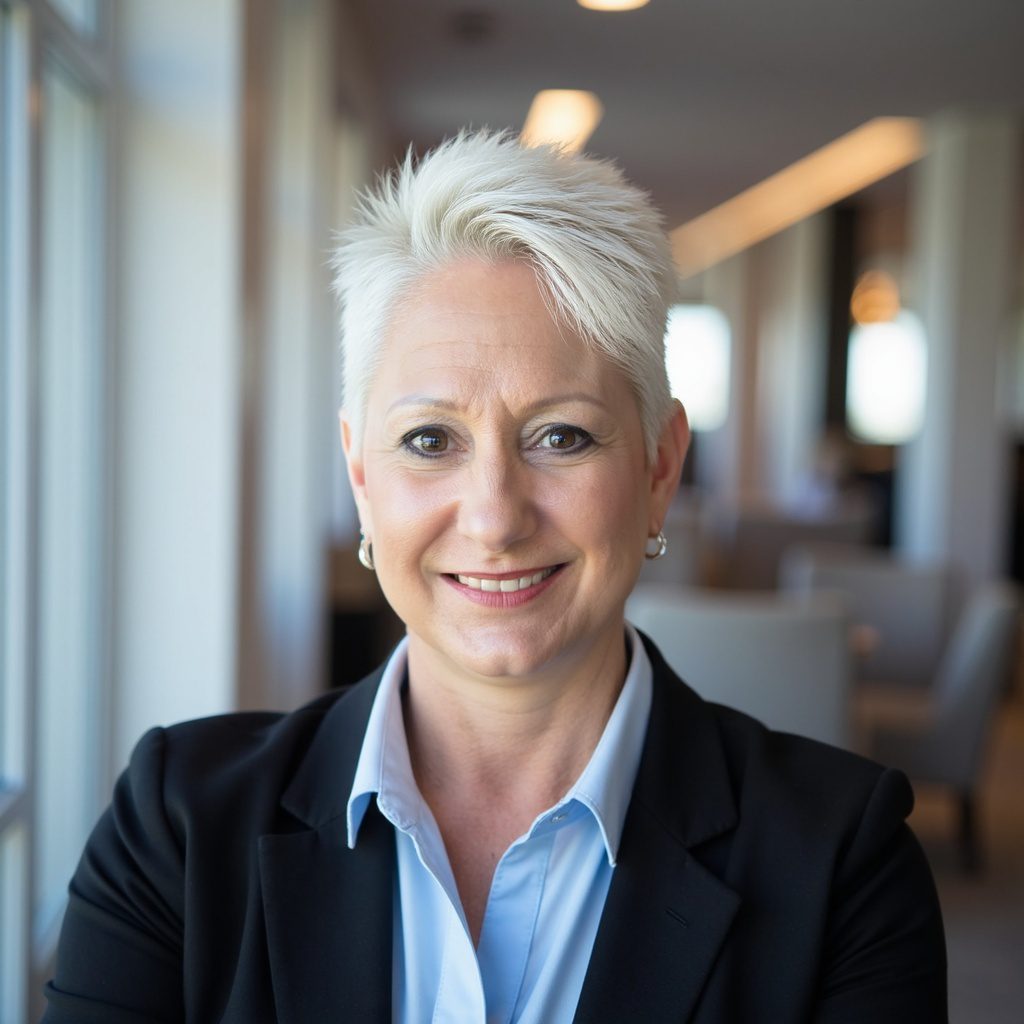
“The evidence isn’t on my résumé,” Rebecca says. “It’s in my clients’ results.” Every engagement starts with a baseline, and months later the measurement runs again.
A People leader came in with Role Ambiguity at 100 out of 100, the highest score possible, and Cultural Inconsistency at 95. Four months later, her Leadership Scan™ came back at 78 out of 100, with Strong Alignment across all four systems. Neither pattern showed up at the top anymore. Clarity, once her biggest gap, had become her strongest pillar.
Some evidence doesn’t come as a score. Another leader realized she had been writing every corrective action plan herself, which quietly told everyone the plan was hers. So sites waited for her to tell them how to finish. “She wasn’t the barrier by flaw,” Rebecca says. “She was the barrier by habit.” Now she works at the beginning and the end, clarifying who owns the outcome and then verifying it’s closed, and not in the middle.
One client wrote in her workbook that she wanted to release “the belief that being thorough requires communicating everything, that uncertainty requires more analysis, and that capacity gaps should automatically be solved through additional effort from me.” That, Rebecca says, is what it sounds like when a leader stops carrying work that isn’t theirs. Another client came in wanting only five sessions. By session three, she asked to continue.
“The evidence is consistent,” she says. “Fix the system, and the leader stops drowning.”
She can read the pattern quickly because she spent 25-plus years inside it.
Three Turns
Ask Rebecca which turns mattered across those years in HR and People leadership, and she names three.
The first came as the sole HR leader of an entrepreneurial company, building an HR function from scratch. “There was no blueprint, so I had to architect one,” she says. Clarity, communication, and capability became her foundation. They still are.
The second was eight years in a high-growth, high-complexity, private-equity environment, supporting leaders through integrations, restructures, rapid scaling, and nonstop change. Her profile puts numbers on those years: a workforce that grew from roughly 400 to more than 1,300 employees while the company integrated 19 acquisitions. Everywhere she looked, she saw the same pattern.
HR and People leaders weren’t burning out because they lacked capability. They were burning out because the system around them wasn’t built to support them.
She wasn’t describing a rare condition. In a 2022 Sage survey of more than 1,000 senior HR leaders and C-suite executives, 81% of HR professionals said they were feeling burned out.
One moment from those years stays with her. During a major organizational shift, communication drift created a breakdown between two leadership teams, “the kind you feel in the room before anyone names it.” She stepped in, rebuilt the decision flow, and re-established expectations. “It taught me that clarity isn’t a luxury,” she says. “It’s oxygen.”
The third turn was the layoff. “It dismantled the system I lived inside and forced me to build my own,” she says. She hired a career ownership coach, stopped trying to get back to anything, and started designing forward. Human-Centered Culture™ emerged from that rupture, “not as a comeback, but as a redesign.” She founded it first. Later, she chose Focal Point for community, support, proven systems, and the freedom to use her own program.
A mentor once told her, “You’re not building HR. You’re building the system that lets people lead.” She says it changed how she saw her work forever. It’s also a fair one-line description of what she builds today.
Where Rebecca Is Now
This year the work runs through one front door, the CliftonStrengths + Leadership System Audit™. “It’s the front door to everything I do,” Rebecca says. When leaders come through the audit, coaching follows naturally. “Speaking is a welcome second.”
Over the next twelve months, she wants HR and People leaders to recognize themselves in the challenge she solves, carrying work that isn’t theirs, and to take the first step before burnout becomes the cost. The reader she most wants to reach is, in her words, “the HR or People leader who is quietly drowning,” the person “who holds everyone else up, but has no system holding them.”

Outside work, the answer is distance running. In 1990 she won the Connecticut state high school championship in the 3,200 meters, and running still shapes how she thinks. “You don’t win the last lap on willpower,” she says. “You win it on the system you built long before you need it.”
The Playbook
Five Lines from Rebecca’s Diary
- “When the decision travels with the work, the work stays where you put it.”
- “It isn’t a people problem. It’s a clarity problem.”
- “A task you hand off still lives on your list. Ownership you transfer leaves it.”
- “Clarity isn’t a luxury. It’s oxygen.”
- “Fix the system, and the leader stops drowning.”
