

From the Diary of
Darren Mann
After nearly thirty years in technology and project management ended without his choosing, the coach behind Rise Above Routine makes the case that a setback is information, not an identity.
“Failure can tell me I need to grow. It cannot tell me my value as a human being.”
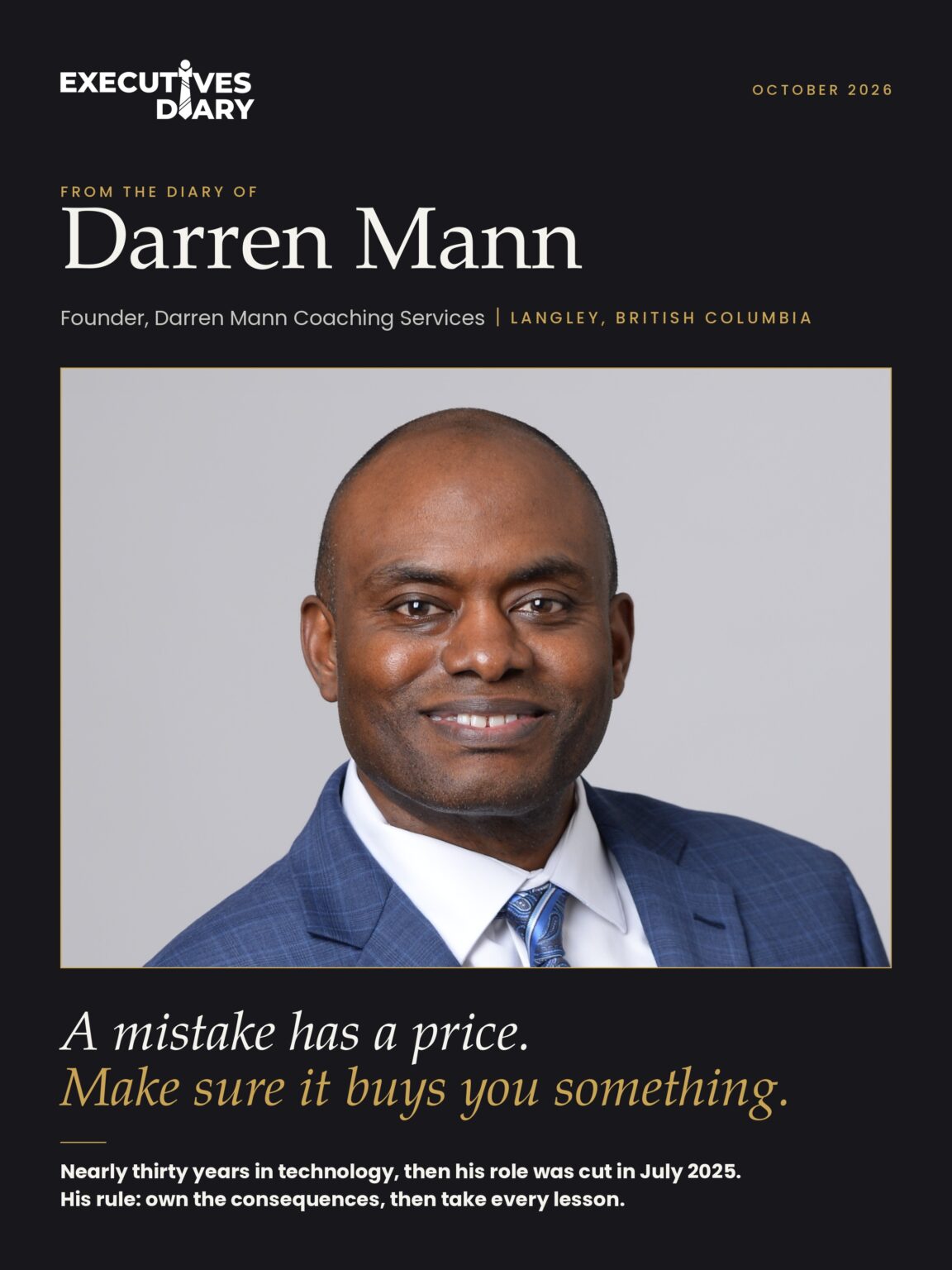
In July 2025, after nearly thirty years in technology and more than fifteen years leading complex projects, Darren Mann’s position was eliminated. Months earlier, he had guided Trinity Western University’s university-wide 2025 to 2030 strategic plan through to the Board of Governors, on time and under its $300,000 budget. Then the role ended, and the career that had given him structure, identity and financial security for decades was gone.
The uncertainty was not unique to him. Nearly a third of US workers now say they feel stuck in their current job, part of a workforce that Gallup, in a report published in March 2026, describes as restless but largely unable to move.
Darren Mann is the founder of Darren Mann Coaching Services, a Langley, British Columbia-based practice built on speaking, training and one-to-one coaching for high-achieving professionals who want, as his own profile puts it, to feel less robotic about their careers. He had been running the practice alongside his day job since August 2022. When his position was eliminated, Darren embraced the opportunity to devote more time to his coaching business, building on the foundation he had established in 2022.
Thirty Years Before the Coaching

Before any of that, Darren trained in electronics engineering technology, then spent close to three decades inside large organisations: coordinating an integrated insurance and rental-reservation rollout for ICBC across more than fifty locations in British Columbia, leading a province-wide electronic breast-screening project for BC Cancer, running major technology initiatives including electronic health records and video-conferencing standardisation at Simon Fraser University, and finally leading Trinity Western University’s 2025 to 2030 strategic plan: a university-wide effort that pulled in directors and managers from across the institution, delivered on time and under budget, and was formally approved by the Board of Governors.
Alongside that career, he had already begun building something else. Since August 2022, Darren had been coaching, speaking, training and mentoring leaders as the founder of Darren Mann Coaching Services, work he says made him feel most alive even while the day job continued. “I loved delivering projects,” he says, “but I increasingly realized that what mattered most to me wasn’t simply completing the work. It was helping the people doing the work grow.”
When his Trinity Western position was eliminated in July 2025, the choice in front of him was not whether to start a coaching practice. It already existed. The choice was whether to keep trying to replace the career he had just lost, or build, full time, the one he had been building on the side for years. “The cost was certainty,” he says. “A salary arrives on schedule. Entrepreneurship doesn’t.” He names three values that carried him through the decision: courage, growth and legacy. “Courage to step into uncertainty, growth to become someone capable of building something new, and legacy to ask a bigger question than, ‘What job should I have next?’”
A salary arrives on schedule. Entrepreneurship doesn’t.
The Case for Calling It Feedback
The idea Darren returns to most often, in his posts and in conversation, is that failure is feedback rather than a verdict on someone’s worth. It is not, he is careful to say, a claim that failure is painless. It is a distinction he learned slowly. “For much of my life, I associated achievement with worth,” he says. “When things went well, I felt confident. When they didn’t, it was easy to internalize the result and ask, ‘What does this say about me?’”
Through leadership, project management, business and some difficult personal seasons, that changed. “The turning point was learning to separate the event from my identity,” he says. Once that separation holds, curiosity replaces defensiveness: what happened, what was within his control, what he needs to learn, what he will do differently next time.
Failure can tell me something about my preparation, my decisions, my assumptions, or my strategy. It can tell me that I need to grow. What it cannot tell me is my value as a human being.
That reframing is the argument his coaching, his talks and his own comeback are all built on.
What a Stuck Client Actually Needs
High achievers who come to Darren for coaching usually arrive wanting a plan: the next job, the promotion, the business, the difficult conversation. “They’re accustomed to accomplishing things,” he says, “so their natural instinct is: give me the steps and I’ll execute them.” He has learned that another plan is often not what they need first. They need space.
Thirty years in technology and project management had trained him to identify problems and move straight to solutions. Coaching asked for the opposite discipline. “My first job as a coach isn’t to give them answers,” he says. “It’s to create enough space for them to hear their own answers.” He listens more, asks more questions, allows silence, and sometimes asks the question underneath the question, because a client who says “I need a better plan” may actually mean “I’ve lost confidence,” or “I’m no longer sure I want the life I’ve worked so hard to build.”

The Honest Answer to the Objection
The clearest challenge to Darren’s argument is that inside organisations, failure carries real costs: budgets, careers, trust. Telling a senior professional that a mistake is only feedback can read as minimizing what is at stake. Darren agrees with the premise and rejects the conclusion. “If a leader makes a poor decision that costs an organization money or damages a relationship, calling it feedback doesn’t erase the consequences,” he says. “And it shouldn’t.”
His answer keeps accountability and learning together rather than treating them as a choice. “A mature leader should be able to say, ‘I made that decision. Here is what happened. Here is the impact. I take responsibility for my part in it,’” he says. “But the next question matters just as much: what will I learn from this?” Left unchecked, he argues, shame becomes the dominant response to failure inside organisations, and people start hiding mistakes rather than surfacing them, which makes the failures that do happen more dangerous, not less. Own the consequences, repair what can be repaired, then extract every lesson available. “The question,” he says, “is whether we pay that price and learn nothing, or whether we turn the experience into better judgment for the future.”
Busy Is Not the Same as Moving
Leading the Trinity Western strategic plan, with its competing stakeholders and dependencies, taught Darren a lesson he now brings into every coaching room: activity and progress are not the same thing. “A team can have full calendars, long task lists, constant meetings, and hundreds of emails moving back and forth and still make very little meaningful progress,” he says. “The question isn’t, ‘How much did we do?’ It’s, ‘Did what we did move us toward the outcome?’”
His advice to a leader whose team feels busy but is not moving starts with clarity, not more effort: ask the team what the three most important outcomes are, not twenty, then look honestly at where the team’s time is actually going.
If your priorities say one thing but your calendars, meetings, resources, and conversations say something else, your real priorities aren’t the ones written in the strategic plan. Your real priorities are where your attention goes.
It is advice that puts the responsibility on the leader, not the team. “Leaders create movement when they help people distinguish between what is important and what is merely urgent,” he says. “That requires saying no. It requires removing work, not simply adding more.”
That requires saying no. It requires removing work, not simply adding more.
Where Darren Is Now
This year, Darren has taken the argument onto larger stages. In September 2026 he presented “Rise Above Routine” to the PMI Germany community, on recognizing limiting routines and reframing failure as feedback, and received the chapter’s Certificate of Appreciation for the session. In October 2026, Darren presented Rise Above Routine at the PMI Puget Sound Professional Development Conference in Seattle, sharing practical strategies for overcoming limiting routines, embracing failure as feedback, and stepping beyond one’s comfort zone.
The talks share a title with his book, Rise Above Routine: Embracing Life Beyond Your Comfort Zone, which carries the same argument to a wider audience: growth rarely starts with a dramatic reinvention. More often, it starts with one honest question, one new habit, or one courageous step beyond what is familiar.
Outside work, Darren is a sports fan, basketball and football especially, the NBA and the NFL. He hikes with his wife, often in British Columbia, which he calls the most beautiful place in the world in summer. He reads for about an hour most days, a habit he says brings him great joy.
Darren still returns to a line he posted not long after that July: “Don’t let one failure become a life sentence. Carry the lesson and keep moving.”
The Playbook
Five Reflections from Darren
- On failure. Failure can tell you what to change. It cannot tell you what you’re worth.
- On the plan you think you want. The plan is rarely the first thing you need. Space to hear your own answer usually comes first.
- On accountability. Own the decision, repair what can be repaired, then ask what you’ll learn from it. Both halves matter.
- On being busy. A full calendar is not proof of movement. Compare where your attention actually goes to what you say matters most.
- On starting over. Courage, growth and legacy: the three questions Darren still asks himself before saying yes to anything new.
Sources
Gallup. “U.S. Worker Thriving Declines as Job Market Pessimism Grows.” Published March 23, 2026. gallup.com/workplace/703280. Accessed September 25, 2026.
