

From the Diary of
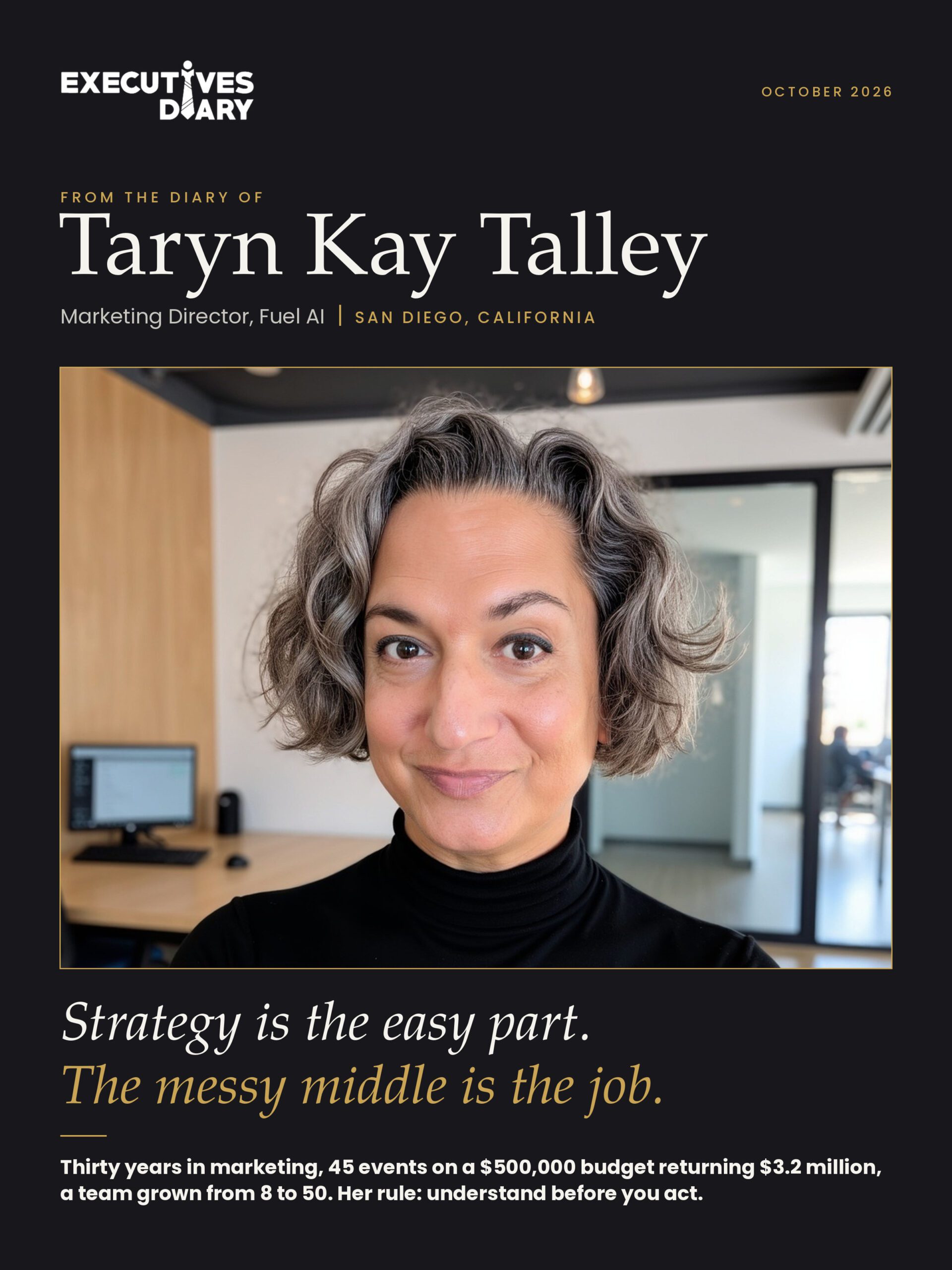
Taryn Kay Talley
If your growth strategy is stuck somewhere between the plan and the execution, this is how one senior operator gets it moving, and what it has returned.
“A strategic operator who embraces the ‘messy middle’ and builds world-class marketing programs from it.”
The company had put $18 million of capital into a marketing platform that could handle personalization at scale. Nobody wanted to use it. The previous leadership team had been fired or reassigned.
Unused marketing technology is not rare to inherit. Gartner’s 2025 Marketing Technology Survey puts Martech utilization at 49%.
Taryn Kay Talley was the person put on it. She met with all the internal stakeholders and interviewed them about their challenges, what their teams needed, and what it would take to get them on board. Then she slashed and reprioritized the backlog, got the development team on the same page and, in her words, “learned Product Management on the fly.” She got the top priorities into the tool and took it on a roadshow to the same leaders. “In a little over a year,” she says, “I scaled that platform from sending 26MM personalized emails to 250MM a year.”
That’s the work Taryn does. She’s the Marketing Director at Fuel AI, with a thirty-year career across B2C and B2B marketing, and she works in the gap between a bold growth strategy and the operational reality of executing it at scale. She calls that gap “the messy middle.” She’d like this read by the CMO or CRO looking for a senior operator to make an impact on their strategy.

The list that hasn’t changed
For the last six years, Taryn’s focus has been B2B, and coming back into it, she says, “was an eye-opener.” Colleagues and leaders kept referring to books written 15 to 20 years ago as must-reads. She started her career, as she tells it, “The month Bill Clinton was reelected,” and she’s seen drastic changes in business and marketing since. So, she keeps a list of the things that haven’t changed.
There are five. Knowing and understanding your competition and why you’re different. Treating feedback as a gift, especially from customers. Not underestimating the power of positioning and awareness. Knowing and prioritizing what your customers say about you on sites such as G2 and Trustpilot. And disciplined execution and focus, which she puts as a question: “How many #1 priorities do you have (spoiler alert: it’s 1)?”
The fourth item has numbers behind it. In G2’s 2025 Buyer Behavior Report, a survey of 1,169 B2B decision-makers found that software review sites ranked second among the sources influencing vendor shortlists, behind generative AI chatbots.
Things evolve, that’s life, but when you’re missing any one or more of the above, that’s the messy middle.
She starts by finding out which item is missing.
A few weeks of questions
At each company, B2C or B2B, Taryn has found some combination of list-related challenges. So, her first couple of weeks go to one-on-ones with team members and leadership, asking the questions. She reviews marketing performance, gets familiar with the brand and studies the competition, “wherever it takes me.”
“This is the part of my process that irritates some leaders,” she says. They’ve got something they need done now, and she doesn’t operate that way. Her position is that you need to understand what’s going on first, and that it takes a few weeks, not months.
This is the part of my process that irritates some leaders.
Over my career, leaders have been eager to jump in and get something done just to cross it off the list. That’s the fast track to team exhaustion, scope creep, budget overruns, and, quite honestly, failure in some way or another.
Ask her how she knows when it’s working and the short answer comes first: “It depends.”
Forty-five events and a CRM
At one firm, the top two revenue-generating actions were CEO-led sales and referrals. Taryn saw an awareness challenge and stood up an event practice that within three years became the number three revenue-generating action, “and yes, we tracked that in the CRM.” The events tied into existing communities and created what she calls a “human-to-human connection.” Each event is a marketing touch, and for her the point of a touch is a strong follow-up: taking a new contact to lunch, sending a case study that addresses their pain point, or inviting them to the next event. Her count is 45+ events over five years, contributing to $3.2 million in revenue on a $500,000 budget.
She has described how she designs them. On a snowshoe trek at one off-site, only one person in the group had done it before, and one had never touched snow. “That’s the whole design behind my events,” she wrote. The format changes (whiskey tastings, an Argentinian parrilla, a mobile Finnish sauna at a lake) and the mechanism stays the same: put people in what she calls “a shared first.” As she wrote, “When nobody in the room has done the thing before, titles stop mattering, and actual bonding starts.”
When nobody in the room has done the thing before, titles stop mattering, and actual bonding starts.
The second proof point had nothing to do with events.
A content engine and a team at the breaking point
It began with a content engine that didn’t exist and a core social media platform collecting dust. She took on both, though she’d been warned to skip the social platform. She built structure and strategy around thought leadership, edited every article for tone and voice, and brought in and managed four freelancers to write targeted content for their ideal customer profiles. The content engine doubled website visits, increased time on site by 30%, and consistently appeared in the top 50 pages in Google Analytics. Consistent posting on the primary social platform grew followers by 40% and quadrupled engagement rates.
“At another company, I came into a hostile organization,” Taryn says. A huge data breach the year before had stretched the process of getting an email campaign out the door from two weeks to six by the time she arrived. The team was overworked and at the breaking point.
She met with every team member. “I listened and acted,” she says. She took on net-new campaigns to lighten the load, stood up for the team in prioritization meetings, and fought to remove duplicative or unnecessary controls. She led the team out of it and grew it from 8 to over 50 employees in a couple of years.
The habit of looking at a problem before touching it has a source.
What design taught her
Taryn holds a Bachelor of Fine Arts in Communication Design from Kutztown University of Pennsylvania. In 2023, NASDAQ ran an interview on her career titled “A Creative’s Path to Leadership.”
I love a problem almost as much as I do a challenge. I spent a third of my career leading creative teams. Design is about solving challenges and problems.
Design, she says, is about maintaining brand and positioning while developing creative that drives action or catches attention, and it forces you to see a problem from all sides. Some of her most effective team members have come from a creative background. “For me, it’s my X-factor.”
Her record includes Roku and JPMorgan Chase, where, as she puts it on her profile, she reduced vendor spending by $1.2 million by building an internal digital comms capability in under a year. In February 2022, she joined Position2 as Head of Marketing. That year, she has written, she stepped into a role that required her to build an event marketing practice, two and a half decades into her career. At Position2, she has managed the marketing and guest recruitment of the Spark of Ages podcast since October 2023 (achieving global top ten percent podcast status), and in March 2026 she led the planning, operations, and execution of the company’s fourth annual Growth Marketing Summit in Park City, Utah. In 2023, she completed the ANA CMO Leadership Program at the Institute for Real Growth.
She credits part of how she leads to the people she worked for.
The leaders she watched
Taryn says she was fortunate to work with a few great leaders. “Clay and Theresa are standouts to me,” she says, “not so much in what they said but in what they did and how they empowered their people.”
Asked for a hard moment, she shares her approach instead: “I learn from them and move forward.” Her advice to others is to “do your best, stay true to your values and who you are.”
Where Taryn Is Now
Taryn leads growth and brand marketing at Fuel AI, a data marketplace that connects data scientists, engineers, architects, and CTOs with a global network of data collectors to create bespoke data sets. On the company’s LinkedIn page, she reports a follower count up by over 10% and a doubling of organic reach and engagement. Her current focus is AI-augmented growth systems and generative engine optimization, or GEO. “You can’t ignore GEO, especially if you want to be competitive,” she has written. She is also a member of the Customer Advisory Forum at Boardy, sharing feedback and insights with the Boardy AI product team.
“I’m doing some of my best work right now; I’m digging in and having fun building apps on Gemini and Lovable,” she says. Outside work, the same instinct holds: “I love learning… always have, and it impacts my work and personal life.”
Over the next six months, she wants this piece in front of CMOs and CROs who are looking for a senior operator to make an impact on their strategy, and she’s open to more podcast appearances and media inquiries.
Whatever the assignment turns out to be, she’ll take it the way she has taken the others. “I try to break down complex challenges into bite-sized pieces and take it a day at a time,” she says. “It’s a marathon, not a sprint.”
It’s a marathon, not a sprint.
The Playbook
The Taryn Kay Talley Playbook: Working in the Messy Middle
- Understand before you act. Spend the first couple of weeks in one-on-ones with the team and leadership, and review performance, brand, and competition before starting anything.
- Keep one #1 priority. Disciplined execution and focus are on her list of things that have not changed.
- Read what customers say about you. Feedback is a gift, and what customers post on review sites such as G2 and Trustpilot gets priority.
- Follow up every marketing touch. A lunch, a case study that addresses the contact’s pain point, or an invitation to the next event.
- Track it in the CRM. This is how she showed that an event practice became the number three revenue-generating action within three years.
