

From the Diary of
Sharon Eden
A psychotherapist coach of more than forty years on why the restlessness so many women meet in midlife may be carrying information about who they’re becoming, and why she now thinks of the first fifty years as an apprenticeship.
“What if there’s nothing wrong with you?”
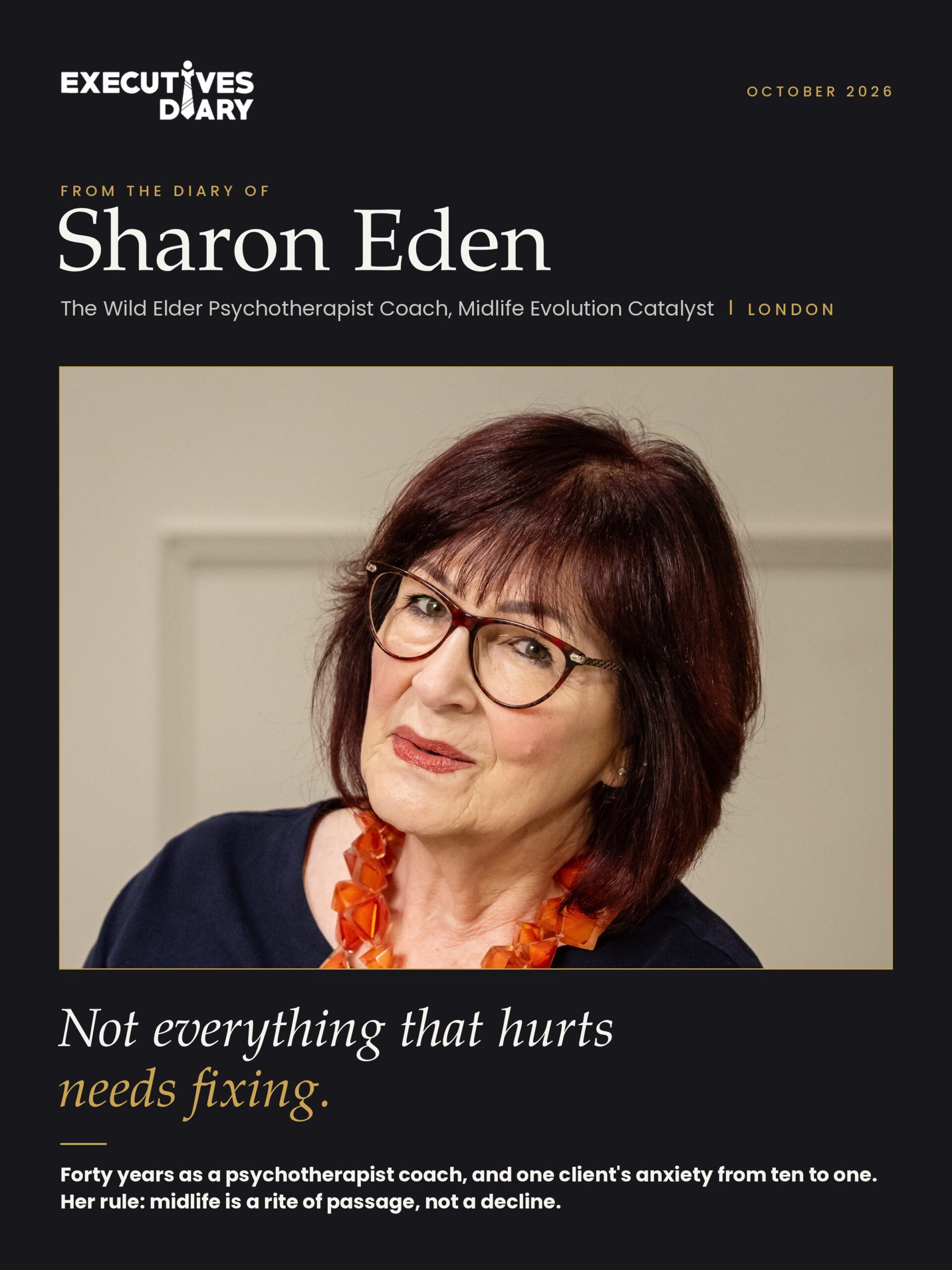
For more than forty years, Sharon Eden has worked as a psychotherapist coach with women who’ve reached the point she sums up in one sentence: “There has to be more to life than this!” She works with them one to one, in a small-group programme called The Soulful Boardroom and, from September 2026, in a twice-monthly online hour called Soulful Momentum. She’s the author of RE-DISCOVERED, published in 2024, and she practises under the name The Wild Elder, from London.
What she offers those women is not a fix. The line she finds herself repeating, to clients and to anyone who’ll listen, is a question: “What if there’s nothing wrong with you?” Her position is that the discomfort a woman feels when a successful-looking life stops fitting on the inside isn’t necessarily a crisis, and isn’t the start of a decline. It may be developmental: a movement away from the woman she was conditioned to be, toward one far more aligned with who she is at essence. And Sharon thinks it doesn’t stop at midlife. It can carry on into what she calls Wild Elderhood.
Two Days Before Her Mother Died
She dates the beginning of that view to a kitchen. Her mother was 89 and terminally ill, and Sharon was making tea for the two of them when she heard her say, to herself, “What a waste of a life!”
“Her words struck me dumb, and I froze, overwhelmed by their enormity and pain,” she says. Her mother died two days later. “In the aftermath and turmoil of the grieving that followed, I had this sudden realisation that, from here on in, no woman I ever worked with would die thinking she’d had a wasted life as my mother had. This would be my mother’s legacy as well as my own.”
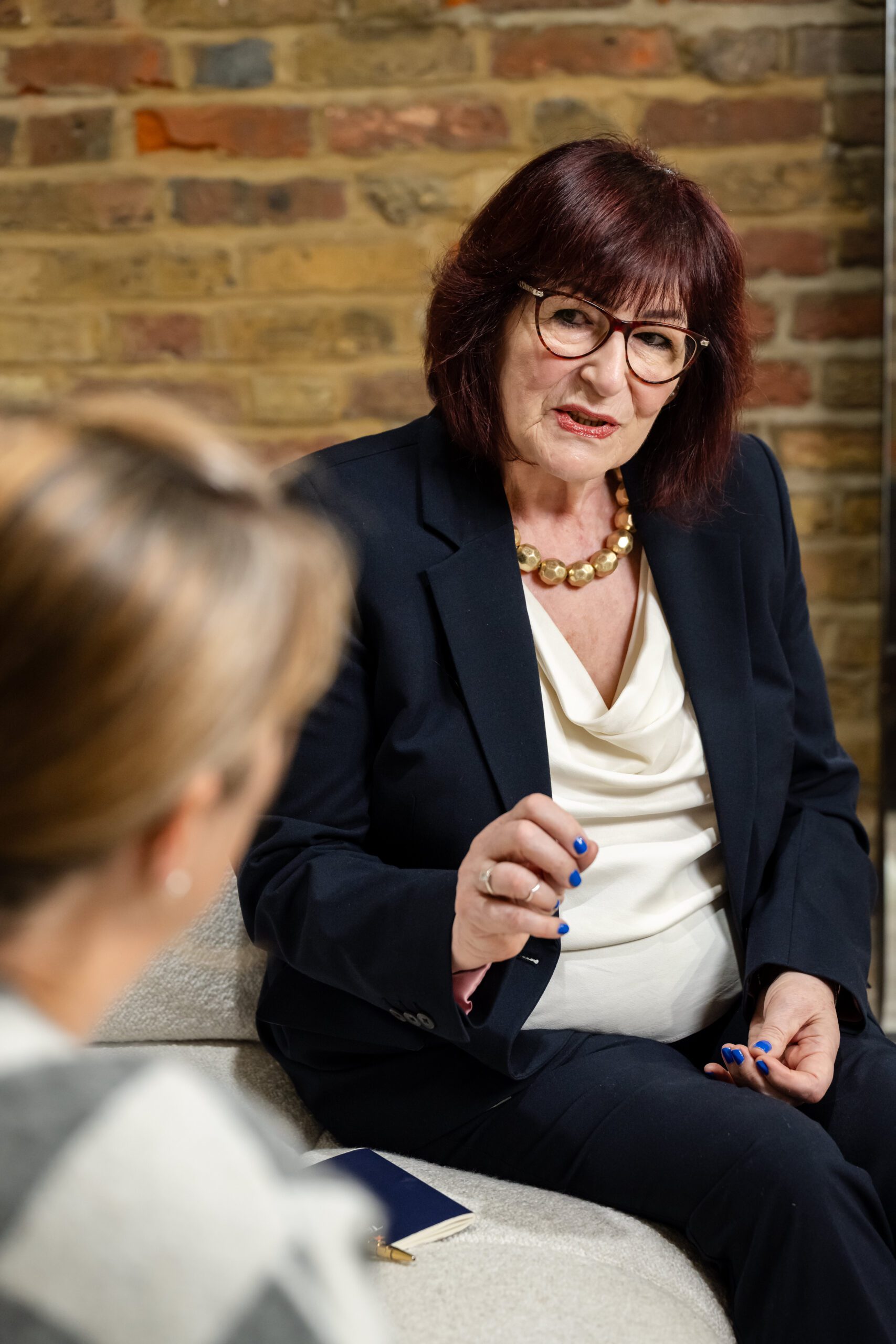
She remembers her first client after she went back to work. “A small, trim woman; she and I sat opposite each other in the periwinkle blue armchairs of my consulting room. Sunlight filtered through sheer, opaque curtains, lighting up her concerned face.” The woman said she no longer felt “joined up,” that she was going through the motions of her life, numb and overwhelmed at the same time. She wanted “to feel like me again.” As they talked, it became clear she no longer felt she fitted her job or quite a lot of what she did outside it.
“When I said, ‘Perhaps, it’s not that you don’t fit those aspects of your life, but rather that they no longer fit you,’ she burst into tears, expressing relief,” Sharon says. “A truth had been spoken. She was growing as a person organically, as if in a skin that was too tight.”
Sharon had always worked to help potential emerge, but it was that woman, and the women who followed her, who helped her recognise what she now describes as a rite of passage.
Not Everything That Hurts Needs Fixing
“I tell people that not everything that hurts needs fixing or transforming,” she says. “That what we so readily call a ‘midlife crisis’ in men and ‘the menopause’ in women can actually be the beginning of a rite of passage into the most potent version of yourself yet.”
She doesn’t dismiss the usual explanations. When a woman reaches that point, the tendency is to look for what’s gone wrong, and the list is long: burnout, perimenopause or menopause, depression, the sandwich years between children and ageing parents, an empty nest, a failing relationship, a loss of purpose and meaning. “Of course, all of those can be real,” she says, “but after more than 40 years working with women, I believe something more fundamental is happening. The woman she was conditioned to be, the one she thought she ought to be, no longer fits the woman she is now or the one she’s becoming.”
The phrase she uses for what comes next is Wild Elderhood, and she’s precise about what she means by it. “Not Elderhood as a polite word for getting old, but as continuing psychological and spiritual development. The evolution moves increasingly away from external approval, performance, and ‘Who should I be?’ toward inner authority, discernment, meaning, and ‘Who am I now, and what’s mine to bring?'”
Which is why she doesn’t think the job of the person in the other chair is to make a woman comfortable in her old life again. “If we simply help her adjust to what no longer fits, we may be doing her a profound disservice by silencing the very discomfort that could be calling her towards further growth,” she says. The job, as she sees it, is to work with that discomfort “as if it is birthing pain, to enable what urges to be born in her.” She has one woman in mind when she says it.
Sarah, at 46
“Sarah,” with the name changed, was 46, bright, articulate and professionally successful, with what looked from the outside like a very good life. She’d become increasingly restless, anxious and disconnected, waking in the early hours asking herself, “Is this it?” and wondering if something was wrong with her. She feared she was losing her mind.
“What became clear was that she wasn’t broken and her life wasn’t necessarily ‘wrong,'” Sharon says. What emerged instead was a growing mismatch between the woman Sarah had learned to be and the woman she was now. Over the two years they worked together, the focus wasn’t on getting rid of the discomfort but on understanding what it was trying to tell her, and on reconnecting her with her own inner authority, values and direction. “As this progressed, her discomfort dissipated of its own accord.”
As this progressed, her discomfort dissipated of its own accord.
Sharon puts numbers on it, on a scale where nought is the least and ten the most. When they began, Sarah rated her anxiety at ten, her sense of disconnection at nine and “feeling more me” at one. After two years, anxiety was at one or two now and then, disconnection mostly at nought, and feeling more herself mostly at nine or ten.
“Sarah didn’t simply become less anxious; she became more herself,” Sharon says. “She began to recognise the difference between the woman she’d been conditioned to be and the woman she actually was, developed greater inner authority and self-trust, became much more discerning about what mattered to her, and increasingly made choices from the inside out rather than according to what she thought she should want.”
The restlessness that had frightened Sarah turned out to be carrying information: the life and identity that had fitted an earlier version of her no longer completely fitted the woman she was becoming. Sharon sees that movement as the great possibility of midlife, and she has a name for where it can lead if a woman keeps developing rather than simply growing older.
Midlife asks us to question the identity we’ve constructed. Elderhood asks what becomes possible when we no longer need to perform it.
What Stayed the Same Since 1984
Her profile puts the start of her practice in 1984. Her primary training was seven years of Psychosynthesis, a transpersonal psychology, and she says it gave her one of the things that has never changed in how she works. “I’ve never seen the person sitting opposite me as the problem she brings into the room. My 7 years of training in Psychosynthesis taught me the problem you bring is a clue to what of your potential is trying to emerge.”
It also gave her a frame that went beyond “What’s wrong and how do we fix it?” “It recognises that we always have potential pressing towards expression as well as wounds needing healing,” she says. “I learned to listen not only to the problem a woman brought me, but to ask what that problem might be telling us about the person trying to emerge through their conditioning and pain.” What Psychosynthesis calls the Higher Self Sharon calls the Wild Soul, which “holds your original design, your potential.” She later took an MA in Counselling & Psychotherapy at the University of East London, in 2001, and is a Registered MBACP Psychotherapist (Accred).
The hardest stretch of her career began while she was specialising in working with depression. “I knew, with absolute certainty, that this wasn’t ‘it’ for me, that there was more I was meant to do with my work, but for the life of me I couldn’t see what it was,” she says. The number of clients she was seeing began to fall. “Looking back, I’m sure my own lack of alignment was showing up in my practice.” Then her mother became ill, and the words in the kitchen landed “in the middle of my own questioning.”
Looking back, I’m sure my own lack of alignment was showing up in my practice.
“Ironically, I now recognise that period as my own experience of exactly what I see in so many midlife women: the painful space where what you’ve been doing no longer fits, but what you’re becoming hasn’t yet revealed itself.”
What has changed in four decades, she says, is the size of the arc she can see. “What I once recognised intuitively in individual women, I now see as part of a journey that can continue through midlife and into Wild Elderhood.” She knows the serious arguments against that view, and she makes them before anyone else does.
Where She Agrees With Her Critics, and Where She Stops
Asked who in her field disagrees with her most, Sharon doesn’t name a person. “My disagreement isn’t really with one person. It’s with any model, psychological, medical or cultural, that sees development as primarily belonging to the first half of life and later life largely through a lens of maintenance, deterioration or managing loss.”
She thinks the best argument against her is an important one. “Depression is real. Trauma is real. Menopause can have profound psychological and physical effects. Bereavement, illness and ageing bring real losses, and we do women no favours by putting a spiritual gloss over genuine suffering. I agree with all of that. Where I disagree is with stopping there.”
She points to research on later life that, in her words, “increasingly gives us reason to take later-life development seriously.” Laura Carstensen’s socioemotional selectivity theory, summarised in The Gerontologist in 2021 after decades of study, holds that as people experience time as more finite they become more selective, giving priority to emotionally meaningful goals and close relationships over exploration and accumulation. Lars Tornstam’s theory of gerotranscendence, first set out in 1989, argues that what gerontologists had labelled disengagement in later life is often a positive development toward a different relationship with self, others and existence, usually accompanied by greater life satisfaction. And a 1993 study by Dan McAdams, Ed de St. Aubin and Regina Logan in Psychology and Aging found that generativity, the concern with guiding and contributing to those who come after, remains developmentally important well beyond youth.
“For if we buy wholesale into the decline model, we risk colluding with it, expecting less of ourselves precisely when further development could still be possible,” Sharon says. She doesn’t deny decline. “At the ripe old age of 78, that would be ridiculous, as my wonderful body shows evidence of wear and tear.”
What I challenge is the assumption that physical ageing and psychological or spiritual development have to travel in the same direction!
That assumption is one she was handed early, without it ever being said out loud.
An Apprenticeship for Wild Elderhood
The unspoken belief she was given turned out to be wrong. “That growing older inevitably means becoming less relevant, less powerful and less visible as a woman. I don’t remember anyone sitting me down and saying those exact words. It was more powerful than that because it’s embedded in the culture and the collective unconscious.” Particularly for women, she says, youth is associated with possibility and ageing with diminishment.
The thing she’s changed her mind about in the last five years is ageing itself. “I used to think of midlife as a rich territory where women could reclaim themselves. I now see that as only half the story. Midlife can also be the beginning of a much longer developmental journey into what I call Wild Elderhood.”

A Wild Elder, she says, isn’t simply an older person. “Age gives us experience, but it doesn’t automatically give us wisdom. Elderhood requires us to metabolise that experience, to become more discerning about what matters, less governed by approval and performance, more able to live from inner authority, and increasingly concerned with what we contribute, transmit and leave behind.”
It has led her to a conclusion she calls provocative. “We think we’re our most potent self during our younger years, but I believe that’s an illusion.”
We think we’re our most potent self during our younger years, but I believe that’s an illusion.
I increasingly think of the first 50 years or so of life as an apprenticeship for Wild Elderhood.
“And for women who grasp that development with both hands,” she says, “it brings us to the most potent version of ourselves yet.”
Where Sharon Is Now
Soulful Momentum launched on 17 September 2026. It’s an online hour, twice a month, that Sharon holds for busy midlife women who struggle to find sacred me-time for themselves, with a replay for anyone who misses one, no contract and no minimum membership. A few days before the launch she wrote on LinkedIn that she’d thought about little else for months: “Pulled it apart. Put it back together. Got bits wrong. Had lightbulb moments. Changed my mind. And soon, I’ll have to let it go and see what it becomes.” What she hopes it becomes is a place where a woman arrives and “their shoulders drop, they exhale a sigh… Aaaaaaah, this is for me.”
The Soulful Boardroom runs alongside it, a 90-day business programme she has described as “a small circle of women ready to trust themselves more than the latest business guru.” She continues to work one to one. Her book, RE-DISCOVERED, published by Intellectual Perspective Press in 2024, was an Amazon bestseller in October that year, and her free Wild Women’s Manifesto is on her website.
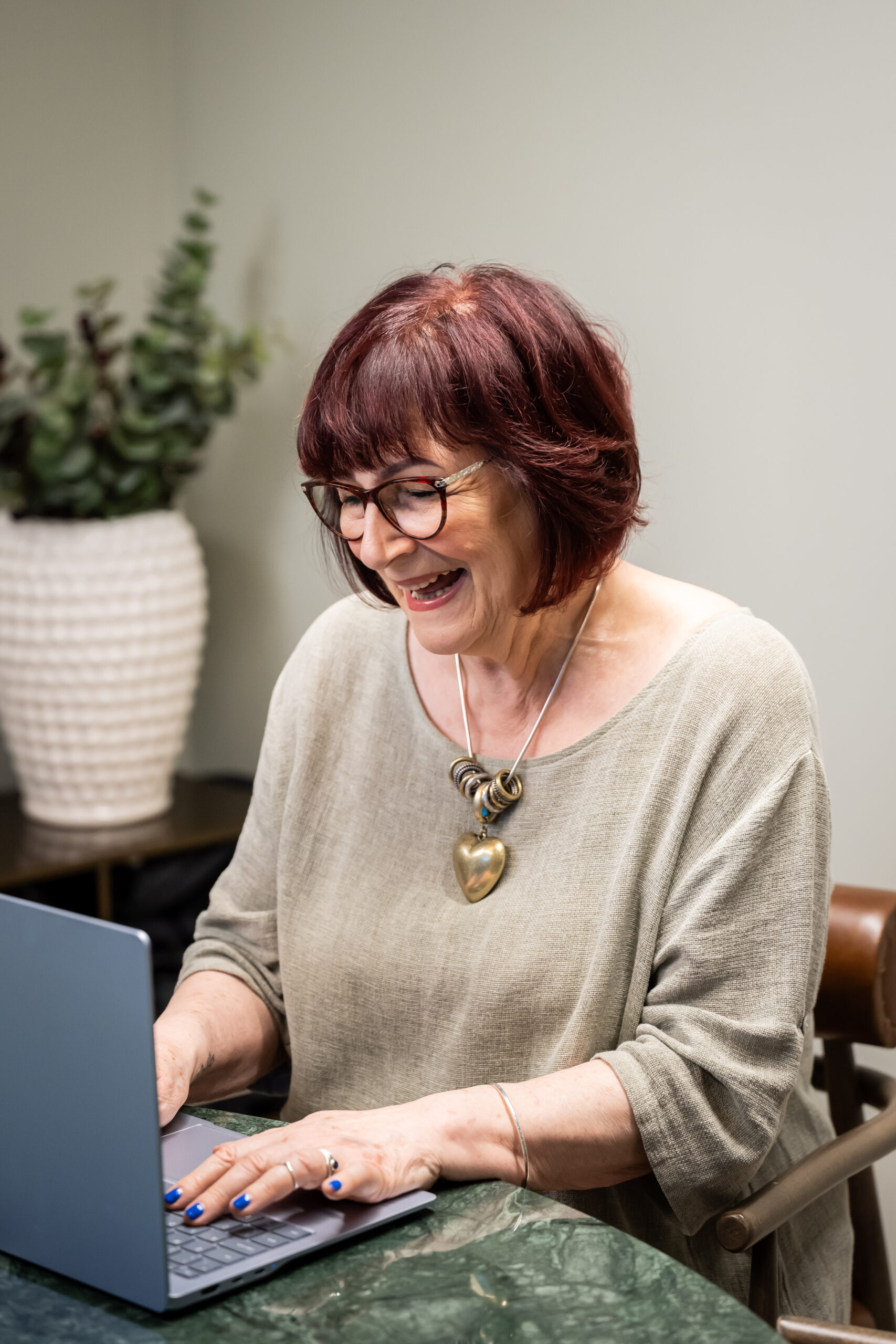
A former client, Chelsea Green, wrote on LinkedIn: “The work has gone deeper and been more transformative than anything I’ve ever experienced before. Her approach is gentle yet deeply impactful, and she created a safe space where I felt truly seen and supported.”
What Sharon is working toward now is a much bigger public conversation around women’s development in midlife and beyond. She wants to hear from prospective clients, from collaborators, and from podcast hosts and other media who want to take the ideas further.
Asked what she’d be doing if she had never gone into this field, she says an actress or a journalist, or both. “They were the two things I wanted to be when I was young. And actually, perhaps they’re not as far removed from psychotherapy as they sound. All three are fascinated by people, by the stories we tell about ourselves, and by what’s really going on underneath them. Although knowing me, I’d probably still have ended up asking everybody far too many questions about who they really are!”
The Playbook
Five Reflections from Sharon
- What if there’s nothing wrong with you? “Often, the thing she most wants to get rid of is carrying important information about what’s trying to grow in her.”
- Is it you that no longer fits, or the life? “Perhaps, it’s not that you don’t fit those aspects of your life, but rather that they no longer fit you.”
- What is the problem a clue to? “The problem you bring is a clue to what of your potential is trying to emerge.”
- Does experience become wisdom on its own? “Age gives us experience, but it doesn’t automatically give us wisdom.”
- Who am I now, and what’s mine to bring? “Human development doesn’t have a use-by date.”
