

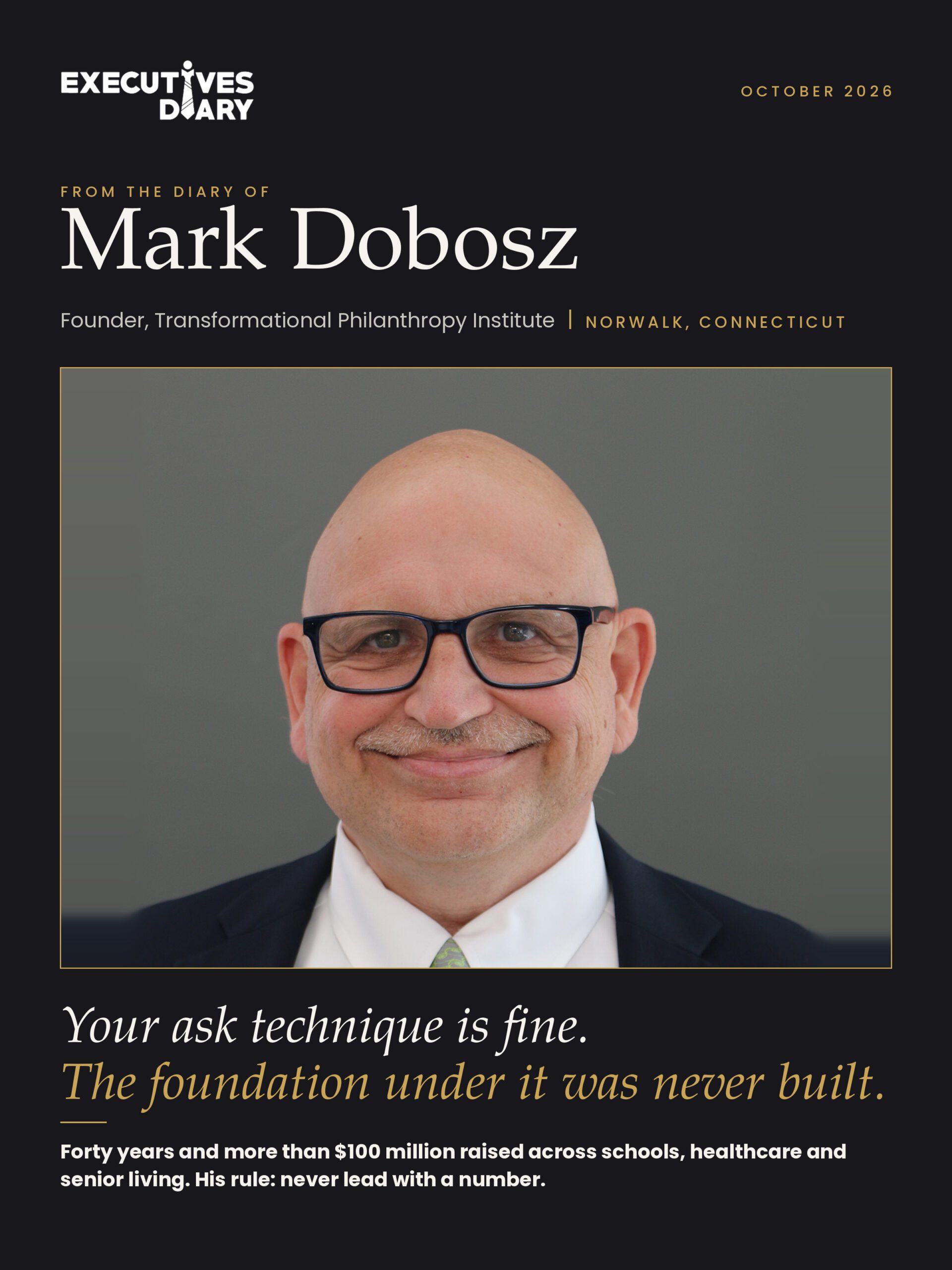
From the Diary of
Mark Dobosz
Your ask technique is fine. It is sitting on a foundation nobody built. Here is how to build it.
“The gift is the entry point, not the endpoint.”
Charitable giving in the United States grew by an estimated 5.0 percent in 2025, the strongest year the sector had seen in five. The number of people giving fell by 3.6 percent, the fifth consecutive annual decline. More money, from fewer people, concentrated at the top.
Mark Dobosz has spent forty years on the inside of numbers like these, raising more than $100 million across independent schools, healthcare, senior living and national foundations. He argues that the growth is hiding the failure rather than answering it.
Overall donor retention edged from 43.1 percent to 43.3 percent. New donor retention did not move at all. Converting a first gift into a second remains the thing the sector cannot do, and the standard response has been better segmentation, tighter ask strings, sharper scoring.
Dobosz thinks that is the wrong repair. What follows is why, and the sequence he uses instead.
The Ask Is Not the Relationship
Sit through enough fundraising training and the sector’s model becomes visible. The ask is the event. Everything before it is preparation, everything after it is stewardship, and the skill worth teaching is what happens in the room when the number gets said out loud.
Dobosz tells experienced fundraisers this is backwards, and he knows precisely where they stop listening.
Veteran fundraisers built their careers on ask technique: the right setting, the right amount, the right pause after the number. I tell them the technique still matters, but it’s load-bearing on a foundation of moral biography and values resonance that most shops never build. That’s the resistance point.
It sounds like an attack on craft, which is why it lands badly. It is not. His claim is narrower and harder to dismiss: skill aimed at a donor whose identity and values were never explored is, he says, “optimizing the wrong variable.”
The gap he is describing has been measured. In 2013, CompassPoint and the Evelyn and Walter Haas, Jr. Fund surveyed more than 2,700 executive directors and senior development staff on whether their organizations had a culture of philanthropy, defined as most people in the building acting as ambassadors and fund development treated as a program of the organization rather than one department’s problem. More than two in five said they had none at all. Among development directors, only 12 percent strongly agreed one existed where they worked.
That is the foundation Dobosz means. Most shops are running technique on top of nothing.
His own position on this changed recently. “I used to think donor retention was a stewardship problem,” he says. “I now think it’s a culture problem, the shops that keep donors are the ones where the whole organization treats giving as a relationship, not just the development office.”
I used to think donor retention was a stewardship problem.
Moral Biography Before the Gift
The SCORE Foundation, 2004. Dobosz was building a fundraising operation from nothing for an organization with two boards, more than three hundred chapters competing for the same dollars, and roughly $74,000 coming in a year. What he noticed in that job was not a technique. It was a pattern in who gave and why.
People gave most generously not where the need was greatest, he says, but where their own identity was strongest.
And they did not want to be spectators to that mission. They wanted to be participants in it, to feel the pull of ownership that comes from knowing their name, their effort, and their belief helped make the outcome real. The gift was the entry point, not the endpoint. What kept them engaged was the sense that they were co-creating the future they cared about, not simply funding someone else’s plan for it.
Giving, in that reading, is “an act of self expression.” The donor is not asking what their money will do. They are asking who they will become.
He had the instinct before he had the vocabulary. His mother took him and his sisters to every church outreach effort of their childhood, he says, “regardless of how little we had to give.” That is where the idea he now calls philanthropy as identity, not generosity, actually comes from, and it explains why his method starts with the person rather than the project.
Before healthcare and senior living there were independent schools, University Liggett School in Grosse Pointe and Out-of-Door Academy in Sarasota. Different donors, different product, same opening move. He never led with the ask. He led by finding out what the school meant to that family, which teacher or turning point they would name if asked why they cared.
Sitting with a school alum in 1994 or a resident’s adult child at Mozaic last month, he says, the discipline is identical. “You earn the right to ask by understanding the story first. The setting changes. The sequence doesn’t.”
You earn the right to ask by understanding the story first.
What Happens Before Anyone Says a Number
The practical instruction is easier to state than to follow: do not name an amount at the first meeting.
Dobosz was told the opposite early on, and it worked, which is what makes it dangerous. “It closes gifts faster but it teaches donors to think transactionally from day one, which is exactly what you spend the next ten years undoing,” he says. A shop that opens with a figure has trained the donor to evaluate every future conversation as a price negotiation. The organization then spends a decade paying for the speed it bought in the first hour.
What replaces the number is the moral biography: what this cause means to this person, what they would name as the reason they care, what part of their own story they are trying to make permanent through the gift.
The strongest objection to all of this comes from people citing the same data he cites. Growth is concentrating among fewer, larger donors, budgets are tight, and multi-year trust building is a luxury when payroll is due Friday. On that view, disciplined transactional fundraising is what keeps the lights on.
Dobosz does not wave it away. “It’s not a weak argument,” he says. “I’d just say it mistakes what’s sustainable for what’s merely survivable this quarter.”
I’d just say it mistakes what’s sustainable for what’s merely survivable this quarter.
Who Will Raise the Money When the Money Raisers Are Gone
The second problem he is working on has no budget line attached to it, which is why it stays invisible until it is acute.
Senior fundraisers are retiring, he wrote in the Stanford Social Innovation Review article that carries that question as its title. The people who learned how to build real donor relationships are leaving. Younger professionals are not entering the field in the numbers required, and mid-career fundraisers are being squeezed out by a culture he describes as quota-driven, metrics-obsessed and allergic to slower relationship work. The pipeline is narrowing from both ends at once.
The 2013 survey saw the front edge of it. Half of development directors expected to leave their jobs within two years. Forty percent said fundraising was their current field but they were not sure they would stay in it for a career.
This is what the Transformational Philanthropy Institute exists to address. The Executive Certificate in Transformational Philanthropy runs thirty-six hours across six sessions, carries thirty-six CFRE education points, and draws on the research of Jen Shang and Adrian Sargeant, Paul Schervish, Jim Langley, Jason Lewis and Sanjay Bindra. Around it sit the books in his Transactional to Transformational Philanthropy series, a set of free assessment apps, and a newsletter.
He is not building a course. He is trying to train a replacement generation before the current one finishes leaving.
Nine Years, and What They Cost
The SCORE Foundation is also the proof. Dobosz worked with the CEO and the two board chairs to consolidate the Foundation and Association boards, strengthened what chapters could raise on their own, and pivoted national fundraising toward corporations. Nine years after the $74,000 year, the Foundation was raising $3.2 million annually, hosting an annual awards gala, and running three nationally sponsored programs for veterans, rural small businesses and entrepreneurs across all fifty states.
It was also the hardest thing he has done.
Building something from nothing means every failure is yours alone, there’s no institutional history to lean on and no predecessor’s goodwill to borrow. It cost me the illusion that passion is enough. What it gave me was the conviction that transformational philanthropy isn’t a technique you apply, it’s a culture you build from the first donor conversation, because there’s no legacy culture to inherit.
The rest of the record is consistent with it. Eighty-nine percent revenue growth at the John Knox Village Foundation. Forty years and more than $100 million across four sectors. An executive certificate in nonprofit management from Notre Dame’s Mendoza College of Business. Twenty-six recommendations on his profile, one of which reads: “Working with Mark is like plugging into a power source of fresh thinking and industry insights. He blends strategic thinking with deep empathy, challenging the old fundraising playbook in all the right ways.”
Where Mark Is Now
Dobosz lives in Norwalk, Connecticut, and leads philanthropy at Mozaic Senior Life in Bridgeport while running the Transformational Philanthropy Institute. He teaches nonprofit leaders, boards and fundraisers how to build the culture that makes asking work, through the certificate program, the books and the assessment tools. He sits on the board of advisors of GOLD, a nonprofit that teaches older adults to use the digital tools that keep them independent, from sending a text to navigating a patient portal.
Asked what he would be doing if he had never gone into fundraising, he says something hands-on. Healthcare, maybe, or teaching.
“The through-line I care about is the same either way: being close enough to someone’s life to actually change its trajectory, not just write about it or fund it from a distance.”
The Playbook
The Mark Dobosz Playbook: Building the Foundation Under the Ask
- Build the biography before the ask. Find out what the cause means to this person and which moment they would name as the reason, before any conversation about money.
- Never lead with a number. Naming an amount at the first meeting closes faster and trains the donor to treat every later conversation as a negotiation.
- Treat retention as culture, not stewardship. Organizations that keep donors are the ones where everyone, not just development, treats giving as a relationship.
- Make donors participants, not spectators. People stay engaged when they are co-creating an outcome their name and effort helped make real, not funding someone else’s plan.
- Train the bench before you need it. Senior fundraisers are leaving faster than the field is replacing them, and no ask technique survives an empty pipeline.
Mark Dobosz teaches transformational philanthropy at ectponline.com. Connect with him on LinkedIn.
