

What an ethnologist looks for when an organization says its culture is great, and why a software module, two books and a consultancy turn out to be one piece of work.
“Most toxic workplaces were not built by bad people. They were built by reasonable decisions that nobody ever put in the same room.”
That is how a LinkedIn post opened on the first of September. It went on to list four such decisions: “A promotion rule that quietly rewards visibility over delivery. A feedback channel that routes through the person the feedback is about. A hiring loop optimized for speed, which filters out everyone who asks slow questions. A meeting culture where the decision is made before the meeting, and the meeting exists to confirm it.” Each one, the post said, “was signed off by someone competent, on a Tuesday, for a defensible reason.” Put all four in one organization “and you get something people call toxic, and nobody can say where it came from.”
The distance between what a company says and what it does has been measured. In 2020, researchers writing in MIT Sloan Management Review compared the values large companies publish with how their own employees rated them on those same values, and found no correlation between the two.
The post’s author is Ginka Saraeva, an ethnologist by training, which she describes as being “taught to study what groups actually do rather than what they say they do. The gap between those two is usually where the damage lives.” She is the co-founder and Chief People Officer of Sixfold OS, where she rebuilt HexaNorm, the module that asks an organization to write down what it actually commits to and then looks for evidence that it keeps its word. She has published two books on how ordinary decisions produce harmful workplaces, and she runs an independent consultancy, Saraeva Consult. From the outside these can look like separate things. She says they aren’t. All of them come back to a question she has asked in public: “If you had to prove your culture, not describe it, what would you show?”
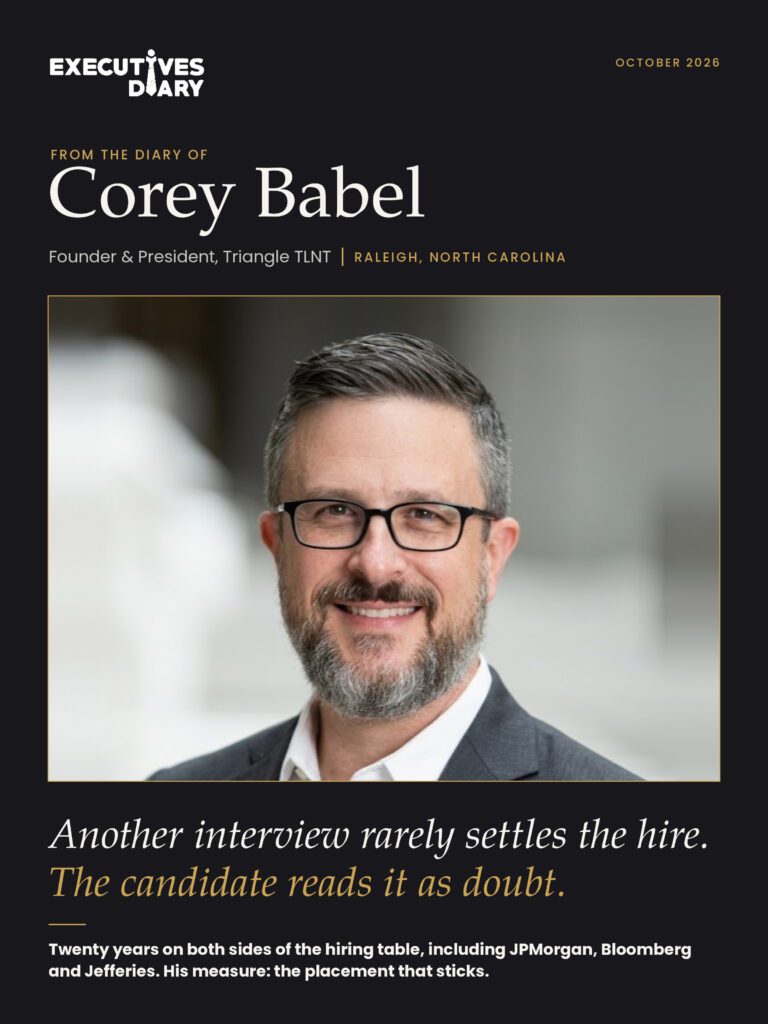
Leader in Spotlight: Read Corey Babel Feature in Executives Diary
What HexaNorm Asks a Company to Write Down
Most organizations, Ginka says, describe their culture “in values statements, handbooks and onboarding slides.” HexaNorm asks them to write down what they actually commit to: “how decisions get made, how workload is shared, what happens when someone raises a problem, how mistakes get repaired.”
It isn’t a standalone product. HexaNorm is the people-and-ethics part of Sixfold OS, one of six core modules that make up the larger system. It covers six areas, “from psychological safety to accountability,” and ties each commitment to the law that applies where the organization works, with layers for the EU and Switzerland.
Then comes the part she cares about most. HexaNorm looks for evidence of whether the commitments are kept, “in the organization’s own processes rather than only in surveys about how people feel.” Leadership sees patterns across teams and processes, never individuals.
“We aren’t interested in building another system that watches employees in the name of understanding them. The principle is: process, never people; metadata, never content; aggregate, never individual.”
Ginka Saraeva, Co-Founder and Chief People Officer, Sixfold OS
What counts as evidence is easiest to see in how she answers her own question.
What She Would Ask You to Show
“I would show you what happens when your values become inconvenient,” Ginka says.
The examples follow in her words. “If you say you value psychological safety, show me what happens when someone disagrees with a senior person. If you value fairness, show me how workload and opportunities are actually distributed.” For accountability, she would ask what happens after a mistake: “who takes responsibility, how it gets repaired, and whether anything changes afterwards.” For transparency, how decisions are made “and whether the people affected can understand why.”
“That’s where culture lives,” she says. “Not in the sentence on the wall, but in the repeated decisions and processes underneath it.”
She isn’t asking for a perfect record. “No organization can do that.” What she would ask is whether an organization can show that what it repeatedly does is “reasonably consistent with what you say you believe, and whether you notice and repair it when it isn’t.”
“For me, that’s the difference between having values and having evidence of them.”
Ginka Saraeva, Co-Founder and Chief People Officer, Sixfold OS
The absence of complaints doesn’t count. When she asks what a great culture is based on, she has written, the answer is usually “a feeling, a few happy faces at the offsite, or the absence of loud complaints. But silence isn’t evidence. Often it’s just the sound of people who’ve stopped expecting anything to change.”
She learned to look at organizations that way well before she worked in HR.
Gastronomy, Logistics, Customer Support
Ginka studied ethnology at Sofia University St. Kliment Ohridski. After university she moved to Germany, intending to continue her education there. “Things didn’t go according to plan, so instead I started exploring,” she says. She worked in gastronomy, logistics and customer support, “quite a collection of environments that looked completely unrelated on paper.”
“But the ethnologist in my head never really stopped working.” Whatever the job, she was watching how people behaved inside systems: “the unwritten rules, how groups formed, how people adapted to processes, where friction appeared, and the difference between how something was supposed to work and how it actually worked.”
The first turn came when she discovered UX. She saw the connection with ethnology at once: “observation, research, understanding behavior and context rather than assuming you already know what people need.” The further she went, the more she found she was “less interested in designing individual interfaces than in designing the systems around them.”
“Then the door into HR opened, and strangely, everything that had looked disconnected until then seemed to find its natural place.” Ethnology, UX and People work share a core for her. They all, she says, “ask you to observe before you assume, understand people in context, find the structures influencing behavior, and design around how humans actually behave rather than how you imagine they should behave.” The earlier jobs made more sense too. They had let her see organizations “from completely different positions, not only from the professional or leadership side.”
“I didn’t plan this path. I think I explored long enough to find the place where all the different parts of my experience could finally sit together.”
Ginka Saraeva, Co-Founder and Chief People Officer, Sixfold OS
One of those positions was in the middle.
The Conversations That Weren’t Hers to Carry
In one earlier role, two senior people she worked with “really didn’t like each other, although I don’t think most people realized it.” She heard from each of them, separately and quite directly, what they thought of the other.
In the same room, everything was perfectly professional, “except for the occasional beautifully polite, professionally coated little bite. Most people probably heard an ordinary comment. I knew what was underneath it.” In retrospect, she says, some of those moments “were actually quite funny; being in the middle of the dynamic at the time was less so.”
She made a point of never joining in, never carrying comments between them and never becoming part of the conflict. It taught her “that personal dynamics exist at every level of an organization, including the very top, and that sometimes professionalism is simply knowing which conversations aren’t yours to carry.”
Asked for the one person who shaped her, she won’t name one. “I’m the result of many people I’ve worked with, loved, disagreed with and learned from, including some who taught me what to do, and others who taught me what never to do.” Choosing one, she says, “would feel untrue, and unfair to the rest.”
“Tell Me More”
Ginka didn’t originate Sixfold OS. Her co-founder, Claus Rainer Nisslmüller, did. He had already started building the larger system and had a small early version of the HexaNorm idea when he approached her. She had just stepped into an HR Lead role at Second Life e.V., and he asked whether she would look at that part of Sixfold from an HR perspective.
“I wasn’t convinced I was the right person,” she says. “Instead of saying no, I said, ‘Tell me more.’”
She joined as a collaborator and began to see possibilities in HexaNorm that went beyond the original draft. Claus, she says, saw she was bringing something quite different to it and “gave me the space to take ownership of the module. Eventually I rebuilt HexaNorm completely, bringing together my background in ethnology, UX, People work and organizational ethics. It became my part of Sixfold.” Her involvement in the thinking and direction of the larger system grew alongside it, and in time she became his co-founder.
A year in, she wrote that her time had gone into “building HexaNorm’s backbone, vertebra by vertebra, because how organizations treat people isn’t the soft part. It’s the whole point.” The module, she says, “gave a question I’d already been carrying through my work somewhere concrete to land.”
The same question runs through the books.
Two Books on the Same Question
How Not to Create Toxic Companies (By Accident) “looks at how perfectly ordinary organizational decisions can accumulate into harmful workplaces, often without anybody consciously intending to create one.” Workplace Bullies Wear Nice Shoes comes at workplace behavior from her ethnological background. It treats the modern workplace “almost as a field site,” with “its types, rituals, hierarchies and behaviors,” and, she adds, “with considerably more humor.” Both are now published. The first came out in September and the second followed shortly after. Both are on Amazon, and the ebooks are linked from saraevaconsult.com.
The humor is hers to demonstrate. In September she reported spending a Saturday “describing a woman who wears sunglasses indoors as though she were a bird.” The specimen is Pica coronata, the Crowned Magpie. “She has never been seen without a blazer. She takes notes in meetings that are not about the meeting. She is always prepared to add context.”
She doesn’t see the books, the system and the consultancy as separate careers. “Writing and building are two different ways I work through the same questions,” she says. “Sometimes the result is a book, sometimes it’s a system like Sixfold OS, and sometimes it’s the direct organizational work I do through Saraeva Consult.” All three examine “how people behave inside systems, how those systems shape behavior in return, and what we can change once we understand that.”
Where Ginka Is Now
HexaNorm is built, as is Sixfold OS as a whole. “So technologically, we’re built,” Ginka says. “Commercially, we’re at the beginning.” The system is moving into the pilot stage, which she describes as “taking the system out of the building environment and into real organizations.” There are no customers or revenue to report yet, and she doesn’t want the project to “sound further along commercially than it is.” The next step is finding the right first pilot partners, learning from how the system performs with them and refining what needs refining.
Alongside it she works directly with organizations and individuals through Saraeva Consult, and she is Chief People Officer at Second Life e.V. For organizations the consultancy offers psychological safety and anti-toxicity audits, fractional Head of People work, ethics frameworks and policy design, and people-systems and organizational design. “Most companies should start with the audit,” she has written. “It’s the one that tells you which of the other three you actually need.” For individuals she offers CV review, application strategy and interview preparation.
She doesn’t want any of this to funnel toward one thing. “The work is broader than that.” Over the next twelve months she would like conversations “with organizations, collaborators, readers and people building things I haven’t thought of yet.” The person she most wants to hear from is “someone building or leading an organization who is willing to look at how it actually behaves, rather than how it describes itself. Someone curious enough to question the systems they’ve inherited and pragmatic enough to do something with the answer.”
Outside work, she draws. “I draw when I need my brain to be quiet. I’m not trying to produce anything useful or particularly good, that’s actually the point. Give me some music, a pencil and something to sketch, and for a while my brain finally stops trying to turn everything into a system.”
Asked for a line she lives by, she declined to supply one. “I don’t have a line I live by. Maybe that’s the line: don’t reduce yourself to one sentence. Your opinions should be allowed to change, they have to, if you want to evolve. Be a whole library.”
Five Lines from Ginka’s Diary
- “Culture is an output. You can’t repair an output by discussing it.”
- “Harm at work is rarely about one bad person. It’s usually a design failure nobody measured.”
- “Don’t just ask what a system was designed to do. Look at what it actually produces.”
- “I’m not really a single-company or single-product person.”
- “Looking backwards, my career appears much more coherent than it felt while I was living it.”
From the Diary of Ginka Saraeva
Ginka Saraeva is a Germany-based author and the Co-Founder and Chief People Officer of Sixfold OS.
| Role | Co-Founder and Chief People Officer, Sixfold OS. Founder and Principal Consultant, Saraeva Consult. |
| Author | How Not to Create Toxic Companies (By Accident); Workplace Bullies Wear Nice Shoes |
| Based in | Germany |
| Previously | IxDF Local Leader, Basel, The Interaction Design Foundation (2025 to 2026) |
| Also | Chief People Officer, Second Life e.V. |
“If you had to prove your culture, not describe it, what would you show?”
Editor’s Note
Ginka Saraeva is in these pages because she asks organizations a question most of them cannot yet answer, and because she has spent a year building one way to answer it. What convinced the editors is how plainly she states where that work stands: built, entering pilots, looking for its first partner organizations. The books, the module and the consultancy all trace to one habit learned as an ethnologist, which is to watch what a group does before listening to what it says. That habit is the reason she is here.
Executives Diary, Editorial
