

From the Diary of
Angela Cutulenco
The Executive Who Learned the Value of Saying No
“For twenty years I said no to technology that did not create value. Now I build companies that help organizations say yes to the right things, for the right reasons.”
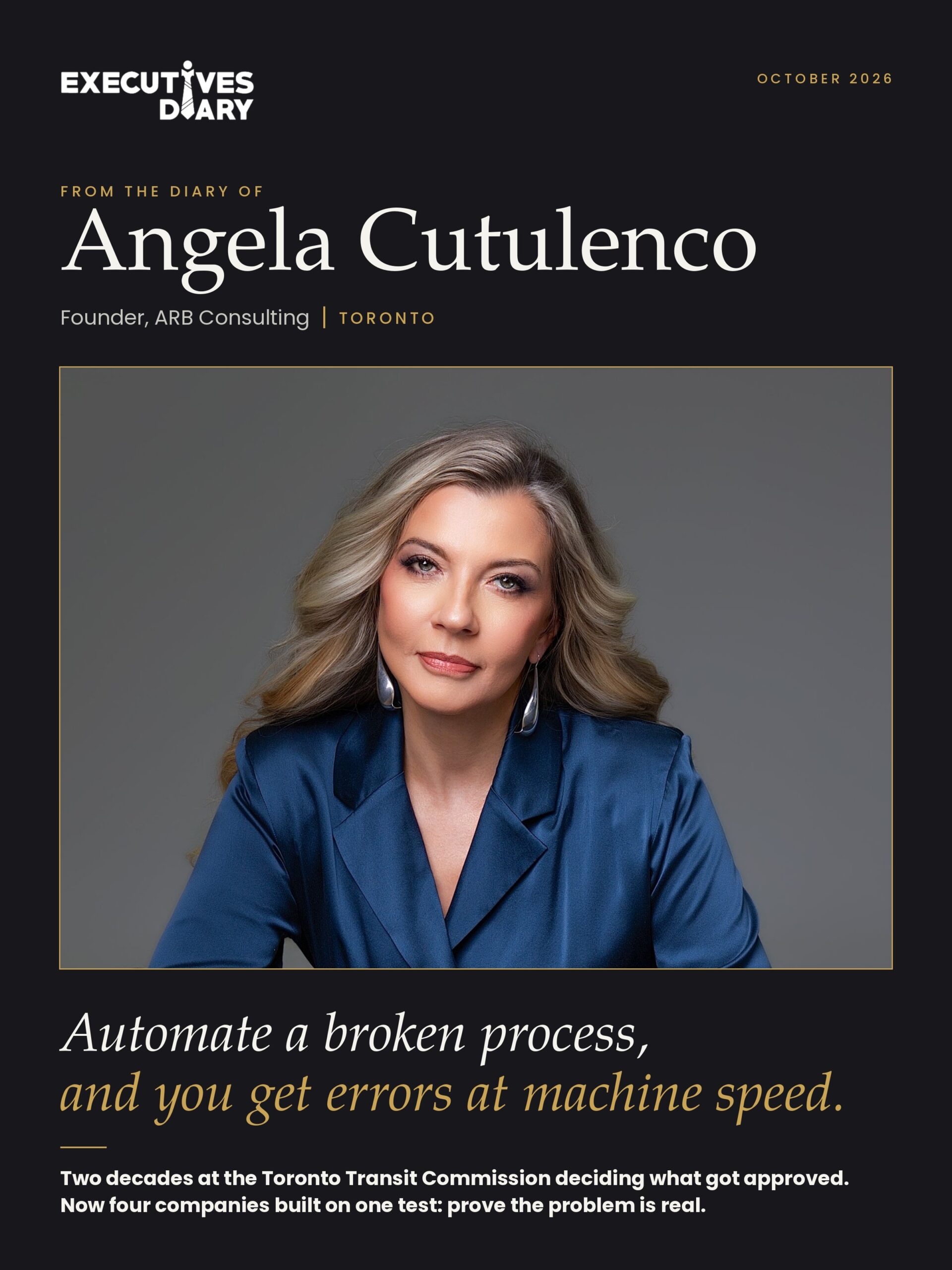
For most technology executives, success is often associated with getting a new system approved, launching a major platform, or moving an organization toward the next big capability. For Angela Cutulenco, some of the most important decisions she made came when she said no.
For two decades, Angela sat on the buyer side of technology decisions inside large North American organizations. She evaluated suppliers, reviewed business cases, weighed risk, questioned proposed investments, and decided which technology deserved organizational support. That experience gave her a perspective that is increasingly relevant as companies rush to adopt AI: the hardest technology question is rarely what the technology can do. It is whether the organization has identified the right problem to solve.
Her current work reflects that belief. As Senior Director of Governance, Administration & Continuous Improvement in the Office of the CIO at the Toronto Transit Commission, she works across governance, quality, risk, compliance, service management, portfolio management, resources, budgeting, performance, and continuous improvement. Alongside that corporate role, she is building companies focused on helping organizations make better decisions about technology, workforce design, and growth.

Experience That Changed the Question
Angela’s technical foundation began with mathematics and computer science before taking her into consulting and eventually enterprise technology leadership. Over more than three decades in IT, including more than two decades at TTC, she moved from working with technology itself to understanding the systems around it: how investments are selected, how work is governed, where accountability breaks down, and why technically sound solutions can still fail inside organizations.
That distinction now sits at the center of her thinking.
She has seen organizations respond to a visible problem by buying the solution someone proposed, without first examining the process underneath it. Her experience building Portfolio Investment Management at TTC gave her a particularly clear example.

When Angela inherited the problem, technology requests were entering the organization through multiple paths. Many arrived with a solution already chosen. Large initiatives could bypass the normal process, while other requests waited through budget cycles without a clear decision.
She did not simply redesign the approval step. She redesigned the system around it.
The resulting PIM process created one entry point for IT demand, established standards for business cases, assessed strategic alignment, ranked priorities, and produced a clear decision to authorize, waitlist, or reject. Work could not begin without approval and confirmed funding. The result was more than cleaner governance. It eliminated unauthorized implementations and gave requesters a clear answer, including when the answer was “not now.”
That experience explains much of what Angela is now saying about AI.
When the Technology Is Not the Real Problem
Angela’s concern with current AI adoption is not that organizations are moving too quickly. It is that they are often asking the wrong question.
Companies can acquire AI capability before they know where that capability should be applied. They can celebrate hours saved without determining whether those hours became usable capacity or financial value. They can automate routine work without examining what happens to the exceptions left behind.
Her own writing repeatedly returns to this problem. In one recent discussion of AI adoption, she argues that technology deployment should begin with an honest examination of operational friction: where manual effort is being consumed, where handoffs stall, and where highly skilled employees are being used as the human connection between disconnected systems.
That is a very different approach from simply asking, “Where can we use AI?”
Angela starts somewhere else: What problem are we actually trying to solve?
Only after that question is answered should an organization decide whether the right answer is a person, a process change, an AI agent, a robot, or some combination.Before any money is spent, she asks for evidence that the problem is real, links it to the organization’s strategy, and defines the benefits that will be measured.
Enterprise AI failure rarely comes from bad models. It comes from skipping the diagnostic work. If you automate a disconnected process, all you’ve done is produce errors at machine speed. True governance isn’t red tape, it is making sure the problem is genuine, the handoffs are protected, and the capacity recovered actually shows up in business performance.
That principle also changes how she thinks about the workforce.
Designing the Workforce Before Automating the Work
The next phase of AI adoption will not simply be about replacing tasks. It will be about redesigning how work gets done.
Angela argues that organizations need to stop designing work primarily around job titles and headcount and start examining the individual tasks within a process. Some tasks may be better handled by people. Others may be suitable for AI agents or robotics. The important question is not which technology is available, but which combination produces the strongest outcome.
That requires more thought than automation promises usually suggest.
AI may remove routine work while leaving behind exceptions that require the most experienced employees. Handoffs between people and machines can introduce new failure points. Skills can weaken when employees rarely perform the underlying work themselves. And measuring how much work a machine completed does not necessarily tell an organization whether it created value.
For Angela, accountability therefore remains human even as more work becomes automated.In practice, that means giving every task a named human owner, designing the handoffs between people and machines as carefully as the tasks themselves, and measuring outcomes rather than activity.

This thinking is now being built into LUKAPS, the company she co-founded to develop AI solutions, train employees, and design hybrid workforces combining people, AI agents, and robots. The objective is not automation for its own sake. It is to create a workforce in which each part is doing the work it is best suited to do.
The underlying question is simple: What should people still be doing when technology becomes capable of doing more?
Taking the Buyer’s Perspective to the Other Side
Angela is now approaching technology from a different position. Her years as a buyer taught her one lesson, which is that good technology fails when nobody starts with the real need. Each of her companies applies that lesson to a different group. Her venture work divides into two core operational pillars: helping enterprise buyers implement technology that actually delivers value, and helping technology creators build solutions that enterprise buyers can actually approve and adopt.

On the enterprise transformation front, LUKAPS focuses on organizations wrestling with AI and automation, helping leadership teams architect their hybrid workforce, determining what work belongs to people, AI agents, or robots before capital is committed. SageBond applies a similar human-technology integration model to personal care, pairing human companionship with smart technology and AI to help seniors safely age in place.
On the market and advisory front, she addresses the enterprise barrier that stalls so many technology providers.
Through ARB Consulting, which she founded, and in partnership with CrossMeridian Partners, which she co-founded, Angela guides international technology and manufacturing companies seeking entry into the North American market.
This work was shaped by what she learned as a buyer, where she repeatedly saw good technology struggle because the product alone was not enough.
Local support, compliance, security, staffing, implementation realities, buyer risk, sales channels, and the difference between a product demonstration and a functioning solution can determine whether technology gains traction. Her role now is to help technology companies understand those realities before they become barriers.
Most technology vendors fail in the enterprise not because their software lacks features, but because they don’t understand the buyer’s risk calculus. If you cannot demonstrate clear compliance, realistic implementation support, and measurable capacity recovery, an enterprise buyer’s only rational move is to say no.
That is also why Angela describes adding entrepreneurship to her executive as more than a change in title. Inside a large organization, she had structure, governance, resources, and institutional authority. Building companies has required speed, direct accountability, sales, partnerships, experimentation, and a willingness to operate without those protections.
Building Better Reasons to Say Yes
Angela has not left enterprise technology behind. She continues to lead at the Toronto Transit Commission while building her companies. She carried its lessons with her.
The governance discipline she developed at TTC now informs how she evaluates AI. Her experience with large-scale technology decisions informs how she helps companies enter new markets. Her understanding of organizational capability informs how she thinks about hybrid workforces.
The common thread is judgment.
She is not arguing that organizations should resist technology. She is arguing that they should become more deliberate about what they approve, why they approve it, and what they expect it to change.
For twenty years I said no to technology that did not create value. Now I build companies that help organizations say yes to the right things, for the right reasons.
That sentence captures the shift in Angela’s work. The executive who spent years deciding which technology deserved a place inside complex organizations is now building companies around a more difficult question: what should organizations actually build, buy, automate, and keep human?
For Angela Cutulenco, the answer does not begin with the technology.
It begins with the work that needs to be done.
