

From the Diary of
Corey Babel
Why another round rarely makes a senior hire safer, and what a founder can do instead.
“The best evidence of a strong process is velocity without sacrificing quality.”
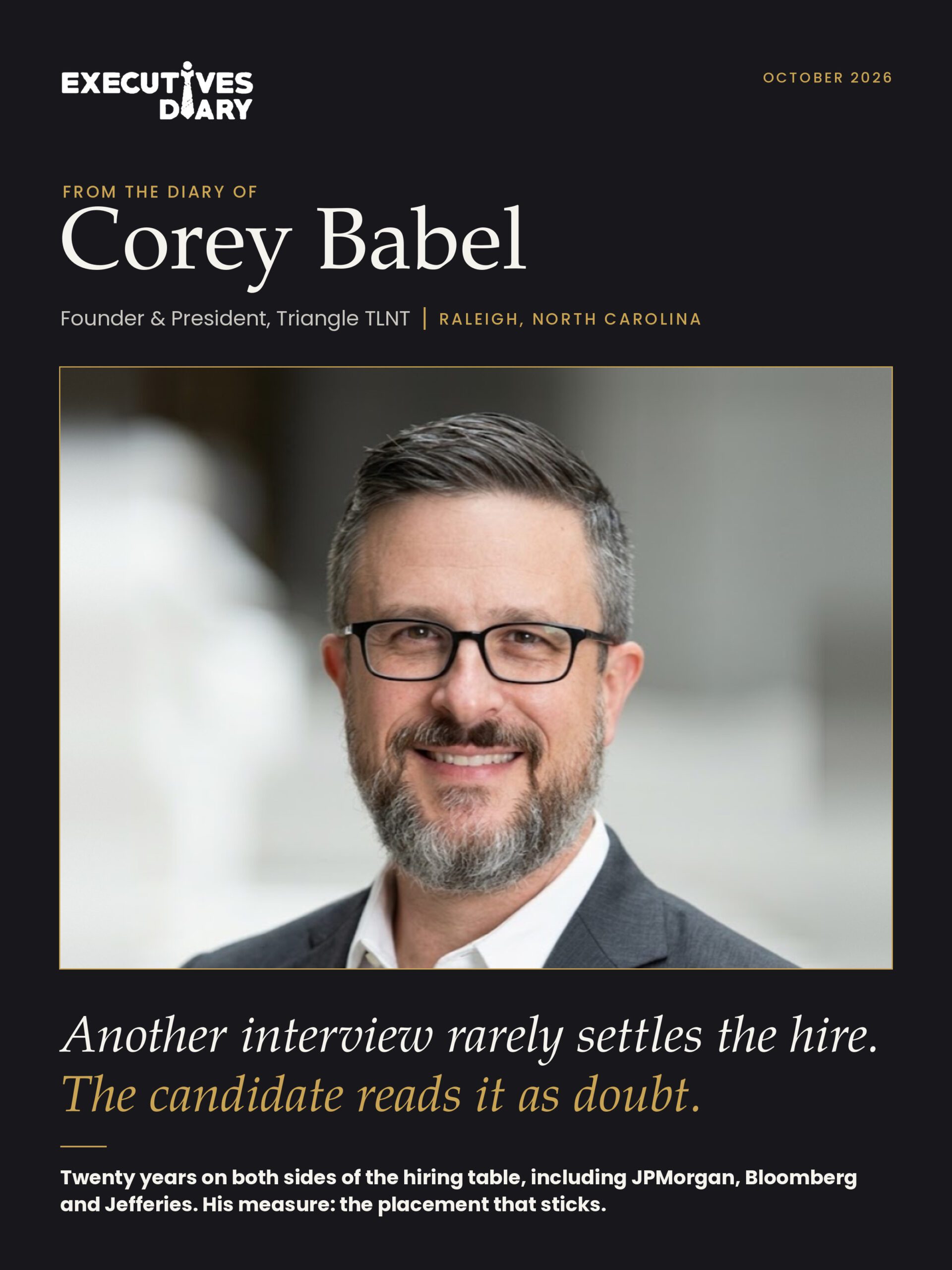
Corey Babel runs Triangle TLNT, a boutique recruiting firm in Raleigh, North Carolina, that fills senior and leadership-level Finance, Operations and Go-To-Market seats for growth-stage companies, from the seed round up. The founders who call him are, in his words, “underwater balancing recruitment with their own executive day-to-day responsibilities.” He takes on as much of the front end of hiring as they want, or partners with the team they already have: sourcing, first review, first interviews, scheduling. And he tells them something early that most of them haven’t heard from a recruiter: the extra interview round they’ve added to feel safer doesn’t make the decision safer, and it’s often the reason the candidate goes elsewhere.
He’s watched that happen from both chairs, agency and in-house, across about 20 years that include JPMorgan, Bloomberg and Jefferies. The cost of getting a senior hire wrong isn’t small. SHRM’s 2025 benchmarking puts the average executive hire at $35,879, more than six times the figure for other roles.
Corey’s argument is that the extra rounds aren’t a safeguard. They’re a symptom. What follows is where the process stalls, how he works with a founder’s team, and the one metric he says matters more than any dashboard.

More Rounds Do Not Mean Less Risk
Founders add interview stages for a reasonable-sounding reason. A senior hire is expensive and one wrong choice ripples through a small team. So a third round becomes a fourth, and an assessment is added on top. Corey has heard the logic many times, and he doesn’t think it holds water.
One of the big misconceptions scaling companies have, a lot of the time, is thinking that adding more interview rounds reduces risk. It used to, but it doesn’t anymore, regardless of what data can be pulled. It does show a level of indecision that candidates will very likely pick up on. This overextends the process, and that talent often accepts an offer elsewhere.
His test is a practical one. If a hiring team can’t decide after three or four structured conversations, including his own screen, the problem isn’t the talent pool. “There’s an alignment problem somewhere causing a disconnect,” he says, “and, until that’s addressed & resolved, adding another assessment or round of interviews won’t help you make a better or more confident decision.” The extra round can, though, have one reliable effect. It sets the search “completely back to square one when that candidate takes themselves out of consideration for any reason.”
And the market won’t wait for another round. “Even in today’s buyer’s market,” he says, “there are simply too many similar roles open for a company to drag its feet as if they’re the only game in town.” On Triangle TLNT’s LinkedIn page he has written the same thing for founders who think one more step will settle it: “You aren’t stress-testing software; you’re dealing with human capital. You simply can’t engineer a process that filters out every potential flaw or variable.”
You aren’t stress-testing software; you’re dealing with human capital.
The companies he wants to hear from need to make critical infrastructure hires that will settle into company leadership & continue developing strong teams under themselves.
How an Engagement Works
Triangle TLNT, which Corey founded in January 2025, takes on as much of the front end of hiring as leadership wants: sourcing, initial review, interviews and scheduling, taking over a foundational build, fractional cover or a retained search. In every case the end point is the same.
That’s the beauty of my fractional model. I don’t want to be on your payroll forever. I step in, help to solve a problem, work on building any kind(s) of infrastructure as requested, & get out of your way.
A foundational engagement, he says, “is about being flexible enough, but knowing when to pull back on the reins a little bit if things start going a little off-track.” It’s also, sometimes, “being the calming factor in a room of C-Suite who have investors breathing down their neck(s).”
He describes one recent client, a scaling technology company whose hiring was entirely reactive: vague job descriptions, interviewers asking candidates the exact same questions, strong candidates leaving for faster processes. He overhauled the intake to get clarity on the roles, took over first review and submittal of every applicant and became the first interviewer for anyone advancing, which by his account saved the hiring team “more than a few weeks.” Once the critical roles were filled and the internal team was running its own interviews, he rolled off.
The Interview That Is a Conversation
The mechanics of Corey’s first-round screen are the part a founder can copy tomorrow.
He tells every candidate at the outset that he wants a conversation, not a scripted exchange. He follows a structure, but “loosely & within the context of the discussion.” His reasoning: “There’s much more to learn from a healthy back & forth with someone vs. following a form that keeps questions and answers in boxes.”
Then he gives as much as he takes. He briefs the candidate on the company and on who they’ll meet next, “not only backgrounds, but tips/ hints about personalities and what they’re really looking for in this hire,” and on as much of the process ahead as he knows. “It’s imperative that people’s expectations are set on both sides of hiring; otherwise, a lot of time can be spent on what turns out to be nothing.”
He calls himself “an Educator & Salesperson.” Ask him what that produces, and he answers with a number.
The Number After the Offer
Ask Corey for proof that a process works and he points first to speed. At RapidRatings, he says, understanding the hiring process quickly and getting ahead of bottlenecks cut time to hire by 35 percent, and he’s clear about why that matters: “Speeding up a search by a month doesn’t just look good on a recruiting dashboard. It gives a scaling company an extra month of output, productivity & revenue generation.”
Speed, though, isn’t the metric he ranks first. “Over my 20 years in the industry,” he says, “the metric I prioritize most is retention. Placing senior leaders is not just about getting a ‘yes.’ It is about making a placement that sticks.” And then: “Nothing elicits more of an internal glow than seeing someone I recruited announce their most recent promotion or logical next step.”
It is about making a placement that sticks.
Fewer companies measure that than you’d expect. The same SHRM benchmarking found that only 20 percent of organizations track quality of hire at all. Most know how fast the seat was filled, not whether it stayed filled. The standard is older than the firm.

From JPMorgan to Raleigh
The building instinct, Corey says, goes back to JPMorgan Chase, where efficiency was the name of the game given the workload. His in-house years were at JPMorgan, at Bloomberg, where he was a senior recruiter for the Financial Products business, and at Jefferies. On the agency side he placed people across banking and financial services, financial products, technology, professional services, consulting, e-learning, sales, engineering, internet security and marketing.
At RapidRatings he ran recruitment for the firm’s offices in Manhattan, Quincy, Massachusetts, and Dublin, wrote the training sessions for new hiring managers, built the summer internship program and partnered with the CEO on confidential searches. From 2020 he consulted on talent acquisition through his own firm, HSTG, and from 2022 spent nearly three years in-house at Family Care Center, a mental health provider. In January 2025 he founded Triangle TLNT in Raleigh.
He describes it as the opposite of “a spray & pray method.” As he puts it on his profile: “If you need qualified senior or leadership-level talent in Finance, Operations, & Go-To-Market (GTM), I’m your guy. Here’s why.” The why is the two chairs.
Both Sides of the Table
Corey’s case for why a founder should bring him in rests on where he’s sat before. His 20 years split between agency desks and in-house seats. As a former agency recruiter, he understands that “A lot of agency recruiters only see the transaction. They source a candidate, collect a fee, & move on.” If a role is hard to fill, an agency can walk away and “chase ‘closest to the money.’” Apart from a backfill clause, “they rarely have to live with the aftermath of a bad hire.”
He learned a lot from being in-house:
Having been in-house at major institutions like JPMorgan, Bloomberg, & Jefferies, I’ve sat on the other side of the table. I’ve navigated the internal politics of headcount approvals & seen firsthand how a single misaligned hire disrupts an entire team. Most importantly, I’ve been ‘stuck’ with those hard-to-fill roles, sometimes for months, weaving in time to keep digging for that one gem while handling the more transactional fills at the same time.
That combination, he says, “gives me a massive advantage against most recruiters. I know how to align external talent with internal realities & build a process that actually serves the business while doing right by the candidate(s).”
One financial reporting analyst he recruited wrote on his profile that he was “the best talent acquisition director I have ever been working with.”
Where Corey Is Now
Corey works from Raleigh, North Carolina, where Triangle TLNT partners with growth-stage companies from the seed round upward on foundational, fractional, retained and contingency recruiting for senior Finance, Operations and Go-To-Market roles.

His aim for the year ahead is to work with more companies that need to scale but aren’t sure how or ones that don’t have the infrastructure set up yet (or both). He wants them to know it will be handled regardless: “I step in to unblock bottlenecks, build whatever sustainable recruitment structure leadership has in mind, & then roll off when their internal team is ready to fly solo or their hiring needs are met.”
He also regularly utilizes his LinkedIn feed for people he has no seat for. After a call with an operator who had spent 23 years at a large consumer brand, he wrote a post laying out her background for anyone who might: “my inbox is always open.” The same month he did it for a CMO and a COO he’d spoken with, offering an introduction to either.
It’s the point he makes to founders adding another round, and he’s put it in one line: “There are zero guarantees with ‘human capital’ no matter how many different steps, assessments, or people they might meet with.”
The Playbook
The Corey Babel Playbook: Hiring Senior Leaders at Speed
- Treat a fourth round as a signal. Usually a bad idea, never a fixed rule: when a team can’t decide after three or four structured discussions, look at alignment before adding another.
- Rewrite the intake before you post. Vague descriptions produce repeated questions and slow decisions, so get clarity on the role first.
- Brief the candidate on the room. Tell them who they’ll meet and what those people care about, so expectations are set on both sides.
- Make the offer when the fit is clear. A strong candidate is deciding on their timetable, not yours, and a more decisive competitor is already in the room.
- Measure retention, not just time to fill. A placement that sticks is often the best proof the process worked.

