

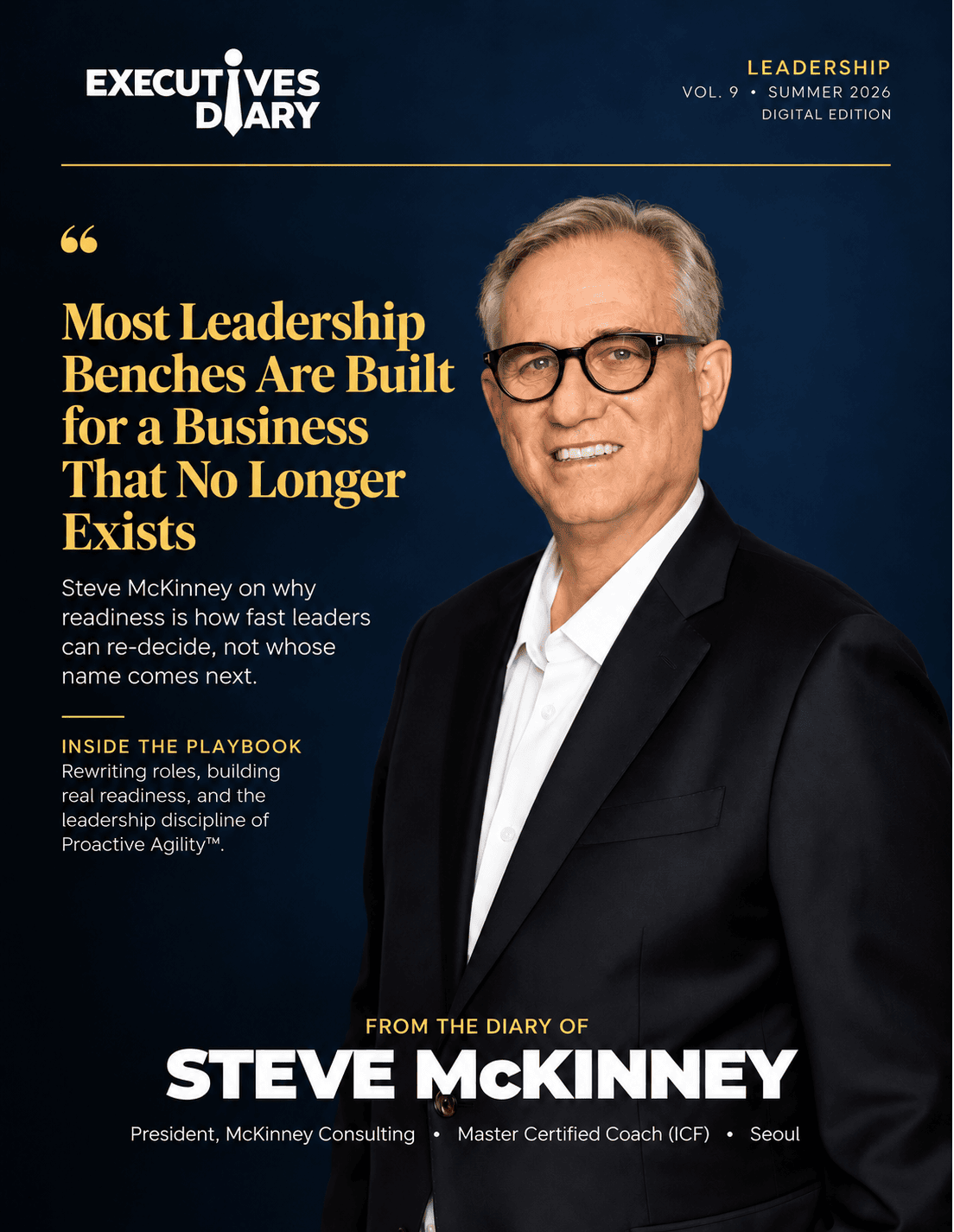
Steve McKinney
on why readiness is how fast leaders can re-decide, not whose name comes next.Boards and CHROs treat readiness like an insurance policy: buy the succession deck, refresh the nine-box, sleep well. Then the disruption lands and the deck is useless, because the deck was built for the org they had, not the fight they’re now in. That is Steve McKinney’s diagnosis after twenty-five years of taking the calls that follow a shock. The belief he is arguing against is that a signed-off bench is a ready one. He learned otherwise first as an operator, then from the search chair.
Steve McKinney is President of McKinney Consulting in Seoul and holds the International Coaching Federation’s Master Certified Coach credential.
Rewrite the Job Before Searching for the Leader
Steve McKinney’s core idea is that readiness is a capacity, not a roster, and that most readiness failures begin before the crisis, in a job written for a business that has already moved on. At Reebok and adidas, a category shifted and the successor flagged as ready turned out to be ready for the business that had just disappeared. In the Airwalk seat in Korea, a headquarters plan met a market that refused to behave. Across twenty-five years of search in the region, the call comes on a Saturday, and in McKinney’s words, “we both know the bench they signed off on in Q1 doesn’t have the person for Monday.”
That is why his first move on a search is to argue with the specification. “I’ve hired the wrong ‘perfect candidate’ myself and paid for it in a product cycle I can still name,” he says.
The clearest test came in Korea. A multinational brand’s country business was drifting. The country manager seat had turned over twice in three years, headquarters was losing patience, and the local team had learned to wait out whoever arrived next. The brief asked for another polished expatriate from the region. McKinney declined to search against it. He told the global CHRO that a hire to that specification would bring the company back to him within eighteen months. He then spent three weeks rewriting the mandate: who the new leader had to move, which headquarters relationships had to be broken and rebuilt, and what the first ninety days had to look like in Seoul.
He ran the search against the rewritten mandate and placed a Korean national with operating scars rather than a career manager. Then he stayed. For the entire first year, a standing Friday call worked whatever problem sat in front of the executive that week. The executive has now held the seat past four years, in a role where the two previous incumbents did not reach twenty-four months. Over the same period, the Korea business moved from a chronic underperformer inside the region to an operation headquarters began citing as a template. McKinney tracks the tenure from the placement date, and the client’s regional reviews, which he has seen, reflect the turnaround.
Promoted Local Leaders Stall on Permission, Not Capability
The same gap appears after a promotion. On a Friday evening in his Seoul office, McKinney sat with a Korean country general manager newly named to a regional role covering North Asia. Forty minutes on the usual checklist of stakeholder maps, headquarters cadence, and leading across three time zones had landed nowhere, so McKinney asked what he was actually afraid of. After a long pause, the executive answered: “I know how to win in Korea. I don’t know if I’m allowed to lose in Japan.”
The executive had built a twenty-year career on never missing a number in a market he understood completely. The regional seat would force calls he would sometimes get wrong, in public, in front of country teams who had been there longer. “The problem wasn’t capability,” McKinney says. “It was permission.” The next six months went to three things:
- leading from questions in the two markets he did not yet own,
- letting his Japan and Greater China country heads teach him without surrendering authority,
- telling headquarters early when something went sideways.
He now runs a bigger piece of the business than the one he was promoted into.
The Scenario Drill CHROs and Boards Can Steal
Steve McKinney calls the approach Proactive Agility™. He defines it as the leadership discipline of building the capacity to re-decide, fast, together, and before a team has to, so that when disruption arrives the team is already moving rather than still meeting. The name grew out of twenty-five years of the same phone call from leadership teams that saw disruption coming and still could not move. In his view, agility had shrunk to reacting faster, so he added the word proactive.
The Five Moves (18-Month Horizon)
- 1. Attack the strategy before defending it: Pick the three scenarios that would actually break the business in the next eighteen months, and have each executive argue the one they would least like to face.
- 2. Test the bench against scenarios: Put each likely successor in front of a situation they have not seen before and measure how quickly they re-decide.
- 3. Shorten the loop between signal and call: Decisions should land in days when a scenario starts showing up in the market, not at the next quarterly review.
- 4. Push authority down: Let the person closest to the market make the call headquarters would rather approve.
- 5. Expect the pushback and name it early: Recognize when senior leaders and CHROs resist giving up decisions or exposing legacy benches.
McKinney first ran the drill about twelve years ago, coaching a country manager in Seoul. The executive was sharp and strong on paper, but was freezing under a channel shift nobody at headquarters believed was real. They dropped the work on leadership presence and drilled scenarios instead: what to do if a key account walked, if a competitor priced below cost, if Seoul had to lead headquarters rather than the other way round. The executive stopped waiting for permission. Within two quarters, the local business was making calls the region later adopted as policy.
Boards that run the five moves are measuring something different from a succession deck. “Readiness isn’t who’s next; it’s how fast your leaders can re-decide when the ground shifts, and whether you’ve stress-tested them against a scenario they haven’t seen yet,” McKinney says.
Who Is Steve McKinney?
Steve McKinney is President of McKinney Consulting, the executive search and coaching firm he founded in Seoul, South Korea, in 2001, and a Master Certified Coach credentialed by the International Coaching Federation.
Before search, he spent the 1990s building footwear. As a senior manager of development and commercialization at Reebok from 1990 to 1994, he led a special global team on mold and upper standardization. He also wrote Tech Sense, a product-engineering training program that spread across the company’s R&D centers, and rebuilt factory hiring, policy, and negotiation practices. Across fiscal 1993, on-time delivery rose from 73 percent to 95 percent, measured monthly as orders received against orders requested. As Head of Footwear Product Development at adidas International from 1994 to 1996, he supervised 30 staff and helped rebuild the product development function that put commercially viable product back in the line. He went on to build Converse’s Action Sports line from the ground up. He then ran Airwalk’s athletic footwear operations in Korea and China as country manager.
That record is the foundation of the practice he has run from Seoul for twenty-five years. “A career consultant runs a process. I run the job my client is trying to survive,” McKinney says.
McKinney Consulting is the Korea partner of Kestria, a global executive search alliance that has completed more than 40,000 searches across its member firms worldwide. McKinney serves a term through 2027 on the Asia Pacific Council of the Association of Executive Search Consultants, which sets regional standards and the code of ethics for retained search. He also holds a Diploma in Organizational Neuropsychological Coaching. With his son, he co-authored Global Mindset: A Guide for Cross-Cultural Leadership, published by Amplify Publishing in May 2026, which reached #1 in Amazon’s Kindle Global Marketing category at release. He has been interviewed by Business Insider, Forbes, Entrepreneur, and European Business Review, and he speaks and runs workshops on Proactive Agility.
