

From the Diary of
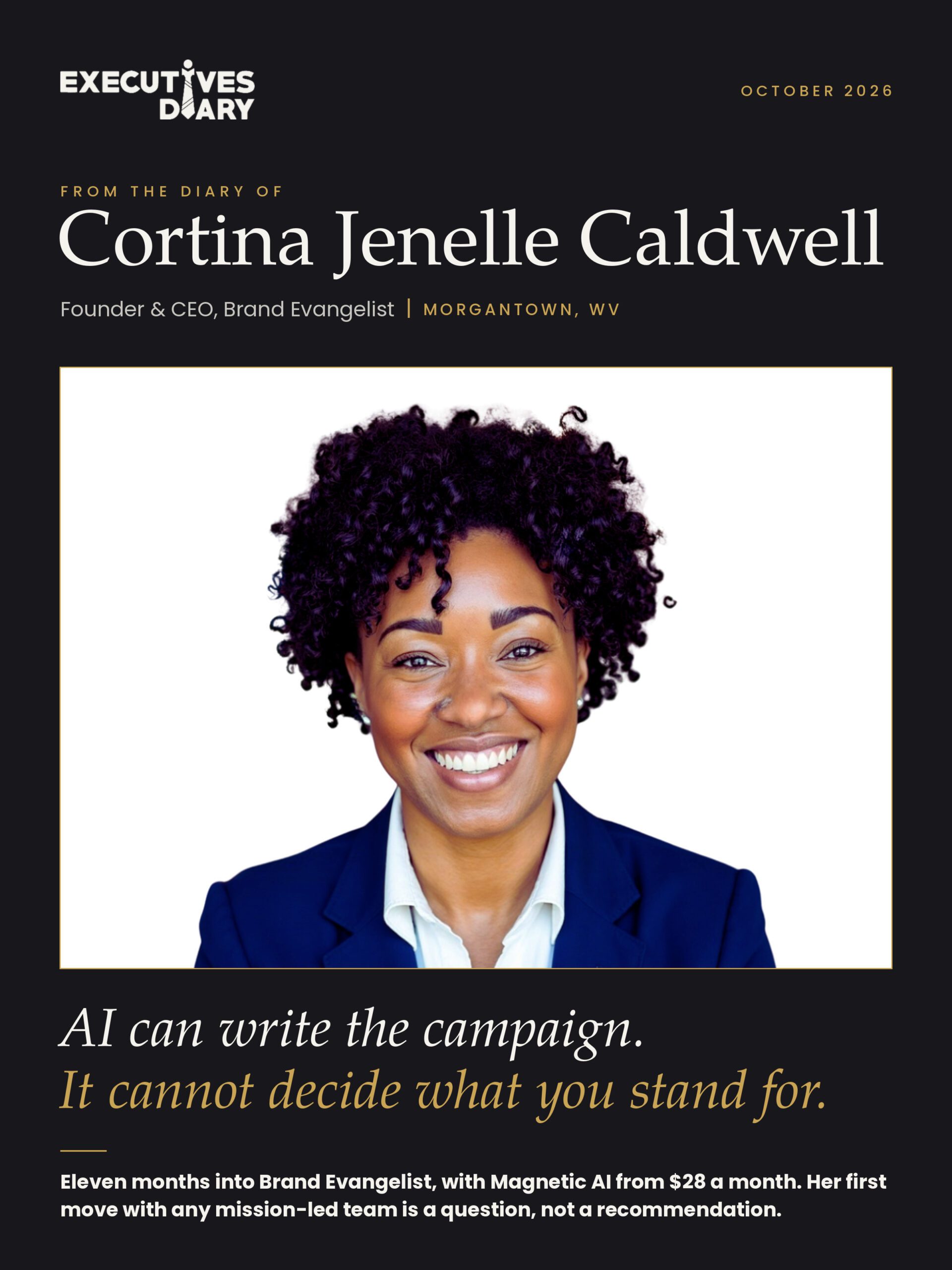
Cortina Jenelle Caldwell
For the executive director, B Corp founder or board chair whose budget has never had a line for the brand: the question one tech founder asks first, and what she is building for the teams who answer it.
“AI can serve our needs certainly, but the truth is, it’s just a good tool; it mimics what’s already been put out into the world, we need human intelligence leading the way.”
The grant comes with conditions on how it can be spent, and marketing is often not on the approved list. The executive director is already at capacity with board development, operations, administration and the face time owed to donors, volunteers and community partners. So design work is left to volunteers or put on the agenda of a board meeting, and marketing becomes a reaction to the latest sales call offering an ad placement or a radio interview. As one tech founder who has worked inside those teams puts it, the nonprofit sector “has been taught to undervalue marketing or it gets overestimated as something anyone can do.”
The money itself has become less certain. The Urban Institute found that a third of US nonprofits experienced at least one government funding disruption in early 2025, from lost funding to delays and freezes.
The tech founder is Cortina Jenelle Caldwell. “If grant funding continues to get cut,” she says, “nonprofits need to position themselves to be self-sufficient or face dissolution.” That, in her view, begins with the proper tools for branding and marketing.
If grant funding continues to get cut, nonprofits need to position themselves to be self-sufficient or face dissolution.
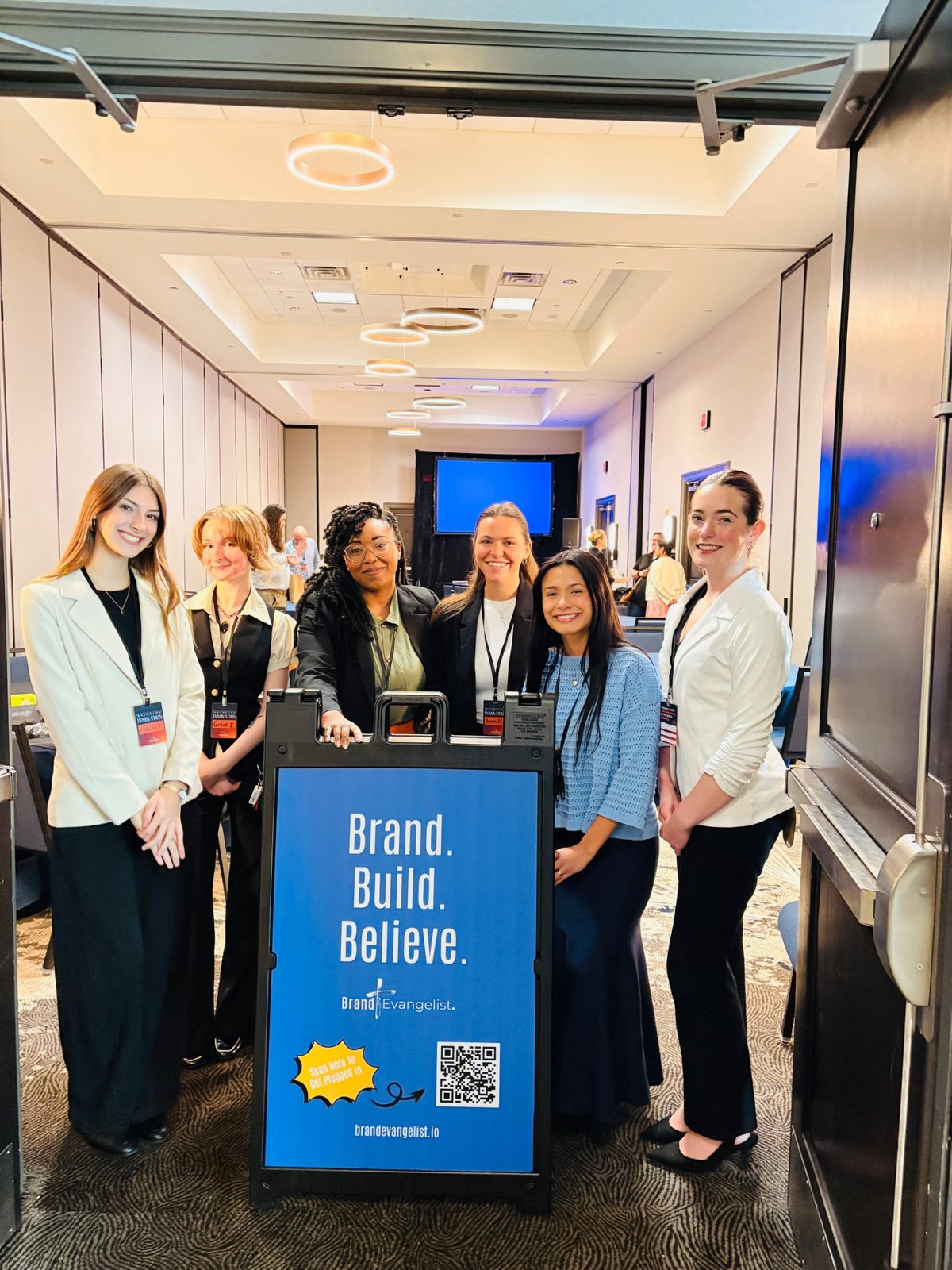
Cortina is the founder and CEO of Brand Evangelist, the tech startup she started in November 2025 to build brand strategy and AI-first business systems for nonprofits, B Corps, social enterprises and other mission-driven teams. It works two ways. One is fractional CMO work, where she audits what is blocking an organization’s marketing and develops the solutions in-house. The other is building the AI-powered technology designed to help lean teams build momentum without compromising ethos. In early 2026, Brand Evangelist announced Magnetic AI, a software platform designed to give a lean team a full suite of strategic marketing tools, as its flagship SaaS. Subscriptions to Magnetic AI start at $28 per month, with white glove upgrades available.
She Asks Before She Tells
When someone comes to her with a mission-led organization whose brand is invisible or whose operations are fragmented, Cortina doesn’t open with a recommendation. “The first thing that I do is actually ask them (not tell them),” she says. The question is always the same: “based on where you are right now, and with your top three challenges in mind, is it more important to you to go fast or to dive deep?”
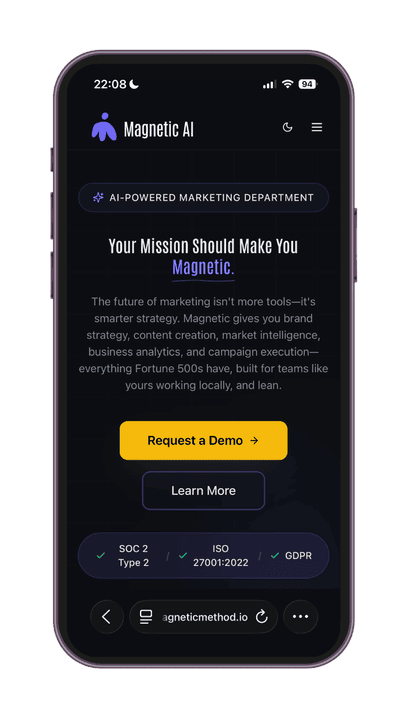
If the answer is fast, the path might run through Magnetic AI, which is designed to build out what a team needs for marketing, “from the brand identity, style guide, case studies, annual communications planner, just to name a few.” If they want to go fast and need a website, there is Chat2Site, a free Brand Evangelist tool. The organization brainstorms its site with an AI chatbot, deploys it directly into Lovable, and publishes it “within minutes.”
If the answer is deep, the path might be to bring on Brand Evangelist for fractional CMO work: a comprehensive audit to see where the blockers to growth marketing are, a roadmap for the necessary pivots, and solutions developed in-house. And for the leader who isn’t sure what they need, she recommends The Pivot Post, her weekly LinkedIn newsletter, which is free.
The fast path rests on a position she holds about AI.
A Middle Road on AI
“AI in the nonprofit sector has split opinions,” Cortina says: “some do not trust it and some are using it for everything.”
The survey data has a similar shape. In a 2025 study by the Center for Effective Philanthropy, almost two-thirds of foundations and nonprofits reported that their organization uses AI in its work, and almost two-thirds said that none or just a few of their staff have a solid understanding of it.
My take is that there is a middle road where AI can be used as a tool to fast track nonprofits and mission-driven teams for outreach, growth and attracting resources but it should not be used to replace the human intelligence needed to first craft and shape the brand and business model.
Magnetic AI, she says, “is designed for exactly that.” It is patent-pending, and she describes it as a suite of tools “that centers the mission of the work and delivers at a level that Fortune 500 companies operate at.”
The argument doesn’t depend on her own product. In the future she describes, nonprofits take more ownership of their brand, create an annual communications plan, keep a clear style guide, and have a network of creative professionals at their fingertips to execute campaigns and keep things consistent. “Whether you use Magnetic AI or not,” she says, “I just hope you recognize the competitive advantage that AI could offer, and what compounding turnaround time could mean for you.”
The process behind the platform was worked out years earlier, at an arts festival.
The Festival That Came First
Asked for one client from this year or last, Cortina goes further back, to LEAF, the arts nonprofit in Black Mountain, North Carolina, and a case study she calls “a precursor to Magnetic AI.”
She joined in December 2014 as director of communications and established a new communications department at what was already a well-established festival. The work repositioned LEAF’s reputation from a local festival to an arts nonprofit. In 2016 she became director of community relations, restructured and rebranded the LEAF Schools & Streets program, and co-authored grants and case studies that secured more than $1.5 million in funding. She stayed until 2018.
“You’ll see the Magnetic Method at work here,” she says of the case study, “and the way the process unfolds is a direct inspiration for the AI-powered technology behind Magnetic AI.”
Her first leadership training came earlier, at a hotel front desk.
From the Front Desk to Her Own Agency
Cortina grew up in the rural South, where, she says, “you were either one of those serving, or a recipient of grace and kindness.”
Taking care of our neighbors was just an inherent value of us as a people, and once I committed to business as my professional path, I didn’t want to leave that ethos behind.
Her grandmother took her under her wing when she was 12, while running a catering business. Her first job out of college, taken after she decided to pivot from social work to business, was the front desk of the O.Henry Hotel, part of Quaintance-Weaver Restaurants & Hotels, a company she chose “because of their community initiatives.” She expected to do check-ins and check-outs. Leah Clark of Quaintance-Weaver promoted her to manager within her first 90 days.
“I became someone I didn’t know I could be,” Cortina says, “and it was honestly life-changing.”
I became someone I didn’t know I could be, and it was honestly life-changing.
In September 2014 she founded Cortina Jenelle Branding Agency, a social impact-focused agency serving artists, hoteliers, restaurant owners, tour operators, wellness brands and small business owners, and led it for ten years.
In 2023 she completed Savvy Coders’ Certified Developer & Product Owner program in full stack web development, and in the fall of 2025 she went through the Vantage Ventures business accelerator at West Virginia University. Brand Evangelist was founded that November.
She says she has spent most of her career, more than 13 years, studying “under professors at Duke University and Liberty University” and working first-hand on nonprofit management and leadership. She has served on boards, worked as a fractional brand strategist for B Corps, communities and councils, and been a member of in-house leadership teams at nonprofits. It is the basis for what she most wants her reader to conclude: “that I have an intimate understanding of their positioning and that what they do is what catalyzes what I build.”
What AI Can’t Train On
“Here’s what AI can’t train on,” Cortina wrote this year. “Your judgment. Your relationships. Your community knowledge. Your values.” In another post she listed ten qualities, from lived experience and ethics to the ability to make people feel seen, and gave them a name. “Those are human multipliers,” she wrote. “And unlike technical skills, they compound over time.”
It is the line she wants to own, and she says it came from her own insights and what she has witnessed over time. For her it is also an argument for the organizations she serves. “The way I see it nonprofits, social enterprises and mission-driven work have an important place in our future,” she says, “not only to preserve what adds value to life, but also to serve as real-world spaces where connection and exchange of original thought can happen.”
AI can serve our needs certainly, but the truth is, it’s just a good tool; it mimics what’s already been put out into the world, we need human intelligence leading the way.
Her own working rule is older than any of the technology. “I am a stickler about being impeccable with my word,” she says, meaning honoring her agreements and commitments. She learned it “over and over and over from every single mentor in my life”: her grandmother, Leah, and then Don Miguel Ruiz’s The Four Agreements. “Even when plans change, I communicate,” she wrote this summer. “I’ll go as far as finding a replacement if that’s what it takes. Honesty is a love language.”
I am a stickler about being impeccable with my word.
Her work, as she puts it on her profile, is “rooted in my faith and based on one core belief,” which is that authentic brands change lives, build better futures and deserve to win.
Where Cortina Is Now
Brand Evangelist is eleven months old, and Magnetic AI is now welcoming its first users after a successful beta round this spring. This summer Cortina wrote that, seven months into founding, the company was “providing expertise in branding, business and market research to improve models for a top AI lab” with Mercor Intelligence. On her fortieth birthday she wrote that Brand Evangelist had been chosen for the founding partner cohort of the Lovable Solution Partner Program, and that it looked to be the only representative from the Appalachia region. The Talents is also part of the Brand Evangelist ecosystem.
The Pivot Post has returned for a new season on people and culture, systems, knowledge transfer and succession planning. She frames it around one distinction: “whether we’re actually preparing the people coming behind us, or simply preparing ourselves to be indispensable forever.”
The readers she wants are the nonprofit executive director, the B Corp founder and the board chair. What she offers them is in the first entry of her diary: “I want to lighten their load by using my expertise at the intersection of business, technology, branding and social impact to make the tools they need to make their work more visible, relatable, scalable and fundable more accessible, without compromise to their mission or filling their calendar with more meetings.”
What comes next, in her words: “Next up? It’s time to build a bigger table for impact investors, staff and community partners to gather around, for Brand Evangelist, in the chapter after ‘solo Founder’.”
Outside work, she has been thinking about where AI began. “I recently learned that Carnegie Mellon University is the birthplace of AI,” she says. “There’s something special about it being founded in Appalachia.”
On that same birthday she gave thanks decade by decade and wrote down what she hopes the next one holds: more teaching, traveling and training, “to pass on what I’ve learned to the next generation.” Then she added one more line. “Let my legacy be ‘she did a lot of good.’”
Five Lines from Cortina’s Diary
- “My mission is simple: serve the people who serve our communities.”
- “Those are human multipliers. And unlike technical skills, they compound over time.”
- “Using technology to bring people in, not leave people behind.”
- “Communication is the foundation of trust.”
- “Honesty is a love language.”
