

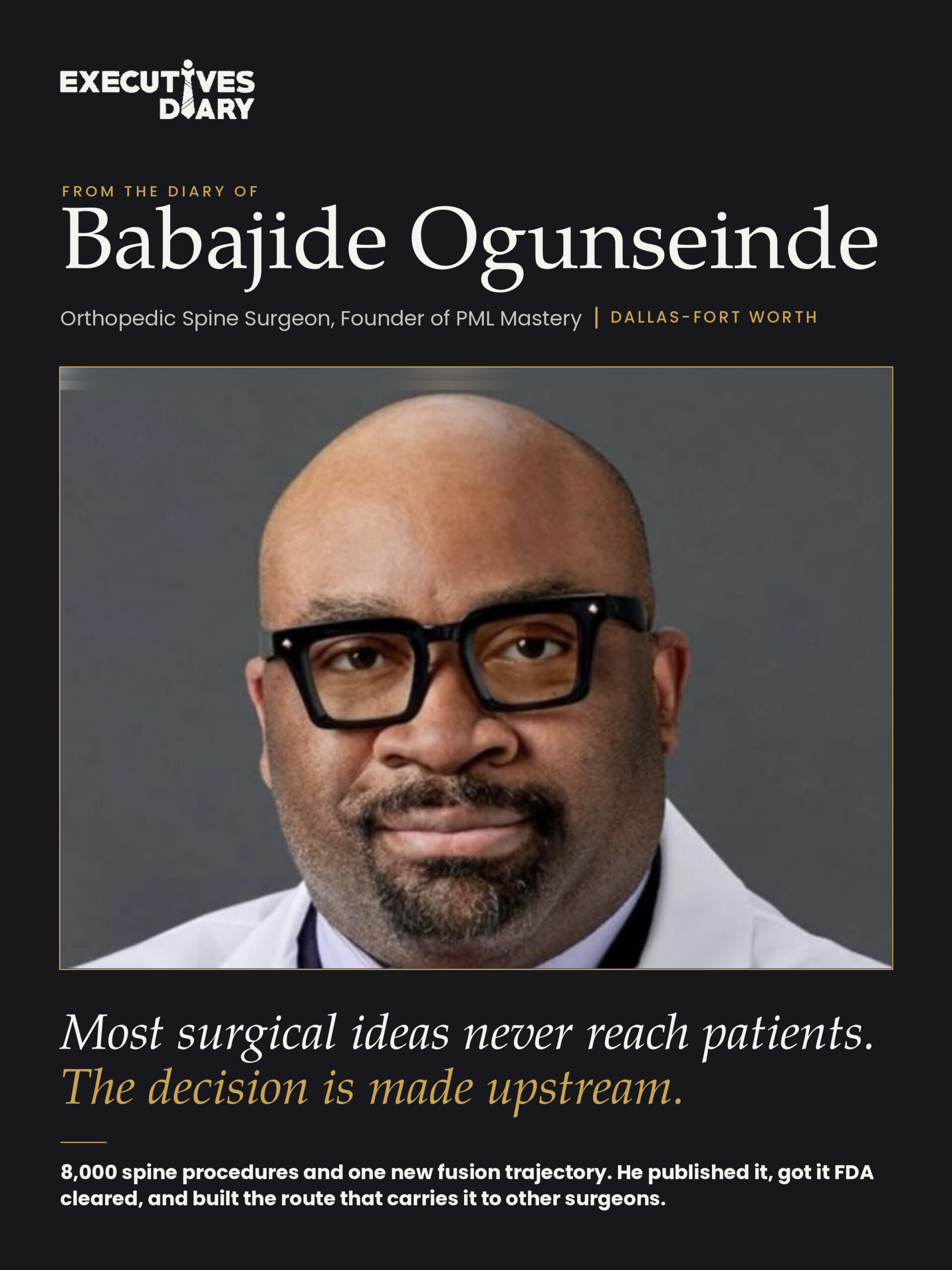
From the Diary of
Babajide Ogunseinde
Most surgical ideas stall before they reach patients. The decisions that stop them are made outside the operating room.
“The operation is only the beginning.”
Medicine repeats a number about itself that it cannot quite defend. Seventeen years is the figure usually given for how long evidence takes to reach the patients it was meant for, and a 2011 review in the Journal of the Royal Society of Medicine took that number for its title, reviewed twenty-three attempts to measure the lag, and found the measures too inconsistent to guide investment.
Babajide Ogunseinde has spent his career on the side of that gap where delay is counted in patients. He is an orthopedic spine surgeon who designed a new implant trajectory for sacroiliac joint fusion, published it, and then built the route the technique would have to travel to reach any other surgeon.
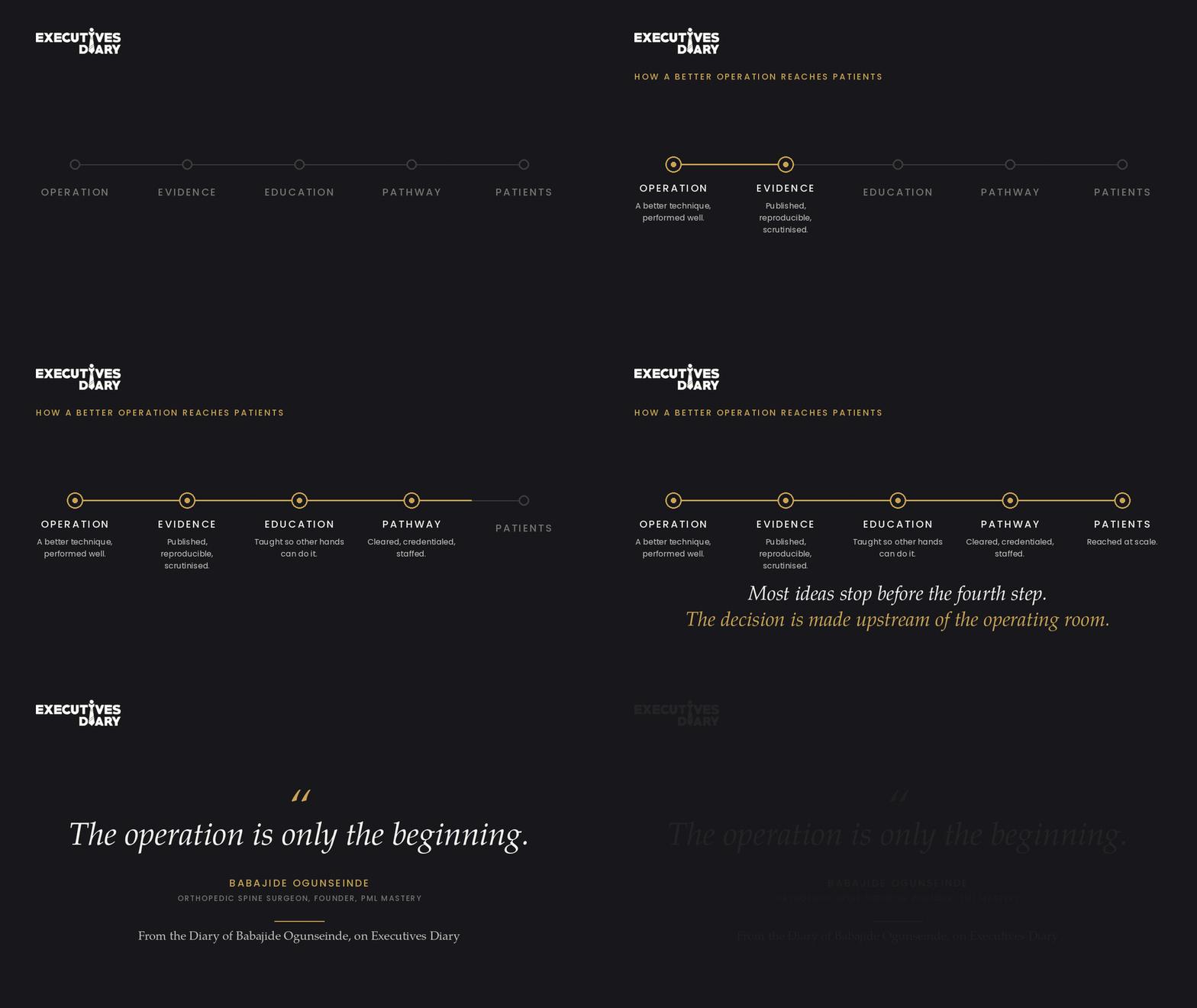
He states the argument in six words. “The operation is only the beginning.”
What follows is the rest of that sentence: where the decision actually gets made, and what has to exist before a better idea is allowed through.
The Idea Is the Easy Part
Ask most surgeons what stands between a better operation and the patients who would benefit from it, and the answer is data. Publish the outcomes, present at the meeting, and the field comes around.
Ogunseinde gives a different answer, and he gives it more often than any other piece of advice.
Innovation is not adopted simply because it works. Adoption requires evidence, education, and an implementation pathway. A surgeon may develop a better technique, but unless others can understand it, reproduce it, and integrate it into their systems, it will not reach patients at scale.
The counsel he was given early, and now considers wrong, was the comfortable version of the opposite belief. “Just be a great surgeon and everything else will take care of itself,” he says. Clinical excellence, in his account, is the entry fee rather than the whole game.
Just be a great surgeon and everything else will take care of itself.
Eight Beds and a Weekly Conference in East Texas
He did not learn this from a book. He learned it building a spine program in East Texas: an eight-bed dedicated spine unit, a rehabilitation pathway, and a weekly multidisciplinary conference.
None of that happens with a scalpel.
I learned this while building a spine program in East Texas. The operation occurred in the OR, but whether patients actually benefited depended on decisions made in administrative meetings, multidisciplinary conferences, rehabilitation planning, staffing, credentialing, and hospital leadership discussions. That taught me that clinical innovation succeeds or fails upstream of the operating room.
The rooms he is describing are rooms surgeons are rarely in. Of the 6,162 hospitals in the American Hospital Association’s 2019 survey, 383, or roughly six percent, were led by a physician chief executive, according to a study of that data published in JAMA Network Open. The people who decide whether a technique gets credentialed, staffed and scheduled are usually not the people who perform it.
Building it, he says, “taught me that outcomes are created by systems.”
What It Took to Get One Trajectory Through
The sacroiliac joint is a small target with a large shadow. A 2013 review in Expert Review of Neurotherapeutics put it behind fifteen to thirty percent of chronic low back pain that does not radiate along a nerve root, which makes it both common and easy to miss.
Where conventional sacroiliac joint fusion relies on a lateral-to-medial path, driving implants through substantial gluteal soft tissue and near branches of the superior gluteal artery, Ogunseinde engineered a posteromedial-to-ventrolateral (PML) trajectory. Starting dorsally on the sacrum, the technique avoids the lateral vascular corridor, preserves a transfixing three-cortex construct, and allows bilateral fusion through a single approximately 1.5-centimeter midline incision, an anatomical advantage that can be particularly relevant in patients with elevated BMI.
Then comes the part that takes longer than the operating.
He published the technique in Clinical Spine Surgery with a step-by-step description, an operative video and four cases. He then worked with SI-BONE, the Nasdaq-listed sacropelvic device company whose surgeon education faculty he sits on, to develop the trajectory for its implant system. In July 2024 the FDA cleared that system under K241574, and the clearance covers the use of two implants in the posteromedial trajectory.
A federal regulator now recognizes the route he draws on the bone. That is what an implementation pathway looks like when it is finished.
Four Ways to Teach One Operation
Most surgeons who develop a technique publish it once and move on. Ogunseinde built four ways into the same operation: the paper with its narrated video, an eight-module masterclass that ends in a cadaver lab in Dallas, a mobile app, and books, two of them about the work rather than the technique: The Coach Before the Scalpel, written with Deji Ogunseinde, and Faith and Purpose: The PML Story.
The reasoning is the same each time. A technique reaches patients only when other people can perform it without him in the room.
In one of his own posts he introduces a seventy-five-year-old patient six weeks after bilateral fusion. “Meet Barbara.” She had come back, he wrote, “to give testimony on how the pain she was having before the procedure is completely resolved and she’s now able to walk without pain.”

What the Evidence Had to Clear First
He is precise about what moved the technique from personal preference to something he would ask colleagues to adopt.
In a retrospective series of seven consecutive patients with a BMI between 35 and 44, followed to twelve weeks, “pain scores improved from approximately 8.6 to 3.6, and ODI improved from approximately 46 to 21, with patients achieving meaningful clinical improvement,” he says. Every patient in it cleared the thresholds for a change large enough to matter to the patient. A separate case report followed a twenty-six-year-old woman with a BMI of 46, who had seventy-five percent less pain at two weeks and ninety percent less at six.
The sample is small and single-surgeon, which he does not hide. Asked for the strongest argument against his own position, he makes it himself rather than deflecting it.
“The strongest argument is that established approaches already have substantial evidence and should not be displaced simply because something new appears more efficient,” he says. “That is why innovation has to earn adoption through evidence, transparency, reproducibility, and appropriate scrutiny.”
That is an unusual sentence from an inventor. It is also the sentence a hospital committee or an investor needs to hear before any other.
Who Reviews the Reviewer
The second argument he is making has nothing to do with the spine. In commentaries published on KevinMD this year he has argued that hospital peer review carries a structural weakness nobody designed on purpose: the physicians best qualified to judge a colleague are often the same people competing with that colleague for referrals, operating room access and leadership positions. His answer is disclosure, independent corroboration and recusal.
He writes it from inside the machinery. He is an oral board examiner and co-director of the certifying board’s leadership program.
As he put it, “expertise gives peer review its clinical authority; independence gives it credibility.”
expertise gives peer review its clinical authority; independence gives it credibility.
The Record Behind the Technique
Orthopedic surgery residency and a combined spine fellowship at Harvard, fifteen years at Longview Orthopedic Regional Clinic, more than 8,000 spine procedures and more than 2,000 sacroiliac joint fusions, board certification in orthopedic surgery, distinguished fellowship of the North American Spine Society, licenses across eight states and the District of Columbia, a second year reviewing manuscripts for the Journal of Spine Surgery, and invited lectures on the technique in Singapore and at the Hospital for Special Surgery in New York.
It started at Howard University College of Medicine, where he finished first in his class.
Alongside the surgical record sits the other education. A Stanford healthcare leadership certificate, an MBA in organizational management to be completed October 18, 2026, and candidacy for the Certified Physician Executive credential are not the usual furniture of a spine surgeon’s file. They follow from a change of mind. “I once believed that clinical excellence was enough,” he says. “I now believe physicians who want to improve healthcare must also understand leadership, economics, organizational behavior, technology, and commercialization.”
I once believed that clinical excellence was enough.
He is also candid that the position has a price.
Innovation can carry professional and personal costs. Challenging established systems creates resistance, particularly when an idea changes familiar workflows or assumptions. But those experiences strengthened my belief that innovation must be supported by evidence and institutions rather than personality alone.
Where Babajide Ogunseinde Is Now
He is based in the Dallas-Fort Worth area, teaching the technique to surgeons through PML Mastery and taking on executive, advisory, board and partnership work where the same question applies at a larger scale.
His stated direction is “toward value-based physician leadership and scalable surgeon education.”
The through-line is the one he started with. A good operation is an event. A pathway is what turns it into a standard, and the pathway is built in the meetings, the submissions and the credentialing files that surgeons are trained to regard as somebody else’s department.
The Playbook
The Babajide Ogunseinde Playbook: Getting a Better Idea Past the System
- Assume the merit is not enough. A technique that works still needs evidence, education and an implementation pathway before it reaches patients at scale.
- Learn the rooms upstream of yours. Credentialing, staffing, rehabilitation planning and leadership meetings decide whether the operation you performed produces the outcome you intended.
- Make the strongest case against yourself. Naming the argument for the established approach is what earns the scrutiny that adoption actually requires.
- Teach the work in several formats. A paper, a video, a course and an app reach different surgeons, and reproducibility by other hands is the only proof that scales.
- Build the standard, not the reputation. Innovation supported by evidence and institutions outlasts innovation supported by personality.
Babajide Ogunseinde teaches the posteromedial to lateral sacroiliac joint fusion technique at masterpml.com, is an opinion contributor to KevinMD.com, and can be found on LinkedIn.