

Alexandra Garcia
International Business | Strategic Partnerships | Systems ChangeGlobal Director of Sustainable Business.
The sustainability industry has a language problem. For decades, the dominant vocabulary has been one of obligation: comply, report, disclose, reduce, offset. Governments issue frameworks. Consultants produce audits. Boards approve policies. And somewhere between the 400-plus competing ESG standards and the next regulatory deadline, the actual work of restoring nature gets buried under the weight of its own paperwork.
Alexandra Garcia has spent over fifteen years working across international business and sustainability, including a decade working with Chinese businesses and eight years focused on sustainability, across five industries and three continents. Her conclusion is not that the industry needs more regulation. It is that it needs a different door.
She calls it the Trojan Horse.
Alexandra Garcia is the Global Director of Sustainable Business at World Wide Generation, a London-based sustainability technology company whose platform, G17Eco, helps organizations measure, verify, and act on their environmental and social impact data. Garcia leads commercial growth and market expansion across Europe, the Middle East, and APAC, working with governments, financial institutions, and multinational organizations to turn sustainability from a compliance burden into a commercial advantage. What defines her, above everything else, is the refusal to ask business to choose between profit and planet. She does not believe businesses should have to choose between the two.
Where a Career Learns to Speak Two Languages at Once
Garcia’s story begins in Cali, Colombia, at a manufacturing company called FORSA S.A., where she entered through one of the more unusual on-ramps in executive education: the German Dual Study Programme, a model that combines full-time university studies with structured, hands-on rotation across real business functions. While her peers were sitting in lecture halls, Garcia was moving through operations, manufacturing, commercial strategy, and continuous improvement simultaneously. By the time she graduated, she had designed and implemented a commercial CRM and information management system for FORSA’s sales team, a system that, according to her own account, continues to support the business today.
That early formation mattered more than it might appear. The German dual model does not produce theorists. It produces people who are constitutionally uncomfortable with ideas that cannot be operationalized. Garcia has carried that instinct into every role she has held since.
From Colombia, she moved into international trade, spending seven years at Ningbo MH Industry, a Chinese manufacturer, where she led business development and regional expansion across Latin America. She then spent a further three years with MH Star in London, part of the same group, working across European markets. In total, ten years working with Chinese businesses gave her a ground-level understanding of how global supply chains actually work, where commercial decisions get made, who makes them, and what drives them commercially. She was operating as a commercial bridge between China and South American markets before that kind of cross-cultural fluency had a name on a CV. The experience gave her something that formal sustainability training rarely offers: a ground-level understanding of how global supply chains actually work, where the decisions get made, who makes them, and what moves them.
A move to London and a role at MH Star UK while completing an MBA at Coventry University London, then a pivot that, in retrospect, was not a pivot at all. At Globechain, an award-winning circular economy platform, Garcia led international business development across European markets, working across private and public sectors to make circular business models commercially viable. The conviction she was forming, that positive environmental outcomes and commercial success are not in tension but are in fact the same thing stated from different angles, was beginning to find its professional form.
Then came the United Nations.
Between 2020 and 2022, Garcia worked at UNEP-WCMC, the United Nations Environment Programme World Conservation Monitoring Centre, on the National Ecosystem Assessment Initiative. The mandate was significant: support governments across 14 of the world’s most biodiverse nations to integrate nature into national decision-making. The first four countries to complete their assessments were Cameroon, Ethiopia, Vietnam, and Colombia. Her own country.
What she did at UNEP-WCMC was not scientific work in the conventional sense. It was translation. She helped shift the conversation in government rooms from nature protection as a cost to natural capital as an essential asset for national accounting, infrastructure, and land-use planning. The work contributed to nationally endorsed biodiversity assessments designed to inform international climate and biodiversity finance, and to the creation of permanent, cross-ministerial science-policy platforms designed to keep nature-positive policy moving regardless of which administration holds office. In a field where progress routinely disappears when governments change, that durability was the point.
She left the UN with a sharpened belief and a clearer method. Both came with her to World Wide Generation.
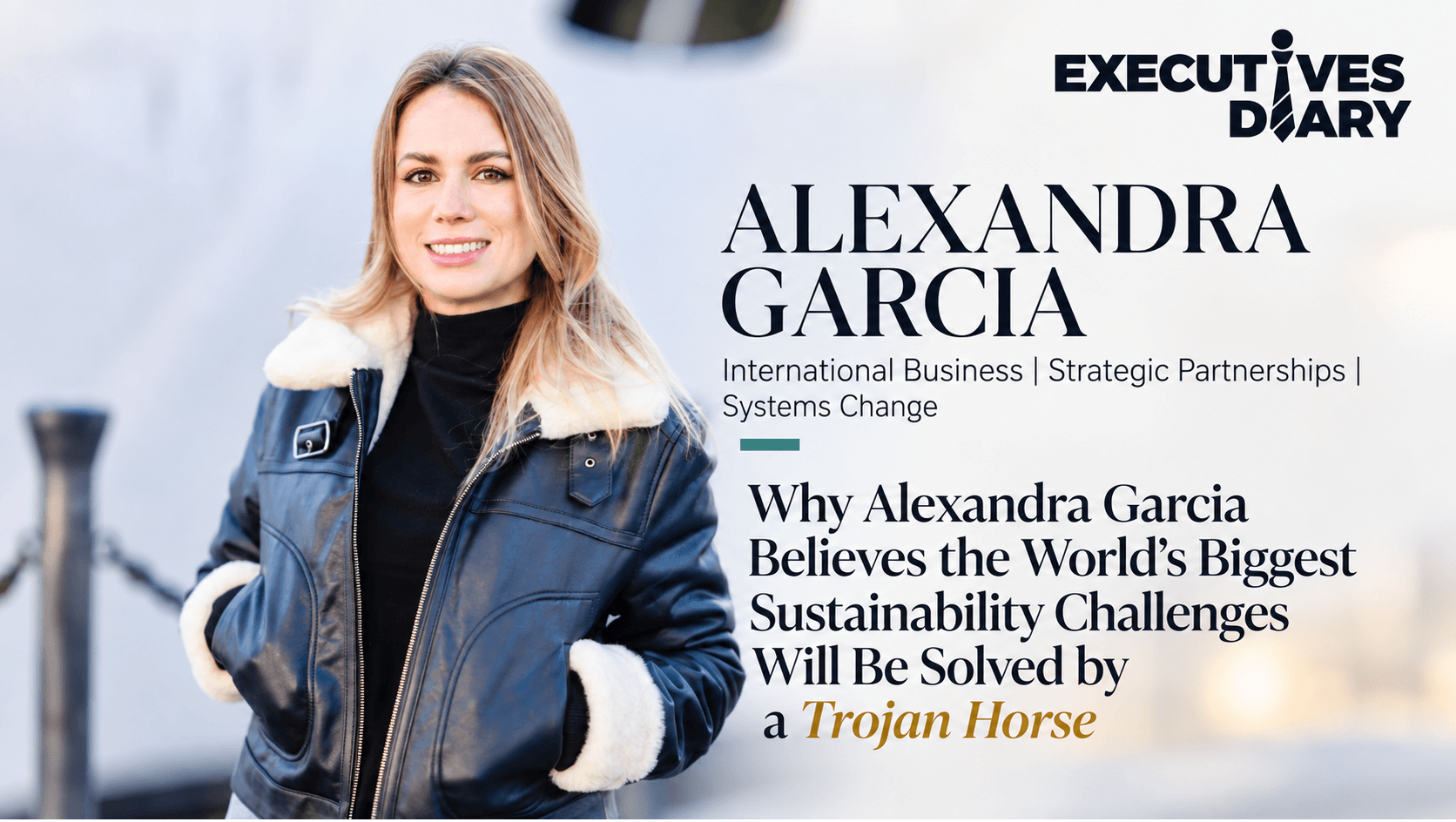 Alexandra Garcia: Driving sustainability through a “Trojan Horse” business strategy.
The Trojan Horse Is Already Inside the Building
Garcia joined World Wide Generation in April 2022 as Senior Business Development Manager for EMEA. By February 2025, she was Global Director of Sustainable Business. The progression reflects what colleagues and managers describe consistently: a professional who combines genuine conviction about sustainability with the commercial judgement to make that conviction produce results.
In her current role, Garcia leads the commercial expansion of G17Eco across Europe, the Middle East, and APAC, working with some of the most complex organizations in the world on one of the most complex problems in business: how to make sustainability data mean something beyond a reporting obligation.
The organizations she works with are not short of ambition. What they are short of is a path from ambition to execution. Garcia has identified three blockers that appear with remarkable consistency across geographies and sectors: sustainability data that is fragmented and therefore untrustworthy, sustainability functions that are organizationally isolated from sales and finance, and regulatory complexity so dense that it produces paralysis rather than action. For Garcia, businesses are ultimately human systems: the decisions made inside them reflect the incentives, information, and opportunities available to the people making them.
Her answer to this is not to argue against the system. It is to enter through a door the system already has open. That door is value creation. When verified ESG and biodiversity data is connected directly to contract wins, supply chain resilience, capital access, and market differentiation, sustainability stops being a cost centre and starts being a competitive advantage. The Trojan Horse is not a workaround. It is a commercial strategy.
Across the markets Garcia covers, this approach is producing the kind of results that make sustainability functions interesting to CFOs. Organizations that can connect credible impact measurement to commercial decision-making can strengthen their position in tenders, financing conversations, and increasingly demanding supply-chain relationships. The domino effect she describes is not rhetorical. It is the commercial mechanism by which her work scales.
Garcia’s longer-term conviction centres on regenerative agriculture as one of the most significant untapped opportunities in the global economy. The argument is structural: healthier soils can improve resilience and carbon outcomes; where appropriate measurement and verification systems exist, farmers can potentially generate additional revenue from ecosystem outcomes; and businesses that support this transition can build supply chains that are more resilient, more transparent, and more attractive to markets that increasingly demand both. The pieces of the ecosystem already exist. What is missing, Garcia argues, is the shared digital infrastructure that allows farmers, policymakers, financial institutions, corporate buyers, and agricultural technology partners to view the same verified impact data simultaneously.
The scale of what she is describing, cross-sector ecosystems linking soil health to sovereign finance to corporate procurement, is considerable. Garcia sees the opportunity in connecting these different parts of the ecosystem, using commercial models, partnerships and incentives to help regenerative agriculture and nature-positive solutions scale.
The Door That Was Always There
Garcia began her career in a Cali factory learning how systems actually work, not how they are supposed to work on paper. She spent seven years bridging China and Latin America, followed by three years working with the same Chinese business group in London and Europe. She then moved into the circular economy, before joining the United Nations, where she worked on an initiative supporting countries, including Colombia, to integrate nature and biodiversity into national decision-making. Each chapter added a layer to the same argument: that the world does not need businesses to become something they are not. It needs the incentives to change so that pursuing value can also produce the right outcomes.
The Trojan Horse was never a metaphor for deception. It is a metaphor for pragmatism. For finding the door that is already open and walking through it with something that changes everything on the other side.
From global supply chains to the United Nations and now sustainable business, Alexandra Garcia has spent her career building that case, one market at a time.
Key Takeaways / Playbook
- 1. The Trojan Horse Strategy: Positioning sustainability as a core commercial driver and market differentiator rather than a mere regulatory compliance burden.
- 2. Operationalizing Sustainability: Ground-level fluency in supply chains and systems engineering ensures ideas transition smoothly from theory to execution.
- 3. Natural Capital Translation: Bridging the gap between complex environmental science and actionable policy/finance frameworks for governments and institutions.
- 4. Scaling Regenerative Ecosystems: Creating shared digital infrastructures that link soil health, sovereign finance, and corporate procurement into a clear win-win model.

