

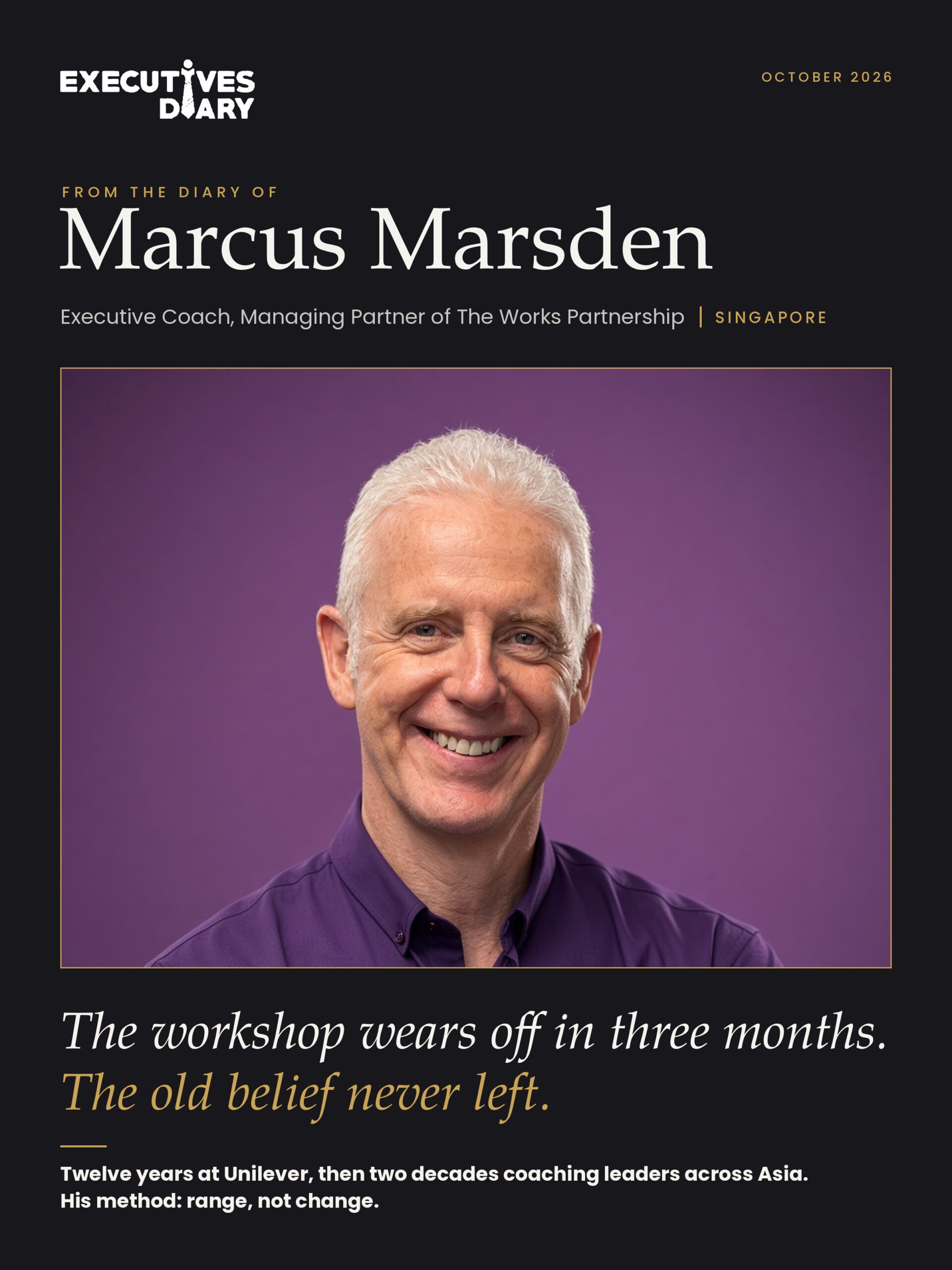
From the Diary of
Marcus Marsden
Here’s why behaviour-first training fails, and what changes when a coach works with identity instead.
“However limiting a belief might seem to be on the surface, the breakdown isn’t the belief itself, it’s treating the belief as though it were a fact.”
A leader sits through the two-day workshop, nods at the right moments, and means the commitment they make on the final afternoon. Three months later, the old pattern is back.
Only 11 percent of executives surveyed by McKinsey strongly agree their organisation’s leadership development actually achieves and sustains the results it was built for.
Marcus Marsden has watched that particular disappointment from both sides of the desk: first as a change manager inside a global corporation, then for more than two decades as the executive coach often called in to help leadership development stick. His explanation for why it fails is not about better content or longer programmes. It is a simple distinction that he now frames as range, not change.
What follows is the method behind that distinction, the difference between a belief you fight and a belief you make room around, and what it has meant for two corporate relationships that have lasted close to two decades each.
What the Old Approach Gets Wrong
Marsden’s diagnosis starts with what happens in the room before anyone says a word.
The vast majority of people I meet come in with an assumption that they need to change their behaviour. Consciously or not, they are in resistance to the process of development because they think it implies they are currently doing something wrong or bad. It’s like they come in tensed up, wearing armour and holding their breath.
That resistance is not a personality flaw to route around. It is the entire coaching problem, in one image.
The standard fix, the one behind most of the training the McKinsey survey measured, tries to talk people out of the tension: techniques to calm nerves, scripts for how to speak up, a slide on why the new behaviour matters. It works, for a while. Then the old belief comes back, usually bigger than before, because nobody addressed what the belief was doing there in the first place.
The Belief Doesn’t Have to Go
Marsden built this distinction over years of watching training and coaching sit side by side, in the two firms he built after leaving Unilever’s change management function in 2002.
“However limiting a belief might seem to be on the surface,” he says, “the breakdown isn’t the belief itself, it’s treating the belief as though it were a fact.”
A simple example might be when a person wants to (or has been told to) speak up more often in meetings. Very often what we uncover underneath that behaviour of staying quiet is a long-established belief that ‘I’m not as smart as …’ and so if I do speak up, then things won’t go well for me. I’ll be found out.
Most programmes would attack the silence directly. Marsden leaves the belief exactly where it is, and asks a different question instead: what is this belief actually doing for the person who holds it.

What Happens in the Room
The instructions that follow are specific enough to try this week, on a real conversation.
First, name the belief without arguing with it. Not “that’s not true,” but “that made sense, given what you’d seen.” The old belief, in Marsden’s frame, got someone to their current position, so there is no case for removing it outright.
Second, ask what the belief has been protecting. A person who stays quiet in meetings is rarely just anxious. The silence is usually doing a job, keeping them safe from being found out, in Marsden’s phrase.
Third, once that protective job is acknowledged, most people “exhale,” his word for the shift from a contracted state, tensed and defended, to an expanded one where a new belief can sit alongside the old one rather than replace it.
It’s also why Marsden is unconvinced that artificial intelligence can shortcut the work. “Anyone can use A.I. to make themselves look smart on LinkedIn,” he wrote in a recent post, “but that’s not where life happens.”
Anyone can use A.I. to make themselves look smart on LinkedIn, but that’s not where life happens.
This is also why his training work and his coaching work are not interchangeable, he says. The training opens the space. The coaching fills it with new practice. Both are critical.
The Corporate Relationships That Have Lasted Two Decades
Marsden doesn’t offer a single marquee client story. What he has is two: corporate relationships with The Works Partnership that have run for twenty years and eighteen years, without a break.
Our corporate relationships tend to last for significant periods because our work is both highly impactful and highly unusual. We genuinely work with the whole human being, and not simply the person as a manager in a business. As a result, people’s relationships both at home and the office are significantly positively impacted. When people see their relationships with their loved ones developing, it completely changes the game.
More than anything else, he says, “people rediscover their sense of personal agency in the world…and that’s gold dust.”
The whole-human premise is not a line borrowed for the article. Marsden built a second company, Sarius Performance, with his wife, the executive coach Sari Marsden, to combine coaching with sports psychology, nutrition and fitness training under one approach, and the two of them co-authored a book, Fit to Lead, on the idea that leadership development which ignores the body is treating half the person.
Twelve Years at Unilever, Then a Different Kind of Coach
Marsden’s case for range over change started, by his own account, on the other side of the desk. He read Philosophy and Theology at Oxford, then spent twelve years at Unilever in marketing, general management and change management, including running the coaching, training and communication side of a major European systems rollout.
“I have sat at the corporate desk, torn between speaking up and staying silent, or between going home to see my family and staying to finish the report,” he says. He knows what it is to be “genuinely pulled apart by a matrix system of reporting that’s asking for inconsistent priorities,” and frustrated by a bell-curve process forcing an unfair ranking onto a good team member.
That grounding shows up in the region he chose to build in. Coach practitioner numbers in Asia grew faster than in any other region in the world in the years after the pandemic, up 86 percent, according to the International Coaching Federation, and it is where Marsden has spent over two decades training coaches, editing The Purple Book of Coaching, and writing Start With Who, his own book on identity and performance. One longtime client wrote: “Working with Marcus has been transformational. I lead with more confidence at work and show up as a more intentional parent at home.”
Where Marcus Is Now

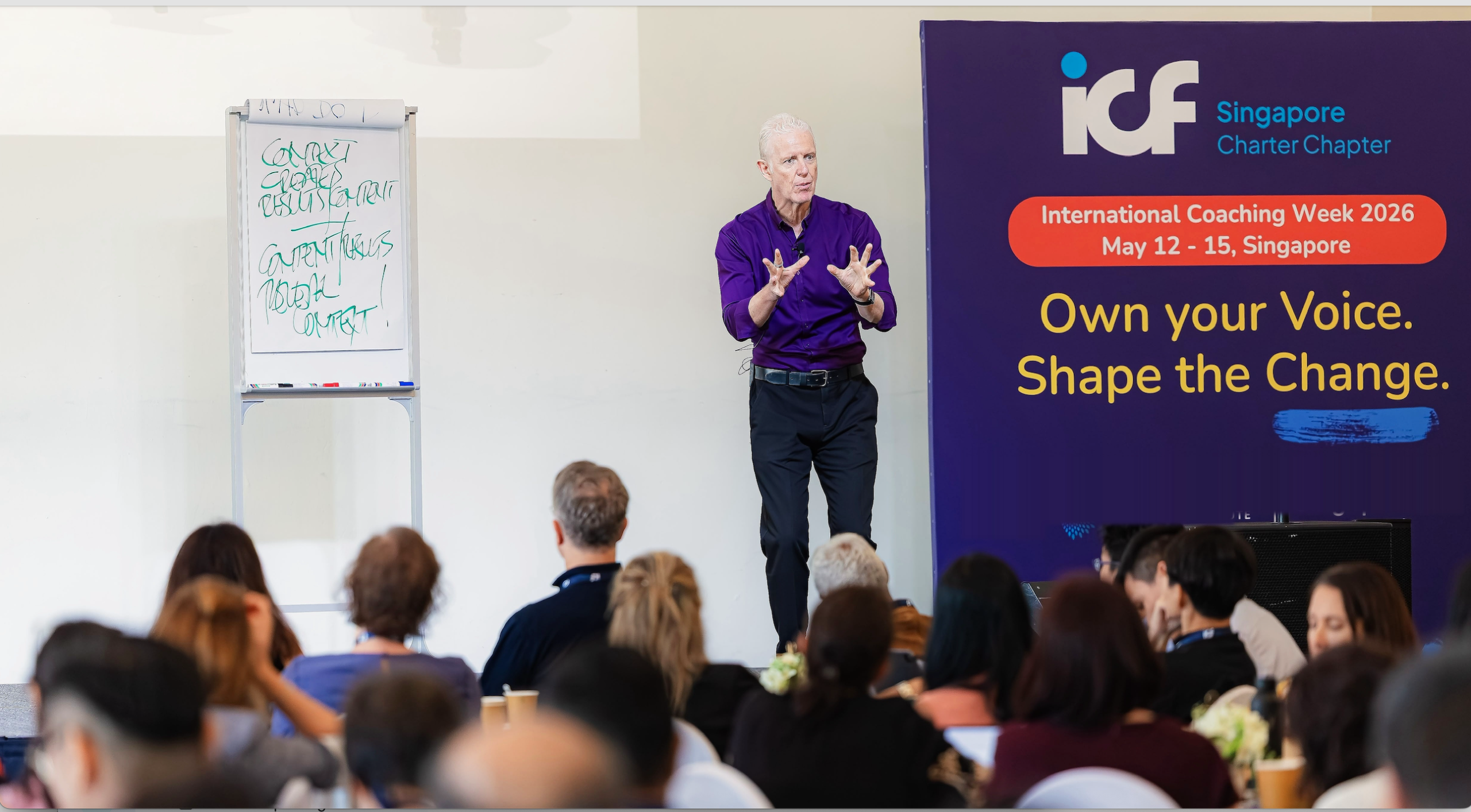
Marsden still lives and works in Singapore, where The Works Partnership and The Coach Partnership run leadership development, executive coaching and coach-training programmes across the region. Outside the training room, the same principle keeps showing up in his own life: for years he avoided exactly the kind of visibility this article represents. “I am never particularly comfortable in the spotlight, and so I haven’t pushed myself onto social media or the web or speaking engagements etc much over the years,” he says. In discussion with his team, that has started to change.
He has just recorded the audiobook for Start With Who, available in the fourth quarter of 2026, and has a fourth book due out in the first quarter of 2027. This new book takes the ideas of Fit to Lead and Start With Who into new territory. “It’s time,” he wrote when he sent the new manuscript to his publisher, “to take Start With Who and Ontological Coaching out of the training room and into the world.”
It’s time to take Start With Who and Ontological Coaching out of the training room and into the world.
The Playbook
The Marcus Marsden Playbook: Building Range Without a Fight
- Name the belief, don’t argue with it. Telling someone their belief is wrong (explicitly or implicitly) only makes them defend it harder. Naming it as something that made sense once opens the door instead of locking it.
- Ask what the belief has been protecting. Behind most stuck behaviour is a belief doing a job, often keeping someone safe from being found out.
- Separate the behaviour from the identity. The old belief can stay in place while a new one develops alongside it, which is where range comes from.
- Give people space before you give them scripts. Training opens the space. Coaching is what fills it with new practice.
- Work with the whole person, not just the manager. Relationships that last twenty years happen when the work touches someone’s life, not just their job.
Marcus Marsden builds range, not change, at thecoachpartnership.com. Connect with him on LinkedIn.

