
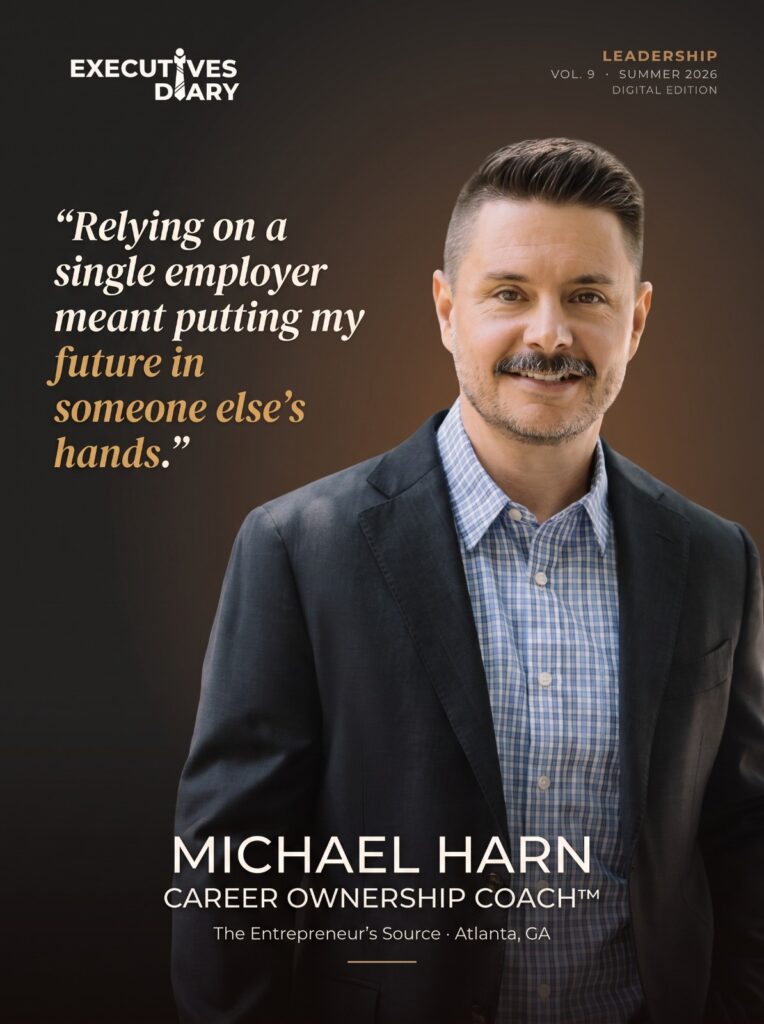
Who is Michael Harn?
Michael Harn spent more than two decades in the wireless telecom industry, rising into senior leadership while navigating multiple layoffs along the way. Today, as a Career Ownership Coach™ with The Entrepreneur’s Source in Atlanta, he works with experienced professionals asking the question that eventually caught up with him: does the next move actually change anything, or does it just repeat the last one?
The recruiter call comes on a Tuesday afternoon, wedged between two back-to-back meetings.
He steps into an empty conference room to take it, already halfway convinced before the pitch even starts. Better title. Bigger number. A logo that will look good on the profile. He says yes to a first conversation almost on reflex, the same way he said yes the last three times something like this came along.
Later that night, scrolling through the offer details on his phone, a smaller thought surfaces underneath the excitement. This will be his fourth company in eleven years. He built himself a strong resume, a working knowledge of three different industries, and a growing suspicion he can’t quite name.
Is the next job actually going anywhere, or is it just the next job?
The Question That Changed His Career
Harn’s career looks, on paper, like a model of steady advancement. He worked his way up through Kyocera managing national accounts, built a side career in commercial real estate, and spent more than ten years at VIP Wireless climbing from Regional Market Manager to Director of Go-to-Market. Along the way, he worked closely with thousands of independent business owners and operators, absorbing how entrepreneurship actually functioned while still building his own corporate resume.
He was also laid off more than once. Each time, he adapted, leaned on his experience, and found the next opportunity without much hesitation. It was only after the pattern repeated itself enough times that it stopped looking like bad luck.
“Those experiences forced me to rethink what career security really meant,” Harn says. “I realized that relying on a single employer meant putting my future in someone else’s hands.”
When he discovered The Entrepreneur’s Source, he wasn’t shopping for a new career. He was looking for answers to his own situation. The process pushed him to stop asking what job should come next and start asking what he actually wanted his career to provide, and which paths could realistically get him there. That shift is what eventually put him on the other side of the coaching relationship.
Education, Awareness, Discovery
“My passion isn’t convincing people to own a business,” Harn explains. “It’s helping them gain the clarity, confidence, and awareness to make informed decisions about their future.”
His coaching centers on education, awareness, and discovery, helping clients evaluate their goals around four key areas: Income, Lifestyle, Wealth, and Equity. The conversation starts with the person, not with a business opportunity sitting on a shelf waiting for a buyer.
What does this person actually want their income to look like day to day? What kind of lifestyle are they protecting or trying to build? Are they accumulating equity toward something, or mainly trading hours for a paycheck? Only once those answers get sharper does Harn help clients look at the vehicles that might actually get them there, whether that’s another corporate role, an added income stream on the side, full ownership, or some mix of the three.
Nothing about the process is designed to land on a predetermined answer. It’s built to make sure the eventual answer is an informed one.
A second principle sits underneath the first: the gap between thinking you know something and actually knowing it. Professionals routinely rule out entire paths based on assumptions they’ve never tested, that ownership requires quitting a job overnight, that it demands capital they don’t have, that staying put is automatically the safer bet.
“The best leaders aren’t the ones with all the answers,” Harn says. “They’re the ones willing to ask better questions, challenge their own assumptions, and remain open to new possibilities.”
He treats his own clients the same way, pushing them to gather real information before deciding whether their assumptions hold up. Sometimes that process points toward business ownership. Sometimes it confirms the corporate path was right all along. Both outcomes count as a win, because the decision was made on evidence instead of fear.
A Different Definition of Career Security
Most of the professionals Harn works with have done everything they were told to do. They built expertise, earned the promotions, changed employers when the timing made sense, and increased their compensation along the way. Some of them still hit a point where the next title or the next paycheck stops feeling like real progress.
Harn doesn’t treat this as a problem with employment itself. A corporate career can still be the right vehicle for someone’s goals. The real question is whether it remains the right vehicle for this version of them, at this point in their life, given what they actually want next.
That distinction matters more now than it used to, as careers stretch across more employers, more restructurings, and more unplanned exits than they once did. For Harn, security was never going to come from finding the one company that promises permanence. It comes from understanding your own value clearly enough to have real options when circumstances change without asking permission first.
The Harn Playbook: 5 Lessons
Security comes from having options, not from one employer. Companies and industries shift constantly, so know your skills and alternatives well before you need them.
Define what your career is actually supposed to provide. Get specific about income, lifestyle, wealth, and equity before chasing the next title.
A new job isn’t automatically a new trajectory. Ask whether the move gets you closer to your long-term goals, not just a better number on the offer letter.
Explore a path fully before ruling it out. Assumptions about ownership, risk, or capital rarely survive real information.
Let evidence make the decision, not fear. Turn “I think” into “I know” before you commit to anything.
Taking Ownership of What’s Next
The professional weighing that fourth job offer isn’t wrong to consider it. The real question is whether that move is simply the next step, or the best step for that individual at this point in their life.
Harn spent twenty years inside that pattern before he stopped to ask better questions himself. Career Ownership, in his definition, was never about leaving corporate life behind. It was about understanding every available option before deciding which path best aligns with your goals.
The next job may absolutely be the right answer. The question is whether it’s the best answer for that individual. That’s a question worth exploring before making another career decision.
Michael Harn is a Career Ownership Coach™ with The Entrepreneur’s Source based in Atlanta, Georgia. He guides experienced professionals through a no-cost process of education, awareness, and discovery, helping them gain clarity about their goals and evaluate the options available to them. To connect with Michael or learn more, visit his LinkedIn profile.