

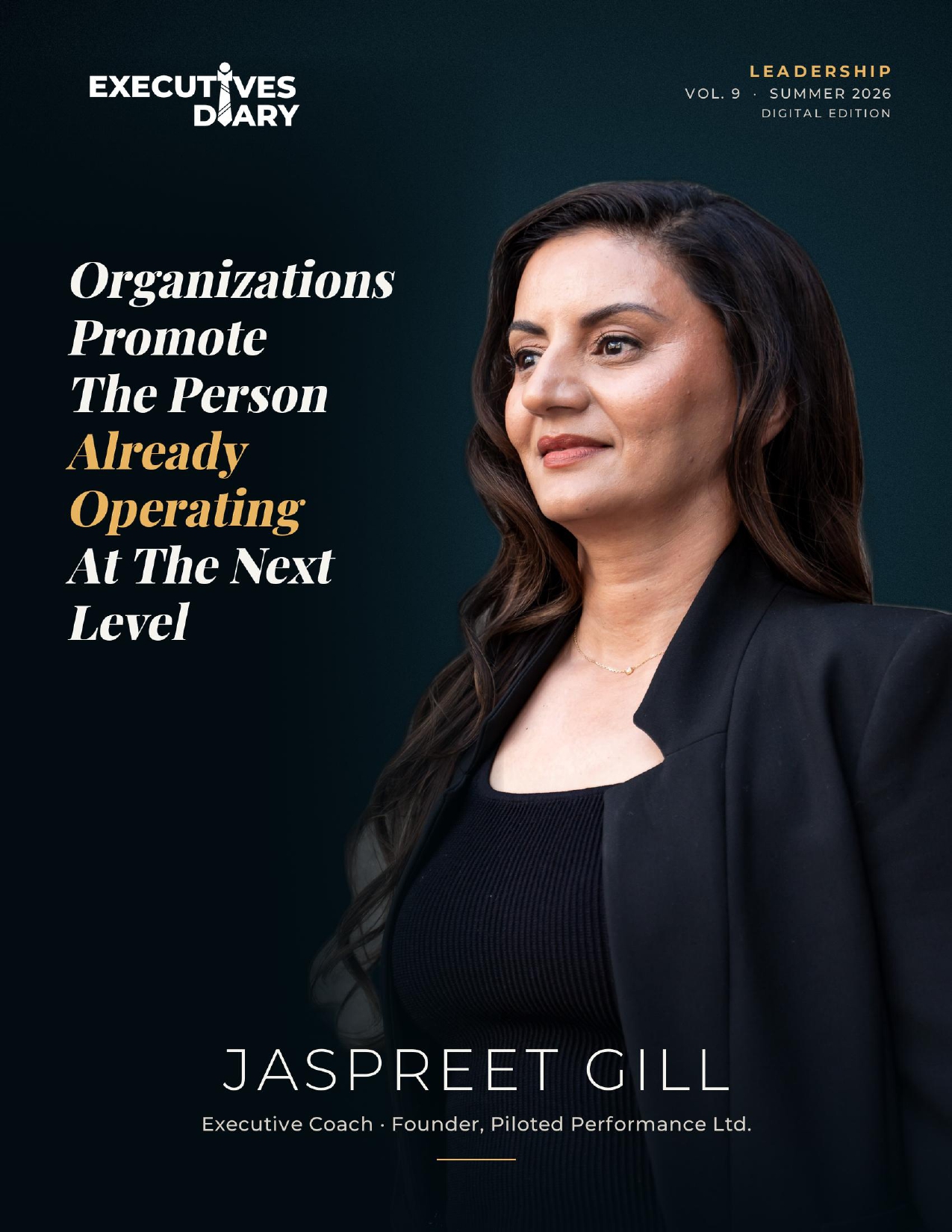
Jaspreet Gill
Founder & CEO @Piloted Performance Ltd.
creator of the ASCEND Method
Jaspreet Gill reached the final round for Field CTO roles at Microsoft and kept losing them. What she found was not a capability gap.
A year and a half into a Microsoft role, Jaspreet Gill began pursuing Field CTO positions. She kept reaching final interviews. She kept not getting selected. There is a well worn explanation for that, and it is readiness: one more credential, one more win, one more year of evidence. Jaspreet ran that play and stayed exactly where she was. “My challenge wasn’t a capability gap. It was a perception gap. And that perception started with me.”
Jaspreet Gill is an executive coach and founder of Piloted Performance Ltd. in Calgary, built after fifteen years in enterprise technology, seven of them at Microsoft.
Identity Sits Under the Skills Everyone Works On
The first thing Jaspreet does with a new client is decline the brief she was handed. “Most high achieving women do not have a skills problem. They have an identity challenge.” So the opening move goes elsewhere. “I do not start by helping a client become more confident, more visible, or more strategic. I start by looking at who she believes she has to be in order to succeed.”
She draws the distinction as an iceberg. “Most coaching programs focus on what I think of as the part of the iceberg above the waterline: behaviors.” Communication, executive presence, visibility. They matter, in her account, and they are the visible fraction. Underneath sit rules a woman has carried for years, which Jaspreet surfaces as questions rather than diagnoses: does she believe she has to prove herself before she can lead, does she believe being valuable means being the person who never drops the ball. “Those stories drive behavior. Over time, they shape identity. And identity shapes results.”
The rule that follows is one she enforces against client expectation. “I generally refuse to give someone a bigger action plan before understanding the identity that is creating the problem.”

What Changed When One Engineer Stopped Discounting Her Wins
A solutions engineer at Microsoft came to Jaspreet with a strong record and a persistent sense she had to prove she deserved the seat. She was describing a customer meeting that had gone well, and spent most of the conversation on the one question she had not been able to answer. “I should have known that,” she said. Jaspreet laughed and answered, “Says who?”
What followed spent little time on skills. “A lot of our work was helping her see how quickly she discounted everything that had gone right and fixated on the one thing she didn’t know,” Jaspreet says. The material underneath was “self trust, letting go of perfectionism, and separating her value from having all the answers.”
Months later came a second customer conversation, another question she could not answer, and no hours replaying it afterward. “I told them I’d pull in the right person,” she told Jaspreet, then laughed: “Turns out I don’t actually need all the answers.” Around six months in, a line Jaspreet had not heard before. “I don’t have a shred of doubt left. I know I can learn and do whatever I want to.”
Eighteen months after that, by Jaspreet’s account, the client received Microsoft’s Gold Club Award, which recognizes top performers companywide. “The surprise for me wasn’t the award,” she says. “The surprise was how little the work had to do with capability.” She had been talented and producing results the whole time. “What changed was that she stopped measuring herself against an impossible standard and started trusting herself.”
The practice itself is young, but the outcomes have been consistent. Clients have renewed, organizations have extended coaching engagements, and many of the women who arrived questioning their readiness now describe a very different relationship with themselves. The shift, Jaspreet says, is rarely about acquiring more capability. It’s about trusting the capability they already have.
The Six Stages, and What Anyone Developing Women Leaders Can Take From Them
The method Jaspreet built from that pattern is the ASCEND Method, six stages in a fixed order: Align, Strengthen, Clarify, Embody, Navigate, Distinguish. Align sets a baseline across career, health, relationships, wellbeing, and fulfillment, since a career cannot be examined in isolation. Strengthen builds capacity before anything else moves, because “Many high achieving women are operating on pressure, responsibility, and willpower.” Clarify defines the future version of the client, “Not just what they want to do, but who they want to become.” Embody works the beliefs limiting that picture, Navigate handles setbacks without reversion, and Distinguish settles what the client wants her leadership known for. Jaspreet is direct about the origin of the sequence. “The sequencing was influenced by my training through the High Performance Institute, but my experience taught me why the order matters.”
The sequence is the portable part, and the error it corrects is the category’s most common: beginning at Clarify.
Key Takeaways / Playbook
- First: Resist the instinct to open on the next step question. “Many high achieving women try to start with clarity. They ask, What should I do next? But if you’re exhausted, disconnected from yourself, or measuring your worth through achievement, clarity alone doesn’t create change.” That failure is not a planning failure. “I’ve seen women gain complete clarity on the next step and still hesitate to take it.”
- Second: Establish what the person is running on before adding to her load. Capacity is a precondition, not a benefit, which is why Strengthen runs second.
- Third: Ask the question that surfaces the trap. Jaspreet put it to a client being considered for a larger leadership role who had spent minutes listing what she lacked: more experience, more exposure, more confidence, more certainty. “What would need to happen for you to finally feel ready?” There was a long pause. The client laughed and said, “I don’t know.” The silence was the finding. She had, in Jaspreet’s reading, “been moving the finish line for years. Every time she achieved something, the requirement changed.”
- Fourth: Treat hesitation as information, not as a clarity failure. “One of the core lessons here is that clarity does not create certainty. You can be clear about where you’re going and still feel fear.”
- Fifth: Measure progress by how the person talks about herself. In week one, most clients are working an immediate challenge. By month three, in Jaspreet’s account, “The conversation shifts from ‘How do I become more confident?’ to ‘I trust myself to handle what’s next.'”
Her one line for the woman everyone relies on and still waiting to feel ready: “You do not build self trust by proving yourself first. You build self trust by acting before you have all the proof.”

Who Is Jaspreet Gill?
Jaspreet Gill, EMBA, CHPC, is an executive coach, speaker, and the founder of Piloted Performance Ltd. in Calgary, Alberta, and the creator of the ASCEND Method, a six stage method for women moving into senior leadership. She began teaching engineering undergraduates in India in 2006, moved to Canada in 2007, then spent two years retraining before joining the consulting firm Ideaca in June 2009.
Ideaca was acquired by Hitachi Solutions in 2014, and Jaspreet moved from business intelligence consulting to senior analytics consulting and an analytics manager role. She joined Microsoft in December 2017 for seven years across business intelligence, technology strategy, and Dynamics work, finishing as a senior sales executive in business applications in December 2024. She completed an Executive MBA at Queen’s University from 2016 to 2018 while working full time, and qualified as a Certified High Performance Coach in 2023.
Piloted Performance launched in November 2023 and went full time the following December. Alongside private coaching, Jaspreet delivers organizational programs: a global workshop series for Kaizen Institute’s Women’s Empowerment Program, reaching roughly 300 women worldwide through live and recorded sessions, a keynote for roughly 70 women at Sunridge Oral and Maxillofacial Surgery, and one for more than 50 employees across Canada at SDK Tek. Her private clients have come from Microsoft, Accenture, KPMG, MNP Digital, and MEG Energy, individual leaders who funded the coaching themselves. She is exact about the boundary. “It is not therapy, counseling, or mental health treatment, which are typically focused on diagnosing or processing past experiences.”
Her grandmother had welcomed fifteen granddaughters before she was born, in a culture where boys were often prized more highly. She became the first girl in her family to attend university, taking a computer science degree at Punjabi University. The belief she took from it still runs under the work: “women are often capable of far more than they have been taught to believe.” The through line has not moved since the interviews she did not win. Organizations select the person already operating at the next level, and the waiting is what keeps her out of view.