

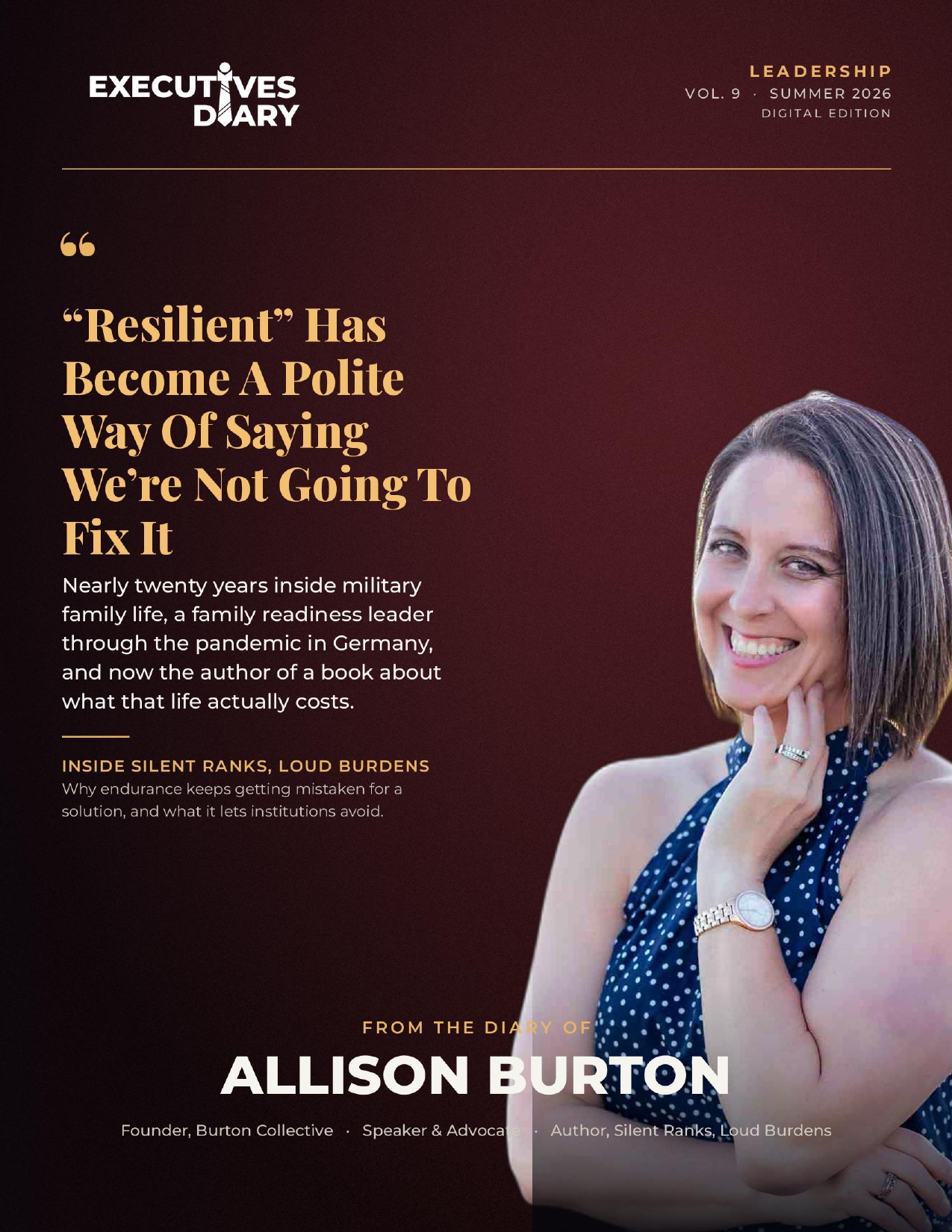
From the Diary of Allison Burton
Praised for Adapting: What Military Families Are Never AskedAllison Burton, speaker, advocate, and author of the forthcoming Silent Ranks, Loud Burdens, on why endurance keeps getting mistaken for a solution.
There is a word that follows military families through every relocation, every school year started in a new country, every stretch of months spent running a household alone. The word is resilient. It arrives as praise. Allison Burton has come to hear it as a closing argument.
“Resilient has become a polite way of saying we’re not going to fix it.”
Burton has spent nearly twenty years inside military family life, currently from Ansbach, Germany. She is not making a case against resilience itself, which she describes as a real and necessary part of the experience. She is making a case against what the word has been asked to do. Somewhere in its repetition, a description of how families cope became a reason to stop examining what they are coping with.
The distinction she draws is narrow and difficult to argue with once stated plainly. There is a difference, she says, between a community that endures hardship well and a community that is repeatedly asked to endure hardship that could have been prevented. Praise for adaptation costs an institution nothing. Fixing the conditions that require the adaptation costs a great deal. When the first is available, the second rarely gets scheduled.
That argument is the foundation of Burton Collective, the advocacy platform she founded, and of her forthcoming book, Silent Ranks, Loud Burdens, now in its final editing pass with a hoped-for release in late 2026. A crowdfunding campaign running through early August is intended to fund professional publication and, depending on what it raises, a small book tour. The title borrows the long-standing military spouse phrase “silent ranks” deliberately, and then argues with it.
The two things spouses are told they cannot say at once
The second belief Burton works against is the idea that gratitude and criticism are opposites, and that voicing one forfeits the other.
She hears the objection often, usually in the form of a reminder that military families have it good: housing, healthcare, benefits a great many civilian workers would want. Her answer is not to deny the value of any of it. It is to point out that affordability is not the same thing as access, that continuity of care is a separate question from cost, and that the standard of military housing has not always matched what families were told to expect for what they were paying.
The claim is easy to nod along with and unusually hard to practice, because the social penalty for the second half of each sentence is real. Spouses who raise problems risk being read as negative, ungrateful, or unsupportive of the mission their family has organized its life around. That penalty does most of the enforcement work. Nobody has to issue an instruction to stay quiet when the cost of speaking is already understood.
What she did before she wrote about it
Burton’s argument did not begin on a page. It came out of two decades of doing the work the argument is about.
For eight years through 2023 she ran a photography business focused on families and weddings, rebuilt from scratch after every move, which is its own quiet illustration of her thesis. She eventually stepped back from it, keeping close-friend shoots and a licensing arrangement, when the energy of the constant rebuild outlasted the pleasure of the work. She holds a master’s in sports administration from Belmont University.
In 2020, as Soldier and Family Readiness Group leader in Germany, she worked through the early months of the pandemic in a community with no established playbook, where policy, restriction, and daily routine changed faster than official channels could distribute them. She consolidated information from local, national, and international sources so that families unable to attend live briefings still had what they needed. When new requirements meant soldiers returning to duty needed face coverings, spouses with sewing machines volunteered their time while others contributed funds and supplies; Burton coordinated the resources and the communication that put hundreds of masks into circulation.
The initiative she is most identifiable by from that period was not logistical. She built a unit-wide virtual challenge in which the community would collectively cover the 8,210-mile length of the autobahn. Every mile counted, from soldiers, spouses, children, and pets. Families reported weekly totals and she compiled and published the progress. It was a reason to go outside, and more importantly a reason to remain visible to one another during a period when isolation was doing real damage.
From 2020 to 2022 she served as Executive Director of the European Defenders Association, formed to support Air Defense Artillery families across Europe with resources and community that fell outside traditional channels. Working with a small team, she helped establish the organization’s legal foundation, completing the required documentation and developing its bylaws, ran its communications with installations and its public presence, organized in-person and online fundraising, and helped secure authorization for the organization to operate on a second installation in Germany. That last item is the one a former colleague would recognize immediately, because expanding an authorization is slow, unglamorous work that determines how many families an organization can actually reach.
Later, as a volunteer recruiter with CASA in Kansas, she worked with community organizations, local leaders, and business owners to build support for children in need. It clarified something she had suspected: advocacy was not a side interest.
The night the book started
The timing was inconvenient by any reasonable measure. She was working full time, running the household alone through a long absence, and supporting a child in competitive sports. She had been saying for years that someday she would write about what military spouses actually carry.
“Somewhere around turning 40, I stopped worrying as much about making people uncomfortable and started focusing more on making sure people were heard.”
She opened a document one night and wrote down every thought, frustration, and experience she had been carrying. That document became the book.
Confirmation that it mattered arrived later, after she posted publicly about military spouse suicide and the realities families carry without saying so. One spouse wrote back that the post had prompted a wave of others to speak up. Burton’s reading of that response is the sharpest thing in her work, because it reframes the problem entirely.
What this means for anyone running an organization
Burton’s material is military, but the mechanism she describes is not. Any organization that praises its people for absorbing dysfunction has discovered a cheaper alternative to fixing it, and organizations tend to keep whatever is cheaper. Her working principles carry directly:
Key Takeaways / Playbook
- 1. Treat endurance as a symptom, not a result: If a group is consistently commended for how well it copes, the question worth asking is what it is coping with, and whether that condition was avoidable.
- 2. Separate the benefit from the experience of using it: A resource that exists on paper and a resource people can actually reach are different things, and satisfaction with the first tells you nothing about the second.
- 3. Make it survivable to say the hard thing: Where honesty reads as disloyalty, leaders do not get less bad news. They get the same bad news later, from further away, when it costs more.
- 4. Assume silence is doing work: In Burton’s phrasing, silence does not protect people. It usually protects the system they are inside.