

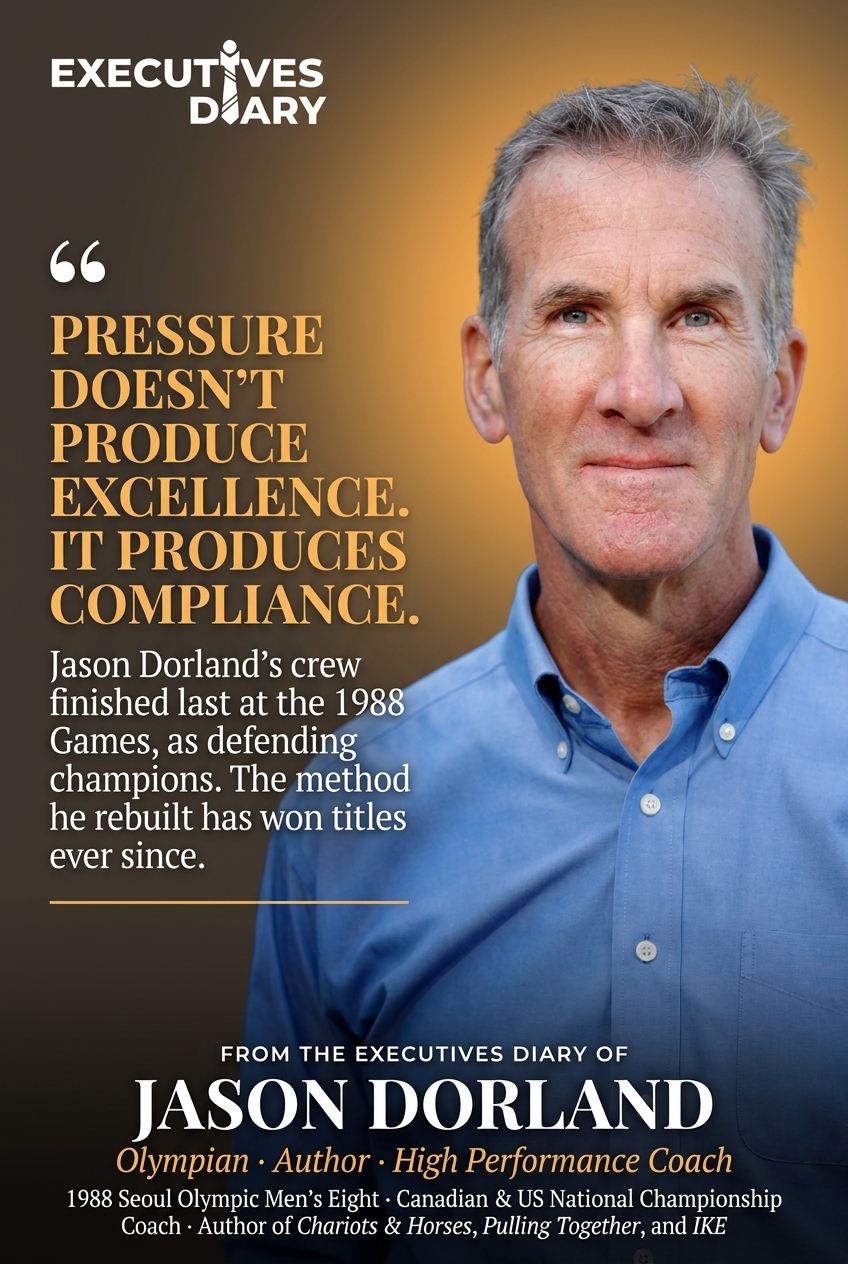
From the Diary of Jason Dorland
His 1988 crew finished last in Seoul. The philosophy he rebuilt from that loss has won championships at every level since.The default system for extracting performance is pressure: harder targets, richer incentives, sharper consequences. Jason Dorland ran on that system at the highest level sport offers, and it carried his crew, defending Olympic champions, to last place in the final at the 1988 Games. “What many high-performing leaders fundamentally get wrong,” he says, “is believing that pressure produces excellence. It may produce compliance, urgency, and even short-term results, but over time it narrows thinking, discourages risk, erodes trust, and makes people afraid to fail.”
Jason Dorland is an Olympian, author, and high performance coach, running Your Mindset Coaching and Consulting with fellow Olympian Robyn Meagher.
The Loss That Built the Method
Dorland’s core claim is that the decisive performance variable is not talent, preparation, or even effort. It is the emotional environment a team performs inside, and whether the people in it have tied their worth to the result. He learned the cost of getting that wrong in the most public way available. “Achievement is a dangerous place to look for your worth,” he says. “I had reached the highest level of my sport, yet when the result did not validate me, I was left wondering who I was without the outcome.”
The Seoul crew was not underprepared. “Our 1988 crew was extraordinarily talented and hardworking, but we became consumed by the outcome and by what winning would mean about us,” he says. “We were no longer simply rowing together; we were carrying fear, expectation, identity, and the need to prove ourselves.” The diagnosis he took from the finish line has anchored everything since: “A team can do almost everything ‘right’ on paper and still be undermined by the emotional environment in which it performs.”
The loss was the catalyst. The rebuild was Robyn Meagher, the fellow Olympian who later became his wife and coaching partner, and who challenged the stories he was telling himself at every turn. “Robyn helped me see that winning wasn’t the purpose of the work; instead, it was the possible consequence of doing the work exceptionally well.” The questions changed with the premise. Instead of how do we win: how do we get better, how do we help each other become our best, how do we respond when things do not go our way. The pattern he found held across sport, teaching, and business: “People perform best when they are deeply committed but not psychologically dependent on the result.”
Build the Love
The principle gets tested every time he presents it. At a national coaching conference, a skeptical coach interrupted him mid-talk: “It’s my job to win, I get paid to have a winning team; how can I not focus on winning?” Dorland’s answer conceded the pressure and refused the premise. “Fair question. And I get it, I honestly do. I’ve had Heads of Schools who have made it very clear to me that they want National Championship crews.” Even with permission to reach into the old-school bag of tricks, he told the room, he wouldn’t. “Because I’ve seen this holistic process-centred approach work too many times and win those National Championships.”
The approach has a rallying cry. “Build the love” is what he told athletes before a hard training piece or a race, and the tell that it worked is who ended up saying it. Eventually the athletes said it to each other at the key moments, having realized that a crew in which each rower raced for the others as much as for himself was the foundation of their fastest boat.
Same Method, Different Arenas
The record travels. Dorland is the first person to win the Calder Cleland Trophy, Canada’s senior men’s eight title, as an athlete and as a coach, and the only coach to win it at two different schools, first Shawnigan Lake School and then Ridley College. At Shawnigan, his crews took championships in multiple categories in 2004 and 2005. At Ridley, his 2012 men’s eight won the Canadian national high school championship and set a course record that still stands. His 2014 crew won the US national championship and the Stotesbury Cup, then took the men’s coxed four and the quad at the Canadian nationals, the first crew to do it with the same four athletes. Athletes from both programs went on to US scholarships and to national teams.
Then the method left sport entirely. One of his corporate clients, the CEO of a tech firm with industry-leading proprietary software, hit a wall inside the Love Score exercise on a single question: how much do you value your competitor. He couldn’t. When Dorland suggested inviting the rival for coffee, the CEO scoffed. Three weeks later he tried it, and on the next call he was laughing: the meeting could not have gone better, the competitor hired his company to solve problems they were facing, and the two now meet monthly to trade ideas. “What changed wasn’t the marketplace,” Dorland says. “What changed was the meaning he had assigned to his competitor.” It is the same principle he gave his rowers: “It’s from your competitors’ best race that you will find yours, if you race with them.”
Set the results side by side and the alternative explanations fall away. The schools changed. The athletes changed. The arena changed from a racecourse to a marketplace. What did not change was the method: process over outcome, connection over fear, worth separated from the scoreboard.
The Love Score, and What a Leader Can Steal From It
The instrument at the center of the practice is the Love Score™, a daily reflection across four areas: love for self, love for the work, love for the team, and love for the people or circumstances a person is inclined to treat as opponents. “When we say, ‘How much do you love?’ we mean how much do you value, connect, trust?” Clients score each area from one to ten. A low score is not a judgment; it flags interference, “fear, resentment, exhaustion, disconnection, or the need to prove something.” Then comes the working question: “What would move this score one point today?” The answers are deliberately small: an honest conversation, asking for help, clarifying a priority, resting, changing the story you are telling yourself.
4 Moves From the Method to Bring Into Any Organization
- 1. Shift attention from outcomes to controllable behaviours: focus on the quality of preparation, communication, decision-making, recovery, and follow-through.
- 2. Separate identity from performance: so that mistakes become information rather than evidence of inadequacy.
- 3. Replace internal competition with contribution: by asking people how they can make those around them better.
- 4. Measure human conditions beneath performance: focus on trust, energy, alignment, and connection, not just the visible results.
His closing case is aimed at the leader still running on sticks and carrots and starting to wonder why the team is burning out, and he makes it on that leader’s own terms: “Even if you don’t care about the long-term impact of incentivizing or threatening your team, if all you want to do is win, then try this process-centred approach. Because once you start to see the results, you will never go back to using sticks and carrots ever again.”