

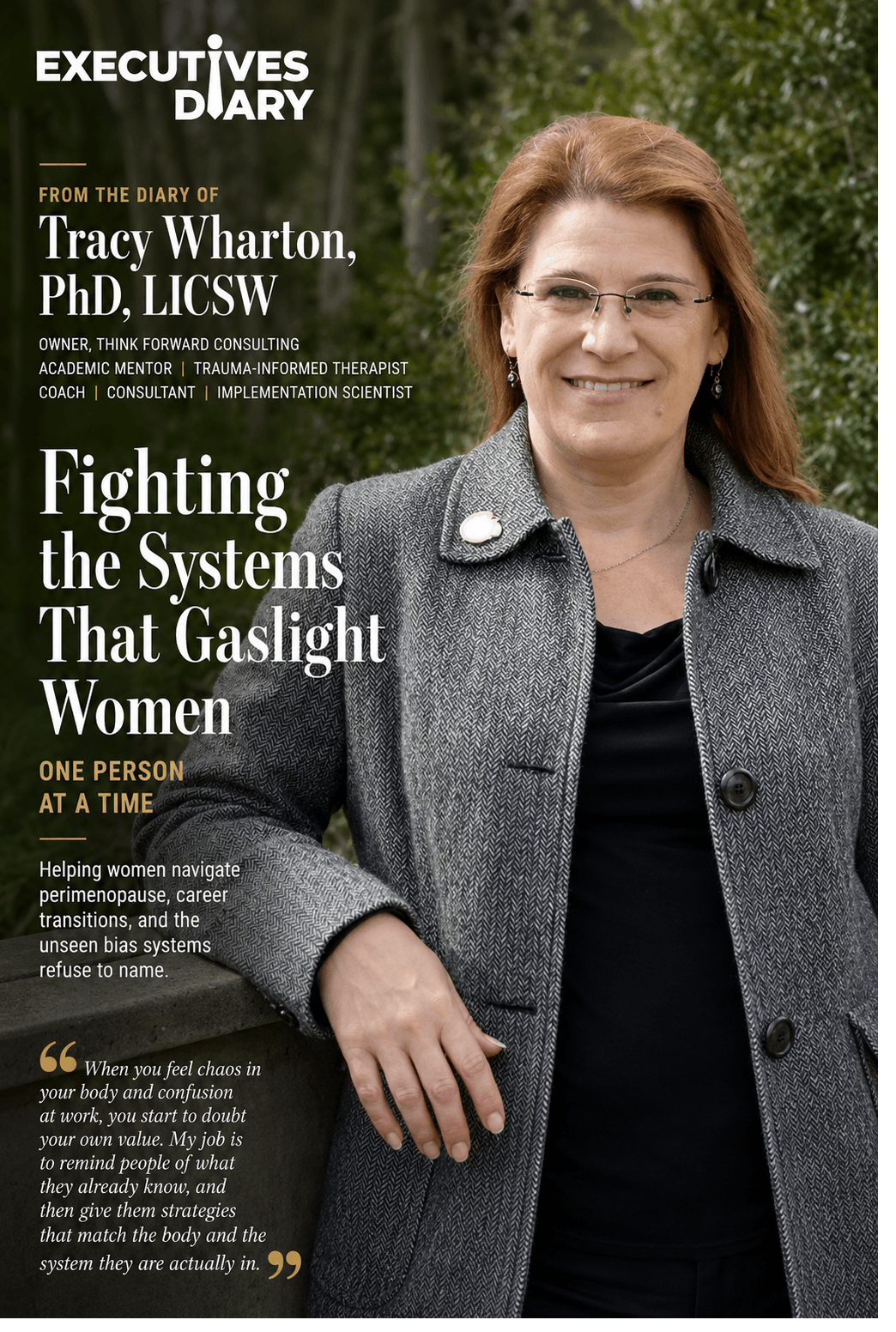
Tracy Wharton, PhD, LICSW
Left a $7 Million Federal Program to Fight the Systems That Gaslight Women One Person at a TimeWhen Scale Becomes the Problem, Not the Solution
The numbers looked impressive on paper. Nearly seven million dollars in federal funding. Public health initiatives reaching more than two million people across 204 counties. Community partnerships spanning 42 identity groups and 42 languages. By every institutional metric, Tracy Wharton was running exactly the kind of program that gets cited in policy papers and featured at national conferences.
But she kept having the same conversation. Women in their late thirties and forties, sitting in social settings, comparing notes about doctors who dismissed their brain fog as stress. Faculty members whose positions had been eliminated, staring at rejection letters they could not decode. High achievers who suddenly felt like their bodies and their careers were betraying them simultaneously.
None of these people were showing up in her federal program evaluations. They were falling through a different kind of gap. Not a funding gap. A belief gap.
The Consultant Who Decodes What Others Ignore
Tracy Wharton PhD, LICSW, is the owner of Think Forward Consulting, a Maryland based practice that provides academic mentoring, trauma informed therapy, and coaching for women navigating perimenopause and major career transitions. She is a licensed clinical social worker in multiple states, a former federal program director, and an implementation scientist who spent more than twenty years asking one question: whose evidence gets to count when systems decide what is real?
Her answer now is tactical. If the systems will not change, she will teach people how to beat them.
The Academic Who Refused to Stay in Her Lane
Tracy did not arrive at this work through a straight career path. She built it through accumulation.
Her PhD in Social Work from the University of Alabama, with a focus on gerontology and intervention research, taught her how to measure outcomes that matter to communities, not just funders. A postdoctoral fellowship in geriatric psychiatry at the University of Michigan Medical School added clinical depth to her understanding of aging, caregiving, and the ways institutions systematically fail people at vulnerable moments.
At the University of Central Florida, she spent seven years as an associate professor building something that still stands as the clearest expression of her values. The Apopka Clinic was a pro-bono, interprofessional outreach program serving migrant farmworkers in central Florida. It won the USPHS/IPEC Excellence in Collaboration Award. More importantly, it treated people who picked crops for a living as humans deserving of care, not data points in a research study.
That drive led her to the National Network of Public Health Institutes, where she directed $6.97 million in federal funding as Principal Research Scientist. Her teams reached over two million people. Community partners like the Dolores Huerta Foundation used her funding structure to host more than 150 vaccination clinics and administer over 11,000 vaccines across four California counties. The Vaccine Equity Guide she helped develop is still used by public health practitioners trying to reach communities that distrust government campaigns.
But through all of it, she kept her clinical license active. She saw therapy clients on the side. She watched a separate set of problems go completely unaddressed by every large program she managed.
The Practice That Meets People Where Systems Fail Them
In October 2024, Tracy walked away from institutional scale to launch Think Forward Consulting full time. The decision was not a retreat. It was a convergence.
Her first faculty coaching client came to her three months after launch. The person’s academic position had been eliminated. They were facing not just job loss but identity loss, the kind of crisis anyone who has spent years in academia will recognize as uniquely disorienting.
They worked through the nuances that seem minor until you realize getting them wrong signals to a search committee that you do not understand the culture you are trying to enter. The difference between applying to an R1 research institution versus a teaching focused program. How to organize a CV that highlights the right credentials first. What to emphasize in cover letters and interviews.
The client revised their materials, applied strategically, and received a job offer on the day of their site visit.
That outcome never appears in federal program evaluations because it was never designed to. But it represents exactly the kind of intervention Tracy realized she wanted to focus on.
She applies the same precision to her perimenopause coaching, and she is blunt about why it matters to executives who might not immediately see themselves in that description. Perimenopause affects anyone with ovaries. It brings cognitive disruption, mood shifts, and physical symptoms that occur during the most demanding professional years of many women’s careers.
Her coaching addresses the present: strategies, tools, frameworks for managing a body and brain operating differently than before. She is precise about distinguishing this from therapy, which addresses past trauma and psychological conflict. The distinction matters clinically, ethically, and practically.
Her consulting work continues the equity focus she has spent decades building. Think Forward offers program evaluation, outcomes mapping, and facilitation services to nonprofits and public sector organizations. For smaller organizations that need dedicated mental health support, she provides a private EAP model: ten hours of therapy per week for a flat monthly rate.
The through line across all of it remains the same question she has been asking since her doctoral training. Whose evidence counts? Whose experience gets to be real?
The Why That Never Wavers
Tracy references Father Greg Boyle and cites conversations with Dolores Huerta. She is drawn to people who have sustained decades of difficult work without losing their sense of purpose. She applies the same standard to herself.
The seven million dollar program she left was doing real work. It reached real people. But it could not sit with a faculty member rebuilding their professional identity. It could not validate a woman whose symptoms were dismissed as stress. It could not decode the unwritten rules of systems built without certain people in mind.
Some problems do not need more scale. They need someone willing to sit down, stay present, and teach people how to win the games they never knew they were playing.
