

Deputy Director of Internships & Corporate Relations at the Institut National des Postes et Télécommunications (INPT) | PhD in Digital Economy | Higher Education Leader Bridging Academia, Industry, and the Future of Workforce Development
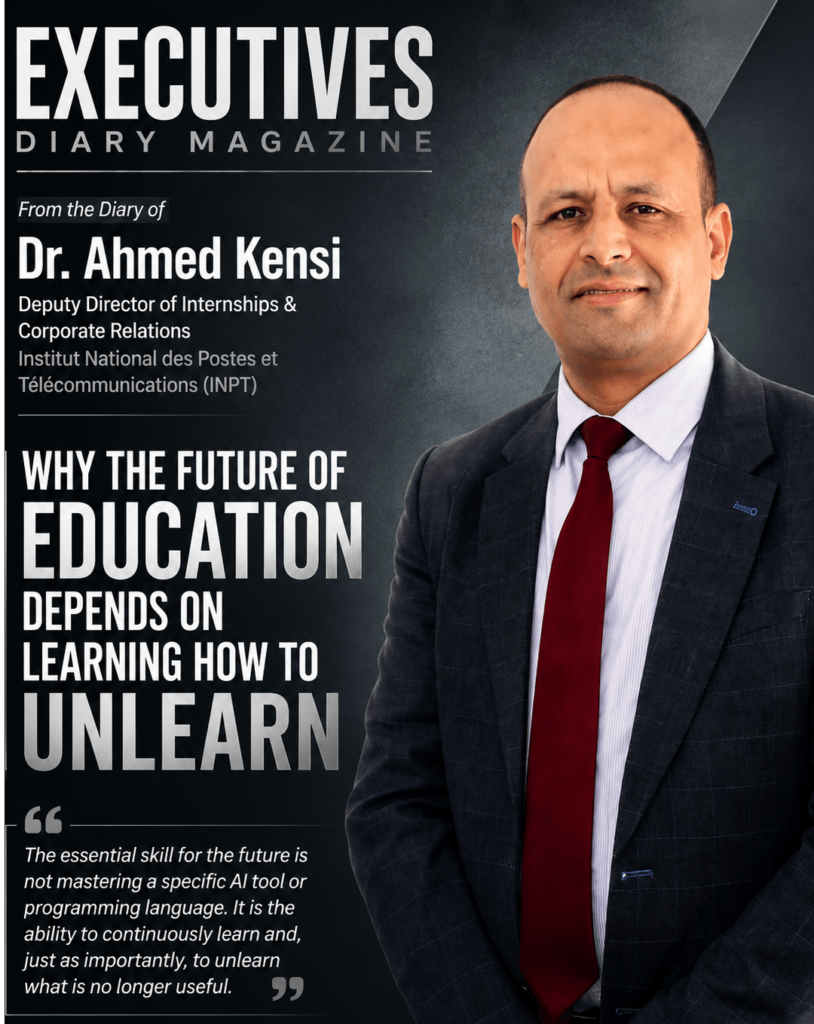
Dr. Ahmed Kensi is a higher education leader and digital economy expert focused on preparing students for the future of work. As Deputy Director of Internships and Corporate Relations at INPT, he strengthens connections between academia and industry to enhance employability and workforce readiness. Holding a Ph.D. in Digital Economy, his work spans digital transformation, AI, innovation, and lifelong learning. He also serves as an elected Municipal Councilor in Rabat, contributing to economic and public policy development. Guided by a belief in resilience, continuous learning, and social impact, Dr. Kensi is committed to helping individuals and institutions adapt, grow, and thrive in a rapidly changing world.
Where Deep Roots First Took Hold
More than 450 kilometers from Rabat, in Morocco’s oasis region, Dr. Ahmed Kensi learned some of life’s most important lessons long before he entered a university classroom or held a leadership title.
He grew up in a place where resources were limited, but generosity was abundant. In oasis culture, scarcity was never viewed as deprivation. Instead, it taught discipline, gratitude, and responsibility. Community mattered. Contribution mattered even more.
“An individual’s value is not defined by what they possess, but by what they contribute to others,” he reflects, a principle that would quietly shape both his leadership philosophy and professional choices.
At just thirteen years old, Dr. Ahmed left home to attend boarding school nearly eighty kilometers away. Independence came early. Decisions had to be made without the comfort of familiarity, and responsibility quickly became a daily habit rather than an abstract concept.
School holidays looked different for him. Instead of rest, they became opportunities to work small jobs that helped finance the next academic year.
“These small jobs taught me something no lecture could: the dignity of independence and the true value of things.”
Leadership also began to emerge in unexpected ways. During secondary school, he organized cultural events, directed theater productions, and spoke up when students’ rights were overlooked. Looking back, he recognizes these moments as the early signs of a deep sense of collective responsibility, one that would later define much of his professional life.
The Questions That Led Beyond the Classroom
Dr. Ahmed Kensi’s academic path was never simply about collecting credentials. It was shaped by curiosity, social awareness, and a growing interest in how institutions influence opportunity.
While studying economics and management, he developed a conviction that still informs much of his work today: technology cannot be separated from the economic and social realities surrounding it. This perspective eventually led him to pursue advanced studies in digital economy, culminating in a PhD focused on the economics and management of information and communication technologies.
His academic experience also deepened his civic engagement and sharpened his ability to think critically about systems, governance, and societal change.
At the same time, he found himself naturally drawn toward education. Teaching became more than a profession. It became an extension of values he had carried since childhood: sharing knowledge, creating access, and helping others move forward.
Over the years, he taught subjects ranging from marketing and accounting to entrepreneurship and descriptive statistics, helping students understand not only theories, but also the realities behind them.
Each role added another layer to his thinking, gradually shaping a professional identity positioned at the intersection of education, communication, strategy, and digital transformation.
Standing Between Students and Opportunity
In 2008, Dr. Ahmed Kensi joined the Institut National des Postes et Télécommunications (INPT), one of Morocco’s leading institutions specializing in engineering, telecommunications, and digital technologies.
Across more than fifteen years, he served in several academic leadership capacities before becoming Deputy Director of Internships and Corporate Relations.
Today, his work centers on one of the most important questions facing higher education: how can institutions prepare students for a labor market that evolves faster than traditional education systems?
At INPT, Ahmed works closely with students, faculty, and corporate partners to strengthen employability, internship opportunities, and long-term industry collaboration. Yet for him, success goes beyond placements and partnerships.
The most rewarding moments are deeply personal.
“Seeing students, sometimes from modest backgrounds or far from major opportunities, gain confidence and successfully transition into the professional world is one of the greatest sources of fulfillment in my career.”
He sees education not only as a way to transfer skills, but as a means of opening doors that once felt out of reach.
“Education is not only about transmitting skills,” he says. “It is also about opening horizons and building self-confidence.”
This belief continues to shape the way he approaches academic leadership, career development, and institutional partnerships.
Why Learning Alone Is No Longer Enough
Few people sit closer to the growing tension between education and industry than Ahmed Kensi.
Working at the crossroads of academia and workforce development has given him a front-row view of one of today’s biggest challenges: the widening gap between what students learn and what employers actually need.
Part of the problem, he believes, is human.
Too often, institutions produce highly skilled graduates who struggle to communicate their ideas, collaborate across teams, or adapt to uncertainty.
“The market is no longer looking for those who know everything,” he explains. “It values those who can learn quickly, collaborate effectively, and adapt continuously.”
But the challenge is also structural.
The pace of digital transformation often moves faster than educational systems can adapt. By the time students graduate, some tools and practices may already feel outdated.
For Dr. Ahmed, the solution is not endlessly redesigning curriculums to chase change. Instead, the real skill of the future lies somewhere deeper.
“The essential skill for the future is not mastering a specific AI tool or programming language,” he says. “It is the ability to continuously learn and, just as importantly, to unlearn what is no longer useful.”
This perspective has become central to his thinking around lifelong learning, workforce readiness, and institutional adaptation in the age of artificial intelligence.
Looking Beyond Borders and Into the Future
Dr. Ahmed Kensi’s work increasingly extends beyond classrooms and institutional walls.
Through his involvement with the AI for Developing Countries Forum (AIFOD), he contributes to conversations about artificial intelligence, digital transformation, and technology governance in developing economies.
His perspective remains grounded in practicality. Technology alone does not create progress. Education, institutions, and human capability still matter most.
Alongside his academic work, he also serves as an elected Municipal Councilor in Rabat and Chair of the Economic and Financial Affairs Committee, where he engages directly with governance, policy realities, and citizen needs.
This role has offered him a different kind of education, one rooted in complexity, trade-offs, and public responsibility.
For Dr. Ahmed, meaningful change rarely happens through ideas alone. It requires implementation, patience, and a commitment to serving real communities.
The Palm Tree and the Meaning of Resilience
There is one idea Ahmed Kensi returns to often, a lesson rooted in the wisdom of Morocco’s oases:
“The wind strikes the palm tree, but does not break the one whose roots are deep.”
For him, resilience is not the absence of hardship. It is the strength built through experience, discipline, and perspective.
Growing up far from major centers of opportunity, leaving home early to study, working during holidays, and building a career across education, governance, and digital transformation did not discourage him. They prepared him.
Today, as industries rethink the future of work and institutions adapt to constant disruption, Ahmed Kensi continues to advocate for something increasingly valuable: the ability to remain grounded while continuing to grow.
Because in a world changing faster than ever, deep roots may be what matter most.
Dr. Ahmed Kensi, Ph.D., is the Deputy Director of Internships and Corporate Relations at the Institut National des Postes et Télécommunications (INPT) in Rabat, Morocco. He works at the intersection of higher education, employability, and digital transformation, helping students, institutions, and organizations prepare for the evolving demands of the workforce.