

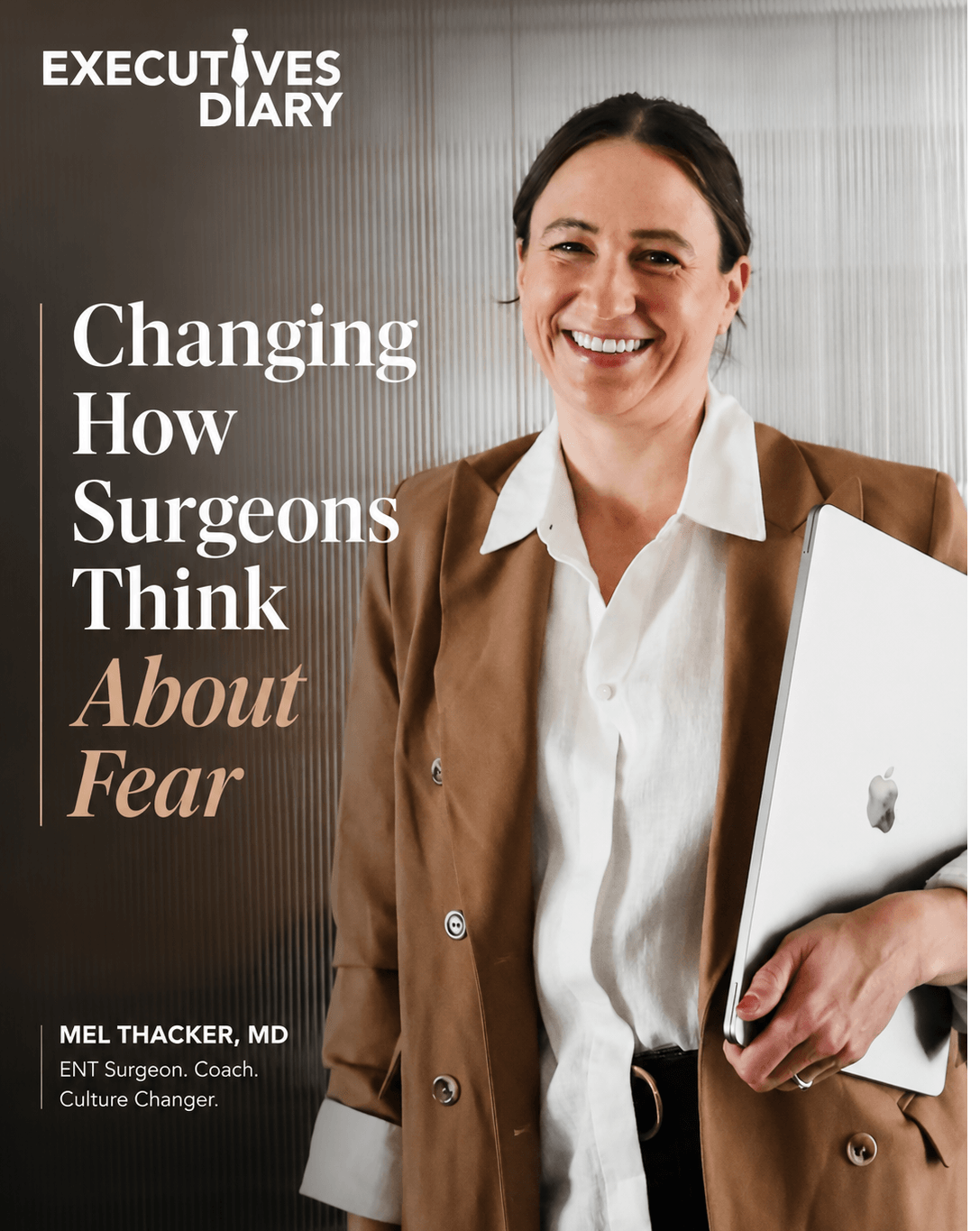
Mel Thacker, MD
Admits to Panic Attacks in Surgery. Now She’s Changing How Surgeons Think About Fear.The Panic Attack No One Saw
The first time Mel Thacker, MD had a panic attack in the operating room, nothing on the monitors gave her away. Heart rate stable. Blood pressure normal. The surgical team moved with practiced efficiency around a routine ENT case.
Inside her body, the floor had dropped out. Racing pulse. Tunnel vision. The flood of thoughts no surgeon is supposed to admit having while holding instruments near someone’s brain.
She finished the case. She never told anyone. She did what surgical culture trains its people to do with their own terror. Bury it. Call it a fluke. Get back to work.
Admitting this publicly is professional heresy in a field built on toxic martyrdom and the illusion of machine-like competence. But Mel Thacker says it anyway, from TEDx stages to hospital auditoriums to small coaching groups. Not as confession, but as ammunition against a medical culture that demands perfection at the cost of physician humanity.
A Surgeon Determined to Challenge the Status Quo
Mel Thacker, MD is a fellowship-trained otolaryngologist, certified master coach, medical expert witness, and cofounder of the Hippocratic Collective based in Worcester, Massachusetts. She spent over a decade in private practice before building a portfolio career spanning coaching, medicolegal consulting, and surgical culture reform. What defines her is not just clinical precision, but her absolute refusal to let high-achieving professionals remain victims of the systems employing them.
From Patient to Physician
Her path into medicine began not in a classroom, but on an operating table as a child patient. That early experience of vulnerability planted something surgical training would strain but never extinguish: understanding that the surgeon-patient relationship is fundamentally human, not transactional.
Building a Distinguished Surgical Career
She executed the traditional excellence pathway flawlessly. Biology degree from University of Wisconsin-Madison. Medical degree from Medical College of Wisconsin with Alpha Omega Alpha honors. Otolaryngology residency. Fellowship training in rhinology. Assistant professor position at University of Florida Jacksonville. Then eight years as partner in a Worcester otolaryngology practice, building expertise in complex nose and paranasal sinus surgery.
She did everything right. Delayed gratification. Sacrificed personal time. Built the exact career she thought she was supposed to want.
Recognizing the Reality of Burnout
Then she looked around. She watched senior partners collapse into office chairs at day’s end, gray and worn down by a system rewarding overextension.
The medical system trains doctors to override internal signals in service of patients. It relies on arrival fallacy, the false promise that the next milestone will finally make the exhaustion worthwhile. Thacker realized that without changing her relationship to the work, she would become another casualty of a profession that consumes its practitioners.
Redefining What Medical Practice Can Be
In late 2024, she stepped back from full-time private practice. What followed was not retreat from medicine but deliberate expansion of what medical practice could mean.
Today she operates three interconnected businesses that challenge surgical orthodoxy from multiple angles. Through Mel Thacker Coaching, she works with surgeons experiencing what she calls “hidden patterns driving distress” – the collision between extraordinarily high-achieving identities and systems never designed to sustain them. Through Thacker Medical Consulting, she serves as medical expert witness in ENT cases, bringing radical transparency to typically opaque medicolegal processes. Through the Hippocratic Collective, she hosts the Surgeons with Purpose podcast, examining internal and systemic forces shaping modern surgical culture.
Giving Surgeons Language for Their Struggles
The scale of need she discovered is striking. Surgeons contact her regularly saying she has given language to experiences they could never name. They describe low-grade dissatisfaction beneath objectively successful lives. They feel trapped by careers that look impressive externally but feel hollow internally. They experience the specific exhaustion of excelling at something slowly consuming them.
Identity Expansion as the Solution
Thacker does not treat this as a wellness problem requiring more sleep and meditation. She treats it as identity problem, and that distinction matters. Her coaching focuses on identity expansion, helping surgeons build self-concepts that include but are not imprisoned by their professional roles.
The results are concrete rather than abstract. A surgeon in her program recently reported: “I feel like I’m making major mindset shifts. I’m hopeful again. And I’m starting to take control of my work.” Nothing changed externally – same job, same system, same pressures. What shifted was the surgeon’s relationship to all of it.
Reclaiming Agency in Medicine
But Thacker’s most confrontational message challenges the victim narrative many physicians carry about their circumstances. “The pressures are real,” she acknowledges. “But the belief that we have no agency is what keeps us trapped. We chose this profession. We sign the contracts. We decide how we relate to what happens next.”
This is not comforting messaging. It strips away the illusion that doctors are helpless employees at the mercy of hospital administrators. When surgeons recognize their autonomy over boundaries, communication, and choices, they stop waiting for external rescue and start curating their professional lives intentionally.
Lessons from Medicolegal Consulting
Her medicolegal work operates on the same foundation. As a High Rock certified expert, she reviews ENT and rhinology cases involving complications, diagnostic delays, and alleged errors.
What she consistently finds is not isolated technical failure but relationship breakdown.
This insight transforms how she approaches case reviews. She analyzes not just medical facts but how surgeons were relating – to patients, teams, and themselves. “Communication isn’t just about what is said. It’s about the state of mind and nervous system from which it’s delivered.”
Preventing Harm Through Better Connection
A depleted surgeon cannot connect with frightened patients or lead operating teams effectively. By teaching nervous system regulation, she is not just improving mental health but actively reducing malpractice risk and protecting patients.
Ending Fear-Driven Healthcare
Her TEDx talk, selected as Editor’s Pick and viewed over 230,000 times, poses the question directly: can we end fear-driven healthcare? The answer she offers is not systemic reform in conventional terms, but something more personal and, in her view, more powerful. Change the surgeon. The surgeon changes the room. The room changes the patient.
Returning to Surgery with a New Perspective
Mel Thacker is not arguing that surgery is irreparably broken. She is arguing that the people inside it are being asked to carry something they were never equipped to handle, and the solution is not leaving the profession but entering it more fully on different terms.
She returned to the OR. She still operates, still sees patients, still does the work that began when she was a child on someone else’s operating table. But she does it now with something surgical training rarely offers: clear understanding of who she is when the case ends, notes are finished, and the room goes quiet.
The Truth About What Surgery Costs
Those panic attacks were not the beginning of professional undoing. They were the beginning of professional understanding. Surgery did not break Mel Thacker. It finally met someone willing to tell the truth about what it costs.
Key Takeaways / Playbook
- 1. Identity Expansion: Helping surgeons build self-concepts that include but are not imprisoned by their professional roles.
- 2. Reclaiming Agency: Recognizing autonomy over boundaries, communication, and choices rather than feeling like helpless employees.
- 3. Nervous System Regulation: Improving mental health and reducing malpractice risks by prioritizing real communication and human connections.
