
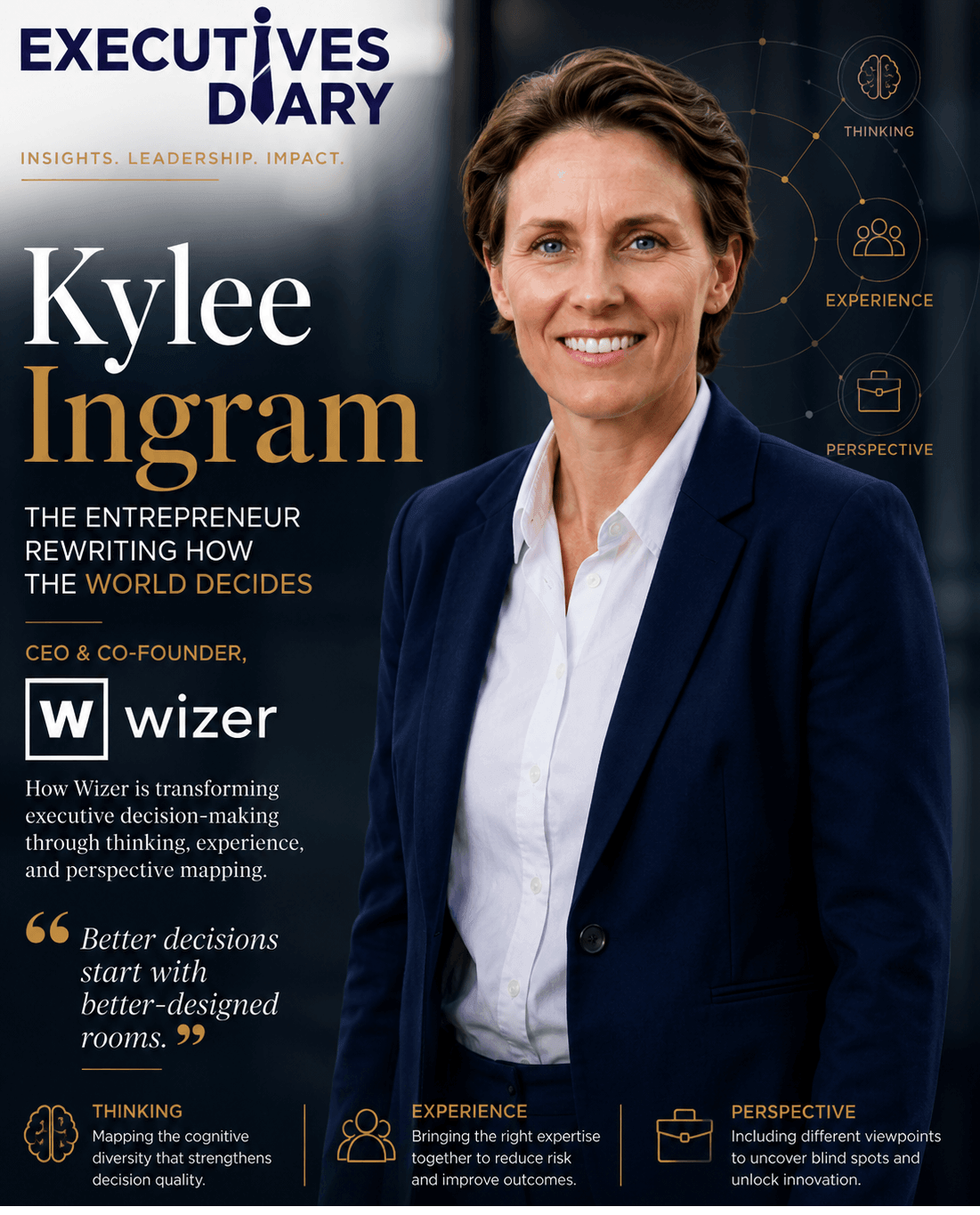
Kylee Ingram
The Australian Entrepreneur Rewriting How the World DecidesKylee Ingram built Wizer to fix the structural forces that quietly distort every decision your organisation makes
The Architecture of the Room
The meeting had been running for forty minutes. The strategy looked solid on paper.
Everyone around the table was experienced, credible, well-prepared. Then someone asked the question nobody had a clean answer for: how do we know this is actually the best decision we could make — and not just the best decision this particular group of people, thinking in this particular way, happened to arrive at?
That question has no comfortable answer in most organisations. It is not a question about information or effort.
It is a question about the architecture of the room itself. Who is in it. How they think.
What they are structurally incapable of seeing together, because of who is not there.
Kylee Ingram has heard that question often enough — and watched it go unanswered often enough — to build a company around it.
Today she is CEO and Co-Founder of Wizer, a live decision science platform that maps how individuals and teams make decisions, scores the strength of any decision group across three structural dimensions — thinking, experience, and perspective — and recommends in real time who should be in the room before a significant call gets made.
Her claim is precise and testable: design the decision room well, and error rates fall by 30 percent while innovative capability rises by 20 percent.
Design it poorly, and the organisation quietly replicates its own blind spots — not through bad intent, but through the predictable mechanics of how humans make choices together.
Three Forces Quietly Wrecking Your Decisions
At its heart, Wizer exists to improve how decisions get made — not by replacing human judgement, but by addressing the structural forces that quietly distort it.
Kylee identifies three.
The first is bias.
Most decisions are shaped by a small, familiar group. Over time, that group replicates itself — not out of bad intent, but because people trust those who think like them, overweight familiar experience, and underestimate what is missing.
When cognitive diversity is low, decisions narrow, blind spots compound, and risk increases — even when everyone involved is capable and well-meaning.
The second is systemic polarisation.
Many modern environments are designed to divide rather than integrate.
Social platforms — some of the most powerful organisations ever built — optimise for engagement by amplifying certainty, outrage, and difference.
Organisations absorb the downstream effects every day: fractured teams, performative agreement, and cultures where challenge becomes personal rather than productive.
Healthy decision systems require the opposite design. They desilos people.
They surface difference early and make disagreement useful — focused on the decision, not the person.
The third is cultural.
Leadership is still widely understood as making the call — rather than designing the conditions for the best call to emerge.
The result is organisations over-reliant on the instincts of a small number of senior people, even when the evidence is clear that groups with the right composition consistently outperform even the most capable individuals deciding alone.
A Career Built on Listening First
Kylee did not arrive at decision science through the usual academic route.
She spent two decades producing documentaries and directing television seen in more than 100 countries.
Her production company, Elevator Entertainment, was built on a principle that shaped everything that followed: the best way to understand a story was to find the person who actually lived it, not the person with the most polished version of it.
“Documentaries put you in rooms with people who are extraordinarily passionate and knowledgeable about something you know nothing about,” she explains.
“And for that brief window, you get to learn from them completely.”
That instinct to walk into unfamiliar territory and listen before speaking was not just professional training.
It was the enforced humility that documentary work demands — the recognition that you are often the least informed person in the room, and that if you are paying attention, that awareness makes you better at almost everything that follows.
For a founder working in decision science, that habit is not incidental. It is foundational.
Most executives climb the ranks by projecting certainty and trusting their instincts.
They stop searching for answers because they believe they have already found them.
Kylee learned the opposite skill: how to identify what she did not know, and find the person who did.
Her early technology projects reflected that same curiosity about how people actually make choices.
Team Tap used the mechanics of sporting events to raise money for team charities while reducing acquisition costs for brands.
Habitat the Game, a climate change experience, was played by more than 200,000 children worldwide.
Each project pushed the same underlying question: if you understood how people decided, could you change what they chose?
Teaching entrepreneurship at AFTRS and through Screen Producers Australia added another layer.
She watched creative professionals attempt to scale their work and saw the same problem appear at each new stage.
“The skills that got you here are not automatically the skills that get you to the next stage,” she says.
“You have to keep learning, keep an open mind, and be honest about where you are not the right person to implement the solution.”
The Research Behind the Platform
The research that gave Wizer its academic foundation came from two sources.
Dr. Juliet Bourke’s team at Deloitte found that when cognitive diversity is applied intentionally to decision-making groups, error rates fall by around 30 percent — and that roughly 75 percent of executive teams cluster into just one or two dominant thinking types.
Scott Page, a mathematician at the University of Michigan, reached a parallel conclusion: groups with varied thinking orientations outperform more uniform groups of higher individual ability, not because anyone is less capable, but because people who think differently make different mistakes, and those mistakes cancel each other out instead of compounding.
Wizer’s architecture turns that evidence into an operational system with three components.
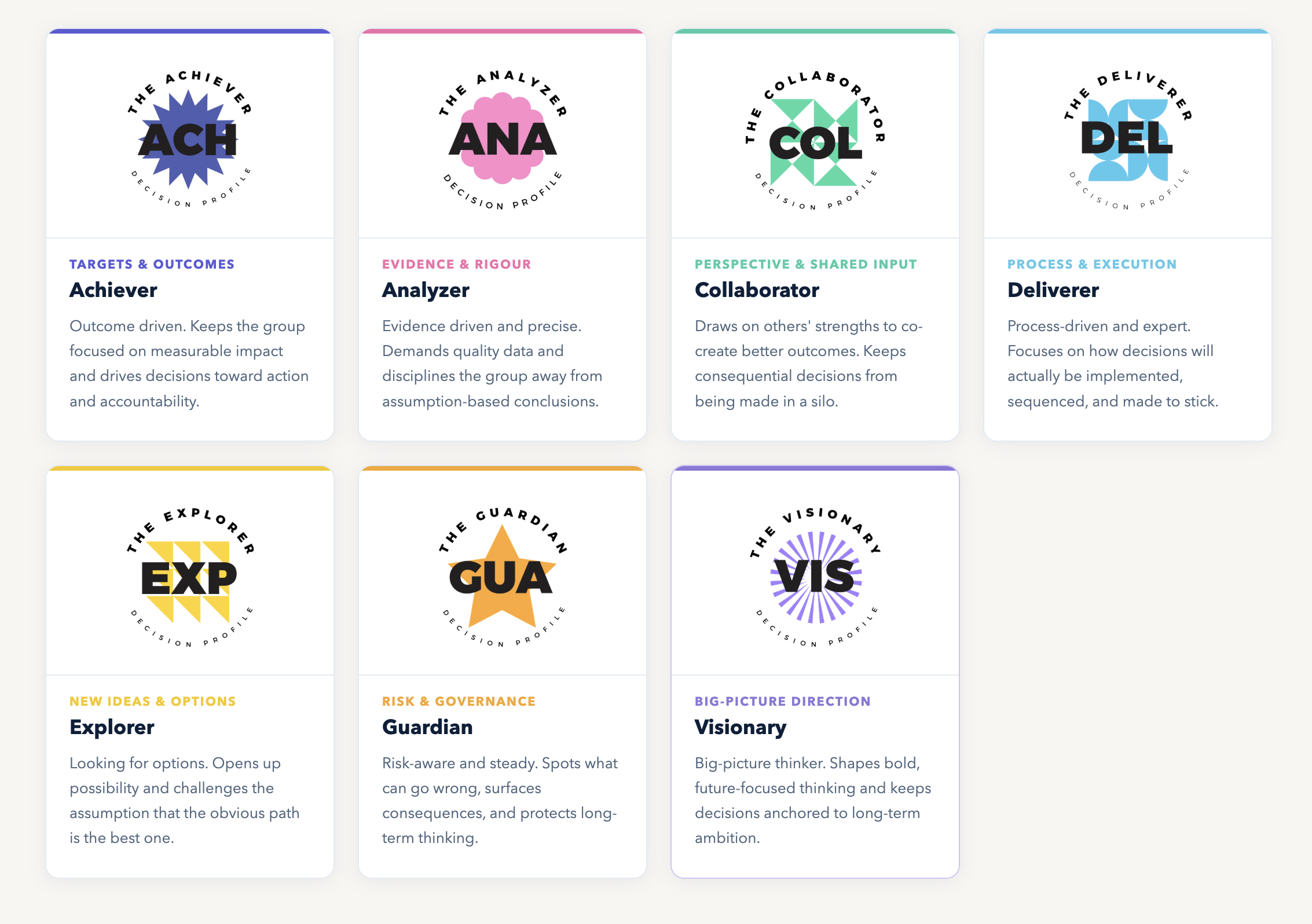
Decision Profiles map how individuals approach outcomes, risk, evidence, and collaboration — capturing thinking style, depth of experience, and breadth of perspective.
Panel Strength scores the composition of whatever group is assembled around a decision — across thinking styles, depth of experience, and breadth of perspective.
The live Recommendation Engine identifies who is structurally missing before the call happens — not after the costly reversal has already occurred.
“We have now mapped over 7,000 Decision Profiles,” she explains, “and we consistently see that 40 to 60 percent of the people our system recommends were never invited into the right conversations.”
These are not peripheral employees. They are often the people with precisely the thinking orientation a particular decision requires, sidelined by habit or hierarchy rather than capability.
When the Right People Enter the Room
When those people start showing up in the room, results shift.
Sydney Children’s Hospital Foundation used the Wizer process to redesign how they organised their fundraising efforts and where they focused resources.
The outcome was not marginal. They tripled paediatric funding — a result that translates directly to beds, research, and lives.
The platform has expanded beyond decision room design into communication itself.
After analysing hundreds of leadership and fundraising messages, Kylee’s team discovered that most were heartfelt and credible, yet badly matched to how recipients actually decided.
Achievers were buried in narrative with no clear outcome. Analysers were asked to trust a vision with no supporting data.
Guardians were pushed with urgency that offered no reassurance their commitment would be protected.
Wize Snaps now profiles the person receiving a critical message and rewrites it to fit how they tend to process information and make choices.
“You spent an hour on that message,” Kylee writes to her audience.
“It didn’t land not because your offer was weak, but because it was written for how you decide, not how they do.”
The Room Is Already Deciding for You
When Kylee read Sam Altman describing the cognitive exhaustion of running OpenAI — decision fatigue so acute that choosing between grey sweaters had become a burden — she saw a structural diagnosis rather than a personal limitation.
“What Altman is experiencing isn’t unusual,” she wrote. “Holding more doesn’t make the decisions better. It makes them narrower.”
Decision fatigue, in her framework, is a signal that the architecture around the decisions has not kept pace with their complexity.
The most powerful thing a leader at that altitude can do is not optimise their personal habits.
It is to build a decision room that does not depend on any one person’s reserves.
“The room you sit in is already deciding for you, long before anyone speaks,” she says.
“If everyone in that room thinks about risk, evidence, and outcomes in similar ways, you are not choosing from the full set of possibilities — no matter how talented they are.”
Which brings the conversation back to that recurring question. How do we know this is actually the best decision we could make?
In Wizer’s framework, the answer requires structural evidence: how the room was composed, whose thinking was present, what range of experience and perspective was brought to bear — and what that made possible that a narrower group never would have found.
The silence that follows that question in boardrooms across the world is not comfortable.
Kylee Ingram did not build Wizer to make it more comfortable.
She built it to replace that silence with a room that was designed, from the start, to answer it.