

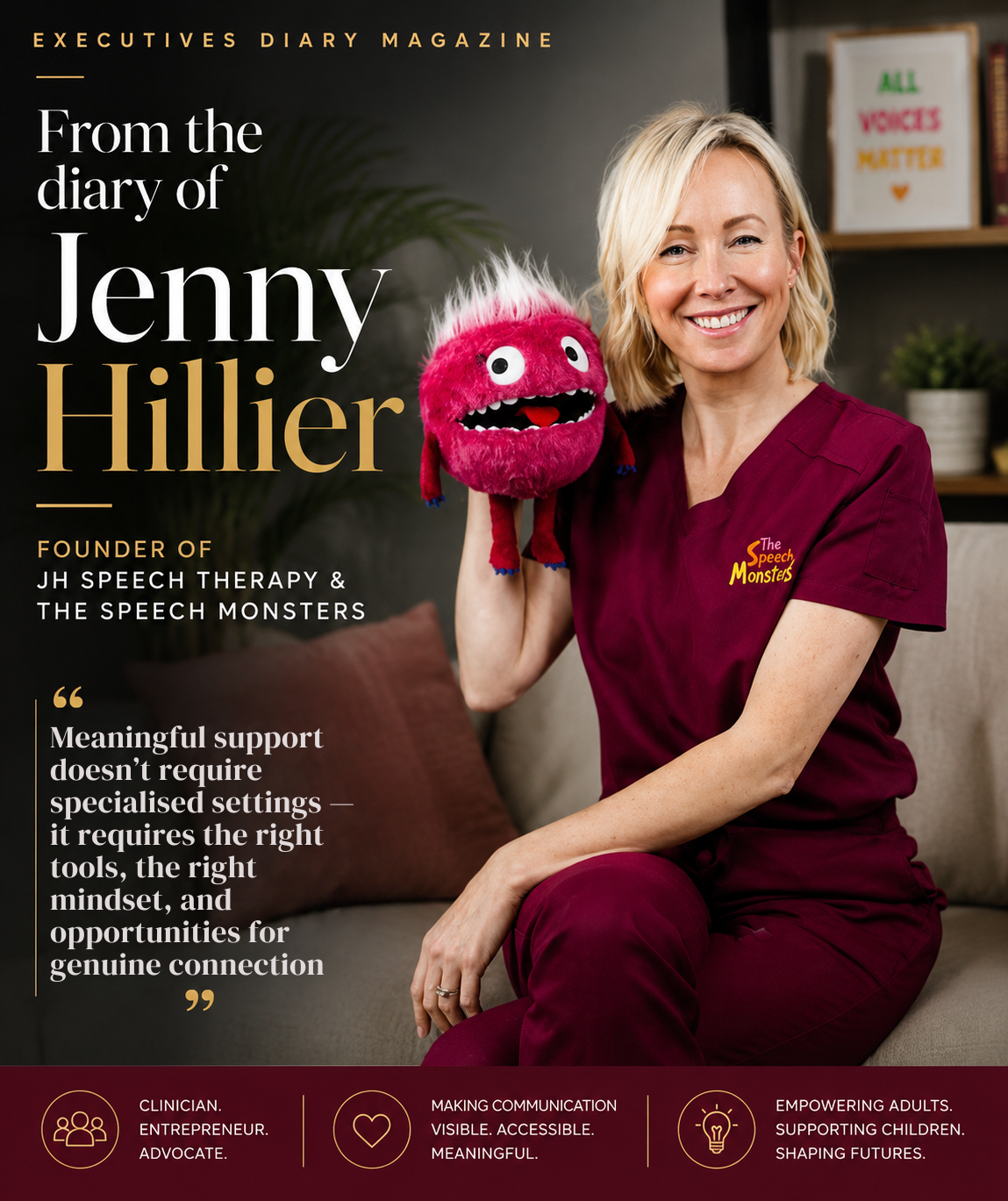
Who is Jenny Hillier?
Jenny Hillier is a Speech and Language Therapist turned entrepreneur, best known as the founder of JH Speech Therapy and creator of The Speech Monsters. With over fourteen years of clinical experience across Australia and Ireland, she has focused her work on early communication development and empowering the adults who support children daily. A graduate of Queen Margaret University and University College Dublin, Hillier combines clinical expertise with practical innovation, developing tools that translate speech and language strategies into engaging, accessible play. Her work bridges the gap between therapy and everyday environments, making communication support more inclusive, scalable, and impactful.
A waiting room is a place of quiet anticipation. For a parent navigating the Irish public healthcare system, it can also be a place of prolonged uncertainty. They sit with a child whose way of communicating may not yet be fully understood, waiting for guidance, reassurance, and support. The clinical reality is challenging: there are more children needing support than there are hours available. This is the gap where opportunities for connection can be delayed—not for a lack of care, but for a lack of accessible tools and shared understanding.
Communication is one of the most human of experiences, yet its development is often treated as something that must be assessed, scheduled, and delivered in structured sessions. We wait for the appointment. We wait for the specialist. We wait for the one-hour session that is expected to carry progress forward. Jenny Hillier recognized early in her career that the most meaningful breakthroughs don’t happen in isolation. They happen at the kitchen table, on the classroom rug, and in the middle of everyday interaction.
Hillier spent fourteen years as a Speech and Language Therapist, working across rural Queensland and the clinical settings of Kildare. Across both contexts, she observed a consistent pattern: the therapist may introduce strategies, but it is the adults in a child’s daily environment who shape how communication develops. When parents and teachers feel confident and empowered, progress becomes part of everyday life rather than something confined to appointments.
Her transition from clinician to founder was driven by a clear question: if early support is so important, why is it often so difficult to access? Establishing her own clinic provided more flexibility, but it also revealed a limitation—impact was still tied to one-to-one sessions. To support the many children navigating communication differences, she needed to expand beyond the therapy room and into the environments where children live, learn, and play.
The Architecture of Play
We often encourage children to “listen carefully” to how a word sounds. For some children, that alone isn’t enough. Sound is abstract—you can’t see it or hold it. Hillier identified that many children benefit from making speech more visible and tangible.
Her earlier collaboration with a Swedish toy company focused on the development of the Rubens Baby educational dolls. The Speech Monsters, however, are a separate product line that Hillier developed independently, inspired by her clinical experience and designed in collaboration with the same Swedish designer.
The Speech Monsters were not conceived in a boardroom, but through hands-on therapy work. With movable mouths, adjustable tongues, and clear visual cues, they transform speech sound learning into something interactive and engaging. What might traditionally feel like a structured exercise becomes a playful exploration.
When a child uses a puppet to demonstrate how a sound is formed, the dynamic shifts. They are not being corrected—they are discovering. This approach reflects Hillier’s belief in “visible language”: making communication something children can see, feel, and explore in their own way. It removes pressure and replaces it with curiosity.
Building a product-based business required stepping into unfamiliar territory—manufacturing, logistics, and scaling distribution. It was a significant shift from clinical practice, but one grounded in the same principle: designing solutions that truly meet people where they are.
The Communication Playbook: 5 Lessons
1. Empower the Ecosystem: Lasting impact comes from supporting the people, the child—parents, teachers, and SNAs—so communication strategies are embedded in everyday life.
2. Make the Invisible Tangible: Skills develop more naturally when abstract concepts are made visual, physical, and interactive.
3. Frictionless Access Wins: Tools need to be intuitive and easy to use from day one, especially for busy adults supporting children.
4. Design for Real Life: Solutions must fit seamlessly into homes and classrooms, not require ideal conditions to be effective.
5. Growth Requires Discomfort: Moving from clinician to creator means embracing new challenges and learning entirely new systems.
Expanding Beyond the Therapy Room
Hillier’s work reflects a shift from reactive support to proactive environments. Rather than waiting for a child to struggle before introducing support, her approach focuses on equipping adults to create communication-rich spaces from the outset.
This includes a strong emphasis on modelling—how adults use language, respond to communication attempts, and shape interactions throughout the day. By adjusting the environment rather than placing expectations solely on the child, communication becomes more accessible and inclusive.
The Speech Monsters are now appearing in classrooms, homes, and educational settings, supporting both individual and group learning. When a teacher integrates a puppet-led activity into a lesson, communication strategies become part of the shared classroom experience rather than a separate intervention.
Hillier’s broader work—including her involvement with Finding Charlie’s Voice and contributions to professional communities—reflects a commitment to making communication support more widely understood and accessible. Her approach is grounded in the belief that all forms of communication are meaningful and worthy of recognition.
The Lasting Echo of a Voice Found
There is a unique kind of moment when a child expresses something in a new way—whether through a sound, a gesture, or a word. It is not about perfection, but about connection. For families, these moments can feel deeply significant. For Hillier, they are a reminder of why accessible, everyday tools matter.
Her vision is one where communication support is not confined to clinical settings but integrated into daily life across homes, schools, and communities. By equipping adults with practical, engaging tools, she is helping to create environments where children can communicate in ways that feel natural to them.
The desire to be understood is universal. Hillier’s work takes the complexity of speech and language development and translates it into something approachable, interactive, and grounded in play. It reinforces a simple but powerful idea: meaningful support doesn’t require specialised settings—it requires the right tools, the right mindset, and a willingness to engage.
A child’s way of communicating is deeply personal. With the right support around them, it has every opportunity to grow, evolve, and be heard.
Editorial Note: Jenny Hillier is the founder of JH Speech Therapy and The Speech Monsters. A Graduate of Queen Margaret University and University College Dublin, she has spent over 14 years bridging the gap between clinical pathology and early childhood education. Her work has been recognized by Network Ireland and InterTradeIreland’s WeGrow programme.