From the Diary of
Nada Jamal
For the owner whose business has grown faster than the way it runs, a strategist on stepping back before deciding what to fix.
“I make business complexity easier to understand, so leaders can act on practical solutions and measure their progress.”
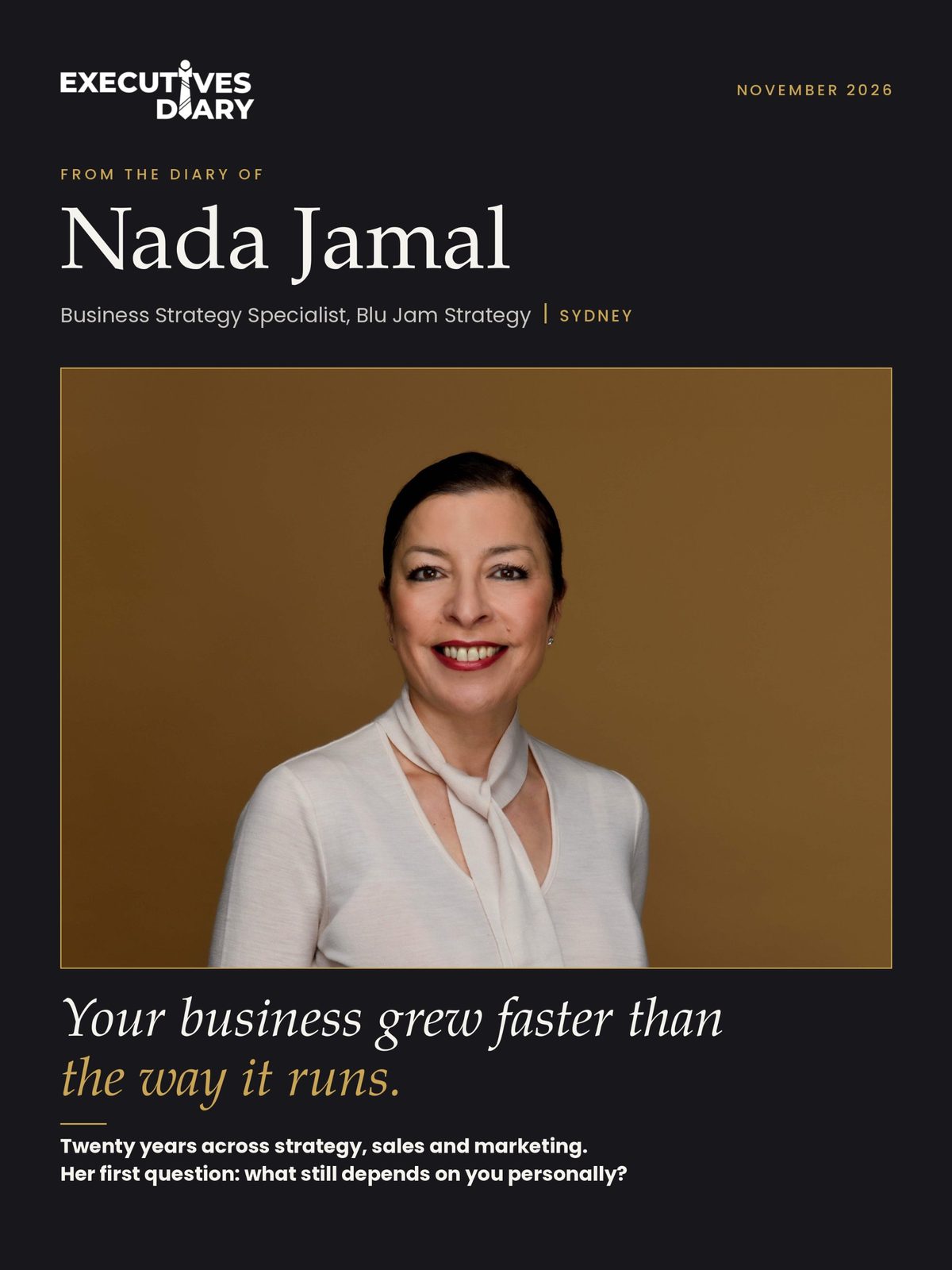
A technology business owner engaged Nada Jamal to help scale and enter new markets. Then she looked at how the business sold.
“Reviewing their sales process revealed inconsistent follow-up and messaging that relied on existing client experience without showing its relevance to new audiences. That shifted the priority: strengthening their sales and marketing approach to support expansion,” she says.
The brief was growth. The work turned out to sit one step before it. Nada says the effort going into a growing business doesn’t always become the progress or the profitability its owner expected. The wider figures show the pressure on profit. In the 2025 Small Business Perspectives Report from the Council of Small Business Organisations Australia, 64% of small businesses reported lower profits than the year before.
Nada runs Blu Jam Strategy in Sydney, where she works with owners and leadership teams whose businesses have grown but whose operations haven’t kept pace. As she describes the work, it’s about having someone alongside them who “connects their ambitions with the decisions, capabilities and actions needed to move forward.”
She also works with ambitious leaders preparing for their next stage of growth, helping them assess opportunities and build the capability to pursue them.

Where the Gap Shows Up
Nada describes the gap between strategy, execution and marketing as “a business working very hard without everyone working towards the same outcome.” The owner has a vision for growth, she says, but it hasn’t become clear priorities for the team. Marketing is bringing in interest, perhaps from customers who aren’t the best fit. Sales is chasing opportunities without enough thought for delivery capacity or margin. Meanwhile the owner steps in to keep everything moving.
Each part of the business can look busy, yet the overall result is disappointing.
The leaders she has in mind are “ambitious and know their industry, yet more decisions are coming back to them.” Their teams are managing competing priorities. She also points to how much SME owners carry. They are often, she says, “the person holding the strategy, customer relationships, team issues and commercial decisions together.”
So the first thing she does is ask the leader to step back.
The Balcony View
“The first thing I do is create space for the leader to step back and look at the entire business,” she says. “I call it the ‘Balcony View’.”
She wants to understand what the leader is working towards, why it matters to them, and what is making progress difficult. She also asks what still depends on the leader personally, “because that often tells us a great deal about how the business operates.”
Then she looks at the commercial and operational reality: customers, profitability, people, systems, responsibilities and how decisions are made. She listens to the leader’s view and tests it against what’s happening in practice. An owner might describe a marketing problem, for example, but the underlying issue could be an unclear offer, inconsistent sales follow-up or limited delivery capacity.
Her questions are plain: “What kind of growth are we pursuing? Which customers and projects will support it? What must the business be capable of delivering?” And then, “who owns the actions, and how will we measure progress?”
From there, she works with the leader to establish a manageable set of priorities, with clear ownership and practical next steps. “The aim is to give the leader a clearer basis for making decisions and the team a plan they can execute,” she says.
One of her clients was a growing health technology company.
A Company With Three Directors
The company was led by three directors who shared a vision but differed in their approaches. Nada says the business had strong market potential and an innovative product. Then she describes what was holding it back: “Misalignment at the top was creating friction, slowing decision-making and stalling progress on the company’s growth strategy.” The tension, she says, was “cascading through the business, leaving teams unclear and momentum stalled.”
She ran a series of structured sessions to reset the working relationship, and describes the facilitation as neutral, focused and solution-oriented. With the directors she developed a Directors Charter. It gave them clarity around decision-making and expectations that they hadn’t formally defined before. She also supported them with a team strategy workshop, to bring alignment beyond the founders into the broader team.
Twelve months on, she says, “they have a stronger leadership framework, improved communication, and most importantly, strengthened alignment that has re-energised their growth strategy.”
In her telling, the tension at the top did not stay at the top.
How the Pieces Connect
Working across strategy, execution and marketing has taught Nada that “a decision in one part of a business almost always creates consequences elsewhere.” Marketing can generate demand, but the business needs the capacity and capability to deliver on the promise. A growth strategy needs to account for margins, people and customer expectations. Operational improvements need to support the direction the business wants to take. An approach that looks sensible within one function, she says, can add pressure elsewhere if nobody considers the whole business.
Seeing those connections helps her recognise when a leader is trying to solve the visible symptom of a broader issue. She is clear that none of this is a case against specialists.
Specialist expertise is valuable. My role is to help connect that expertise to a shared direction, with priorities the business has the capacity to deliver.
Her own working life has run across several of those functions.

The Roles Behind It
Nada brings more than 20 years of experience across strategy, marketing, sales and business development, working with SMEs and multinational clients. Her previous roles span project management and business development at Formrite Group, account direction at Smartsource Marketing, business ownership at Sales Staff Australia, and business development at McKinnon Direct. That breadth has given her practical insight into how businesses win customers, deliver on their promises and manage growth, and how to translate strategic ambition into action that reflects their resources and capabilities.
At a US-based media organisation, a print production issue put a multinational FMCG account at risk. “I worked closely with the client and production team to resolve the quality and delivery concerns, rebuilding trust and securing a 12-month marketing campaign,” she says.
She was promoted to sales manager at Magnus Advertising, and the business owner told her to always lead from the front. “That is something that I live by in my professional career,” she says. Her own rule is shorter: “I do what I say I will do, when I say I will do it.”
I do what I say I will do, when I say I will do it.
Today she runs Blu Jam Strategy, which she rebranded in April from Magnus Business Builder, and Blu Jam Digital, which she founded two years ago. Blu Jam Digital ties brand, content, SEO and AI search, websites and performance marketing to clear commercial goals.
It’s the work she is building now.
Where Nada Is Now
Over the next twelve months, Nada wants to build awareness of Blu Jam Strategy among business owners and SME leaders whose businesses have grown, but whose operations haven’t kept pace. “I want them to recognise the value of having someone alongside them who connects their ambitions with the decisions, capabilities and actions needed to move forward,” she says.
Findex reports in its SME Growth Index 2026 that close to half of Australian SMEs have made costly decisions because they don’t have proper support.
Her ambition is stated plainly: “to become one of the most trusted and respected voices in business strategy, helping ambitious business leaders turn their vision into sustainable, profitable growth.” Outside work, her answer is short: “My love of family.”
“Ultimately, I want growth to strengthen the business and give its leader more confidence in how it runs,” she says.
The Playbook
Five Reflections from Nada
- What kind of growth are you pursuing? Nada starts here, before customers, projects or actions.
- Which customers and projects will support it? Marketing can bring in interest from customers who aren’t the best fit, she says.
- What must the business be capable of delivering? Sales can chase opportunities without enough thought for delivery capacity or margin.
- Who owns the actions, and how will you measure progress? Priorities need clear ownership and practical next steps.
- What still depends on you personally? The answer, she says, often tells her a great deal about how the business operates.