

From the Diary of
Ernest Akinlola
For the experienced professional asking “What next?”, a three-time CEO explains why the logical next step and the right next step are not always the same.
“I help people discover what they are capable of, develop it and deploy it with purpose.”
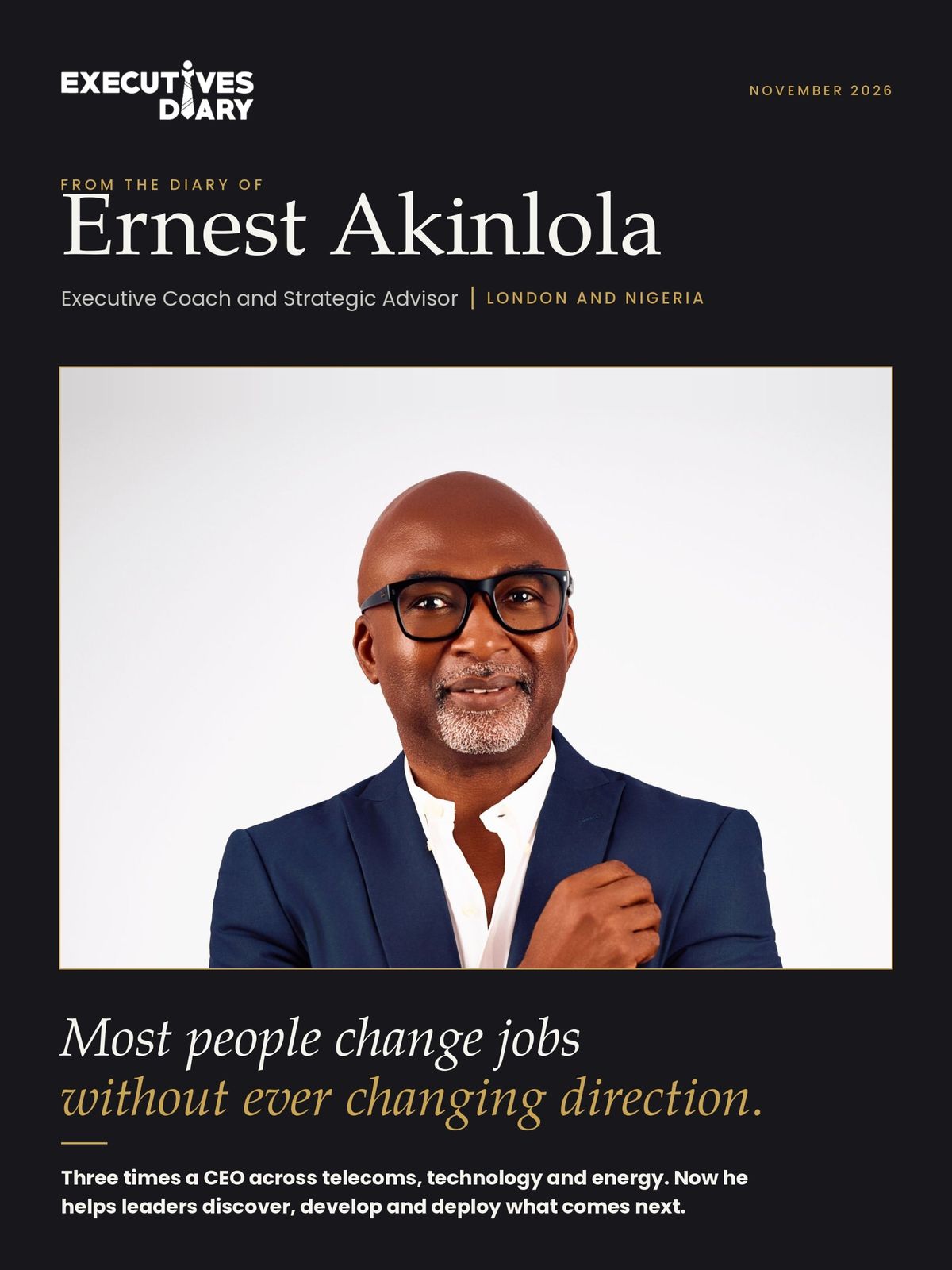
The question arrived after the career had gone well. Ernest Akinlola was in his fifties and had been a chief executive three times. “I had achieved many of the things I had set out to achieve, but a deeper realisation emerged: Am I intentionally building a meaningful career, or am I simply moving from one impressive role to the next?”
It’s the question he now puts to other people. Capable professionals, in Ernest’s experience, can become very good at succeeding on a path they never consciously chose, and doing well only makes the question harder to ask. “Success can become its own trap. If you have been rewarded for doing something well for twenty years, it can be very difficult to ask whether you still want to do it.”
Success can become its own trap
Too many people, as Ernest sees it, are “surviving through their jobs, not for lack of talent, but because they lack clarity and direction to thrive.” The numbers back him up. Gallup’s State of the Global Workplace: 2026 Report found that 34% of employees worldwide were thriving in their lives in 2025, and 20% were engaged in their work.
That is the work he does now, after almost four decades in senior roles across telecoms, technology and energy. He coaches experienced professionals and leaders through career transitions, advises organisations, speaks, mentors, and sits as a non-executive board member and an advisory board member. What he brings is the years he spent in the operating seat: “I have spent too many years actually running businesses to approach these questions purely theoretically.”
Lawyer, Accountant, Engineer, Doctor, Banker
Ask Ernest why career transitions go wrong and he doesn’t start with ability. “I don’t think most career transitions go wrong because people lack talent. They often go wrong because people move before they have achieved clarity.”
He has seen very capable people decide on the obvious next step: more money, a bigger title, a more prestigious company, what their peers are doing, or simply what becomes available. “The problem is that a logical next step is not necessarily the right next step.”
The problem is that a logical next step is not necessarily the right next step
His example comes from home. Most Africans of his generation are “almost mandated” to become a lawyer, an accountant, an engineer, a doctor or a banker: “the holy grail careers.” Over the years he has watched many people stay in them and do quite well, yet remain “not truly fulfilled,” their hidden potential “often subdued and never realised.”
So for Ernest, a transition has to begin with a deeper question than “What job should I take next?” The one he puts in its place: “Who am I really? What do I actually want this next chapter of my life and career to be about?” Until you answer that, “you can easily end up changing jobs without actually changing direction.”
It took him three decades to understand that fully.
Forty Rejections and One Resignation
Ernest returned to the UK as a teenager in the 1980s with nothing to his name, in a family of three that included “a determined mother who believed: ‘There’s no such thing as can’t.’” They struggled. He could barely afford college and relied on support from family and friends to get through.
In 1988 he applied for more than 40 jobs and received more than 40 rejections. In his twenties he “got certified for a job I didn’t enjoy,” because he believed what many people believe: “You work to survive first. Passion can wait.” In his thirties the roles grew, the income improved and “everything looked like progress.” Inside, another question had appeared: “Am I building the career I truly want or just following the path in front of me?”
In 1998, after nine years in his first real job, he resigned. “No plan. No safety net. Not a single clue what would come next.” Three days later the phone rang with an invitation to stop by for an informal meeting. “And since then, I’ve never applied for a job.”
He left accountancy for telecoms to help build the world’s first MVNO, a mobile operator that runs on another company’s network. He was told he would become “a glorified help desk.” Months later, Virgin Mobile had its first 100,000 customers.
From there his career ran through T-Mobile, BlackBerry, Etisalat, Lycamobile and Bboxx Nigeria, in commercial, strategic, COO and CEO roles, all the way “from analyst to CEO.”
What interests him more than the list is what those roles taught him.
What the CEO’s Chair Teaches

“Being a CEO changes the way you see decisions.” With P&L responsibility, people depending on you, customers depending on your organisation and shareholders asking questions, “you learn that there is rarely a perfect answer.” You learn to make decisions with incomplete information.
You learn that leadership is not about having all the answers. It is about having enough clarity to make the best decision you can and then taking responsibility for it.
The hard moment he picks is from T-Mobile in 2002, when he was commercial operations manager. A technical term in a major supplier contract had put the company in a very difficult commercial position. “It was not my error, but I was the one managing the relationship.” The CEO screamed at him and at the lawyer. “I assumed my career was over.” Then came “a glass of red wine from my wife and moral support from the CTO and COO.” He rewrote the clause to remove the company’s liability, the supplier agreed to it, and he took it to the CEO. Six months later he received the Outstanding CEO award.
Another comes from 2021, when he was leading Bboxx in Nigeria. The team travelled to Ijebu Ode with the full technical crew for its first installation, and then the customer changed his mind. Instead of heading home, Ernest closed a sale in Ibadan from Ijebu Ode, the system went in, and the business had its first customer. The questions he took from that day are ones he still asks: “What exactly failed? What can I change? Do I reroute or walk away?”
All of it “has profoundly influenced how I coach,” and it is why his clients get someone who has been there: “I know what it feels like to sit in the CEO’s chair when the decision is difficult. I know what it feels like to be responsible for other people’s livelihoods and careers.”
The way he coaches starts from there.
He Starts by Slowing People Down
“I start by slowing the person down.” Most people who come to a coach during a career transition are already moving very quickly. They have a problem, they want an answer, and they want someone to tell them what to do. “I don’t start there. I start by helping them understand themselves.”
The first conversations are questions. What have they actually enjoyed? What gives them energy, and what drains them? What are they unwilling to compromise on? And perhaps the most important: what has changed about them since they made their last major career decision?

I start by slowing the person down
The questioning comes naturally to him. “I am constantly asking questions. I tend to listen, observe and then ask, ‘Why?’ or ‘What are we really trying to achieve here?’” He has always been more interested in understanding the underlying problem than in treating the symptom.
Then he and the client look at the gap between where they are and where they want to be.
My role is not to tell anyone what career they should choose. It is to help them develop enough clarity and self-awareness to make a decision that is genuinely theirs.
From there the work moves “from discovery to development and ultimately to deployment.” Discover, develop, deploy is the sequence he keeps coming back to, and it’s the thinking behind North Star, the self-discovery app he has developed. “The idea is simple. Before deciding where you are going, you need a clearer understanding of who you are, what matters to you and what you want your contribution to be.”
Edwin, and the Extra KPI
Asked for evidence, Ernest points first to the operating record, then to the board and advisory work and the entrepreneurs he has mentored through accelerator programmes. “But the evidence I value most is what happens when someone begins to see their own situation differently and starts to believe more in themselves.”
In every organisation he gives himself “an extra KPI”: seek out the “hidden superstars” and promote them on merit, “so that the business grows, they believe in themselves more and then they do the same for the next person.”
The one who stands out is Edwin. Ernest was 40 and marketing director at Etisalat in Nigeria, and at the same time completing his own national youth service, the NYSC year that every Nigerian graduate under 30 is expected to serve. He chose to do it despite the title, and it taught him something about humility and about understanding the generation coming up behind him. Edwin was a 21-year-old graduate on the same service year, hoping to work in IT. “I took him under my wing, coached him into a career in customer value management in telecoms and he has never looked back since.” Four more names follow Edwin’s, and there are many others.
For me, the measure of good coaching is not that the coach has given someone the answer. It is that the person leaves with greater clarity, greater ownership of the decision and a clearer understanding of what they are going to do next.
“That is ultimately what I am trying to create through my work.”
Barbados, Rwanda and Grown-Up Children
Outside work, it comes back to the people around him. “Family and Friends are important to me. They lift you, inspire you, keep you grounded and are simply a source of happiness and balance.”
Ernest has grown-up children, and what he loves best is that “we teach each other new stuff everyday.” The learning runs both ways. Each of them is different, and he has learned that “tuning into their respective frequencies is important.” It is exactly how he leads.
He has travelled widely. He has holidayed in the Caribbean several times, including in Barbados, among “Lovely people that enjoy and take care of the environment.” But it is his trips to Rwanda, several of them, and to Cape Town that have shaped his perspective most, showing him “how much untapped human potential and business opportunities there are in the world.”
He is highly energetic. He swims, does resistance training, takes long walks and sings. He reads spy thrillers and espionage novels, and he is “super obsessed with nature and the animal kingdom, and Formula 1.”
“Everyone has an inner sanctum and so do I.” The people in his don’t necessarily know each other, “but if they met, they would all get on like a house on fire,” because they share the same traits: humility, integrity, authenticity and empathy. “They all show up in different rooms, and the different rooms make up the house.”
Three times a week he shares his career story on LinkedIn in bite-sized chunks, and the feedback on the lessons from it has been consistently positive.
Those lessons now feed two platforms of his own.
Where Ernest Is Now
The first is North Star, at getnorthstarapp.com, the app he has developed and the original concept and product. It is designed to help people discover who they truly are and give them the courage to pursue their true North Star. The app then recommends the key actions they must take and tracks their progress, all within the app.
The second is ernestakinlola.com, newly launched and a spin-off of North Star. It is his platform for one-to-one coaching, and it takes in his consulting, speaking, writing and advisory work as well. He also serves as a Non-Executive Board Member and as an Advisory Board Member.
Allumno and RIGHT INSTINCT LIMITED, the boutique consulting vehicles through which he has undertaken advisory and consulting work, belong to the middle of the story. He created them because “they gave me somewhere to put that instinct” at a point when he knew he wanted to contribute differently and “didn’t yet have the language for it.” His verdict on them is exact: “They were useful vehicles for doing work, but they were not the destination.”
He has also launched and won awards with startups of his own, among them mylottohub.com, a lottery aggregation platform. Two more digital solutions are in testing, headed for a retail launch in Africa.
The people he most wants to reach are experienced professionals and leaders who have arrived at “What next?”: the person who has achieved a great deal and is no longer sure the path they are on is the one they want. He also wants HR, L&D and business leaders to understand what he brings as a coach, advisor and mentor.
He is often asked whether he would take another CEO role. “The answer is yes, as long as I can be creative in the role, engineer growth and most importantly inspire the next set of leaders to become more than they believe they are.”
And on what comes next: “My next chapter is about turning almost four decades of experience into contribution through coaching, consulting, speaking, writing, mentoring and board-level work.”
He has the whole of it down to three words. “Discover. Develop. Deploy. That is the journey I want to help people make.”
The Playbook
Five Reflections from Ernest
- Who am I really? A transition begins with what you want the next chapter of your life and career to be about, not with which job to take.
- Am I building the career I truly want, or simply following the path expected or available to me? The question can be uncomfortable, particularly for people who have been rewarded for doing something well.
- What has changed about me since my last major career decision? Perhaps the most important thing he asks a client.
- What are we really trying to achieve here? He would rather understand the underlying problem than treat the symptom.
- Who is this making me? Small choices add up, and each one is a vote for the person you are becoming.

