

From the Diary of
Susie Gidseg
For the manager who was handed a team and no guidebook: the author of BOSS on why kind and nice are not the same thing, and what kindness looks like in practice.
“No one needs a perfect boss. They just need a kind one.”
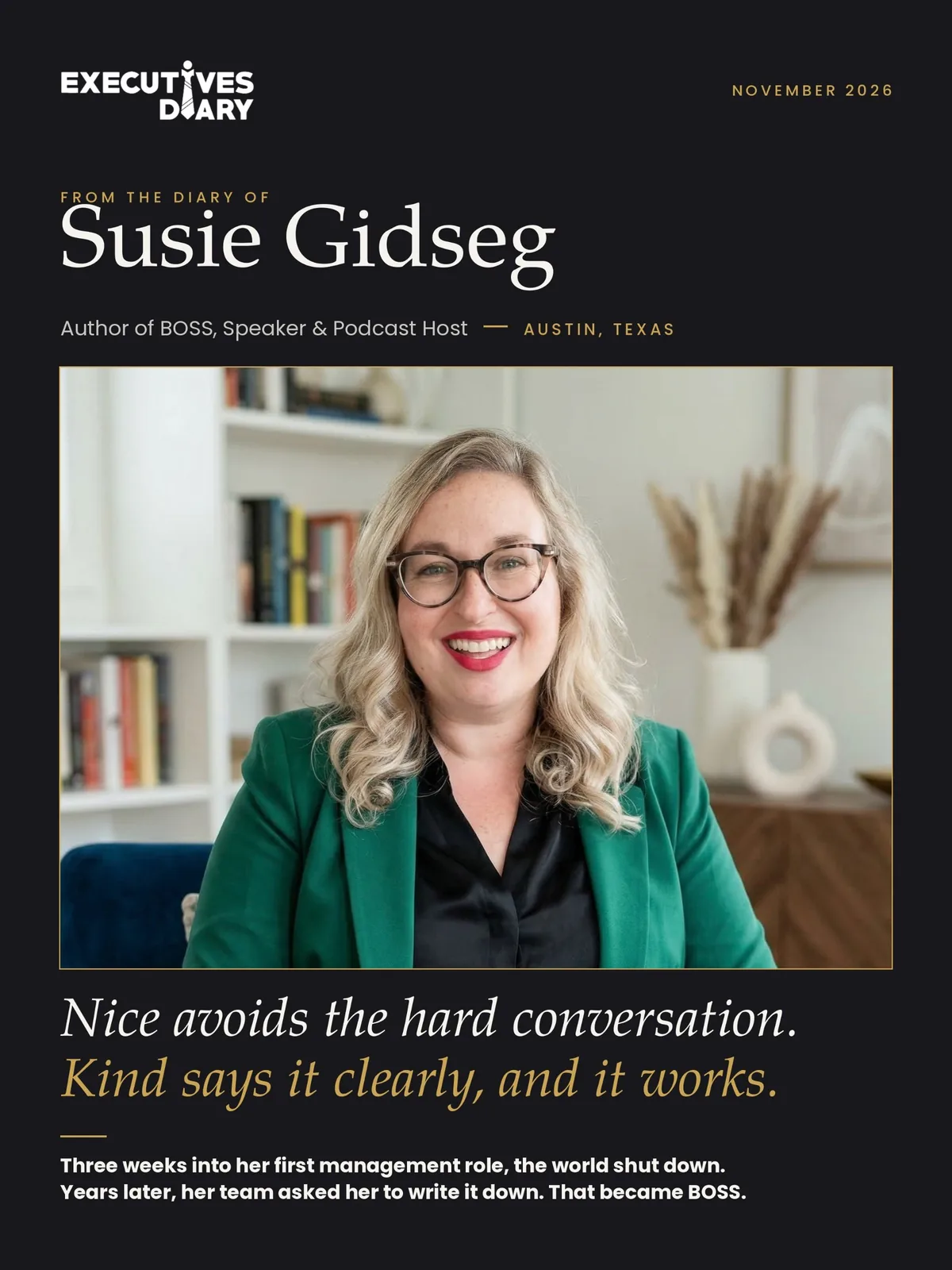
Susie Gidseg had been a manager for three weeks when everything changed. “I was three weeks into my first management role when the world shut down during COVID,” she says. “I realized quickly that I was going to be the one to help my team succeed or fail, and I was a brand new manager who was still learning and had no roadmap to follow.”
“I did it wrong at first,” she says. “I triple-booked meetings, worked late, and tried to carry the whole team alone, because I thought I should.”
Her start is a common one. Gallup’s State of the Global Workplace 2025 report found that fewer than half of the world’s managers, 44 percent, say they have received management training, and that young managers and female managers saw the largest drops in engagement.
Susie is the author of BOSS: Becoming the Leader You Always Wished You Had, a leadership book written for that manager, and she is now building leadership workshops for women stepping into the role. Her argument is that leading with kindness is a strategy, not a weakness. “Most leaders are promoted into leadership without a clue where to start,” she says. “A switch is flipped, and all of a sudden it’s up to them. That’s the manager I wrote BOSS for, and the one I want in my workshops.”

Kind Is Not the Same as Nice

What got Susie through that first year was letting go of the idea that she had to do it alone. “But then I realized that it didn’t need to be all on me. I leaned into my team,” she says. She worked on trust, and on listening to her team “both as employees, but most importantly as people,” and she focused on “building a culture of collaboration and appreciation.”
The idea at the center of BOSS starts from a line on her profile: the people who lead with kindness, as she puts it, “get told it’s a weakness.” Her answer begins with a distinction. “Nice and kind are not the same thing,” she says. “Nice avoids the hard conversation so nobody’s uncomfortable. Kind says the hard thing clearly, because you care about the person and the work.”
Nice and kind are not the same thing
In practice, she says, that means giving feedback before it piles up. It means saying “that one’s on me” when your call didn’t work out. It means telling your team what you know, what you don’t, and when you’ll update them next. Some of it she had to learn against her own instincts. “I’m a recovering people pleaser, so I had to learn that not everyone will like your decisions, and that’s okay.”
Kindness isn’t weakness. It’s strategy. And it works.
The reason she gives is about what people carry with them afterward. “At the end of the day, you won’t remember the projects you did, or the deadlines you met, but you will remember that time your leader treated you with kindness.”
Her own route to that first management role was not a straight one.
From the Stage to Social Media
Susie started in theatre. Her degree, a Bachelors of Fine Arts in Theatre Dramaturgy, is from the University of Oklahoma, and she spent ten years leading and producing theatre before she pivoted into running social media for nonprofits. “I made that move because I had the right skill set (creativity, experimentation) just as social media was taking off,” she says.
From there she moved into corporate work, first as a contractor. “I came into corporate as a contractor and thrived, but I never got a raise or a bonus,” she says. The next turn came down to one person.
Taking the Job for the Boss
Susie eventually took a full-time role “at a lower grade than I deserved, because of the manager.” She describes that manager as the person who shaped how she works. “From day one she asked about my strengths and truly listened,” she says. “She saw that my job grade was unfair and quietly got me a two-level promotion, which was almost unheard of at my company. We’re still friends.”
“Watching her showed me I could choose what kind of leader to be,” she says. She stepped into management in 2020, and that was the role she was three weeks into when the world shut down. The team she built there is the reason BOSS exists.
The Dinner That Became a Book
“After 13 years at one company, my director role was eliminated,” Susie says. A month later, her former team took her to dinner. They “reminded me that how I had built and led our team was special, and they challenged me to turn what I created into a leadership book for others to do the same.”
Then came another leadership job, which was followed by another workforce reduction a year later. “This time I decided to build my own brand to tell my own story,” she says. She is plain about what that period cost.

Workforce reductions pull the rug out from underneath you. One day you know who you are, what you do, who you represent. The next day, you have to pick yourself up, piece by piece, to rediscover who you are and what you bring to the table.
“The journey was humbling and incredibly hard, yet it brought so many pockets of joy,” she says: the coworkers who told her about the impact she had left on them, the friends and contacts who rallied for her during her job searches, and “the creative highs that I reached, in spite of where I started.”
She turned the experience into a season of her podcast, Leading Questions, “focused on people involved in big pivots.” The dinner challenge, she says, “turned into my book, BOSS: Becoming the Leader You Always Wished You Had, which launched 2 years later and tells this story.” It has just become an Amazon #1 new release.
Where Susie Is Now

BOSS launched on October 16, and Susie has spent the weeks around it on a virtual book tour of podcasts. “My husband says Podcast Susie is looking sharp,” she has written. “(She wears a lot more makeup than Everyday Susie.)” At first, she wrote, “I was prepping for each one like a job interview.” By the fourth, “I’m just trying to speak from the heart.” Her conclusion: “Turns out the turny twisty version of my story was the one worth telling all along.”
Her workshops are next. Over the coming year she wants BOSS in front of more readers, and to “bring more women in leadership into my workshops, so I can help them build on their strengths and eventually lead a cohort.” She knows exactly who that reader is: “a millennial woman manager in corporate, the one who was handed a team without a guidebook and is wondering if she’s doing it right, and who cares enough about her team to learn what she doesn’t already know.”
The book has a forerunner in her family. In 1935, she has written, her great-uncle self-published a hardcover book of love sonnets, Guardian of Lovers. The copy that came down to her carries a sticky note from her mother: “Uncle Marvy’s Book of Poetry. DO NOT THROW OUT.” Of BOSS, she wrote: “Another author in the family line, waiting for her story to be told.”
Outside work, she has gone back to the stage. After years as a theatre performer and director, she took a 15-year break, and last year she returned with improv classes. “When you drop a line or miss a cue, the rule is to take a huge, exaggerated bow and shout ‘I failed!'” she says. “It’s terrifying at first, then freeing.” It taught her “to take myself less seriously and to bring joy back into my daily life.” She is now, in her words, “an improv graduate.”
It’s terrifying at first, then freeing.
The sentence she wants readers to take away is the one she wrote the book around. “No one needs a perfect boss,” she says. “They just need a kind one.”
The Playbook
The Susie Gidseg Playbook: Kind, Not Nice
- Lean into your team. It doesn’t need to be all on you, and trust starts with listening to people as people.
- Give feedback before it piles up. Kind says the hard thing clearly, because you care about the person and the work.
- Say “that one’s on me.” When your call doesn’t work out, own it out loud.
- Tell your team what you know, what you don’t, and when you’ll update them next. Not everyone will like your decisions, and that’s okay.
- Ask about strengths, and listen. The manager who shaped Susie did it from day one.

