From the Diary of
Shreya Mehta
An award-winning artist who co-owns a 50-year-old diamond business on why creativity is not reserved for artists, and what the studio has taught her about leading.
“Creativity isn’t what we do. It’s how we think.”
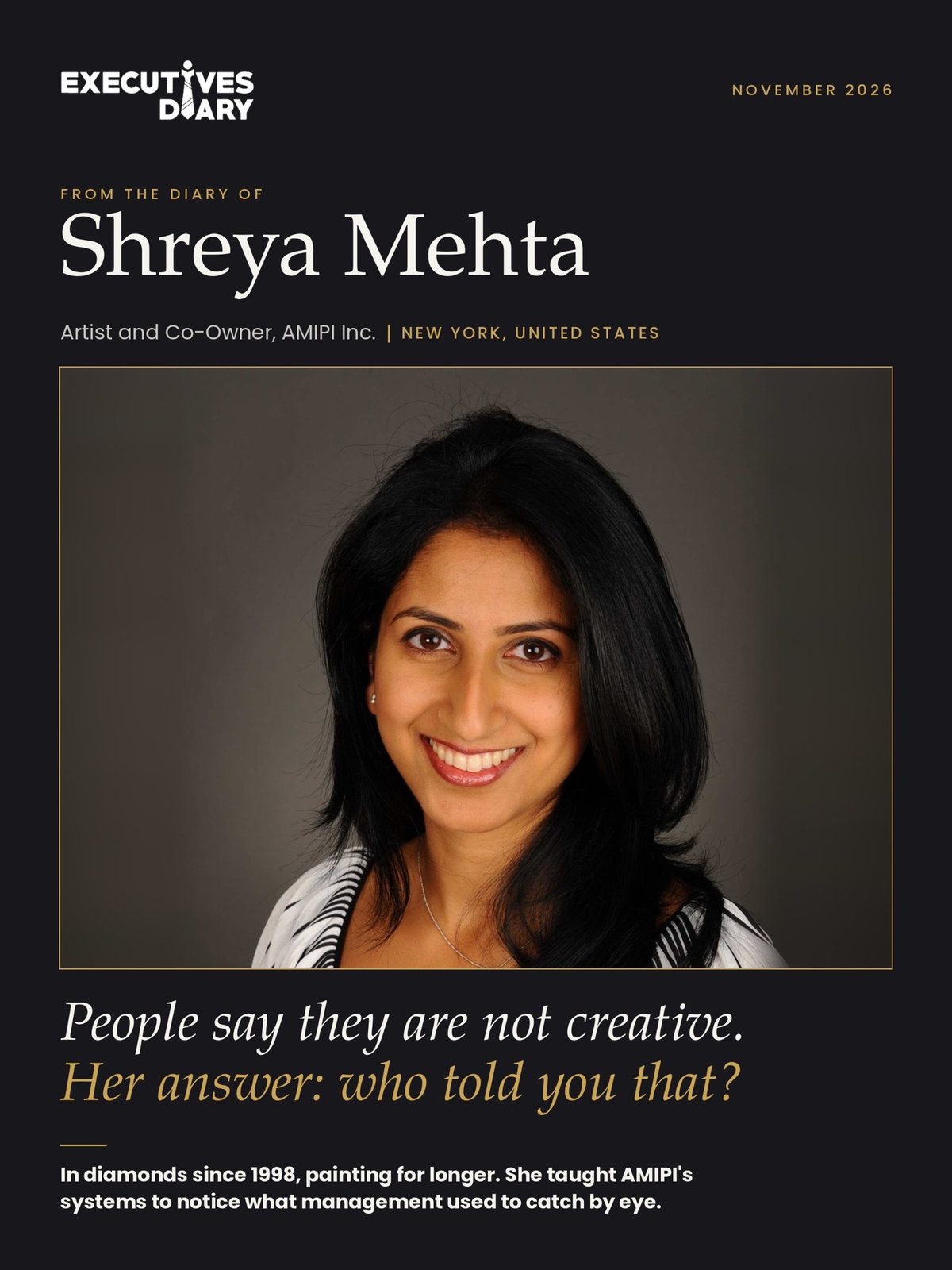
“I grew up in Antwerp, surrounded by diamonds, but I was also an artist,” Shreya Mehta says. She has never treated those as two separate lives. “I never felt I had to choose between being creative and being a businesswoman. In fact, I think one has made me better at the other.”
Shreya is the co-owner of AMIPI Inc., a New York diamond and jewelry supplier that is, in her words, “a 50-year-old company serving approximately 7,000 retailers.” She has been involved with it since 1998, and for longer than that she has been a contemporary fine artist, with work exhibited in New York, Dubai and Mumbai. After almost three decades doing both, she wants other leaders to hear an argument she feels strongly about: “creativity is probably one of the most underused skills in business.”
Employers already list it among the essentials. In the World Economic Forum’s Future of Jobs Report 2025, creative thinking ranks fourth among the core skills employers say workers need today. The difficulty, as Shreya sees it, is where people think creativity lives. “When people hear creativity, they immediately think of artists, designers or marketing people,” she says. “But I think creativity belongs in the boardroom just as much as it belongs in an art studio.”
But I think creativity belongs in the boardroom just as much as it belongs in an art studio.
Antwerp, the Academy and 1998
Her family was connected to the diamond industry, and the lesson she took from it was about relationships and reputation. “Business is never just about the transaction. It’s about the trust you build over time,” she says. “You can lose a sale and recover from it. Losing someone’s trust is much harder.”
She studied fine arts at the Royal Academy of Art in Antwerp, where her degree is an MA in Monumental Arts. She attended, as her profile puts it, “as its first woman of Indian origin,” and graduated with the V.R.I.K.A Award.
Then, in 1998, she became involved with AMIPI. “Suddenly I was navigating a very different world,” she says. “Business operations, customers, pricing, people, and all the challenges that come with building a company.”
“But I never stopped being an artist,” she says. Her paintings sit in private collections, among them that of the Prime Minister of India. “I don’t think I’ve ever seen my life as a straight line. And perhaps that’s because I’ve never felt I had to be just one thing.”
What the Studio Brings to the Business
For Shreya, creativity isn’t just about making art. “It’s about observing differently, being comfortable with uncertainty, experimenting, and questioning established ways of doing things,” she says. Each of those started in the studio.
The first is looking. “As an artist, I’m constantly trying to see differently,” she has written. “To notice what changes when you shift the angle, the distance, the light.” She brings the same habit to people. “As an artist, I’ve also learned to observe before reacting. Sometimes the most important thing you can do is simply stop, look and listen.”
The second is living with not knowing. “As artists, we learn to observe, experiment, make unexpected connections and accept that something may not work the first time,” she wrote. “I’ve realized I bring that same thinking into business.”
The third is the question itself. In her definition, creativity “is looking at what everyone else is looking at and seeing another possibility.” She once found that perspective on a mountain, paragliding in the Dolomites, where everything that felt enormous from the ground looked different from above. “Proximity can distort perspective,” she wrote, and closed with a line at her own expense: “28 years in business, a lifetime of making art, and apparently I still need a mountain to remind me.”

Teaching a Machine What Management Noticed
The clearest place to see that thinking at work is AMIPI’s website. “We’re a jewelry company, not a technology company,” she says, and for years it handled its site the way many businesses do. “Someone from management would go onto the website, notice something wasn’t right, maybe a page was slow, an image was missing or something wasn’t functioning properly. We’d point it out and the team would fix it. And then we’d do it all over again.”
At some point she started questioning the routine. “Why couldn’t the system identify them before we did?” The answer became an AI-powered website auditing tool. “We had to take the things we were noticing intuitively, almost without thinking and turn them into specific rules that the tool could understand,” she says. “That actually took quite a bit of time.”
Today an automated system runs periodic audits, checking speed, broken pages, missing images and other issues, and it generates reports so the team can act without waiting for management to find a problem. “For me, the biggest change isn’t just efficiency,” she says. “It’s that we’ve moved from being reactive to being proactive.” “We had to teach the technology how we think. That’s where I think creativity and technology really come together.”
The website was one process among several. Instead of asking how AI could help the business as a whole, AMIPI looked at individual processes, shipping, customer communication, marketing and product images among them, and asked of each one, “Could this be done completely differently?” Shipping shows how far that question has gone. The team used Mentra AI glasses alongside Komodo AI to document the shipping department’s standard operating procedures, then used Claude to analyze the entire workflow, identify inefficiencies and highlight opportunities to save both time and money. “We’re not simply adopting AI for the sake of technology,” she says. “We’re using it to examine processes we’ve followed for years, question what can be improved, and make practical changes to how we operate.”
Technology can improve efficiency. But it takes human creativity to decide what is worth improving.
As she puts it, technology is a tool, but human curiosity and creativity determine how it is used. Which means the curiosity has to come from the people.
“Who Told You That?”
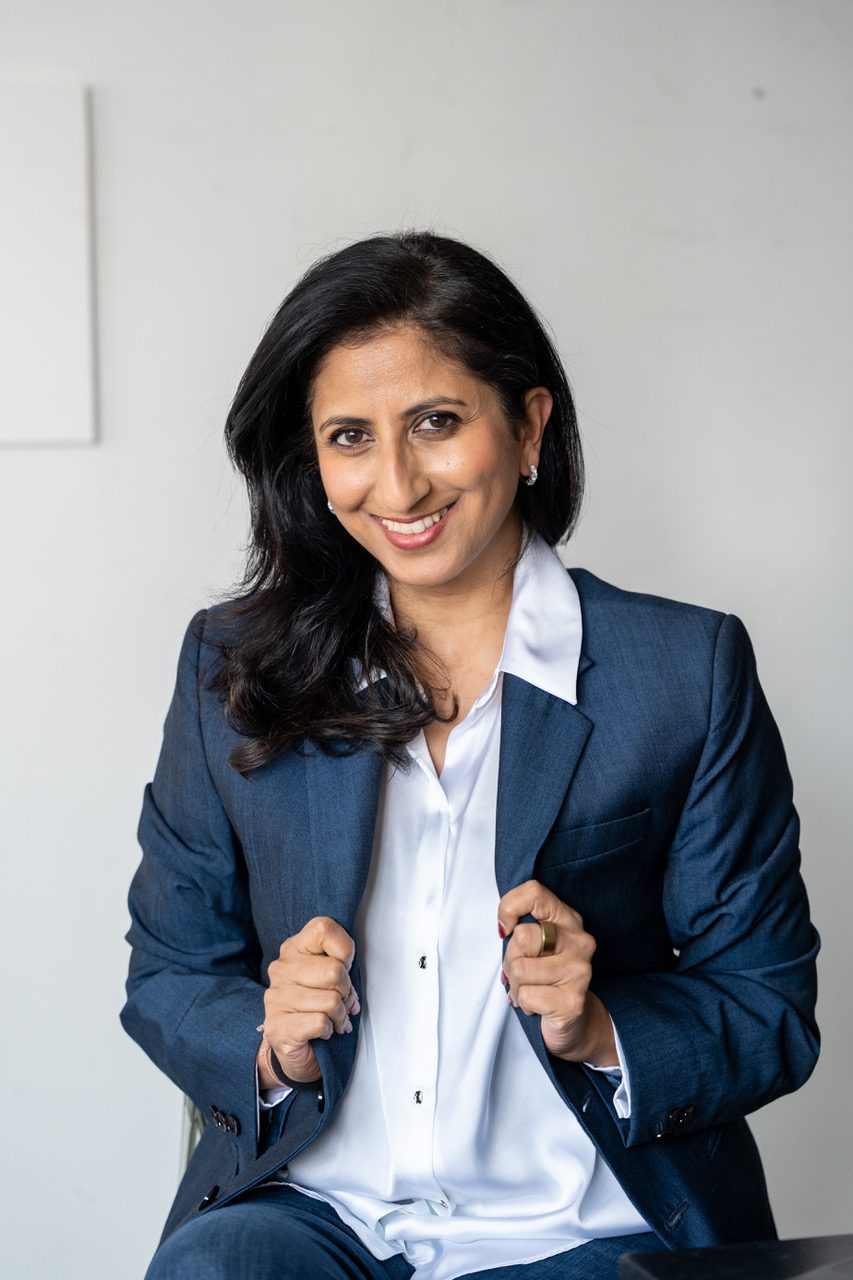
Her answer to the question she asks on her own profile, how to nurture creativity in a workplace, starts with a word people use about themselves. “I hear people say, ‘Oh, I’m not creative.’ And I always think, really? Who told you that?” For her, creativity “is not necessarily about painting a beautiful picture or coming up with a brilliant marketing campaign. Sometimes it’s simply finding a different solution to a problem.”
At AMIPI, she tries to encourage people to question things. “I want someone to be able to say, ‘Why don’t we try this instead?'” That takes permission to make mistakes. “I’m not suggesting we throw discipline out the window. But if every new idea is immediately met with ten reasons why it won’t work, eventually people stop bringing ideas. And I think that’s a terrible loss for a company.”
She also believes creativity needs exposure. “Read something outside your industry. Meet someone who thinks differently. Visit a museum. Have a conversation that has absolutely nothing to do with your business,” she says. “Some of my most interesting business ideas have come when I wasn’t actually thinking about business.”
You cannot expect people to think outside the box if you never allow them to step outside it.
Family, Silence and the Customer AMIPI Let Go
Shreya works with her husband and her son. “Working with family is both a blessing and a challenge!” she says. “You can have a perfectly normal business disagreement at 4 p.m., and somehow that same conversation finds its way to the dinner table at 8 p.m. And I’ll admit, I’m often the culprit!”
“I think the challenge is learning when to stop being business partners and just be a family,” she says. “We’re still figuring that out and I suspect we always will be.” The balancing act, she says, has taught her “a lot about communication, patience, and knowing when a conversation can wait.”
She keeps an eight-day silence ritual, a spiritual practice without speaking or electronics. Before it begins, she sits with the different departments, aligns what needs aligning and closes the decisions that cannot wait. “I want my choice to step away to create as little inconvenience for anyone else as possible,” she wrote. “The work should continue. Responsibilities should remain clear.”
The same care runs toward the people who work for AMIPI. “We fired a customer. And I’d do it again,” she wrote recently. It wasn’t because of how much they bought, but because of how they treated one of the company’s employees. AMIPI’s No Bull philosophy, she wrote, is built on honesty, accountability and respect. “If keeping a customer means sacrificing your team’s dignity, that business comes at too high a price.”
If keeping a customer means sacrificing your team’s dignity, that business comes at too high a price.
Where Shreya Is Now
In the studio, her recent Diamond Nebula series brings diamonds and natural pigments together, which, she says, “in many ways feels like my two worlds coming full circle.” Outside both worlds, there is meditation. “Meditation has probably influenced my leadership more than any business book I’ve read,” she says. “It has taught me to create a little space between what happens and how I respond. And believe me, in business, that space can make all the difference.”
What she wants next is to be part of more conversations about leadership, innovation and the role of creativity in decision-making. The reader she has in mind is a business leader who has spent years building a successful company “but is beginning to realize that the same thinking that got them here may not get them where they want to go next.” She wants that person to come away thinking, “maybe I need a different perspective in the room.”
Almost three decades in, she doesn’t think experience should settle the question. In her view, it shouldn’t make us rigid in our thinking, but more open to questioning what we think we know. “Looking back, I don’t see these as separate careers,” she says. “I see them as different expressions of the same curiosity.”
Whether she’s standing in front of a blank canvas or sitting in a business meeting, she says, the question is often the same. “What else is possible?”
The Playbook
Five Lines from Shreya’s Diary
- “Creativity is not necessarily about painting a beautiful picture or coming up with a brilliant marketing campaign.”
- “You can lose a sale and recover from it. Losing someone’s trust is much harder.”
- “AI can give us answers. Human creativity helps us ask better questions.”
- “Some of my most interesting business ideas have come when I wasn’t actually thinking about business.”
- “Meditation has probably influenced my leadership more than any business book I’ve read.”
Creativity isn’t what we do. It’s how we think.