

From the Diary of
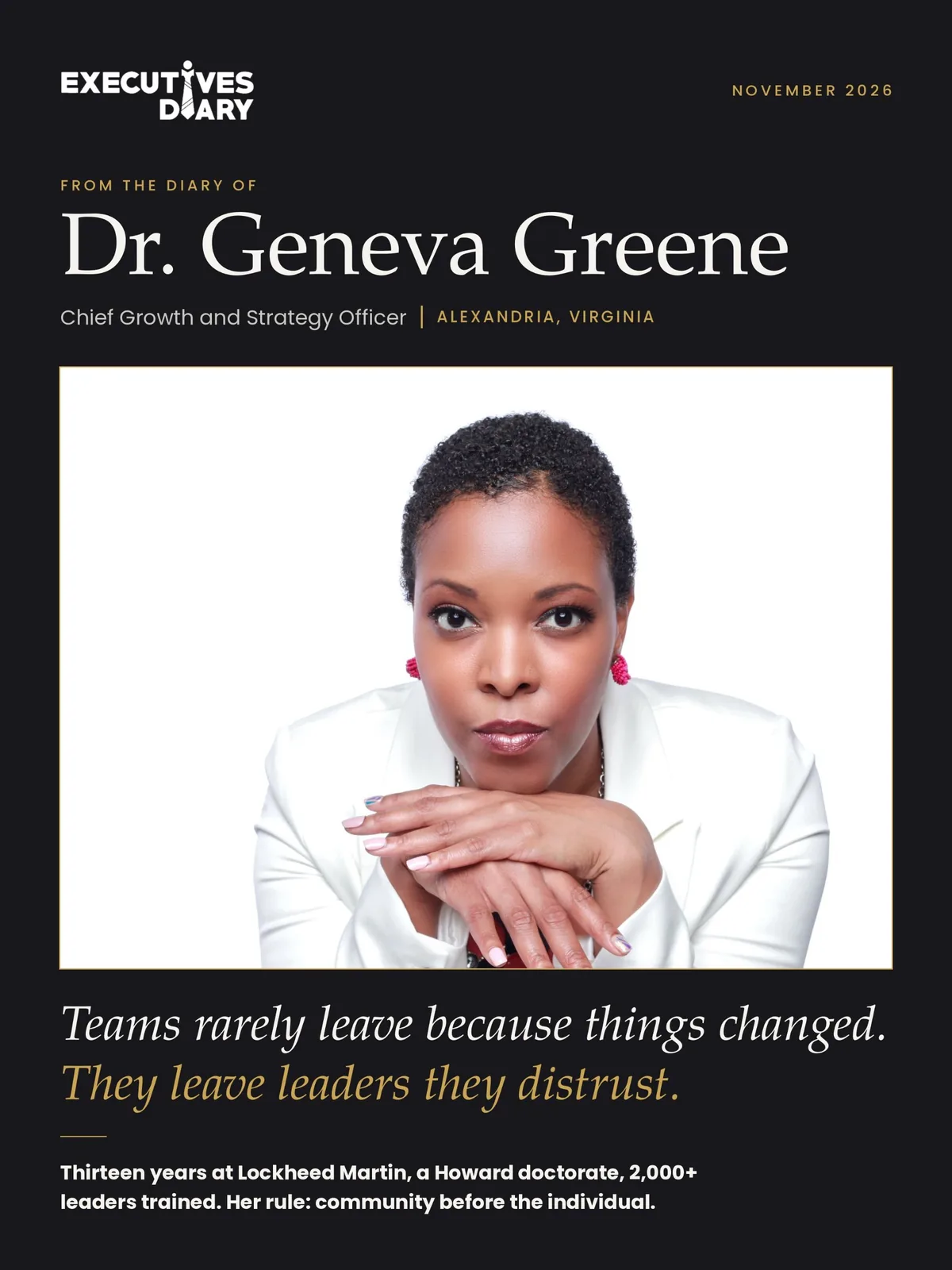
Dr. Geneva Greene
For leaders whose teams keep living through change: what happens when a leader and a team see the same room differently, and how one consultant gives both a safe way to say so.
“We owe it to ourselves and the world to ‘trust our truth.’”
A leader asked for a team development exercise at the beginning-of-the-year offsite. Going in, the leader felt that everyone on the team was comfortable expressing any challenges. The team revealed the opposite. “The leader had one interpretation of the team’s dynamics, but the team had a different perspective,” says the consultant hired to assist the team.
It’s a common gap. In PwC’s 2024 Trust Survey, 86% of business executives said they thought employee trust was high, while 67% of employees said they highly trust their employer.
The consultant is Dr. Geneva Greene, Chief Growth and Strategy Officer of Sprouts Consulting, and her work is with leaders whose teams are experiencing constant change. What she used at that offsite was the Uknite framework, which, she says, “allowed both parties to safely express themselves and understand their shared responsibility in strengthening the team dynamics.” For leaders in that position, she says, the framework “allows them to build stronger more resilient and connected teams that avoid burnout.”
Behind that work are more than 13 years at a large, global corporation and a doctorate from Howard University. She has, she says, “played a role in training more than 2,000 leaders and teams” at Lockheed Martin, Amazon, the National Hockey League, the Department of Homeland Security and other local and global organizations.

Why Teams Leave
In a recent Sprouts Consulting article, she wrote: “People do not necessarily leave because things changed. They leave when they lose confidence in how change is being led.” Asked what that means in practice, and to say it the way she would to a client, she’s blunter.
Frankly, teams leave leaders they distrust.
Trust, in her account, has conditions. “In order to nurture trust during transformative times, teams must feel that transparency, clear and honest communication exist with leadership,” she says. “They also must see that they are being considered in the new team direction and feel some investment in the shift.”
Forbes cites “ineffective leadership” as a top reason for employee burnout. According to Geneva, the next reason is change.
“Change happens, but the way leaders help teams navigate the changes can make the difference between major turnover or retention,” she wrote in a post pointing readers to the article. The changes keep arriving. Gartner research found that the average employee went through 10 planned enterprise changes in 2022, up from two in 2016, and that employees’ willingness to support enterprise change fell from 74% to 43% over the same years.
Her answer begins with the group rather than the person.
Community First
Sprouts Consulting, she says, “addresses change fatigue and burnout by introducing services, resources, and training approaches that center community building,” and draws on indigenous ideologies that are thousands of years old.
Many team development approaches center the individual first, but we place the community first in a way that appeals to the humanity in all of us.
The aim, as she puts it on her profile, is “helping people move through change with greater clarity, connection and capacity.” Through Sprouts she has run consultations and learning experiences with organizations such as Amazon, the National Hockey League, Exelon, FHI360, WACIF, Howard University, the District of Columbia Courts, the Department of Homeland Security and the National Management Association. She also developed and taught a new Communications course for master’s students in Georgetown University’s school of Public Relations and Corporate Communications.
The pandemic sparked major change.
One Event Instead of Several
“The coronavirus forced us to think about life differently,” she says. She was working with groups that typically hosted regional conferences, and quarantine affected all of them. She encouraged them to think differently about how they approached execution and how they used their resources. Together they decided to host one unified event. It drew nearly 900 registrants, and instead of charging a registration fee, it raised thousands of dollars for local charities.
Challenging moments often demand innovation and creativity, which is something that I fully embrace.
The first of the turns she names goes back further.
Thirteen Years at Lockheed Martin
It was joining Lockheed Martin as a participant in its Communications Leadership Development Program. That decision, she says, “allowed me to embark on a journey of learning and global experiences that I never imagined.” Over the years that followed she moved through communications and public affairs, media relations, and diversity and inclusion roles, in Orlando, Fort Worth, Dallas and the Washington, D.C. Metropolitan Area.
Some of her favorite moments, she says, involved “working on new technology and energy market contracts, strategizing with employee resources groups, and building relationships with local communities.” In the development program, she formulated and implemented a community partnerships plan that led Florida’s Orange County school district to recognize Lockheed Martin as a top partner in education. As communications lead for the African American Leadership Forum’s Mid-West Region, she ran employee communications and marketing initiatives that increased regional conference participation by 50 percent. In her last role there, as Global Diversity and Inclusion Consultant, she advised all levels of the corporation, with a particular focus on how business resource groups evolved and aligned across the enterprise, earning her two company awards.
The second turn meant leaving.
Leaving for Sprouts and Howard
Leaving her corporate position “to pursue Sprouts Consulting and a doctoral program at Howard University was a huge defining moment,” she says. “I believe that transition took a lot of courage because I did not really know what lay ahead.”
I believe that transition took a lot of courage because I did not really know what lay ahead.
Her time at Howard exposed her to research studies in Cuba, Brazil and Belize and, she says, “introduced new perspectives that allowed me to expand my professional services and network.” It also “encouraged me to center talents, skills, and interests that I marginalized or left dormant.” She completed a PhD in Communication, Culture, and Media Studies at the university.
In a post marking five years since she moved into full-time entrepreneurship, she wrote that the move was not just about starting a business. It was about “recognizing my truth, challenging expectations, and finding the courage to pursue something different.” She has since released the Stepping Into Greatness workbook, she says, “to support others deciding to take a similar journey.”
The third turn, she says, was one she didn’t see coming.
Transformation to Triumph

Starting the non-profit Transformation to Triumph in 2026 “has been a pleasant surprise,” she says. “Similar to getting a doctoral degree, it was not something that I expected to do. However, it is evolving into something so amazing.”
“My colleagues and I began with a knowing that we wanted to do something for the hundreds of thousands of women losing their jobs in the United States since 2025,” she says. “The numbers keep growing and that is something that especially keeps me up at night. So many families are impacted with some people being out of work for almost two years now.”
The non-profit equips women with resources and networks as they navigate professional and personal transitions, with a focus on finance, entrepreneurship and wellbeing. “Transformation to Triumph has the opportunity to support women as they transition into new versions of themselves and their lives,” she says. “I am excited about where we are headed.” Her consulting work goes on alongside it.
Where Geneva Is Now
At Sprouts Consulting, the priority now is helping leaders understand the value of building resilient internal communities with intention. Recently that has meant supporting the Crohn’s and Colitis Foundation as, she wrote, “they fortify their internal community to support the important needs of families and patients across America.” This October she is also among the speakers at DC Startup & Tech Week, on what the clean energy advantage can mean for entrepreneurs.
The leaders she most wants to reach are the ones she named at the start: leaders with teams experiencing constant change. Her invitation, to anyone whose people are disconnected or navigating constant change, is to get in touch about consulting, facilitation, training or speaking.
The person who shaped how she works is her mother. “She embodies compassionate, servant leadership,” she says. “When I became an adult, my perspective shifted and I was able to appreciate the phenomenal woman that she is.”
Outside work, she holds to a line from Alice Walker: “The most common way people give up their power is thinking they do not have any.” “All of my work is helping people to understand their power,” she says.
All of my work is helping people to understand their power.
“I believe we must live in our truth and authenticity,” she says. “When you say yes to parts of you that you buried deep within that can help another, then that is where the beauty lies. We owe it to ourselves and the world to ‘trust our truth.’”
Five Reflections from Geneva
- Whose picture of the team is this? At the offsite, the leader had one interpretation of the team’s dynamics and the team had another.
- Do they hear it from you? During transformative times, teams need to feel that transparency and clear, honest communication exist with leadership.
- Can they see themselves in the new direction? People need to see that they are being considered in where the team is going, and to feel some investment in the shift.
- Where does the community come first? Sprouts places the community before the individual, in a way she says appeals to the humanity in all of us.
- What power do you think you lack? She lives by Alice Walker’s line that the most common way people give up their power is thinking they do not have any.

