

From the Diary of
Lyndsey M. Olson
Build relationships before you need them. Trust isn’t built by agreeing on everything; it’s built through mutual respect, keeping your word, and acting with integrity before a crisis puts those relationships to the test.
“Trust is infrastructure.”
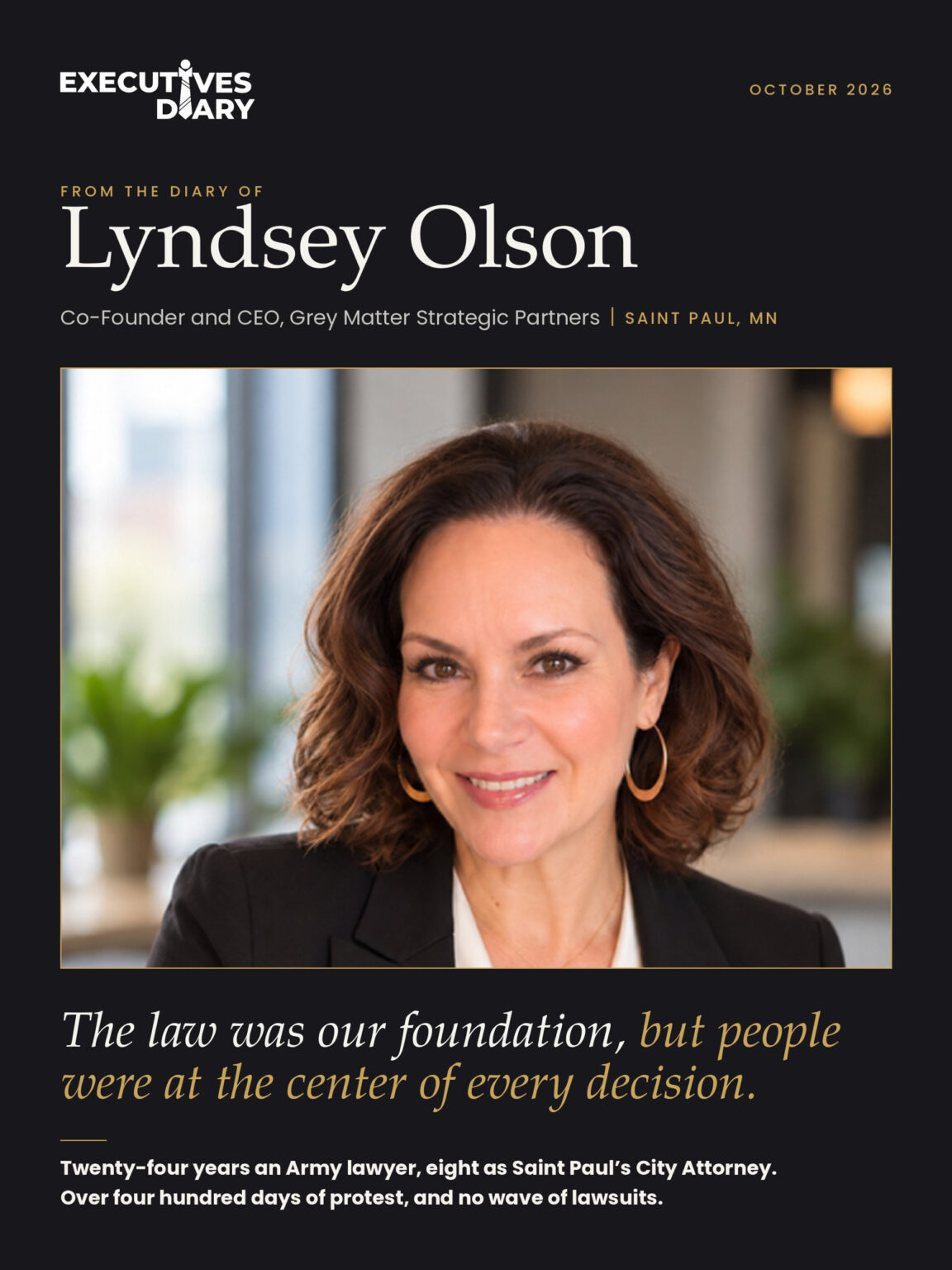
From the Army and the Saint Paul City Attorney’s Office to Grey Matter Strategic Partners, Olson shows that managing legal risk and protecting public safety are not a trade-off, and that the trust behind both has to be built before the crisis and kept in practice after it.
In the summer of 2020, after George Floyd was murdered a few miles away in Minneapolis, Saint Paul faced a question that no statute could answer on its own. City government knew its legal obligations. The harder task was meeting them while protecting protesters, residents, businesses, journalists, and police officers at the same time, in a community full of grief, anger, and distrust.
Lyndsey M. Olson, former City Attorney for Saint Paul, kept returning to one question in those meetings: What does this look like from where they sit?
It was not a question about agreement. It was a way of taking another person’s position seriously enough to understand the circumstances in which every decision would land. The answer often revealed something the lawyers, the officers, or the elected officials had overlooked.

Trust is infrastructure.
Trust Before the Crisis
“There was no playbook for what we were facing,” Olson says.
That did not mean there were no rules. As City Attorney, she needed to help leaders understand their legal obligations and decide how to act responsibly within them. Knowing what the law allowed was essential. Deciding what the city should do required more: attention to public safety, community trust, communication, and the likely consequences of each operational choice.
Her legal team worked closely with Saint Paul Police leadership and the department’s Special Operations Unit before and throughout the demonstrations. They discussed constitutional rights, procedural justice, de-escalation, communication, and protections for the press, and they examined how individual tactical decisions could reduce tension or escalate it.
The results were unusual. Saint Paul experienced more than 400 days of protests and demonstrations after George Floyd’s murder. The vast majority stayed peaceful, arrests were relatively few, and the city avoided Section 1983 civil rights claims arising from the protests, the kind of litigation that hit many other jurisdictions.
For general counsels and chief legal officers, that outcome is a case study in institutional risk management. Cities have absorbed the cost of law enforcement lawsuits for decades, and many have come to treat it as unavoidable. Saint Paul’s experience points the other way. Lower litigation exposure did not come at the expense of public safety or officer safety. The same preparation that protected the city from liability also protected the people on both sides of the police line.
Elsewhere, the bill kept growing. The Guardian reported that at least 19 cities had agreed to pay more than $80 million to people injured by police during the 2020 protests, a record that experts expected to rise as lawsuits continued. The cities included New York, Los Angeles, Atlanta, Portland, Philadelphia, and Denver. Portland alone has reported more than $9.1 million in protest-related police costs, including litigation expenses, and Chicago more than $12.8 million to defend and settle suits from the 2020 unrest.
She does not credit one person or one strategy. She points instead to people across disciplines who listened to one another, adapted, learned from mistakes, and stayed focused on shared responsibilities. And she points to something that predated the crisis.
“Trust is infrastructure,” she says. It is built through relationships formed long before an emergency, and it does not require agreement. It requires respect, follow-through, and integrity.
It is also never finished. Trust, training, and capacity are a muscle, and they weaken without exercise. An organization cannot build the foundation for results like Saint Paul’s and then set aside the principles that produced them and expect the same outcome the next time.
From the Army to the City Attorney’s Office
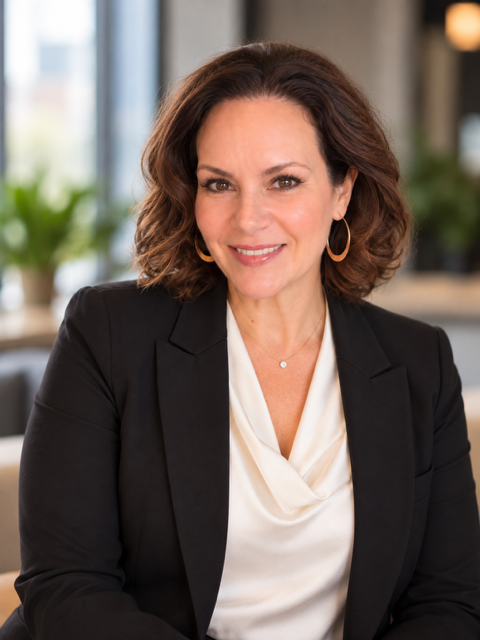
Olson’s approach took shape over two careers that ran side by side. She spent 24 years as a U.S. Army Judge Advocate, retiring as a Colonel. She served as the first female General Counsel for the Minnesota National Guard and Department of Military Affairs and the first female Staff Judge Advocate for Minnesota’s 34th Infantry Division. She deployed in support of Operation Iraqi Freedom and later earned a master’s degree in Strategic Studies at the U.S. Army War College.
“The military taught me a tremendous amount about leadership, particularly how to make decisions with incomplete information,” she says. It also taught her that leaders depend on trust when stakes are high, and that leadership does not mean having every answer. It means drawing on the expertise of others, setting clear expectations, and exercising judgment with the information available.
The military taught me a tremendous amount about leadership, particularly how to make decisions with incomplete information.
Leadership is also iterative. So much of the environment is in constant flux that a leader has to keep checking and rechecking facts, validate assumptions rather than act on them, and be willing to rework an operating picture when new information shows up. Olson says that means being open to challenging your own assumptions and changing your mind when facts or circumstances change.
Olson is also trained in Human Systems Dynamics, an approach to solving tough problems in complex and constantly changing conditions. HSD, as practiced by the Human Systems Dynamics Global Association, uses inquiry, applied complexity science and pattern recognition to help people act when they cannot predict or control what is coming next. That training sits directly behind the way she works: identify the patterns in a situation, keep asking what is emerging, and adjust as conditions change.
That idea shows up in HSD’s core language, which she now uses constantly: the “next right thing to do” is not about finding a single correct answer. It is about taking informed, adaptive action that moves you and your system toward your desired outcome, while staying open to emergence.
After practicing law in the public and private sectors, she served as City Attorney for Saint Paul from January 2018 to January 2026, leading an office of more than 100 legal professionals through the pandemic, the unrest that followed George Floyd’s murder, and a public conversation about what safety should look like.
She used the role to widen what a city law office could do. Rather than only reacting to legal problems after they arose, Olson and her colleagues worked to make the office a partner in solving them. That work included helping create Saint Paul’s Office of Neighborhood Safety and Project PEACE, building restorative justice and diversion programs, and collaborating across government and community organizations.
Clarity, Integrity, and Curiosity
Ask Olson what guides her decisions and she names three principles.
Clarity means helping people understand the objective, the principles that should shape their choices, and where they have authority to act. Ambiguity at the top, she observes, multiplies as it moves through an organization.
Integrity includes making sound decisions when they are inconvenient or politically difficult, and being honest about what is known, what is uncertain, and who is accountable.
Curiosity means examining your own assumptions. “I try to enter difficult situations asking, ‘What am I missing?’ rather than simply looking for evidence that confirms what I already believe,” she says.
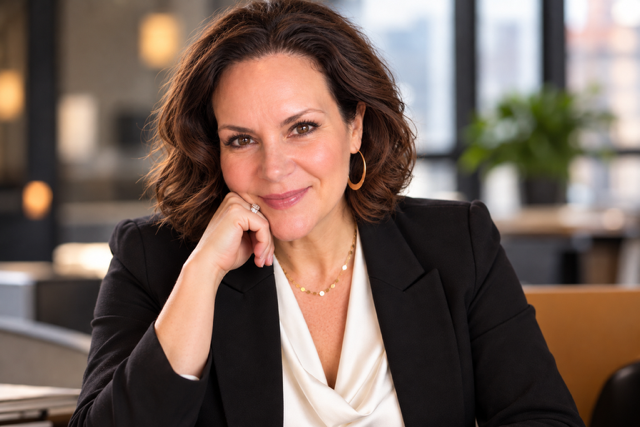
In the City Attorney’s Office, those principles sat alongside four organizational values: Respect, Integrity, Service, and Equity. They were meant to guide decisions, not just describe aspirations. Leaders still have to decide and accept responsibility, Olson says, but first they need to hear from people who see the issue differently.
Her bottom line for the people she works with is simple. “Ultimately, I want people who work with me to know two things: I will tell them the truth, and I will stay with the problem when it gets hard.”
From Strategy to Implementation
Olson co-founded Grey Matter Strategic Partners with Brooke Blakey and John Harrington after noticing a pattern. Organizations often have capable people and good ideas but cannot move, because a problem crosses departments or because the people affected see it differently.
Grey Matter works with leaders on high-stakes decisions, governance, crisis, organizational change, public safety, and program development, bringing together experience in law, public safety, strategy, and facilitation. The name reflects that most consequential decisions do not fit neatly within one discipline.
Olson also sees growing demand for flexible, experienced support. Nonprofits, governments, associations, and small and mid-sized businesses often need senior-level help without needing, or being able to afford, another full-time executive. Fractional leadership and embedded strategic partnerships fill that gap.
The point, she says, is not to hand over a report. “We do not want to simply hand clients recommendations. We want to help them build the capability to execute them.”

Where Judgment Fits
Artificial intelligence is changing how organizations research, analyze information, and develop options. Olson sees that as changing the contribution of experienced advisors, not eliminating it. “The premium is increasingly on judgment, context, implementation, and trust,” she says.
The premium is increasingly on judgment, context, implementation, and trust.
A tool can produce twenty strategies before lunch. Deciding which one fits an organization’s culture, anticipating how stakeholders will respond, building agreement among competing interests, and supporting implementation still take experience. Grey Matter uses technology where it improves the work, and treats it as something that augments human judgment rather than replacing it.
The Playbook
Five Lessons from the Work
- Build trust before you need it. The relationships that hold under pressure are the ones formed before the pressure arrived. Trust does not require agreement. It requires respect, follow-through, and integrity. Then keep exercising it: the trust, training, and capacity behind good outcomes fade when the principles behind them are dropped.
- Ask what you are missing. Walk into hard situations looking for what you have overlooked, not for confirmation. Ask how it looks from where the other person sits, and say “I don’t know yet” when that is true.
- Let expertise open doors. Be exceptionally good at something, then use that credibility to work beyond the edges of your title.
- Take the assignment nobody knows how to solve. Difficult work develops judgment, and judgment is the one leadership skill you cannot get from a textbook.
- Decide what your leadership is for. Titles are temporary. What remains is whether you made the organization stronger, solved something that mattered, and helped people grow.
What Remains After the Title
“Eventually, someone else gets every title,” Olson says. She has held several she is proud of, including Colonel, General Counsel, and City Attorney.

What remains, she says, is whether the organization became stronger, whether a problem that mattered was solved, whether people grew because someone invested in them, and whether authority was used responsibly.
“I have reached a point in my career where I am much less interested in collecting titles and much more interested in meaningful work with good people,” she says. That is one reason she helped create Grey Matter.
The lesson from Saint Paul, in her view, applies well beyond a single city. Results like these are not a one-time achievement. They depend on keeping the principles that produced them at the center of the work. Her advice to emerging leaders is simple and long-range: build expertise, stay curious, take some risks, and find excellent people. And when there is a chance to make something better, use it.

