

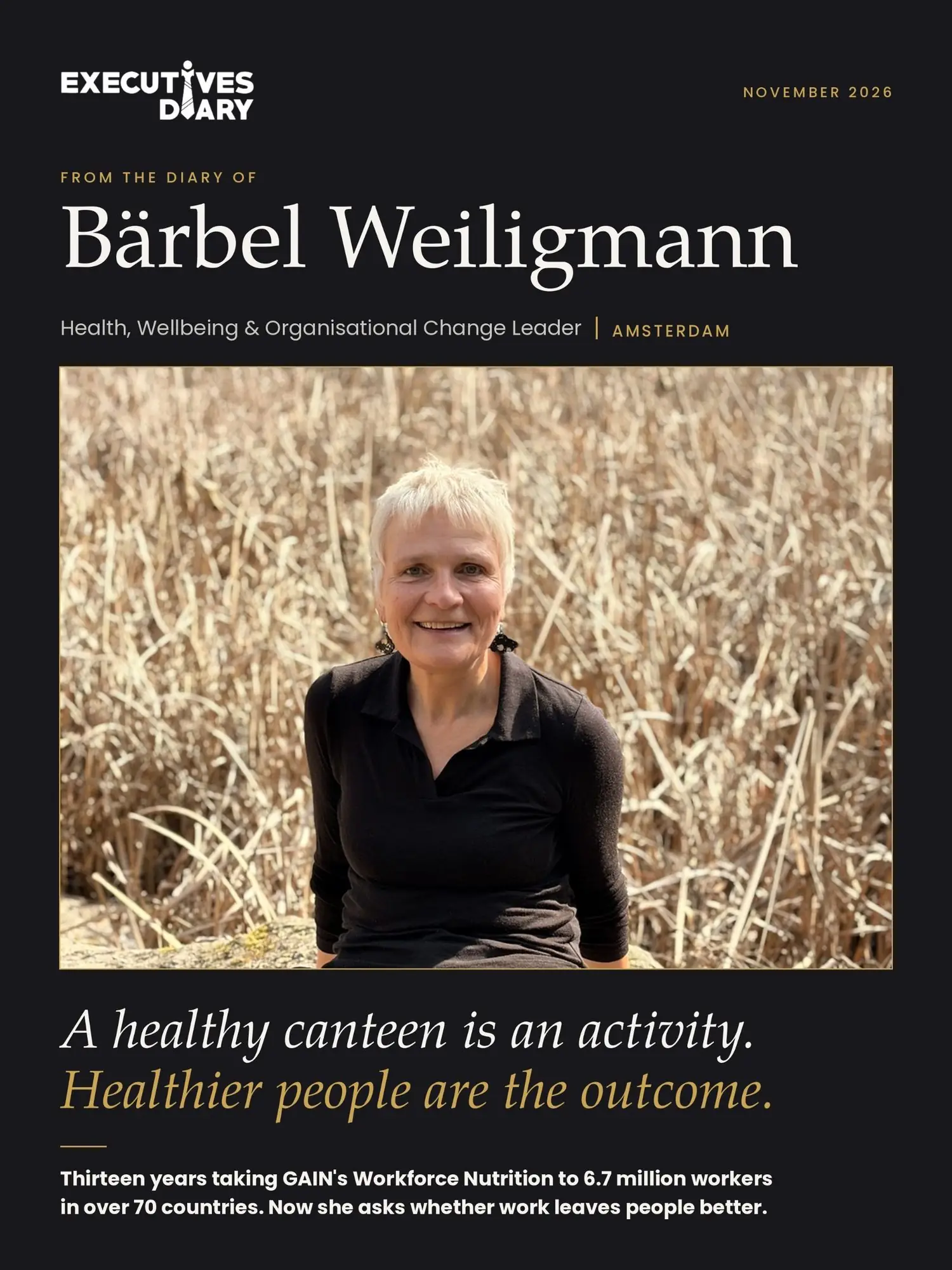
From the Diary of
Bärbel Weiligmann
A leader who took workplace nutrition to 6.7 million people on what it takes to turn a belief about people into strategy, indicators and accountability.
“A successful organisation should not only ask, ‘What did our people achieve?’ It should also ask, ‘What did working here do to our people?'”
Ask an organization what it produces through its people and the answer arrives quickly: revenue, growth, productivity, innovation, customer satisfaction, engagement, retention. Ask what it produces in its people, whether they leave work with more energy or less, whether they belong, whether they’re growing, and the answer comes slowly, if it comes at all.
The gap between what leaders assume and what their people report is on the record. In Deloitte’s 2023 Well-Being at Work survey, more than three in four executives believed their workforce’s wellbeing had improved over the year, while about one in three employees said their own health had. Gallup’s State of the Global Workplace 2026 report finds that 34 percent of employees worldwide are thriving in their lives.
Bärbel Weiligmann has spent more than 25 years turning ambitious ideas about people’s health into programs that can be measured. At the Global Alliance for Improved Nutrition (GAIN) she developed Workforce Nutrition from an emerging idea in 2013 into a global program reaching 6.7 million workers and farmers in more than 70 countries, built on one narrow, testable question: are people better nourished because they work here? Since leaving GAIN in May she’s been asking the wider version, and she wants to help a CEO or Chief People Officer answer it: wellbeing integrated into leadership, people strategy and performance, and measured like anything else the organization cares about. “These are often treated as ‘soft’ questions,” she says. “I think they are becoming hard organisational questions.”
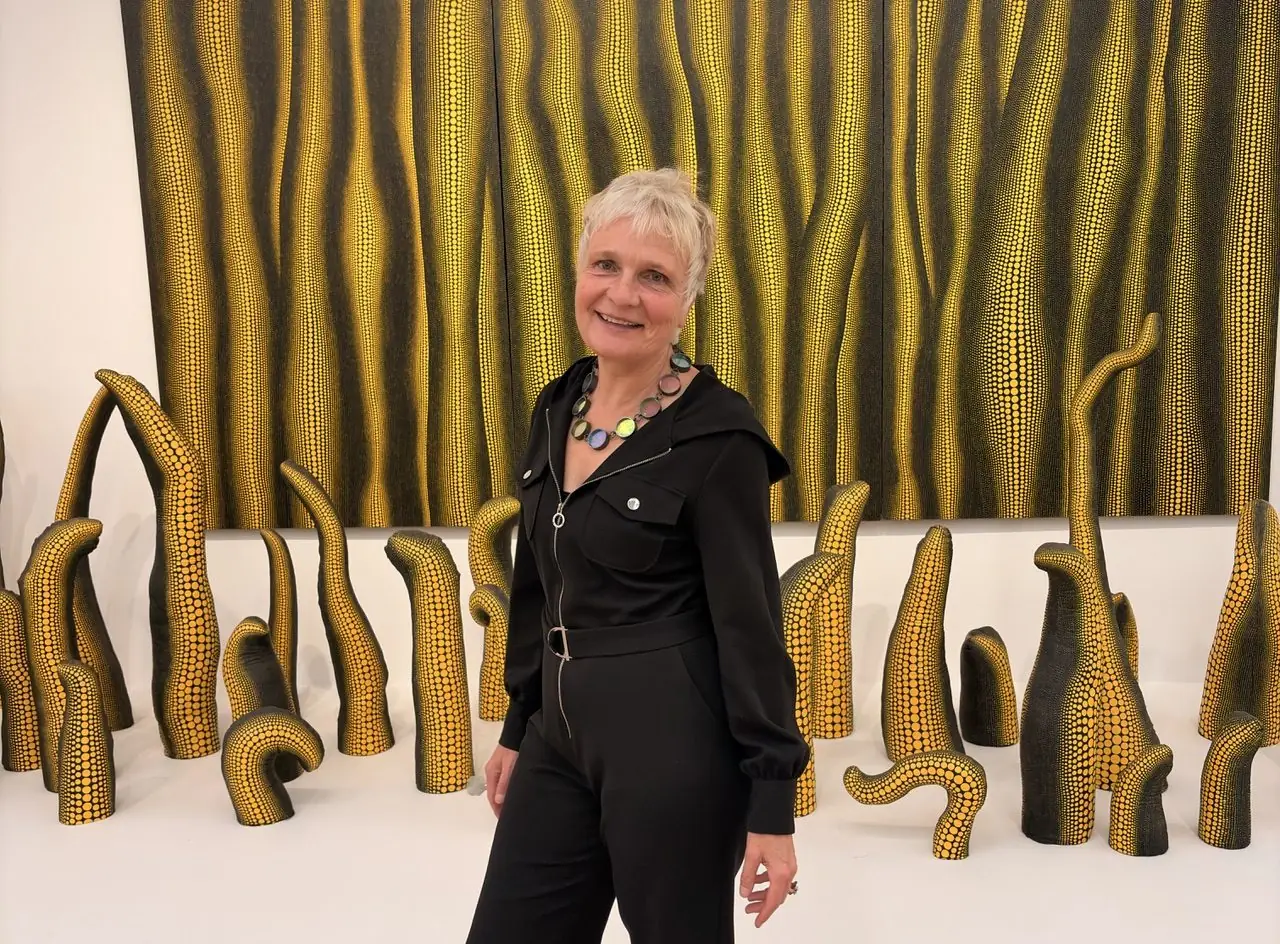
Sumatra, 2012
The question that would occupy the next thirteen years arrived on a field trip. In 2012 Bärbel was at the Rabobank Foundation and travelled with a researcher from Wageningen University to cocoa-growing communities in Sumatra, Indonesia.
“For the first time, I could really see and feel the burden of malnutrition,” she says. “People were eating enough calories, but not getting enough nutrients to be healthy. What shocked me most was seeing signs of malnutrition among farmers producing certified cocoa for international markets.”
She came home wanting to know whether this was an isolated problem or something systemic. With Wageningen University she looked at other agricultural supply chains, and the findings were, in her word, disturbing: in major sourcing locations for cocoa, tea and coffee, more than 25 percent of children were malnourished. “It left me with a question I could not ignore: How can the people who produce food for the world themselves lack access to healthy nutrition?”
That question took her to GAIN, where in 2013 she was asked to develop the Workforce Nutrition program.
Four Things an Employer Can Do
Workforce Nutrition began, in Bärbel’s words, “with a deceptively simple ambition: Could the workplace become a place where people become healthier because they work there?” We spend a large part of our adult lives at work and often eat at least one main meal there. Yet in 2013, she says, many companies had little awareness of how strongly nutrition could influence employee health and performance. “There was no widely established concept, roadmap or practical set of evidence-based tools.”
So the team started by building the evidence and the business case, with a return on investment of 1:3. Then they translated the evidence into four practical areas where employers could act: access to healthy food at work, nutrition education, nutrition-focused health checks and breastfeeding support. “But implementation required much more than designing interventions. We needed practical guidance, indicators, senior management commitment, partnerships and an approach that could work across very different companies, cultures and countries.”
The partnership with The Consumer Goods Forum, she says, became crucial, because it connected the program with major global food manufacturers and retailers and helped it move from concept to scale. In 2019 the two organizations launched the Workforce Nutrition Alliance. Over time the program reached 6.7 million workers and farmers in more than 70 countries, built partnerships with more than 100 companies and mobilized USD 9 million for workplace nutrition, employee wellbeing and organizational health programs. She led an international team of 26 colleagues across eight countries on the principle that outcomes and the experience of the people delivering them matter equally.
A programme is not successful because activities have been implemented. It is successful because something changes for people.
In Workforce Nutrition, she says, the question became: “Are people actually better nourished because they work here?” Today she is asking the broader one: “Are people actually doing better because they work here?”
Activity Is Not Outcome
Bärbel’s argument runs like this. If wellbeing becomes an organizational outcome rather than an employee benefit, four things change. First, accountability. “The question stops being: ‘What wellbeing initiatives did we provide?’ and becomes: ‘Are our people actually doing well?'” Second, responsibility. “Wellbeing can no longer sit exclusively with HR or with the individual employee. Leadership, workload, autonomy, psychological safety, recognition, relationships, job design, opportunities to learn and organisational purpose all shape the outcome. The organisation itself becomes accountable for the conditions it creates.” Third, attention. “Once wellbeing sits alongside other organisational KPIs, it enters management conversations. Leaders ask why results are changing. Resources follow.” Fourth, impact. “Interventions can be evaluated. Progress can be tracked.”
It matters for talent too. People increasingly want to know not only “What will I earn here?” but “What kind of life will I have if I work here?” Organizations that can answer that credibly, she says, will be better placed to attract and retain people.
The evidence she brings is the lesson of Workforce Nutrition itself. “Providing nutrition education is an activity. Opening a healthy canteen is an intervention. What ultimately matters is whether people’s nutrition and health improve.” A later GAIN review of workplace wellbeing frameworks highlighted the same measurement gap: programs and frameworks existed, but strong indicators capable of tracking meaningful outcomes were much less common. “The outcome questions are different: Do they still have energy at the end of the working day? Are people flourishing? Do they experience belonging and life satisfaction?”
That is why she became interested in the work of Lisa Bevill at the IE Center for Health & Well-being, whose approach measures positive outcomes such as life satisfaction and flourishing rather than only the absence of mental ill-health. “We should certainly measure burnout, stress and sickness. But the absence of illness is not the same as flourishing. The more ambitious question is: What does good look like? And then measure it.”
We should certainly measure burnout, stress and sickness. But the absence of illness is not the same as flourishing.
She draws one line carefully. “I don’t want wellbeing to become valuable only because it improves productivity. Of course wellbeing and performance are connected. But human flourishing has value in itself.”
A company can deliver an excellent quarter while exhausting the people who produced those results. I would hesitate to call that a high-performing organisation.
Sustainable performance, as she defines it, means achieving results while preserving or strengthening the human capacity needed to continue achieving them. “That is why I see wellbeing as both a driver of performance and an outcome of good organisational performance.”
Sixteen Months for a Meeting
One of the hardest periods in developing Workforce Nutrition, she says, was trying to bring the issue onto the international labor agenda. At one point the team waited more than sixteen months for a meeting with senior leadership at the International Labour Organization. “Priorities were different, progress was slow, and there were moments when the collaboration felt almost impossible.”
“The temptation in those situations is either to push harder or to walk away. I learned a third option: Stay with the purpose. Keep engaging. Understand the other party’s reality. And keep looking for where your interests genuinely meet.” It taught her endurance, she says, but not endurance as simply working harder: patience, relationship-building, and trust that meaningful innovation often takes much longer than you want it to. It paid off, not on the team’s timetable but through a trusted relationship with an ILO colleague and a new opportunity to embed workforce nutrition more deeply in the international labor agenda.
Persistence matters. But relationships make persistence productive.
Asked about the person who shaped her, she names a lesson instead, one that several people in her career taught her: how we work together matters as much as what we achieve. “We can deliver an excellent result and leave people frustrated and depleted. Or we can deliver that same result while creating trust, confidence, learning and connection. Then we leave something behind.” In her own words: “Results matter. But the experience we create while achieving them lasts.”
Results matter. But the experience we create while achieving them lasts.
Leaving Well
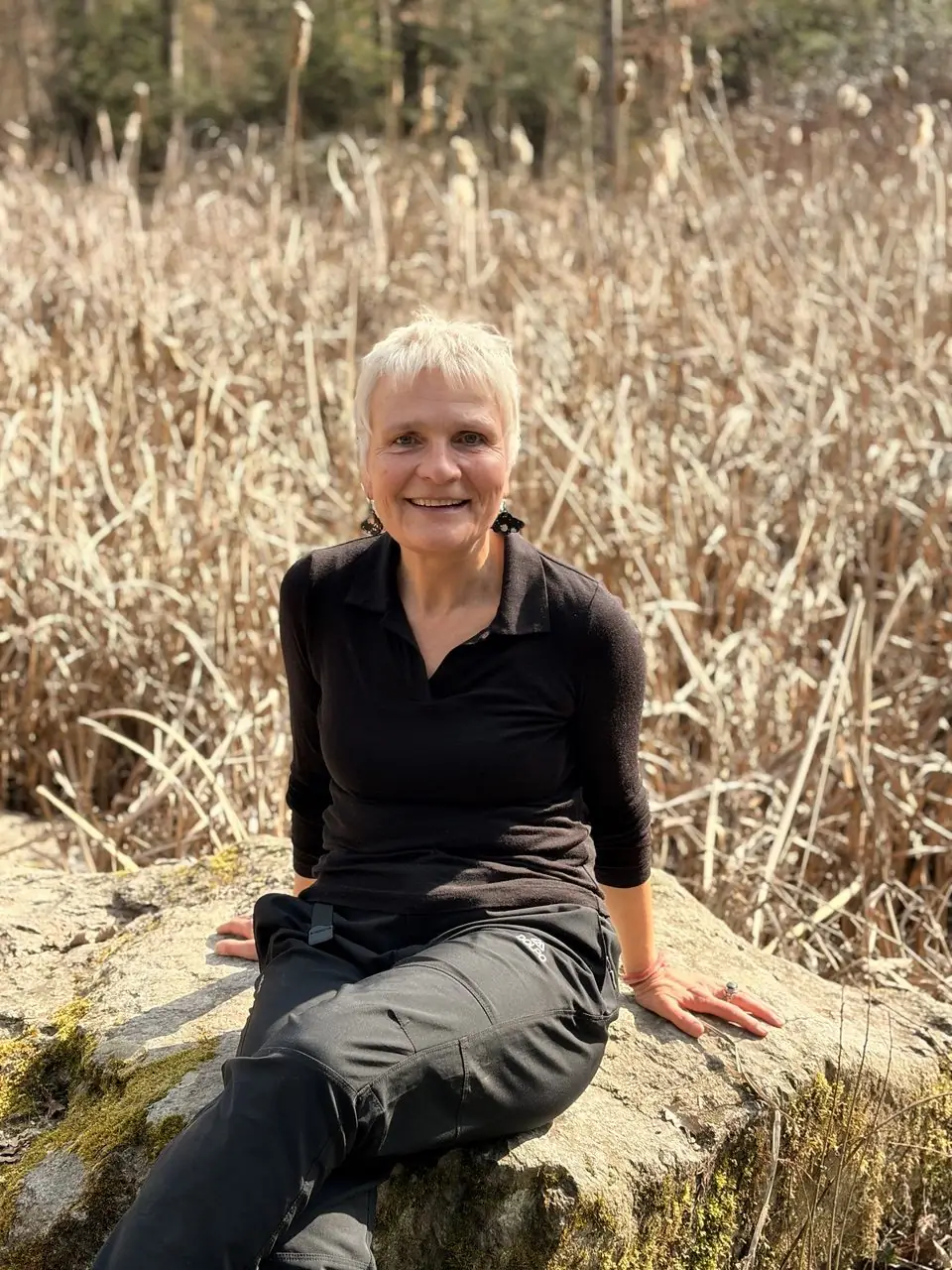
Bärbel’s own departure from GAIN tested the idea. “In November, my role was affected by GAIN’s re-organisation, and in May my journey came to an end,” she wrote in her farewell post. “It has been a tremendous journey, the best job I have ever had, so far.”
Rather than one farewell speech, she created six moments of closure, and has been writing about them since in a series she calls The Art of Leaving Well. She invited her direct team to dinner at her home and built the evening around one question, what did we learn from each team member, recording and transcribing the answers so each person could keep them. At her farewell she learned that colleagues had invented a verb, “to Bärbelize”: finding a way forward when the path was unclear, showing up, pushing on and still making space for others’ insights. “It made me laugh and moved me deeply,” she wrote.
Between March and June she trained as a Chief Happiness Officer with the Happiness Bureau in the Netherlands. The training, she says, gave her language and frameworks for questions that were already occupying her: what creates the conditions in which people thrive, what role leadership plays, and how we know whether an organization is actually good for the people inside it. “I don’t see it as leaving nutrition behind. I see it as zooming out. Workforce Nutrition taught me to look for outcomes. Wellbeing made me ask what the ultimate human outcome should be.”
A Family of the Heart
One of the deepest sorrows in Bärbel’s life was not being able to have biological children. Letting go of that dream was painful. But she made herself a promise: she would not allow the sadness to turn into bitterness or close her heart. Instead, she began looking for other ways to give children a place in her life. Today, thirteen children hold a special place in her heart, each in their own way.
Five years ago, Françoise, who had lost her mother when she was just twelve, came into Bärbel’s life and chose her as her mother.
“To be chosen as someone’s mother is an extraordinary gift,” Bärbel says. “I couldn’t have children of my own, but I discovered that there are many ways to give and receive a mother’s love. Life didn’t give me the family I once imagined, but it gave me something I could never have planned. I learned that love is not only something we receive. It is something that we are and that creates new possibilities.”
Where Bärbel Is Now
Bärbel’s next chapter builds on her experience turning ambitious ideas into large-scale programs and measurable change. Over the next twelve months, she wants to become a recognized voice in what she sees as the next generation of workplace wellbeing: “moving from wellbeing as a collection of employee benefits towards wellbeing as an organisational outcome.”
Her focus is helping organizations embed health, wellbeing and human flourishing into leadership and organizational performance. She wants to help an organization put it into practice, “integrating wellbeing into leadership, people strategy and organisational performance rather than leaving it at the edge of HR,” and she will bring this vision to life through a senior leadership role, strategic transformation programs, advisory collaborations and speaking engagements.
The reader she most wants to reach is specific: a CEO, Chief People Officer or senior People & Culture leader “who already believes people matter, but is asking: How do we translate that belief into strategy, measurement and accountability?”
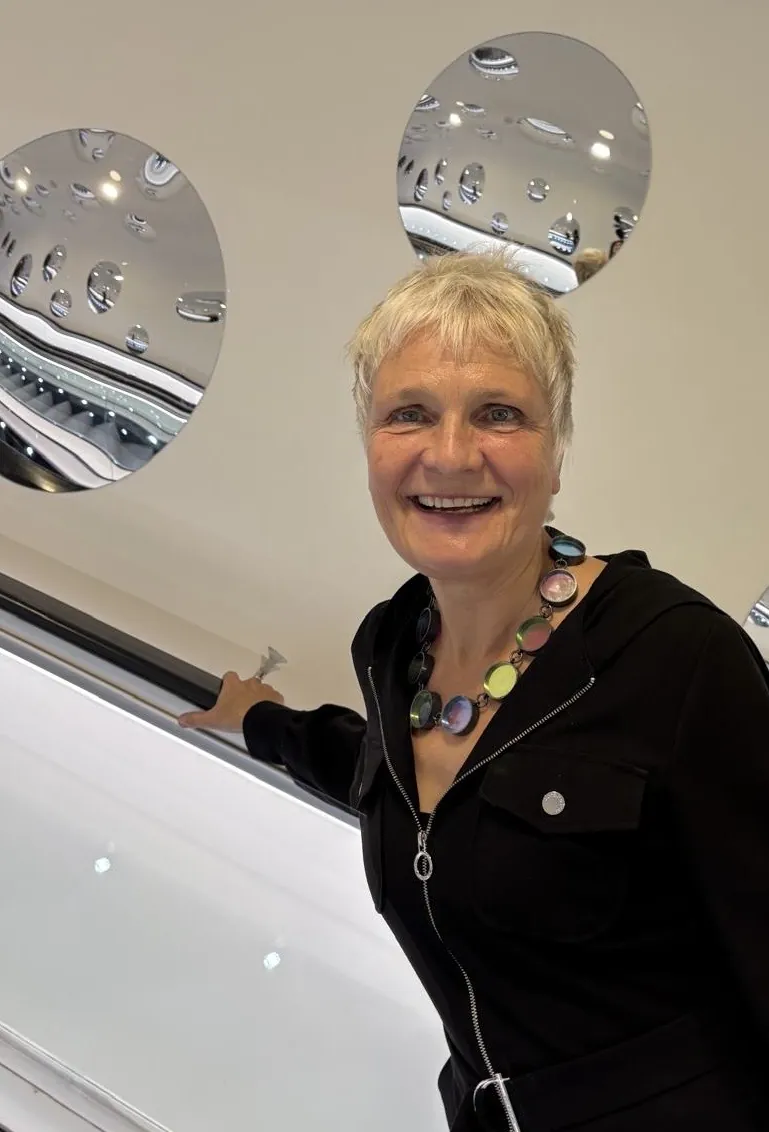
In September she was at the Happiness Camp in Porto, where a masterclass with Lisa Bevill sharpened the question she now puts to every organization. The line she lives by is the one she wants organizations to adopt. “A successful organisation should not only ask, ‘What did our people achieve?’ It should also ask, ‘What did working here do to our people?’ We spend a significant part of our lives at work. Work should leave us with enough energy and capacity to thrive in the rest of our lives too.”
The Playbook
Five Reflections from Bärbel
- Activity is not outcome. Opening a healthy canteen is an intervention. What matters is whether people’s health improves.
- What does good look like? Measure burnout, stress and sickness, and then measure flourishing and life satisfaction, because the absence of illness is not the same thing.
- Who is accountable for the conditions? Workload, job design, autonomy and leadership shape wellbeing, so it cannot sit with HR or the individual alone.
- Can people sustain the pace? Sustainable performance means achieving results while preserving the energy and capacity needed to keep performing over time.
- Is there a third option? Between pushing harder and walking away: stay with the purpose, understand the other party’s reality, and look for where interests meet.

