

From the Diary of
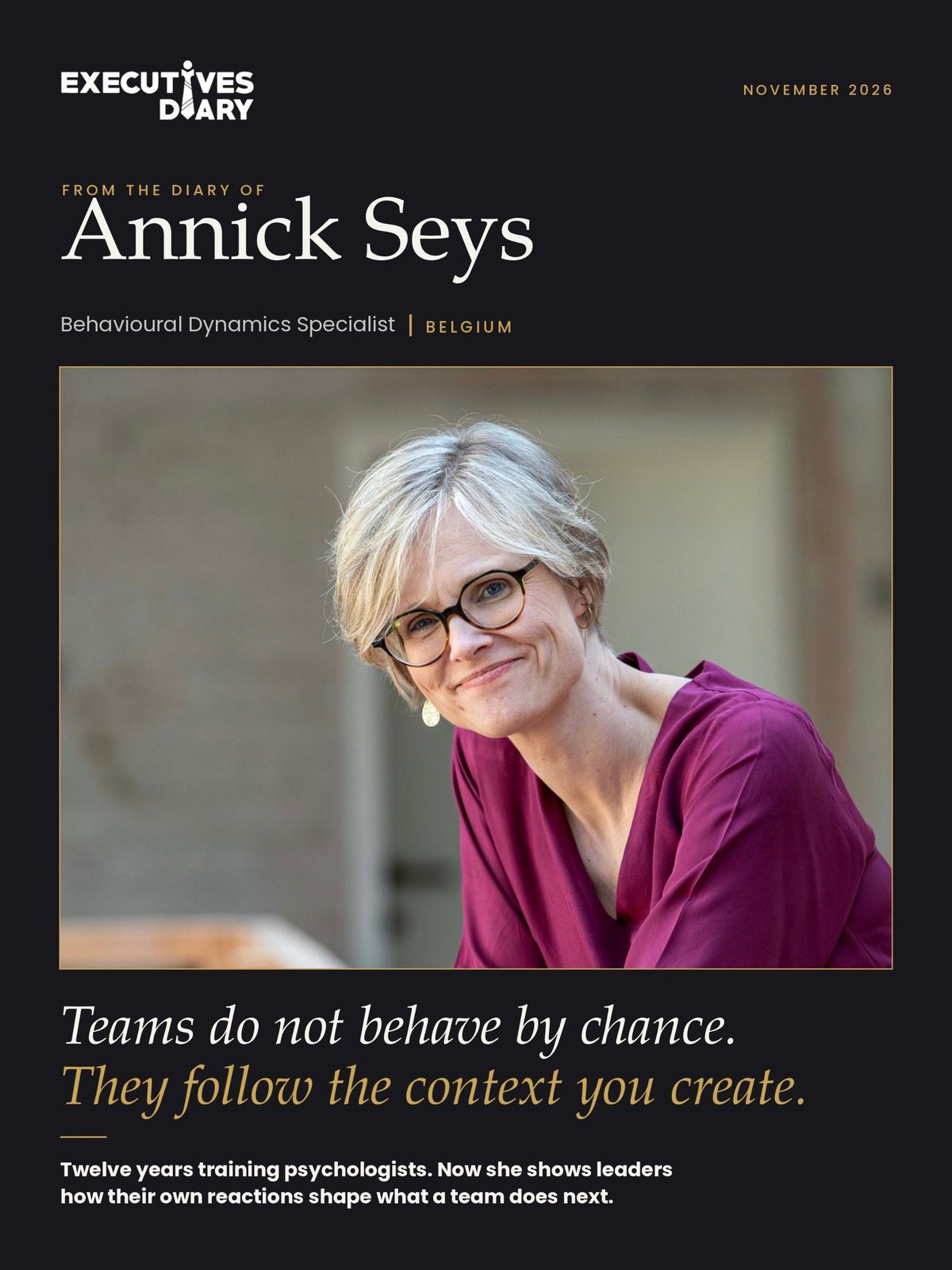
Annick Seys
How a leader’s own choices shape the way a team behaves, and what one behavioural dynamics specialist does first when a team is stuck.
“It’s easy to see how someone’s behaviour affects you. It’s harder to see what that person needs from you to become who they could be.”
A CEO had just come through a very hard period. A shareholder had deceived him, and the fallout was hitting the company from every side. So when he hired a new C-level executive with an excellent CV, a man he clicked with immediately, he felt enormous relief. He didn’t check with the man’s previous employers.
Annick Seys, who coached that CEO, calls the new executive Vincent. Vincent’s results were great. He took a lot off the CEO’s plate and slowly became his confidant. Meanwhile, people were off sick because of his passive-aggressive tone, and in the team’s WhatsApp group he regularly lashed out at someone. The CEO saw the messages and told Vincent to tone it down, “but made nothing of it,” Annick says. “He saw how many people started not to put things into the WhatsApp anymore, but ignored that.” Within two years, several people had left and one person had gone on burnout leave. In the end the CEO had to let Vincent go.
That CEO’s is not a rare kind of story. When the McKinsey Health Institute surveyed nearly 15,000 employees across 15 countries in 2022, it found that toxic workplace behaviour was the biggest predictor of burnout symptoms and of intent to leave. A 2015 Harvard Business School working paper found that avoiding a toxic worker did more for performance than replacing an average worker with a top performer.
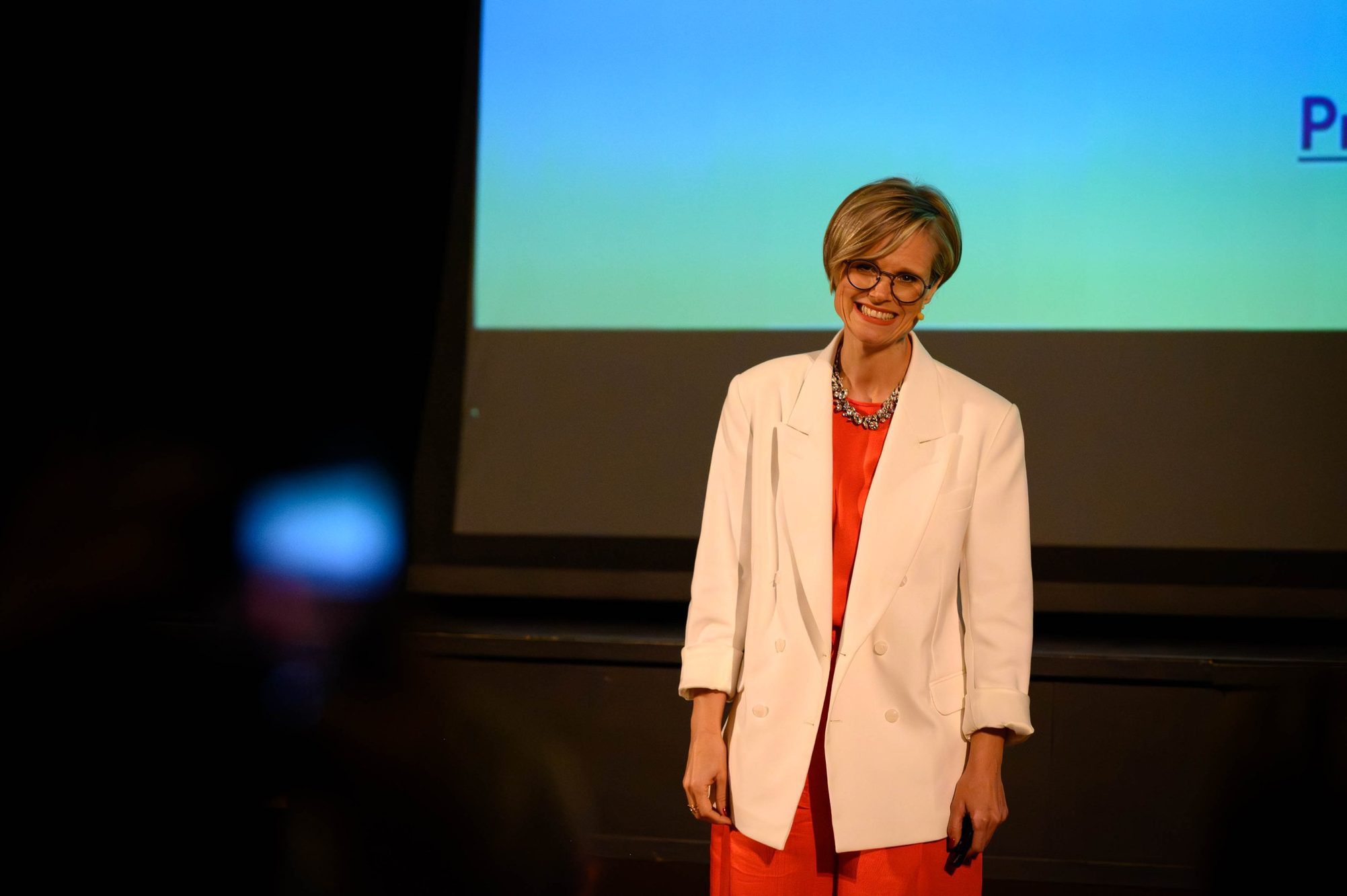
This is the work Annick does. Based in Belgium, she’s a behavioural dynamics specialist, keynote speaker, author and executive coach, and the developer of Behavioural Team Dynamics, a framework that helps leaders understand how behavioural dynamics emerge, which patterns become predictable within teams, and how they themselves influence those patterns. “I help leaders and their teams see how their own behaviour creates the context in which people grow, withdraw or cross boundaries they shouldn’t,” she says, “through keynotes, executive coaching and leadership programmes.” The CEO’s story is her answer to a plain question: why do leaders let harmful behaviour in a team go unaddressed?
What the CEO Missed
“What the CEO missed was the pattern,” Annick says. Vincent, in her account, “sent double signals: positive about the company and about him as CEO, negative about the people, the way the CEO managed them, and the structure that supposedly kept him from delivering.” The CEO got confused about where the problem actually lay.
What the CEO missed was the pattern.
During the coaching, he stopped ignoring the stories and confronted Vincent. Vincent went in all directions: one moment he said he needed therapy, the next he blamed everyone around him. Afterwards the CEO held on to the mention of therapy and offered Vincent coaching through the company. “That’s positive, isn’t it, Annick? He wants to work on it,” he said to her. “But Vincent never showed guilt, regret, or any sign that he wanted to do things differently,” she says.
Team coaching was brought in and went nowhere, “because nobody dared to say how unsafe they felt around Vincent.” Her reading of that step is direct: “In truth, it had been set up so the CEO wouldn’t have to deal with the situation himself: maybe the team would speak up, and the coach would fix it.”
As she puts it on her profile, behavioural dynamics “do not emerge by chance. They develop within the context leaders create.” One of her own examples of that context comes from a kitchen.
A Pot of Water
Annick has written about being nine, when her mother put a pot of water on the stove and asked her to say when it started boiling. Unsure how she would recognise it, she called her mother in at the first bubbles and was told, irritably, that it wasn’t boiling. Later, when the water really boiled, she hesitated. Her mother walked in and said: “I can’t trust you with anything.”
The story came back to her, she wrote, when a manager told her how frustrated he was that his team “just doesn’t do what I ask.” At the same time, he was micromanaging everything. She could already see his team: hesitating, double-checking, looking for reassurance, and eventually doing less. “Not because they don’t care,” she wrote. “But because they want to avoid getting it wrong again.”
She sets the circle out in the post: vague expectations, irritation when it’s not right, more control, more doubt, less ownership. Then she turns the manager’s question around. “The question is not: ‘Why don’t they take ownership?’ The question is: ‘How clear and safe is it to get it wrong?’”
What Annick Does First
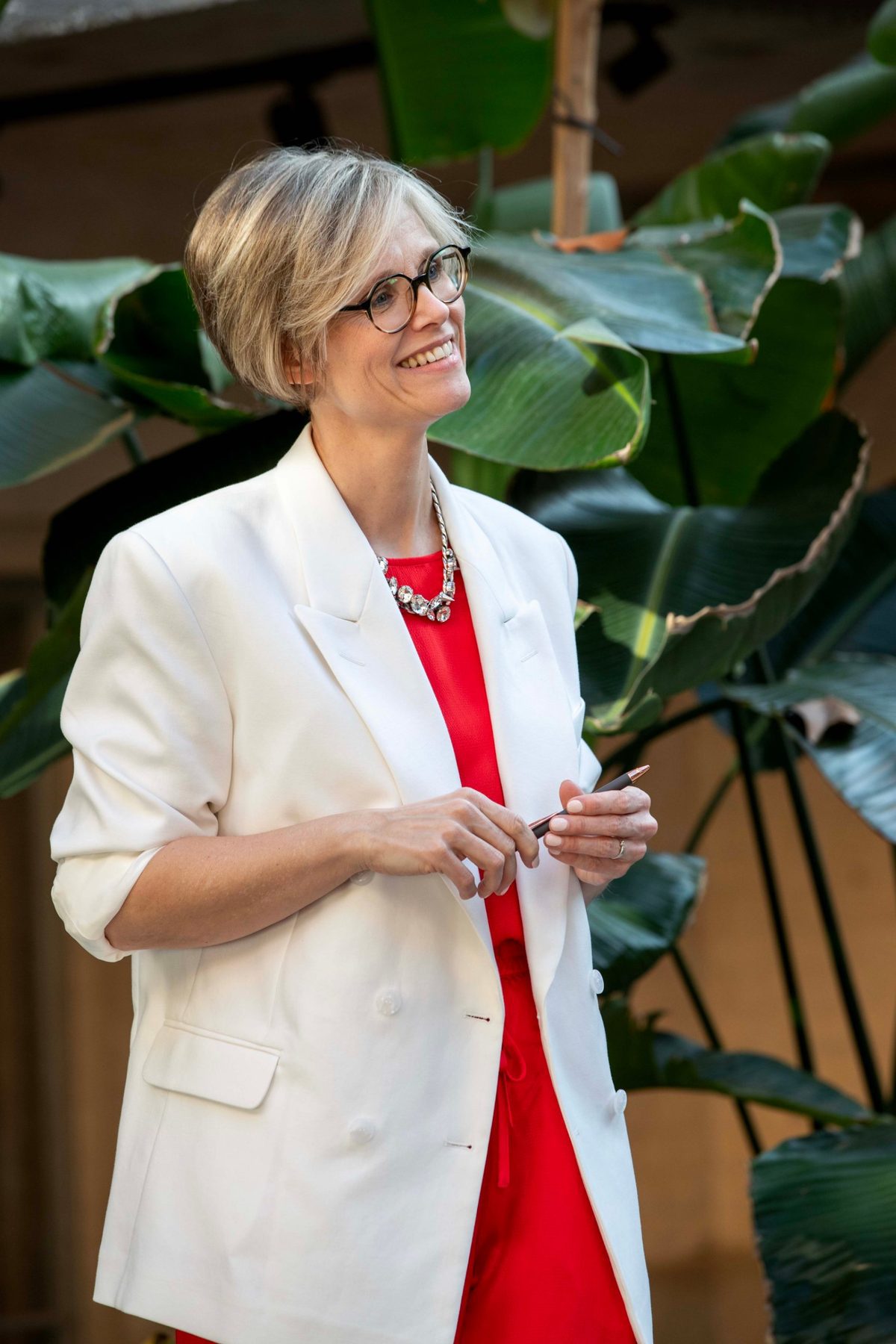
“The first thing I do is listen to what’s happening between the lines: the interactions between people,” she says. “That’s where the gold is for me. What is happening now, and what does that tell me about what is likely to keep happening?”
If the situation isn’t that serious, or she feels she has enough information, she dives right in with the whole team. In a complex, multi-layered case, she takes the time to talk to each person individually first, to understand how people are behaving towards one another. Those conversations are more than fact-finding, something she learned from her training at the University of Washington in Functional Analytic Psychotherapy, which she describes as “essentially the study of interpersonal behaviour.”
The way people act with me tells me a lot about how they act with others. So those individual conversations are information in themselves.
Then she brings the team together, and they work with sticky notes. People write down how they feel in the team, how they behave because of it, and what the impact of that behaviour is. “I use sticky notes because I don’t want them to dive into the stories they want to tell,” she says. “I want to let them talk about the essential issues. I build this up very slowly, until we can touch the core.”
Throughout the day, how people behave towards each other in the room matters just as much to her as what they write down.
The Function of Behaviour
Asked what a decade of training psychologists taught her that other coaches might not know, Annick names one ability.
What I miss most in coaches, and sometimes in psychologists too, is the ability to read the function of behaviour: not just what someone does, but what that behaviour does for them.
“Many coaching approaches start from a philosophy,” she says. “When you look at behaviour, you start from science. For me, that’s a big difference. I find those philosophies interesting, but I love precision.”
She says the same of models that sort people into colours or personality types. “There’s a lot of richness in them, but when I come into companies where they’ve already been used, I see that they rarely change or solve anything at the core.”
Twelve Years Training Psychologists
“I’m actually a bit of an exception to the rule: I’m not a psychologist,” Annick says. Long before she worked with companies, she has written, she taught vocational students, worked as a student counsellor and helped set the direction for a school’s educational policy. Then she started her own training centre.
I’m actually a bit of an exception to the rule: I’m not a psychologist.
For twelve years she ran Allegre, a training practice for psychologists, alongside four psychotherapy practices. She has supervised and trained thousands of professionals, lectured as a guest at universities and co-authored three books for psychologists. Leadership teams were already coming to her in those years, because psychologists working inside companies trained there too and would contact her when they had a situation they struggled with.
What she did do, for fifteen years, was keep studying internationally, following the latest insights into lasting behaviour change. That led her to certification as a trainer in Functional Analytic Psychotherapy at the University of Washington, and to setting up a four-year postgraduate programme on the subject together with an Irish research group that was then affiliated with Ghent University.
The person she names as having shaped how she works is Dr Robert (Bob) Kohlenberg, co-founder of Functional Analytic Psychotherapy at the University of Washington. She took his very last training in behaviour change, when he was well past eighty. “Because it was his last, he didn’t hold too tightly to the programme, and there was so much room for deep discussion,” she says. “I’ll never forget it. It was a true gift. He lived what he taught.”
When the Leader Keeps Getting Checkmated
Over the years, Annick has worked with a number of business leaders on the hiring of a new CEO or another C-level executive, or the arrival of a new investor on their board. When those people turned out to behave in toxic ways, she says, it was often a real challenge, “because they tended to be high-functioning and very intelligent.” When behaviour is genuinely toxic, she adds, the person has often long been able to predict the leader’s reactions, from months of interaction.
By the time you want to address it, you feel powerless, because you keep getting checkmated.
“My goal is never to mediate. I support the person who comes to me,” she says. She takes the time to observe from a distance until she can make predictions that are actually reliable. Then the question becomes what is best for the company: should this person leave as quietly as possible, or is it better that they stay a while longer? She teaches the leader how to handle it, “sometimes down to the exact sentences they can use.”
The feedback she says she gets most in these situations: “It felt as if you were sitting right there with me. I was so well prepared for what was coming, and I knew what to do with it. I can sleep through the night again.”
She names things herself, too. In one team coaching, a member made it clear from the very first session that she didn’t want to be there, and nothing Annick tried worked. When the woman had to leave early and spoke to her “quite arrogantly,” Annick named it: she could see the woman didn’t want to be there, but that didn’t mean she could talk to her like that. “Afterwards, the team was relieved,” she says. “They had seen me do what none of them had ever dared to do with her.” At the next session the woman actively took part.
The Indestructible Self
A habit of hers, in her words: “I consciously treat setbacks as an opportunity: to deepen the relationship I have with myself, to learn to handle what hurts, to understand myself better in relation to others, to take better care of myself, and to understand even more deeply what my mission is.” It is, she says, how she has faced every major setback in her life.
Annick describes her childhood as severely traumatised, and says she took a massive amount of time to work on her psyche and her ability to deal with difficult situations. A year ago, in the year she was Highly Commended at the London Speaker Awards, her doctor told her she has three chronic illnesses and that, as a coach and a speaker, she couldn’t sit or stand for a long time. She was 49. “For a minute I thought my life was over,” she says.
She’d had the conditions, and health issues, her whole life, she says, “only no one would believe me because of my background, it must’ve been psychological.” Having worked on herself for so long, she had the skills to go into what she calls “a laser focus.” Everything she did for a whole year was about healing her body, finding the team that could do that with her, and learning what she needed to understand the diseases. “And I decided right there and then: nope, not me. I’m not these diseases, I want to live and choose life.” A year later she is, in her words, “(nearly entirely) back on my feet.”
The book she wants to write is called The Indestructible Self.
Where Annick Is Now
Annick works through keynotes, executive coaching, workshops and masterclasses, in Dutch and English, in Belgium and internationally. What she wants from the next twelve months is specific: more clients for her keynotes and executive coaching, and more organisations bringing her in to teach Behavioural Team Dynamics. The readers she has in mind are corporate leaders.
“Next is a book,” she says, “and a dream I’m already working on: a theatre show about my own life story, and how self-worth grows alongside a strong connection with the people around you.”
Outside work she loves to draw, read a great story and walk with her dog in nature when she can. She draws hand-lettered cards for people as a token of appreciation. “I want people to feel seen because I believe that relationships are the glue that heals society,” she says. A quote she says is very dear to her heart: “Life is a gift, not a right.”
The sentence she wants people to remember her by is this one: “It’s easy to see how someone’s behaviour affects you. It’s harder to see what that person needs from you to become who they could be.”
The Playbook
Five Reflections from Annick
- What does this person need from me? Empathy, trust, connection, direction or a boundary: get it wrong, she has written, and you lose energy and impact, get it right and people grow.
- How clear and safe is it to get it wrong? Her replacement for the question “Why don’t they take ownership?”
- What is happening now, and what does that tell me about what is likely to keep happening? The first thing she listens for, between the lines.
- Not just what someone does, but what that behaviour does for them. The ability she misses most in coaches, and sometimes in psychologists too.
- Do you feel free to speak honestly, or do you feel like you have to watch your words? One of the checks she gives leaders for reading someone by the experiences they have actually had with them.